Business Case HistoriesCase review
South Sea Bubble: Anderson Dates the Bubble Act Pre-Crash
Treaties & Tradeoffs Filed
The Bubble Act, the 1720 law against unauthorized joint-stock schemes, received the royal assent on 11 June 1720, by the account of Adam Anderson, a longtime clerk in South Sea House. That was before South Sea stock reached its top, on either date the sources give, and 110 days before Anderson's price of 175 on 29 September. The scheme began as a plan to swap government debt for company shares [1][2][3].
Order of business (7 sections)
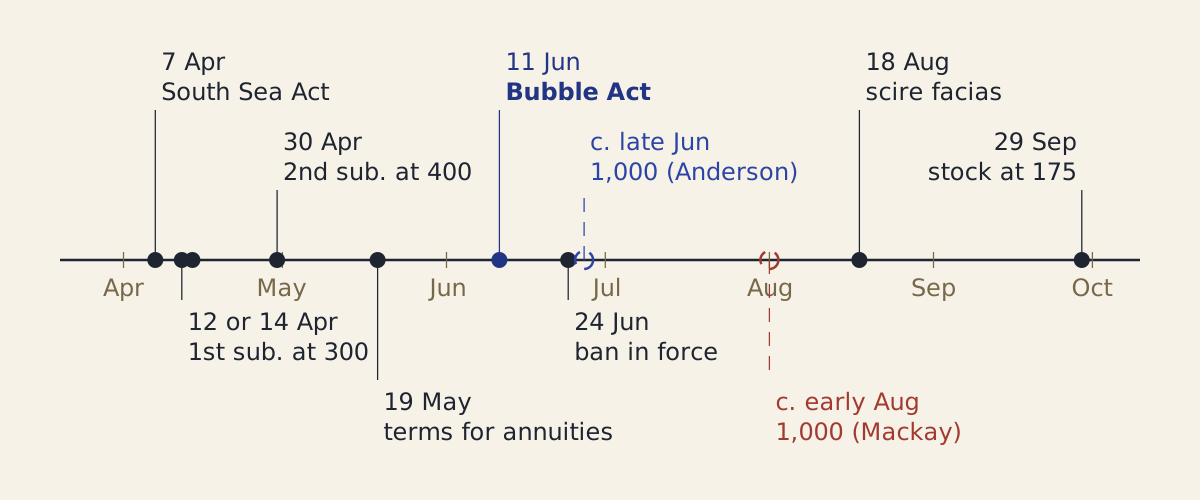
Figure: The South Sea year of 1720, from the South Sea Act in April to the low at the end of September. Dashed marks have no exact date; Anderson and Mackay place the top at different times.
Diagram: Treaties & Tradeoffs. CC BY 4.0. Open full size
Reuse credit
Diagram: Treaties & Tradeoffs, "The South Sea year of 1720: dated events" — https://treatiesandtradeoffs.com/case-studies/south-sea-bubble/, CC BY 4.0 (https://creativecommons.org/licenses/by/4.0/)
Data: Adam Anderson, An Historical and Chronological Deduction of the Origin of Commerce, vol. 2 (London, 1764), pp. 285–297, accessed 2026-11-02, public domain; Charles Mackay, Memoirs of Extraordinary Popular Delusions (1852), Project Gutenberg eBook #24518, accessed 2026-11-02, public domain
The timeline as text
- 7 April 1720: the South Sea bill passes the Lords and receives the royal assent, by Mackay's account [2].
- 12 or 14 April 1720: the first cash subscription for new stock opens at 300 per cent (Mackay gives 12 April, Anderson 14 April) [1][2].
- 30 April 1720: the second cash subscription, at 400 [1].
- 19 May 1720: the directors declare the terms for the government annuities [1].
- 11 June 1720: the Bubble Act receives the royal assent [1].
- 24 June 1720: the Act's ban on unauthorized undertakings takes effect [1].
- A few days after midsummer: the stock at 1,000 and upward, by Anderson's account [1].
- Early August: the stock at 1,000, by Mackay's account [2].
- 18 August 1720: writs of scire facias against the bubble companies [1].
- 29 September 1720: the stock at 175, by Anderson's account [1].
In the summer of 1720, at Garraway's Coffee-house, a South Sea director was asked about a third subscription at 1,000. Anderson, who remembered the exchange decades later, gives the reply: “Truly Gentlemen seem to strive to talk us into some such Price, whether we will or no!” The South Sea Company did open a third cash subscription at 1,000 per cent, and by Anderson's account its stock traded at that level a few days after midsummer [1]. Parliament's law against the smaller bubble companies was already on the books.
What was the South Sea scheme?
Reported: In January 1720 the South Sea Company offered to take government debts into its own capital stock, and the Bank of England bid against it for the same privilege [1][2]. The company's final offer promised the public as much as £7,567,500 if all the debts were subscribed, and the House of Commons accepted the company's proposals on 2 February, Mackay writes [1][2].
Reported: Mackay dates the bill's passage through the Lords and its royal assent to 7 April [2]. Holders of government annuities and other debts could hand them to the company for new South Sea stock. The Act also let the company make calls, open subscriptions and raise money on the credit of its stock, so it could sell new stock for cash [1].
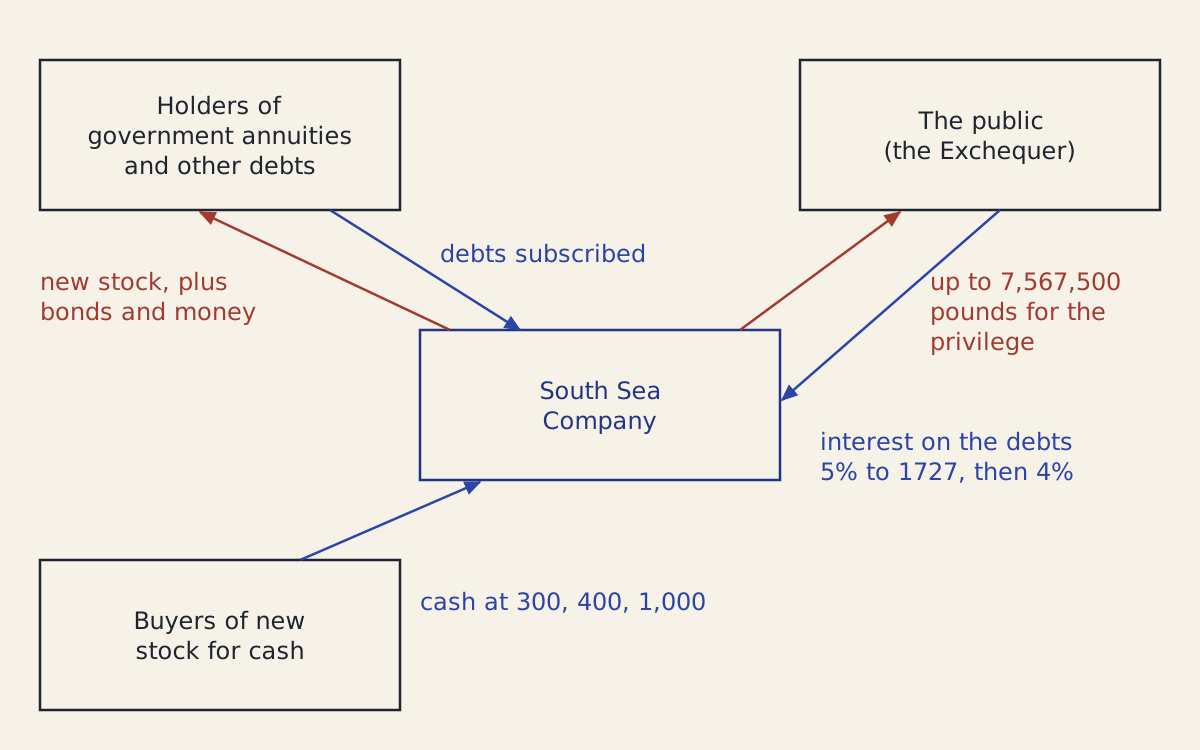
Figure: How the 1720 debt swap was meant to work, drawn from Anderson's and Mackay's accounts of the South Sea Act.
Diagram: Treaties & Tradeoffs. CC BY 4.0. Open full size
Reuse credit
Diagram: Treaties & Tradeoffs, "How the 1720 South Sea debt swap was meant to work" — https://treatiesandtradeoffs.com/case-studies/south-sea-bubble/, CC BY 4.0 (https://creativecommons.org/licenses/by/4.0/)
Data: Adam Anderson, An Historical and Chronological Deduction of the Origin of Commerce, vol. 2 (London, 1764), pp. 285–297, accessed 2026-11-02, public domain; Charles Mackay, Memoirs of Extraordinary Popular Delusions (1852), Project Gutenberg eBook #24518, accessed 2026-11-02, public domain
The flows as text
- Holders of government annuities and other debts subscribe them into the company [1].
- The company gives them new stock, plus bonds and money [1].
- Buyers pay cash for new stock in subscriptions at 300, 400 and 1,000 per cent [1].
- The company pays the public up to £7,567,500 for the privilege, if all the debts come in [1].
- The Exchequer pays the company interest on the debts, 5 per cent until 1727 and 4 per cent after, by Mackay's account [2].
Reported: Prices on this page are in per cent, the price in pounds of £100 of stock at face value. Rumour alone, Anderson records, lifted the stock to 126 at the Christmas 1719 closing of the books, and to 319 while the bill was before Parliament [1]. Opponents of the bill warned that raising the price so high was “a dangerous Baite” for the unwary and asked that the rise be limited [1]. The ministry's defenders answered that nobody could have foreseen the rise, and that had the price stayed at 137, where it stood when the bargain was first struck, the public would have gained more [1].
Reported: Anderson's objection was to the open price. The Bank's second offer had named a fixed 1,700 pounds of Bank stock for every 100 pounds a year of long annuity, but under the South Sea plan “the Company was not limited in the Price they were to put on their Stock” [1].
Assessed: That clause tied the company's gain to its share price. The higher the price it put on its stock, the fewer shares it had to hand over for each debt, and the more stock was left to sell for cash.
What did the directors offer the annuitants in May 1720?
Reported: The company sold new stock for cash at 300 per cent on 14 April and at 400 per cent on 30 April, and after the first sale the price rose to 340 [1]. Mackay dates the first sale to 12 April [2]. On 28 April the directors resolved to take the long-term government annuities into their stock, and many annuitants deposited their annuities at South Sea House before they knew the terms, Anderson writes [1].
Reported: On 19 May 1720 the directors declared the terms. For each £100 a year of long annuity they gave £700 of stock, valued at 375 per cent, or £2,625, plus £575 in bonds and money: £3,200 in all, which Anderson calls 32 years' purchase [1]. Annuitants had six days to accept, and by 25 May the stock stood above 500 [1].
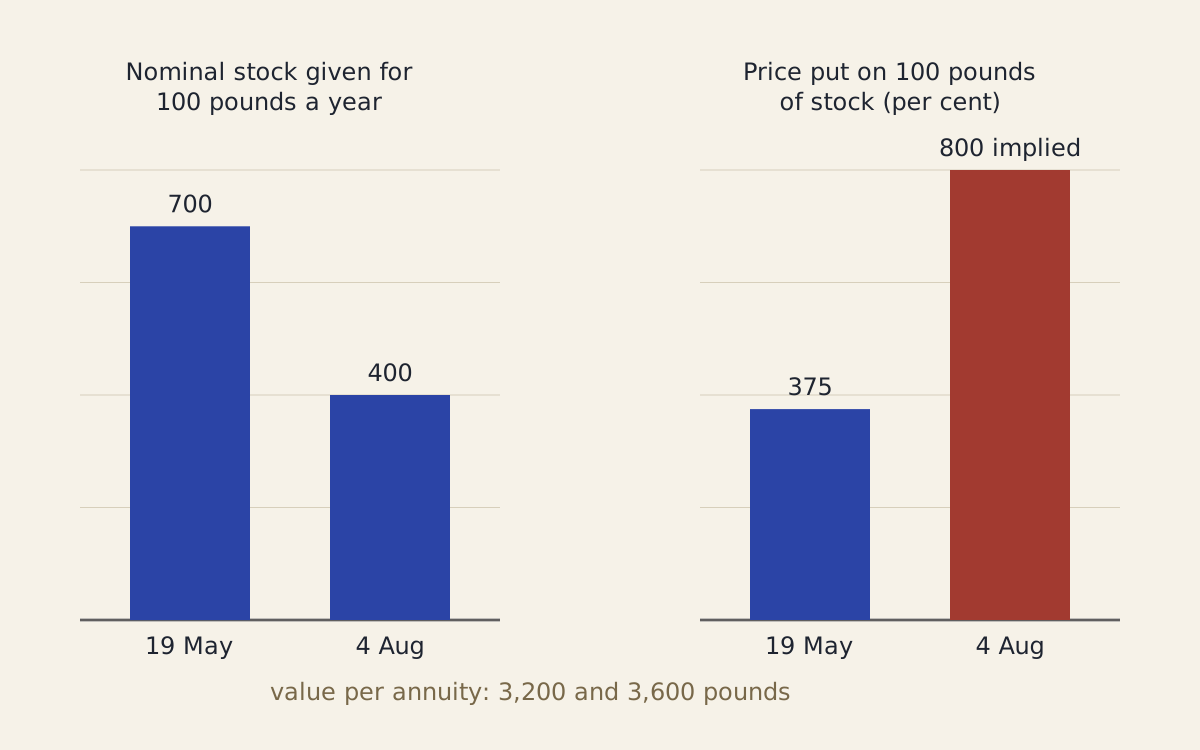
Figure: The South Sea Company's terms for £100 a year of long annuity on 19 May and 4 August 1720, from Anderson's figures.
Diagram: Treaties & Tradeoffs. CC BY 4.0. Open full size
Reuse credit
Diagram: Treaties & Tradeoffs, "South Sea terms for long annuities, 19 May and 4 August 1720" — https://treatiesandtradeoffs.com/case-studies/south-sea-bubble/, CC BY 4.0 (https://creativecommons.org/licenses/by/4.0/)
Data: Adam Anderson, An Historical and Chronological Deduction of the Origin of Commerce, vol. 2 (London, 1764), pp. 285–297, accessed 2026-11-02, public domain

Figure: Illustration of the 1720 swap, in which holders handed government annuities to the South Sea Company for new stock plus bonds and money.
Illustration: Treaties & Tradeoffs. Generated schematic image — not a photograph or historical record. © Treaties & Tradeoffs, all rights reserved.
Reported, with our check: The May terms add up: 700 × 3.75 + 575 = 3,200, which is 32 times the £100 annuity. The second subscription of annuities, taken on 4 August, gave £400 of stock and £400 in bonds and money at 36 years' purchase, which values the stock at 800 per cent, the price Anderson says the directors put on the redeemable debts on 12 August [1]. The two lottery classes in the August list also give 800, reading their unclear years' purchase as 17½, and so do the 14 per cents if valued at the same 36 years, which Anderson does not state for them; the years for the nine per cents are unclear in the copy we read.
The annuity terms, class by class (CSV) Source and license notes (JSON) Data: Adam Anderson, An Historical and Chronological Deduction of the Origin of Commerce, vol. 2 (London, 1764), pp. 285–297, accessed 2026-11-02, public domain
The card at the top of this page applies what we call the known-then test: score the choice only on what its makers could know at the time, with each piece of that knowledge tied to a source. On 19 May the directors knew that the Act set no price for their stock, that the Bank had offered a fixed amount, and that cash buyers had paid 300 and then 400 per cent [1].
Assessed: On that record, the May terms were not yet the trap the scheme became. They priced the company's stock at 375, below the market of the following week, and Anderson judged them “tolerably fair” for the time, had the subscribers been free to sell their new stock at once, which he says the managers never intended [1]. The real exposure was the one the bill's opponents had named: nothing limited the price the company could put on later terms, and by August it put 800 [1].
When did the Bubble Act pass?
Reported: The Act received the royal assent on 11 June 1720, Anderson writes, and the King issued a proclamation the same day to enforce its clauses against “those Projects vulgarly called Bubbles” [1]. Elsewhere Anderson says the two insurance companies that the same Act authorized were incorporated on 24 June, the statute having had the royal assent “14 Days before” [1]. Mackay's chapter does not mention the Act. He records the proclamation of 11 June, “the day the parliament rose” [2].
Reported, with our check: Counted with both ends included, 11 June to 24 June is 14 days, which would square Anderson's two statements; counted the modern way, 14 days before 24 June would be 10 June [1]. Dates on this page are as Anderson and Mackay print them, in the Old Style calendar; 11 June Old Style is 22 June in the Gregorian calendar.
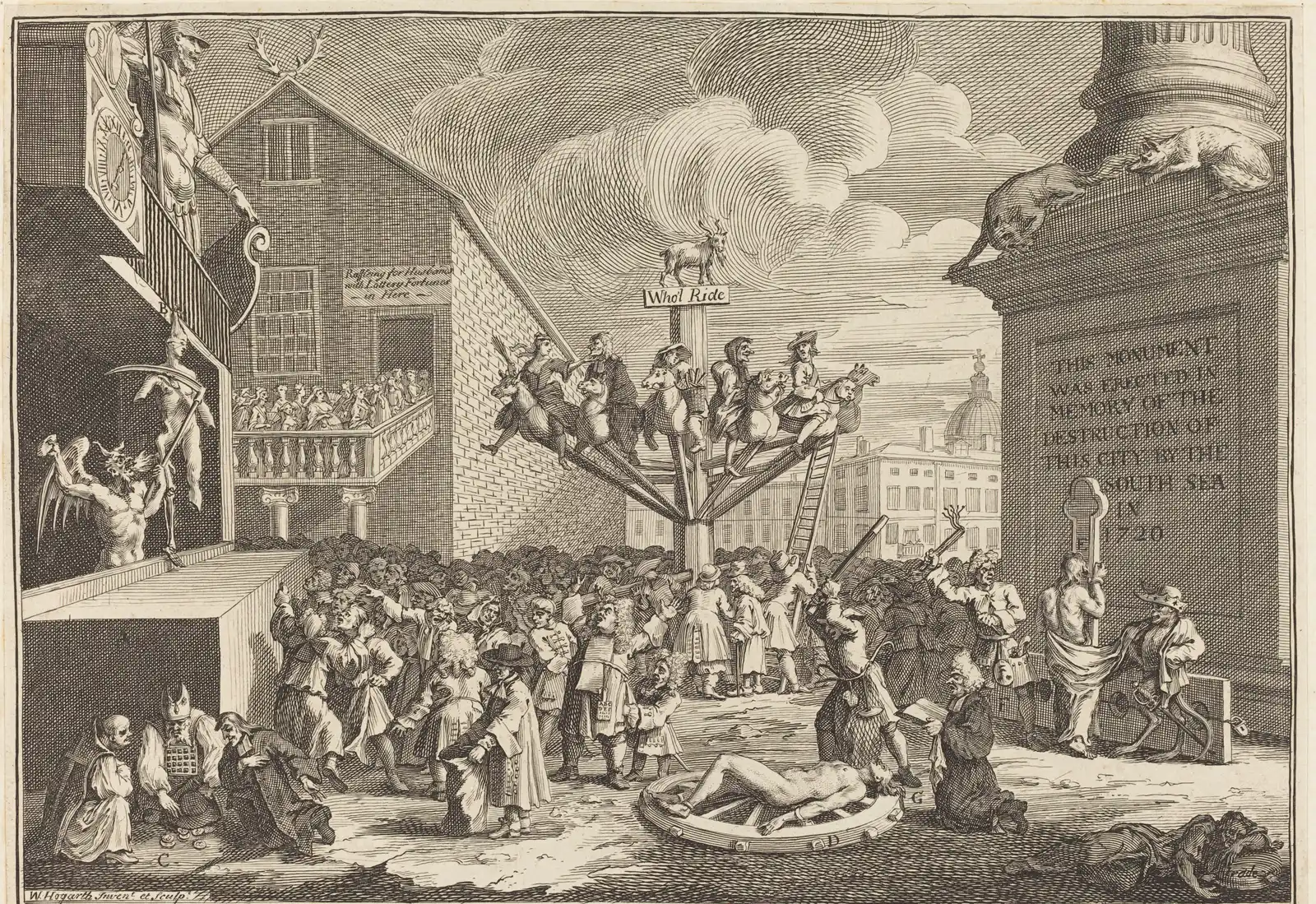
Figure: The South Sea Scheme, etching and engraving by William Hogarth, 1721 (National Gallery of Art, Washington).
"The South Sea Scheme" by William Hogarth — https://commons.wikimedia.org/wiki/File:William_Hogarth,_The_South_Sea_Scheme,_1721,_NGA_30435.jpg — CC0 1.0 (https://creativecommons.org/publicdomain/zero/1.0/); modified: cropped

Reported: In Anderson's summary, the Act declared that from 24 June 1720 undertakings that acted as corporate bodies without legal authority, and all subscriptions and transfers of shares in them, were void and public nuisances. Brokers who dealt in them forfeited £500. Projects settled before Midsummer 1718 were exempt, and Anderson says the exemption also covered the South Sea Company's own subscriptions [1].
Reported: The law did not stop the trade: for a few days, Anderson writes, it checked the “frantic Traffic,” and then the bubbles revived and rose more than ever [1]. Mackay reports an order of the Lords Justices on 12 July declaring the bubble companies illegal [2]. What broke them, in Anderson's account, came on 18 August: writs of scire facias against named companies, with orders to prosecute anyone who had opened or bought into such subscriptions, obtained from the government at the instance of the South Sea Company's own managers [1].
Reported: The managers believed the small bubbles were drawing money away from their stock, Anderson says, though he thought the opposite: small winners in the bubbles often moved on into South Sea stock [1]. When the writs were published, he writes, York Buildings stock fell from 300 to 200, and within two days the named companies had no buyers at any price. In his account the fall of South Sea stock followed [1].
Assessed: The headline claim holds on both accounts we read. The Act came before the stock's top, whether that top fell just after midsummer or in early August, and 110 days before Anderson's price of 175 on 29 September. Read on its own, it was a law against unchartered projects passed before the market's top, not a response to a crash. The enforcement that Anderson ties to the fall came 68 days later.
Which companies the law should allow came back in a different form nearly two centuries later, in the Standard Oil case.
When did South Sea stock peak and fall?
Reported: Anderson prints a run of dated prices. The stock reached 890 on 2 June, fell to 640 the next day before recovering to 770 that evening, and stood at 820 on 6 June and 710 on 14 June [1]. A few days after the company shut its books at midsummer, the price for their reopening was “1,000 per Cent, and upward, including the 10 per Cent. Midsummer Dividend,” the moment he calls the stock's “meridian Glory” [1].
Reported: Mackay tells it differently. He has the stock at about 750 until the books closed on 22 June, and writes that it “finally rose to one thousand per cent” and was quoted at that price at the commencement of August [2]. The two accounts disagree on when the top came. We found no fuller price series we could use to settle it.
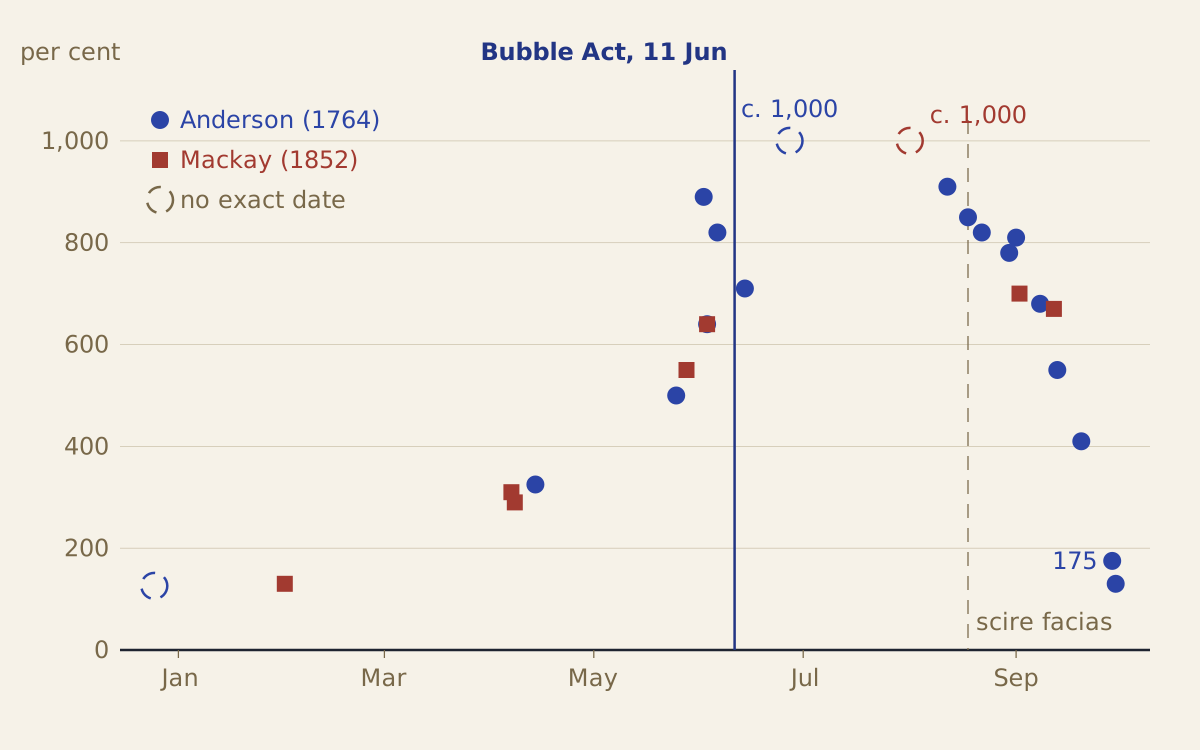
Figure: South Sea stock prices as Anderson (circles) and Mackay (squares) print them, December 1719 to September 1720. Dashed rings have no exact date.
Diagram: Treaties & Tradeoffs. CC BY 4.0. Open full size
Reuse credit
Diagram: Treaties & Tradeoffs, "South Sea stock prices in two accounts, 1719–1720" — https://treatiesandtradeoffs.com/case-studies/south-sea-bubble/, CC BY 4.0 (https://creativecommons.org/licenses/by/4.0/)
Data: Adam Anderson, An Historical and Chronological Deduction of the Origin of Commerce, vol. 2 (London, 1764), pp. 285–297, accessed 2026-11-02, public domain; Charles Mackay, Memoirs of Extraordinary Popular Delusions (1852), Project Gutenberg eBook #24518, accessed 2026-11-02, public domain
Reported: In Anderson's figures the fall came in late August and September. When the writs came out, the price for the August opening of the books was 850, the midsummer dividend included. It was 820 when the books reopened on 22 August, and on 24 August the directors opened a fourth cash subscription at 1,000 [1].
Reported: Their promise on 30 August of a 30 per cent dividend at Christmas, and at least 50 per cent a year for twelve years, Anderson writes, lifted the stock only from 780 to 810 by 1 September. It was 680 on 8 September, 410 on 20 September and 175 on 29 September [1]. Mackay's end-of-September figures are lower, 150 and then 135 [2].
Where Mackay and Anderson differ
| Question | Mackay (1852) | Anderson (1764) |
|---|---|---|
| When did the first cash subscription open? | 12 April 1720, at 300 [2] | 14 April 1720, at 300, with the market at 325 [1] |
| What happened on 11 June 1720? | A proclamation against unlawful projects, the day Parliament rose [2] | The royal assent to the Act, and a proclamation the same day [1] |
| When did the stock reach 1,000? | At the commencement of August [2] | A few days after the Midsummer closing of the books [1] |
| What acted against the smaller bubbles after 11 June? | The Lords Justices' order of 12 July declaring them illegal [2] | The writs of scire facias of 18 August, which he says ended the trade [1] |
| How low was the stock at the end of September? | 150, then 135 [2] | 175 on 29 September, 130 on 30 September before a rise to 320 [1] |
The two accounts compared, with sources (CSV) Source and license notes (JSON) Data: Adam Anderson, An Historical and Chronological Deduction of the Origin of Commerce, vol. 2 (London, 1764), pp. 285–297, accessed 2026-11-02, public domain; Charles Mackay, Memoirs of Extraordinary Popular Delusions (1852), Project Gutenberg eBook #24518, accessed 2026-11-02, public domain
Method: Larger collections of 1720 prices exist. The archive at Yale's International Center for Finance, described in a 2009 working paper by Rik Frehen, William Goetzmann and Geert Rouwenhorst, is supplied for academic research only, so this page uses only the prices that Anderson and Mackay print, each with its page or chapter [7][8].
The dated events and prices, with sources (CSV) Source and license notes (JSON) Data: Adam Anderson, An Historical and Chronological Deduction of the Origin of Commerce, vol. 2 (London, 1764), pp. 285–297, accessed 2026-11-02, public domain; Charles Mackay, Memoirs of Extraordinary Popular Delusions (1852), Project Gutenberg eBook #24518, accessed 2026-11-02, public domain
What did a share cost in wages?
For a scale from the time, we converted these prices into days of a London building worker's wage. Robert C. Allen's London series gives 30 pence a day for a building craftsman and 22 pence for a building labourer in 1720 [4].
The series repeats the same 30 and 22 pence for every year from 1710 to 1730 in the rows we read, and we could not confirm from those rows whether each year was recorded separately. Anderson says buyers came from all ranks. No source we read counts them by trade, so the craftsman's rate is the main column and the labourer's stands beside it [1].
Reported, with our conversion: At 1,000 per cent, £100 of stock cost £1,000, or 240,000 pence: 8,000 days of a London craftsman's wage and about 10,909 days of a labourer's [1][4]. The first cash subscription at 300 came to 2,400 craftsman days, but buyers paid in instalments, and its first payment of £60 equaled 480 days [1][2][4]. The third subscription at 1,000 was payable in ten payments of £100, each worth 800 days, and the fourth asked £200 down, or 1,600 days [1][4]. By 29 September the market price of 175 equaled 1,400 craftsman days, or about 1,909 labourer days [1][4].
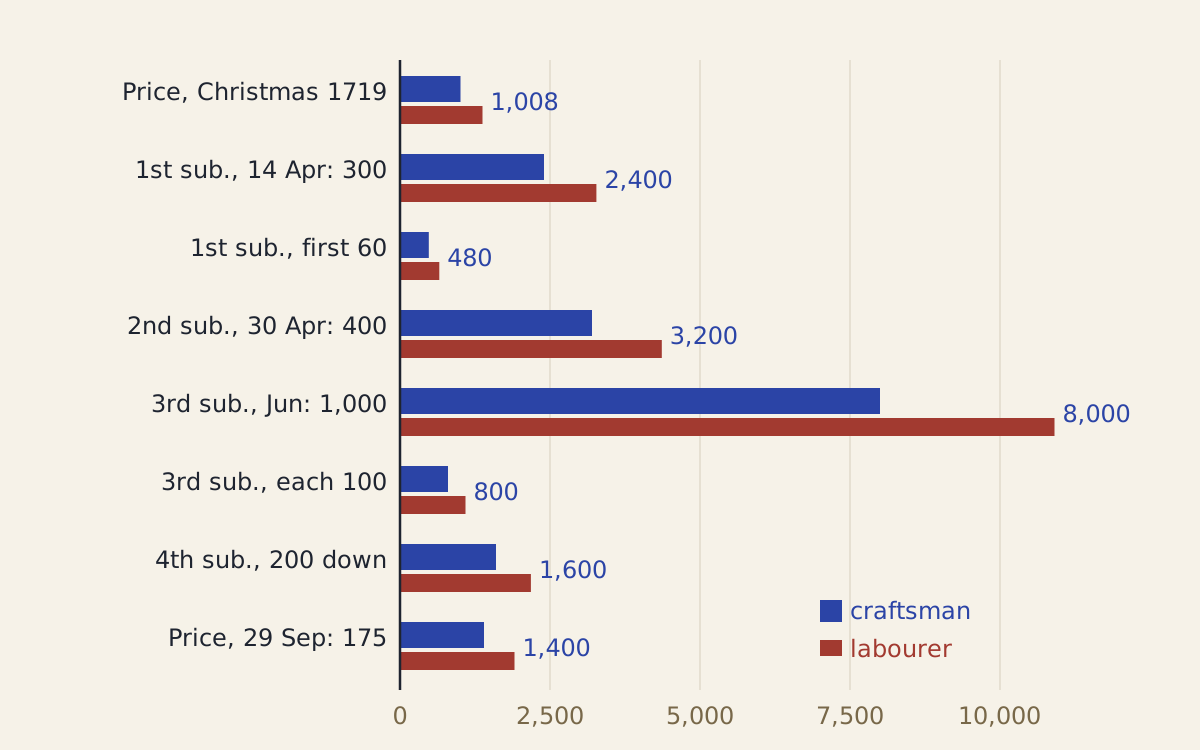
Figure: South Sea prices and payments of 1719–20 counted in days of a London building craftsman's and labourer's wage. Inputs in the conversion table below.
Diagram: Treaties & Tradeoffs. CC BY 4.0. Open full size
Reuse credit
Diagram: Treaties & Tradeoffs, "South Sea prices in days of a London building wage, 1720" — https://treatiesandtradeoffs.com/case-studies/south-sea-bubble/, CC BY 4.0 (https://creativecommons.org/licenses/by/4.0/)
Data: Robert C. Allen, "Prices and Wages in London & Southern England, 1259–1914," published data series, accessed 2026-11-01, copyrighted, individual daily wage figures cited; Adam Anderson, An Historical and Chronological Deduction of the Origin of Commerce, vol. 2 (London, 1764), pp. 285–297, accessed 2026-11-02, public domain
Assessed: Instalments lowered the price of entry. Anderson writes that many people of the lower classes could not at first afford South Sea stock and bought into the smaller bubbles, then moved into South Sea stock with their gains [1]. We found no record of how many buyers paid only a first payment. Wage-days show what a price meant to a London building worker then, not a modern value or a living standard, and we do not turn them into years because the series does not say how many days a year were paid.
Who lost money?
Reported: Anderson lists the losers at the close of 1720: families of rank, merchants of great standing, physicians, clergy, lawyers and many tradesmen, some of whom, he writes, died of heartbreak or left the country for good [1]. Private bankers who had lent on South Sea stock stopped payment for a time, and Mackay adds that the Sword-blade company, the South Sea Company's chief cashiers, stopped payment [1][2].
Reported: The directors paid next. Parliament confiscated £2,014,000 from their estates, Mackay reports, leaving each a sum to start again: Sir John Blunt kept £5,000 of a fortune of upwards of £183,000, and Sir Theodore Janssen £50,000 of £243,000 [2].
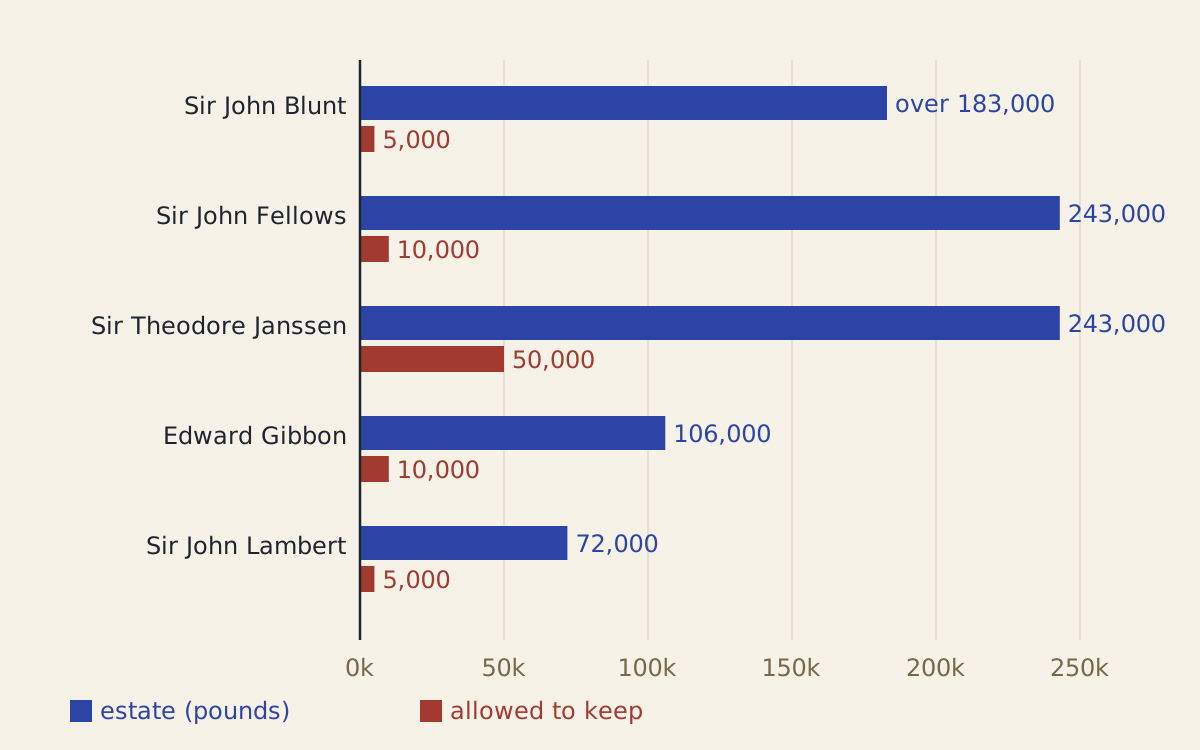
Figure: Estates of five South Sea directors and the sums Parliament let them keep, as Mackay reports them.
Diagram: Treaties & Tradeoffs. CC BY 4.0. Open full size
Reuse credit
Diagram: Treaties & Tradeoffs, "Five South Sea directors: estates and allowances" — https://treatiesandtradeoffs.com/case-studies/south-sea-bubble/, CC BY 4.0 (https://creativecommons.org/licenses/by/4.0/)
Data: Charles Mackay, Memoirs of Extraordinary Popular Delusions (1852), Project Gutenberg eBook #24518, accessed 2026-11-02, public domain
Reported: Mackay also gives a computation of the company's capital at the end of 1720: £37.8 million, of which £24.5 million was allotted to the proprietors and £13.3 million belonged to the company itself. More than £8 million of the company's part was divided among proprietors and subscribers, and people who had borrowed from the company on pledged stock were released on paying 10 per cent of their loans [2].
Reported: Not every investor lost. In a 2004 study of Hoare's Bank, a young London bank, Peter Temin and Hans-Joachim Voth argue that the bank knew a bubble was under way and invested anyway, and that riding the bubble was profitable [6].
Assessed: The record names the losers by rank and trade but does not count them, and we found no source that does.
Directors' estates and the 1720 totals, with sources (CSV) Source and license notes (JSON) Data: Charles Mackay, Memoirs of Extraordinary Popular Delusions (1852), Project Gutenberg eBook #24518, accessed 2026-11-02, public domain; Adam Anderson, An Historical and Chronological Deduction of the Origin of Commerce, vol. 2 (London, 1764), pp. 285–297, accessed 2026-11-02, public domain
How does the South Sea Bubble compare with tulip mania?
Reported: Peter Garber's 1990 article argues that before calling an episode a bubble, economists must exhaust reasonable “market fundamental” explanations, and it proposes such explanations for the Dutch tulipmania, the Mississippi Bubble and the South Sea Bubble [5]. Among fundamentals he counts a perceived rise in the chance of large returns, even one set off by insiders' fraud [5]. On the other side, Temin and Voth's study of Hoare's Bank argues that a well-informed investor saw the bubble and rode it [6].
Reported: Contemporaries already tried to measure the gap. By a computation Anderson reports, all stocks of every kind at London about midsummer 1720 came to about £500 million at their raised prices. He set that against at most £224 million for all the land and houses of Great Britain, valued at 16 years' purchase of at most £14 million a year in rents [1].
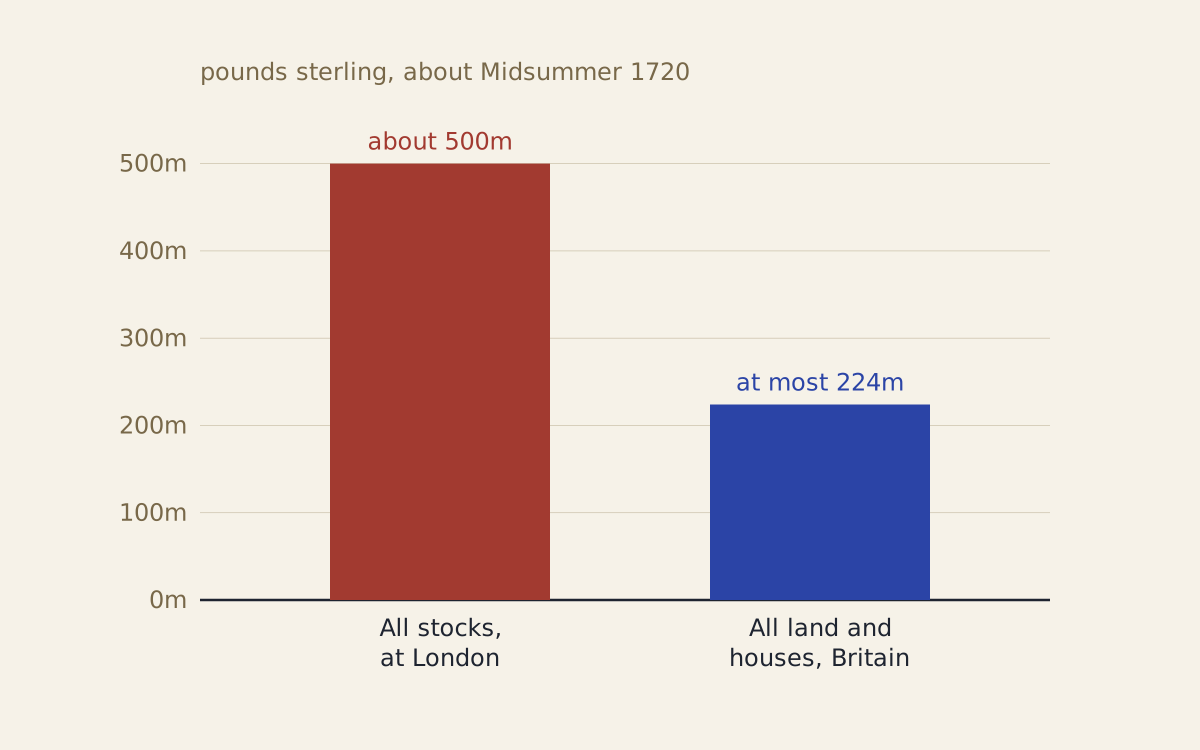
Figure: The midsummer 1720 computation Anderson reports for all stocks at London, beside his ceiling for the value of all land and houses in Great Britain.
Diagram: Treaties & Tradeoffs. CC BY 4.0. Open full size
Reuse credit
Diagram: Treaties & Tradeoffs, "The 1720 computation Anderson reports: stocks against land and houses" — https://treatiesandtradeoffs.com/case-studies/south-sea-bubble/, CC BY 4.0 (https://creativecommons.org/licenses/by/4.0/)
Data: Adam Anderson, An Historical and Chronological Deduction of the Origin of Commerce, vol. 2 (London, 1764), pp. 285–297, accessed 2026-11-02, public domain
Reported, with our check: 14 × 16 = 224, and 500 is a little more than twice 224, as Anderson says [1].
Assessed: Set beside tulip mania, the South Sea case has firmer evidence of real losses. Anderson lived through them, and Mackay prints the directors' penalties [1][2]. The timing of the rules also differs: the Dutch florists ruled on their contracts after prices broke, while the Bubble Act came before South Sea stock reached its top.
Assessed: Much of the folly in the standard South Sea story is what we call the hindsight premium, the share of a decision's apparent wisdom or folly that is added only after the outcome is known. On the record we read, the May terms look less reckless than the August ones, and neither Garber's reading nor Temin and Voth's settles whether June prices were irrational, so we leave that open.
Wage-day conversion table
Method: pounds × 240 ÷ daily wage in pence, using Allen's London series for 1720: 30 pence for a building craftsman and 22 for a building labourer [4]. The wage source does not say whether pay in kind is included. Prices are per £100 of stock at face value, or the sum of one payment, from the pages cited. Decimals are in the CSV below the table.
| Item | Date | Pounds | Craftsman days | Labourer days | Price source |
|---|---|---|---|---|---|
| Price at the Christmas closing of the books | December 1719 | 126 | 1,008 | 1,375 | [1] |
| First cash subscription, per £100 of stock | 14 April 1720 (Mackay: 12 April) | 300 | 2,400 | 3,273 | [1] |
| First cash subscription, first payment | April 1720 | 60 | 480 | 655 | [1][2] |
| Second cash subscription, per £100 of stock | 30 April 1720 | 400 | 3,200 | 4,364 | [1] |
| Third cash subscription, per £100 of stock | June 1720 | 1,000 | 8,000 | 10,909 | [1] |
| Third cash subscription, each of ten payments | June 1720 | 100 | 800 | 1,091 | [1] |
| Fourth cash subscription, sum paid down | 24 August 1720 | 200 | 1,600 | 2,182 | [1] |
| Market price | 29 September 1720 | 175 | 1,400 | 1,909 | [1] |
Download the table (CSV, south-sea-bubble-wage-days.csv) Source and license notes (JSON) Data: Robert C. Allen, "Prices and Wages in London & Southern England, 1259–1914," published data series, accessed 2026-11-01, copyrighted, individual daily wage figures cited; Adam Anderson, An Historical and Chronological Deduction of the Origin of Commerce, vol. 2 (London, 1764), pp. 285–297, accessed 2026-11-02, public domain; Charles Mackay, Memoirs of Extraordinary Popular Delusions (1852), Project Gutenberg eBook #24518, accessed 2026-11-02, public domain
Sources
- Adam Anderson, An Historical and Chronological Deduction of the Origin of Commerce, vol. 2 (London: A. Millar and others, 1764), pp. 285–297 (year 1720). https://archive.org/details/historicalchrono02andeRead: full text of vol. 2, pp. 285–297
- Charles Mackay, Memoirs of Extraordinary Popular Delusions and the Madness of Crowds, vol. 1, chapter "The South-Sea Bubble" (London: Office of the National Illustrated Library, 1852; first published 1841). Project Gutenberg eBook #24518. https://www.gutenberg.org/ebooks/24518Read: full text of the 1852 edition
- "Anderson, Adam (1692?–1765)," Dictionary of National Biography, vol. 1 (London: Smith, Elder, 1885). Wikisource transcription. https://en.wikisource.org/wiki/Dictionary_of_National_Biography,_1885-1900/Anderson,_Adam_(1692%3F-1765)Read: full text of the entry
- Robert C. Allen, "Prices and Wages in London & Southern England, 1259–1914," published data series (wages of building craftsmen and labourers, pence per day). Bob Allen – Research Pages, Nuffield College, Oxford. https://www.nuffield.ox.ac.uk/people/sites/allen-research-pages/Read: individual daily wage figures for 1710–1730
- Peter M. Garber, "Famous First Bubbles," Journal of Economic Perspectives 4, no. 2 (Spring 1990): 35–54. https://www.aeaweb.org/articles?id=10.1257/jep.4.2.35Read: article page with abstract
- Peter Temin and Hans-Joachim Voth, "Riding the South Sea Bubble," American Economic Review 94, no. 5 (December 2004): 1654–1668. https://www.aeaweb.org/articles?id=10.1257/0002828043052268Read: article page with abstract
- Rik Frehen, William N. Goetzmann and K. Geert Rouwenhorst, "New Evidence on the First Financial Bubble," NBER Working Paper 15332 (National Bureau of Economic Research, September 2009). https://doi.org/10.3386/w15332Read: bibliographic record only
- International Center for Finance, Yale School of Management, "South Sea Bubble 1720 Project" (web page). https://som.yale.edu/centers/international-center-for-finance/data/historical-financial-research-data/south-seas-bubble-1720Read: web page, data terms only
Cite this page
Treaties & Tradeoffs. “South Sea Bubble: Anderson Dates the Bubble Act Pre-Crash.” published 2026-11-02. https://treatiesandtradeoffs.com/case-studies/south-sea-bubble/. Accessed [the date you read it].
Plain citation; add the date you consulted the page. No DOI is assigned.