Business Case HistoriesCase review
East India Company: Its 1600 Charter Set a 15-Year Term
Treaties & Tradeoffs Filed
Queen Elizabeth I's charter of 31 December 1600 granted the London merchants' East India Company its trade for 15 years, counted from Christmas 1600, not forever, by the charter's text as printed in 1887. The Crown could end the grant sooner, on two years' warning, if it proved unprofitable to the Crown or the realm. A new charter of 31 May 1609 made the grant last “for ever,” though the Crown could still end it on three years' warning on the same condition [1].
Order of business (6 sections)
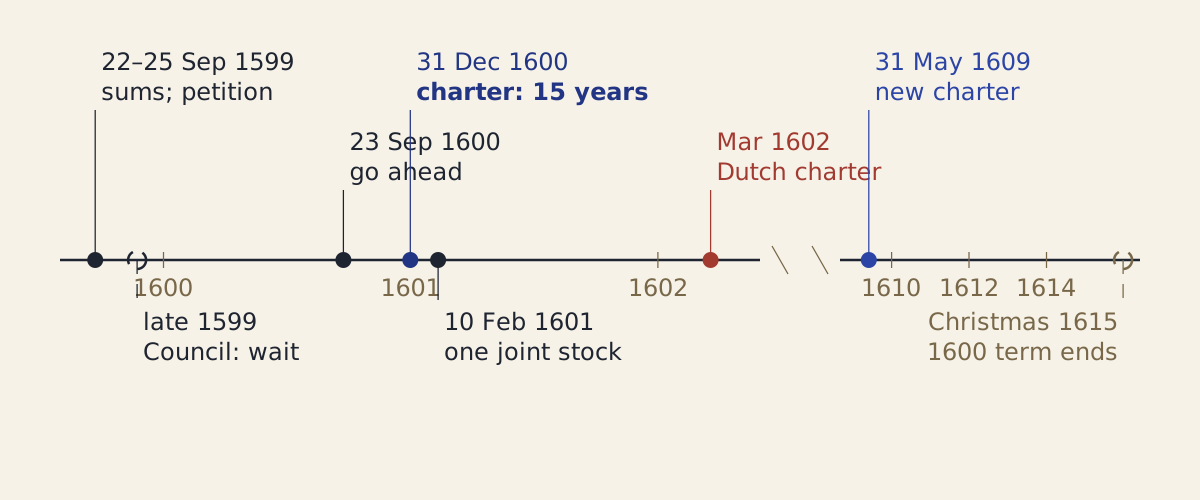
Figure: The East India Company's first decade, from the merchants' subscription book of September 1599 to the charter of 1609. Dashed marks are undated in the minutes or computed from the charter's term.
Diagram: Treaties & Tradeoffs. CC BY 4.0. Open full size
Reuse credit
Diagram: Treaties & Tradeoffs, "The East India Company's first decade, 1599–1615" — https://treatiesandtradeoffs.com/case-studies/east-india-company/, CC BY 4.0 (https://creativecommons.org/licenses/by/4.0/)
Data: Charters relating to the East India Company from 1600 to 1761 (Madras, 1887), pp. 1–31, accessed 2026-11-02, public domain; Henry Stevens (ed.), The Dawn of British Trade to the East Indies as Recorded in the Court Minutes of the East India Company, 1599–1603 (London, 1886), accessed 2026-11-02, public domain; Octrooi of the States General for the Dutch East India Company, 20 March 1602, Dutch Wikisource transcription, accessed 2026-11-02, public domain
The timeline as text
- 22 September 1599: merchants write their names and sums in a book for one voyage; the sums total £30,133 6s 8d [2].
- 24 September 1599: no new adventurer is to be taken for less than £200 [2].
- 25 September 1599: the directors resolve to petition the Privy Council for a privilege, citing the Dutch voyages [2].
- Late 1599, undated: by the company's minutes, the Privy Council will not shield the voyage from peace talks with Spain, and the merchants go no further that year [2].
- 23 September 1600: at Founders' Hall the merchants hear that the Queen wants them to proceed, and vote to go forward [2].
- 31 December 1600: Queen Elizabeth I grants the charter, for 15 years from Christmas 1600 [1].
- 10 February 1601 (1600 in the minutes): the general court orders the voyage run as one joint stock [2].
- 20 March 1602: the States General charter the Dutch East India Company [4].
- 31 May 1609: James I grants a new charter “for ever,” which the Crown can end on three years' warning if it proves unprofitable [1].
- Christmas 1615: where the 1600 term would have ended [1].
The dated events, with sources (CSV) Source and license notes (JSON) Data: Charters relating to the East India Company from 1600 to 1761 (Madras, 1887), pp. 1–31, accessed 2026-11-02, public domain; Henry Stevens (ed.), The Dawn of British Trade to the East Indies as Recorded in the Court Minutes of the East India Company, 1599–1603 (London, 1886), accessed 2026-11-02, public domain; Octrooi of the States General for the Dutch East India Company, 20 March 1602, Dutch Wikisource transcription, accessed 2026-11-02, public domain
On 31 December 1600, Queen Elizabeth I granted a London company the East India trade for fifteen years. The merchants who received it had waited more than a year for the grant, and their first fleet was still being fitted out. They had asked for a privilege that would pass to their successors. The East India Company got the trade for a fixed term, with a way out for the Crown.
What did the 1600 charter grant?
Reported: The charter made the named merchants one body corporate, The Governor and Company of Merchants of London, Trading into the East-Indies. It named Thomas Smith, Alderman of London, as the first Governor, and 24 Committees to direct the voyages, the ships and the sale of goods. The company was to elect its Governor and Committees each year on 1 July or within six days after [1].
Reported: The trade itself was granted for a term. Members, their sons aged 21 or more, and their apprentices, factors and servants “shall and may, by the Space of Fifteen Years, from the Feast of the Birth of our Lord GOD last past,” trade beyond the Cape of Good Hope as far as the Straits of Magellan. The volume's index dates the start to 25 December 1600, six days before the charter [1].
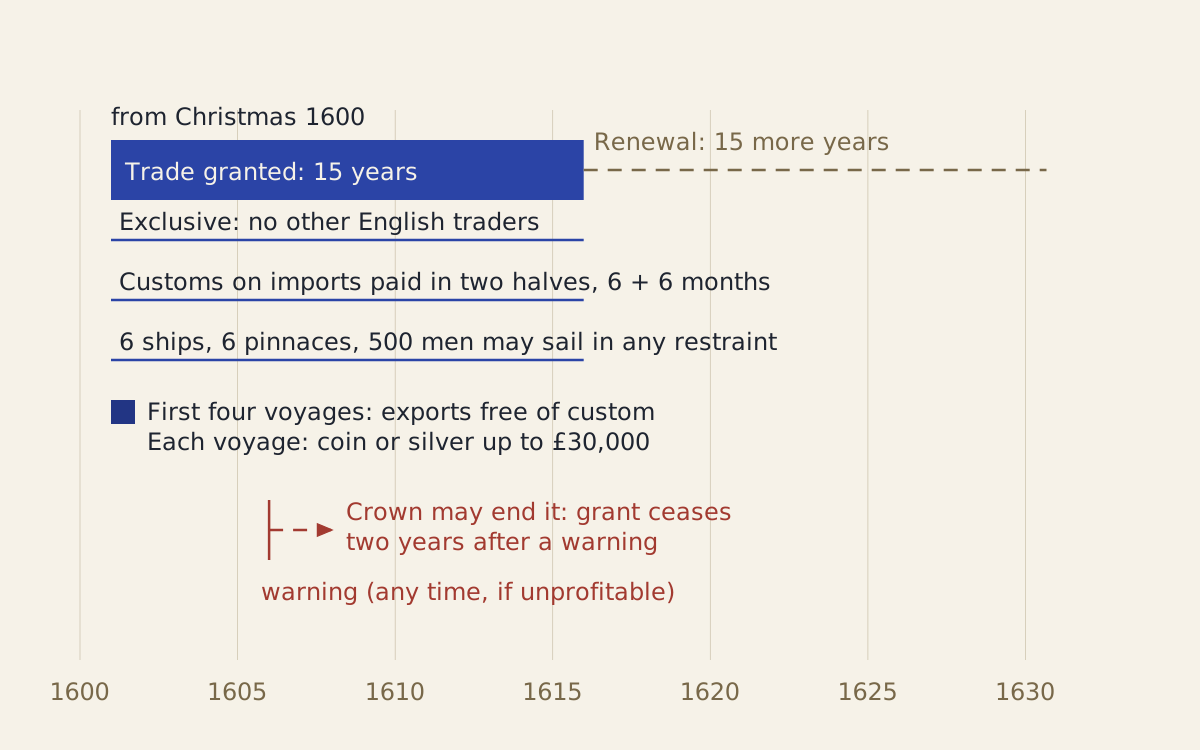
Figure: The main clauses of the 1600 charter laid out against its 15-year term, from the printed text of the charter.
Diagram: Treaties & Tradeoffs. CC BY 4.0. Open full size
Reuse credit
Diagram: Treaties & Tradeoffs, "The East India Company charter of 1600: clauses and term" — https://treatiesandtradeoffs.com/case-studies/east-india-company/, CC BY 4.0 (https://creativecommons.org/licenses/by/4.0/)
Data: Charters relating to the East India Company from 1600 to 1761 (Madras, 1887), pp. 1–31, accessed 2026-11-02, public domain
The clauses as text
- Trade granted for 15 years from Christmas 1600 [1].
- No other English subjects may trade there without the company's licence, during the 15 years [1].
- Customs on goods brought home may be paid half after six months and half after another six, during the 15 years [1].
- Six ships, six pinnaces and 500 mariners may sail even in a time of restraint, during the 15 years [1].
- Exports on the first four voyages go out free of custom; each voyage may carry up to £30,000 in foreign coin or silver [1].
- The Crown may end the grant on two years' warning if it is not profitable to the Crown or the realm [1].
- On petition, the Crown will grant a further 15 years if it finds that profitable [1].
Reported: Inside the term, the privileges were wide. No other subject could trade to the East Indies without the company's licence, on pain of losing ships and goods, and the Crown promised not to license anyone else without the company's consent. Exports on the first four voyages went out free of custom. The first voyage could carry up to £30,000 in foreign coin or silver, and so could each later voyage, which the clause expects to be “set forth yearly” [1].
Reported: Two clauses set the limits. If the grant “shall not be profitable” to the Crown or the realm, then “upon and after Two Years Warning” under the Privy Seal or sign manual, “this present Grant shall cease.” If the company asked for the grant to go on and the Crown found the trade profitable, new letters patent would follow for a further fifteen years [1].
The 1600 charter, clause by clause (CSV) Source and license notes (JSON) Data: Charters relating to the East India Company from 1600 to 1761 (Madras, 1887), pp. 1–31, accessed 2026-11-02, public domain
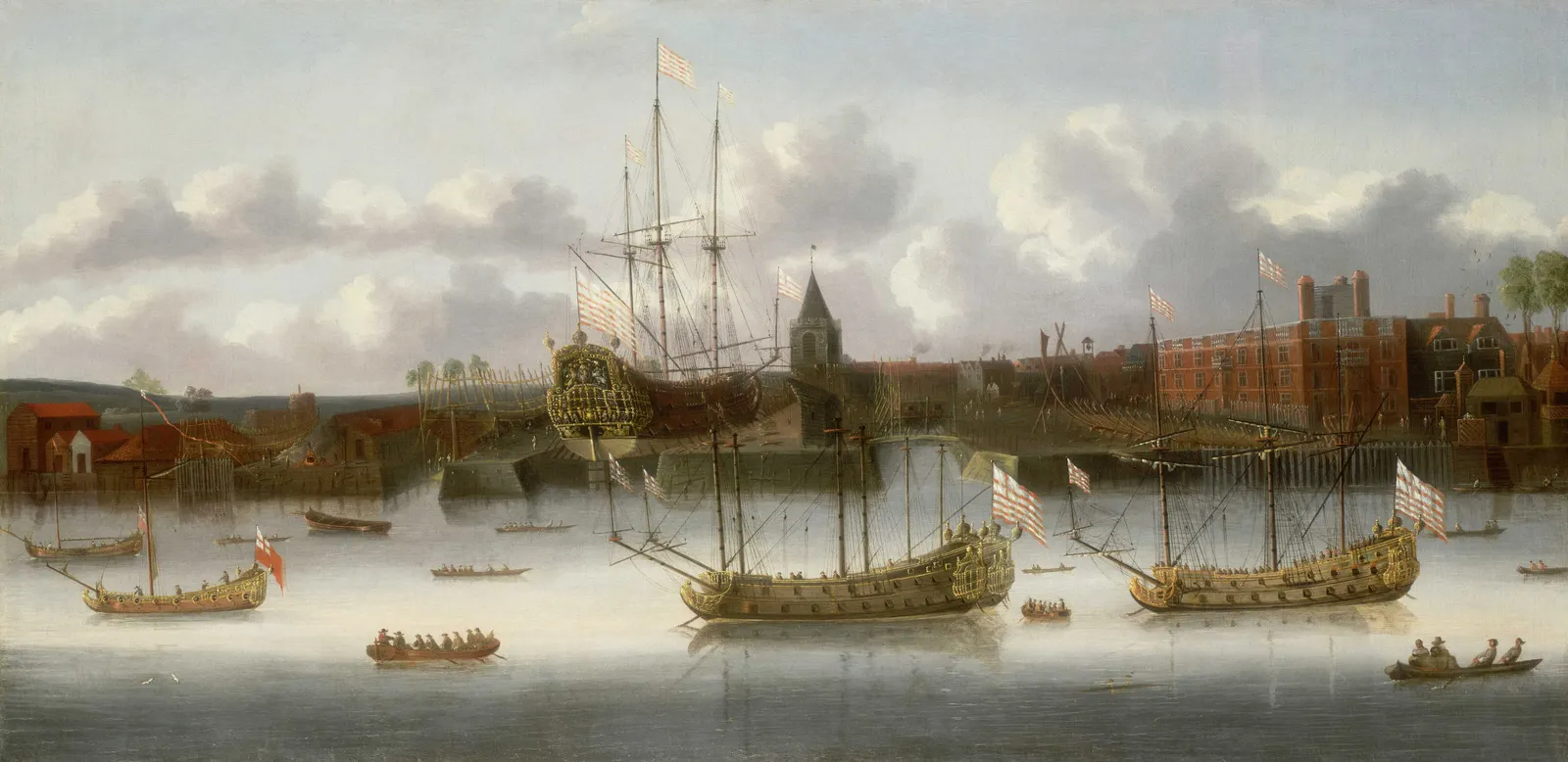
Figure: East India Company ships at Deptford, oil on canvas, English school, about 1683, more than eighty years after the first charter (Royal Museums Greenwich).
“East India Company ships at Deptford” by English School, 17th century (anonymous). Public Domain Mark.
Full credit
"East India Company ships at Deptford" by English School, 17th century (anonymous) — https://commons.wikimedia.org/wiki/File:East_India_Company_ships_at_Deptford_RMG_BHC1873.tiff — Public domain (anonymous painting of about 1683; US: made and shown before 1931 and more than 120 years old; EU: anonymous work more than 70 years after it was made public; faithful reproduction of a two-dimensional work, assessed as public domain by age by Royal Museums Greenwich, BHC1873)
Assessed: The record does not support the picture of a permanent monopoly handed over in 1600. The grant was exclusive, but it was temporary and revocable, and the merchants knew both facts on the day it was sealed.
Why did the merchants want a charter?
Reported: The company's own minute book opens on 22 September 1599 with the names of those who wrote “withe there owne handes” the sums they would venture in “the pretended voiage to the Easte Indias.” Two days later the assembly chose directors to seek a sole privilege from the Queen “for soe manie yeres as can be obteyned.” The next day the directors resolved to petition the Privy Council [2].
Reported: The petition, as the minutes record it, said that merchants had been stirred by the success of the voyage made by the Dutch, who were preparing a new voyage and had bought ships in England. They asked to be incorporated with a privilege in succession, because a trade so far away “cannot be traded but in a Joint and a vnyted stock.” They also asked for freedom of custom on goods carried out in 6 voyages, noting that Dutch merchants were freed of custom for divers years [2]. Many experiments would have to be made, the petition said, before the merchants knew which goods would sell in the East [2].
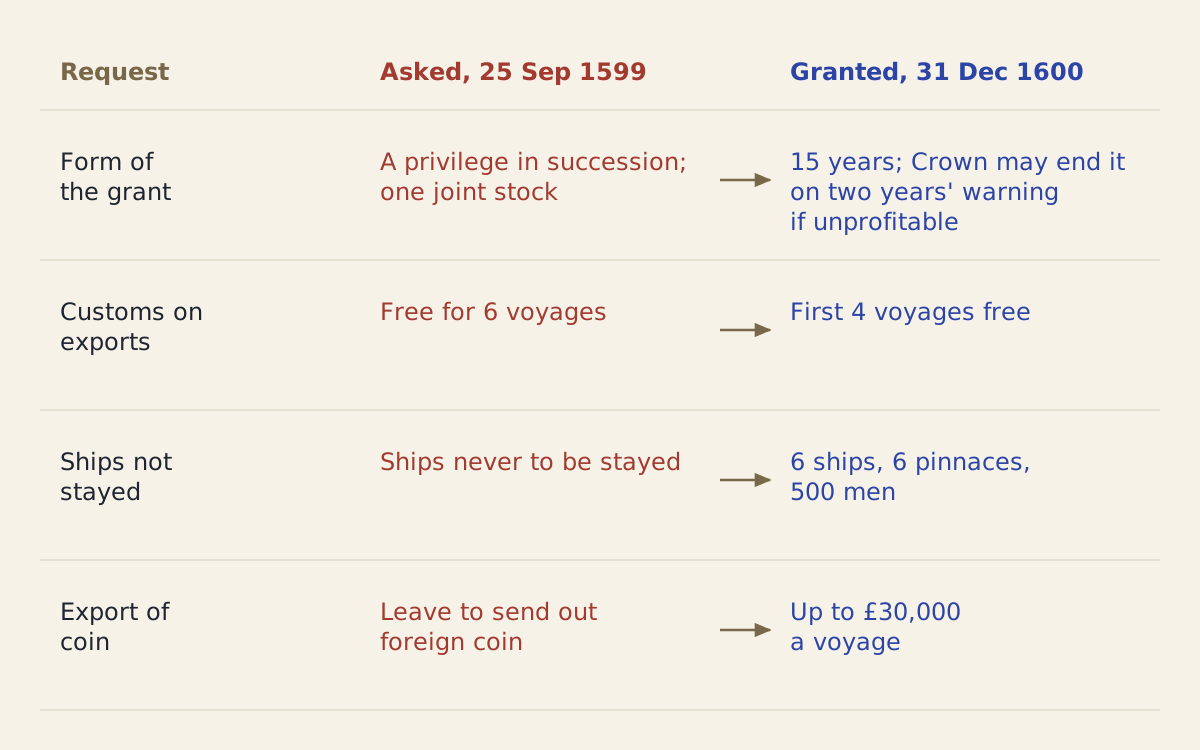
Figure: Four requests in the merchants' petition of September 1599 set beside what the charter of December 1600 granted.
Diagram: Treaties & Tradeoffs. CC BY 4.0. Open full size
Reuse credit
Diagram: Treaties & Tradeoffs, "The 1599 petition and the 1600 charter compared" — https://treatiesandtradeoffs.com/case-studies/east-india-company/, CC BY 4.0 (https://creativecommons.org/licenses/by/4.0/)
Data: Henry Stevens (ed.), The Dawn of British Trade to the East Indies as Recorded in the Court Minutes of the East India Company, 1599–1603 (London, 1886), accessed 2026-11-02, public domain; Charters relating to the East India Company from 1600 to 1761 (Madras, 1887), pp. 1–31, accessed 2026-11-02, public domain
| Request | Asked in September 1599 | Granted on 31 December 1600 |
|---|---|---|
| Form of the grant | A privilege in succession, and incorporation for a joint and united stock [2] | Incorporation, with the trade for 15 years, which the Crown could end on two years' warning if unprofitable [1] |
| Customs on exports | Free for 6 voyages [2] | Free for the first four voyages [1] |
| Ships not to be stayed | No stay on any pretence, since a month's delay loses a year's voyage [2] | Six ships, six pinnaces and 500 mariners may sail in any restraint [1] |
| Export of coin | Leave to send out foreign coin, and to mint more if short [2] | Foreign coin or silver, up to £30,000 a voyage from the first voyage on [1] |
The petition and the charter compared, with sources (CSV) Source and license notes (JSON) Data: Henry Stevens (ed.), The Dawn of British Trade to the East Indies as Recorded in the Court Minutes of the East India Company, 1599–1603 (London, 1886), accessed 2026-11-02, public domain; Charters relating to the East India Company from 1600 to 1761 (Madras, 1887), pp. 1–31, accessed 2026-11-02, public domain
Reported: The first answer was delay. An undated memorandum in the minutes records that the Privy Council refused a warrant that would protect the voyage while a treaty of peace with Spain was in hand, and that the adventurers, fearing they would be ordered to stop after they had spent money, went no further that year. On 23 September 1600, at Founders' Hall, they heard that it was the Queen's pleasure that they proceed, and they voted by show of hands to go forward. The charter came 99 days later [2].
Assessed: The merchants asked for a privilege in succession and a longer customs holiday, and their directors were sent to get as many years as they could. They got 15 years, fewer free voyages and a clause that let the Crown walk away.
How did investors put up money?
Reported: The sums in the 1599 book ran from £100, written by Nicholas Ling among others, to £3,000 from Richard Cockayne and company. Sir John Spencer wrote £800 and Alderman Paul Banning £1,000. The printed total is £30,133 6s 8d [2].
Reported, with our check: The sums we could read in the printed list add up exactly to that total; one entry is unclear in the copy we read and adds nothing to the sum [2]. On 24 September 1599 the assembly ruled that no new adventurer would be taken for less than £200, payable in two instalments in November and December [2]. The same assembly ruled that every share had to be paid in money: no adventurer could bring in a ship or goods as his part, and all ships were to be bought for ready money by those appointed [2].
Reported: The charter tied membership to payment. Anyone named in it who did not pay in the sum he had written in the company's book before the first voyage sailed could be removed [1]. On 10 February 1601, a date the minutes give as 1600 in the old reckoning, the general court ordered that everything prepared for the voyage, and everything it brought back, be handled as one entire joint and common stock of adventure, with no private trade [2].
Reported: Paying in proved slow. The introduction to the printed minutes, by Sir George Birdwood, says that in April 1601 the company was £7,000 in default and asked the Privy Council for powers against members who were “remisse & vnwillinge” to pay [2].
For a scale from the time, we converted the 1599 sums into days of a London building worker's wage. Robert C. Allen's London series gives 18 pence a day for a building craftsman and 12 pence for a building labourer in both 1599 and 1600 [3]. The subscribers named in the book were aldermen, grocers, drapers and other London tradesmen, so the craftsman's rate is the main column and the labourer's stands beside it [2][3].
Reported, with our conversion: The £200 minimum equalled about 2,667 days of a London craftsman's wage, or 4,000 days of a labourer's. Paul Banning's £1,000 came to about 13,333 craftsman days, and the whole book of £30,133 6s 8d to about 401,778 [2][3].
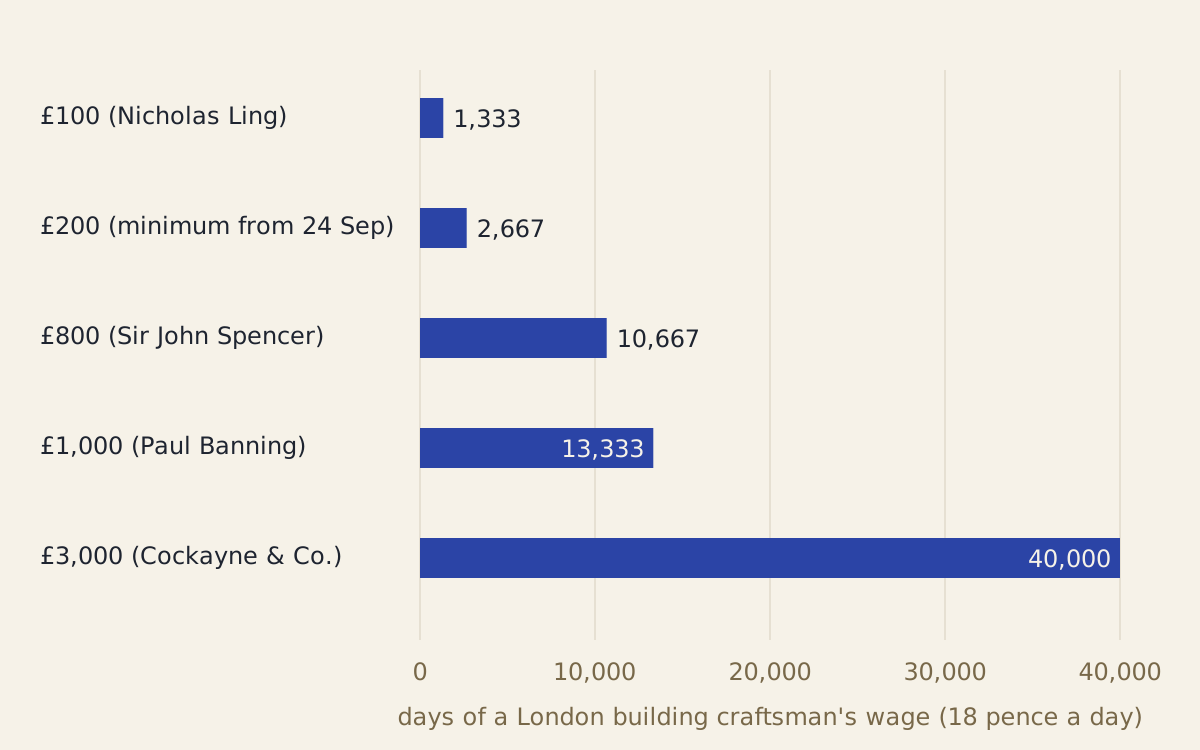
Figure: Sums written in the East India subscription book of 22 September 1599, with the £200 minimum ruled on 24 September, counted in days of a London building craftsman's wage. Inputs in the conversion table below.
Diagram: Treaties & Tradeoffs. CC BY 4.0. Open full size
Reuse credit
Diagram: Treaties & Tradeoffs, "East India subscriptions of 1599 in London wage-days" — https://treatiesandtradeoffs.com/case-studies/east-india-company/, CC BY 4.0 (https://creativecommons.org/licenses/by/4.0/)
Data: Robert C. Allen, "Prices and Wages in London & Southern England, 1259–1914," published data series, accessed 2026-11-01, copyrighted, individual daily wage figures cited; Henry Stevens (ed.), The Dawn of British Trade to the East Indies as Recorded in the Court Minutes of the East India Company, 1599–1603 (London, 1886), accessed 2026-11-02, public domain
Assessed: These were large commitments for a single voyage with no fixed return date. The record shows the company enforcing them by threat of removal. Wage-days show what a sum meant to a London building worker then, not a modern value or a standard of living.
Who led it?
Reported: The charter named “the said Thomas Smith, Alderman of London” as “the First and present Governor,” to hold office until another was chosen [1]. The preface to the 1887 volume says that a meeting on 30 October 1600 resolved on a Governor and 24 Committees, with Alderman Thomas Smith as the first Governor [1].
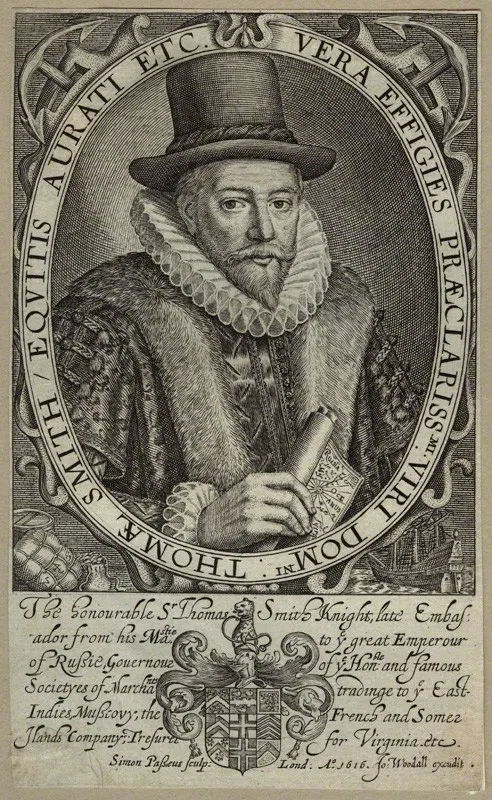
Figure: Sir Thomas Smith, engraving by Simon van de Passe, dated 1616 on the plate; the lettering calls him Governor of the East India, Muscovy, French and Somers Islands companies.
“Sir Thomas Smythe” by Simon van de Passe. Public Domain Mark.
Full credit
"Sir Thomas Smythe" by Simon van de Passe — https://commons.wikimedia.org/wiki/File:Sir_Thomas_Smythe.jpg — Public domain (Simon van de Passe d. 1647; US: published 1616, before 1931; EU: author died more than 70 years ago; faithful reproduction of a two-dimensional print, National Portrait Gallery, London)

Reported: Several of the 24 Committees named in the charter appear in the 1599 book, among them Paul Banning, Nicholas Ling, Oliver Style and Richard Wiseman [1][2]. James Lancaster, who commanded the first voyage, is also named as a Committee [1][2].
Reported: The introduction to the printed minutes says the Court made Lancaster captain of the largest ship and admiral of the squadron, and refused the Lord Treasurer's request to employ Sir Edward Michelborne, asking leave to work with “men of ther owne quality” [2].
What ships did it use?
Reported: Birdwood's introduction lists the first ships the committees bought: the Susan, the Hector and the Ascension, then the Mare Scurge (usually called the Malice Scourge), bought from the Earl of Cumberland and renamed the Red Dragon as the admiral's ship. A smaller vessel, the Guift (usually the Guest), carried supplies and was to be cast adrift when the commander chose [2].
Reported: A memorandum on the end leaves of the minute book gives the Red Dragon 600 tons and 180 men, the Hector 300 tons and 100 men, the Ascension 260 tons and the Susan 240 tons, with 80 men each. It puts the stock of the venture at £68,373, besides the cost of the northwest voyage [2]. Birdwood's introduction gives the same ship 200 men, so the two counts in the same volume differ [2].
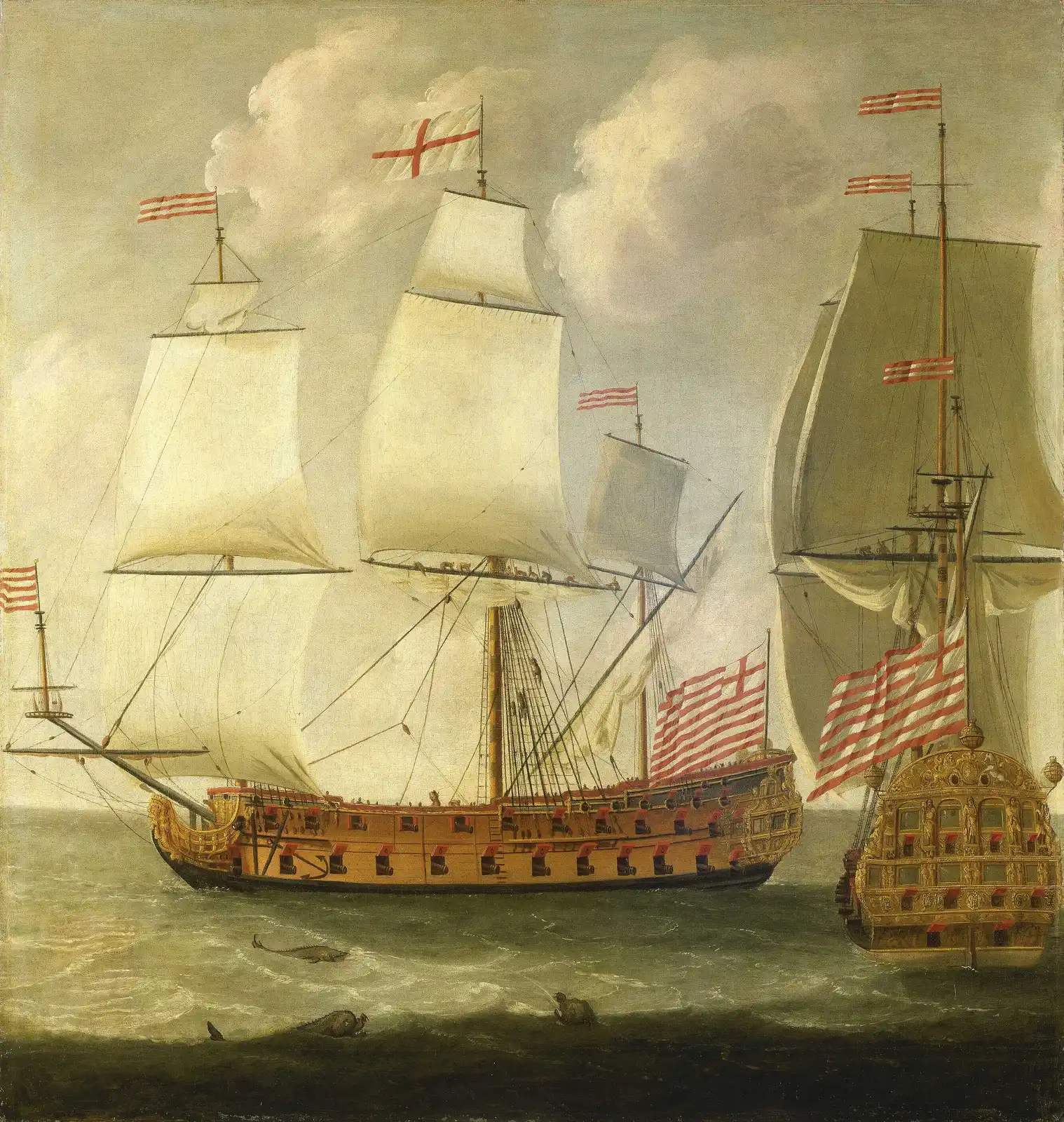
Figure: Two Views of an East Indiaman of the Time of King William III, oil by Isaac Sailmaker, a ship of the 1690s and much later than the first voyage (Royal Museums Greenwich).
“Two views of an East Indiaman of the time of King William III” by Isaac Sailmaker. Public Domain Mark.
Full credit
"Two views of an East Indiaman of the time of King William III" by Isaac Sailmaker — https://commons.wikimedia.org/wiki/File:Two_Views_of_an_East_Indiaman_of_the_Time_of_King_William_III_RMG_BHC1676.tiff — Public domain (Isaac Sailmaker d. 1721; US: made before 1931 and author dead more than 120 years; EU: author died more than 70 years ago; faithful reproduction of a two-dimensional work, Royal Museums Greenwich BHC1676)
Figure: A fleet of four ships and a small supply vessel putting to sea, the size of the East India Company's first voyage as its records describe it.
Illustration: Treaties & Tradeoffs. Generated schematic image — not a photograph or historical record. © Treaties & Tradeoffs, all rights reserved.
Assessed: The first fleet was bought second-hand. The charter's figure of six ships and six pinnaces was a cap on what could sail in a time of restraint, not a description of a fleet the company owned.
What changed in 1609?
Reported: On 31 May 1609 James I granted a new charter. It recited that the 1600 grant had been limited to “the space of Fifteen Years,” with the two-year warning clause, and it granted that members “shall and may from henceforth for ever, from the Day of the Date of these Presents,” trade to the East Indies [1].
Reported: The Crown kept a way out. If the grant did not prove profitable to the Crown or the realm, it would cease “upon and after Three Years Warning” [1]. The first term had about six and a half years left to run when the new charter replaced it [1].
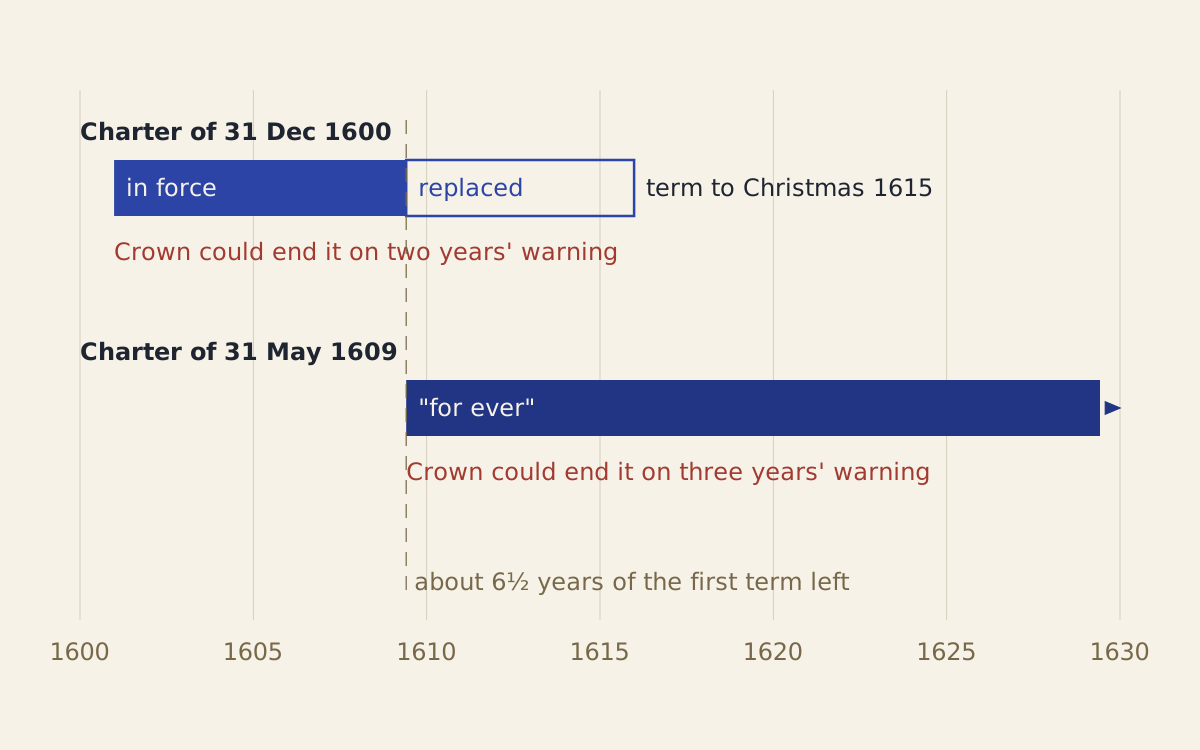
Figure: The term of the 1600 charter and the open-ended grant of 1609, with the warning period in each, from the printed charters.
Diagram: Treaties & Tradeoffs. CC BY 4.0. Open full size
Reuse credit
Diagram: Treaties & Tradeoffs, "East India Company charters of 1600 and 1609: terms compared" — https://treatiesandtradeoffs.com/case-studies/east-india-company/, CC BY 4.0 (https://creativecommons.org/licenses/by/4.0/)
Data: Charters relating to the East India Company from 1600 to 1761 (Madras, 1887), pp. 1–31, accessed 2026-11-02, public domain
Reported: The Dutch East India Company came later than the London charter. The States General granted its charter on 20 March 1602, or 10 March in the English calendar. In the eighteenth-century Dutch text read here, its seventh article ran the company for 21 years from 1602, with a general account every 10 years, and left each member free to withdraw his money at the end of those years [4].
Assessed: The two companies were not built the same way at the start, and neither was permanent by charter. The London merchants financed one voyage at a time inside a royal grant with an end date. The Dutch charter, as written, framed the members' capital for a set term instead. On the record read here, the 1609 change ended the London company's clock, but it did not end the Crown's right to call the grant back.
The card at the top of this page applies what we call the known-then test: score the choice only on what its makers could know at the time, with each piece of that knowledge tied to a source. The same test is run on a modern board in the Kodak replay, which begins with a dividend decision of September 2003.
Assessed: On 31 December 1600 the company held a grant that could vanish on two years' notice and a venture that had already lost a year to diplomacy. Raising money voyage by voyage fitted those facts. Reading the company's later size back into its first charter adds what we call the hindsight premium, the share of a decision's apparent wisdom or folly that is added only after the outcome is known.
A royal grant of exclusive trade was one way to shape a market; a court reading a statute three centuries later was another, as in the Standard Oil case.
Wage-day conversion table
Method: pence ÷ daily wage in pence, where pence = pounds × 240 + shillings × 12 + pence, using Allen's London series for 1599 and 1600: 18 pence a day for a building craftsman and 12 for a building labourer [3]. The wage source does not say whether pay in kind is included. Sums are as written in the subscription book of 22 September 1599 or ruled on 24 September 1599. Decimals are in the CSV below the table.
| Sum in the 1599 book | Pounds | Craftsman days | Labourer days | Source of the sum |
|---|---|---|---|---|
| Smallest entries, for example Nicholas Ling | £100 | 1,333 | 2,000 | [2] |
| Minimum for new adventurers from 24 September 1599 | £200 | 2,667 | 4,000 | [2] |
| Sir John Spencer | £800 | 10,667 | 16,000 | [2] |
| Paul Banning, alderman | £1,000 | 13,333 | 20,000 | [2] |
| Richard Cockayne and company | £3,000 | 40,000 | 60,000 | [2] |
| All sums written in the book | £30,133 6s 8d | 401,778 | 602,667 | [2] |
Download the table (CSV, east-india-company-wage-days.csv) Source and license notes (JSON) Data: Robert C. Allen, "Prices and Wages in London & Southern England, 1259–1914," published data series, accessed 2026-11-01, copyrighted, individual daily wage figures cited; Henry Stevens (ed.), The Dawn of British Trade to the East Indies as Recorded in the Court Minutes of the East India Company, 1599–1603 (London, 1886), accessed 2026-11-02, public domain
Sources
- Charters relating to the East India Company from 1600 to 1761 (Madras, 1887): charter of Queen Elizabeth I, 31 December 1600, pp. 1–15; charter of James I, 31 May 1609, pp. 16–31; preface. https://archive.org/details/dli.ministry.01275Read: full text of the 1600 charter and the 1609 charter, with the preface
- Henry Stevens (ed.), The Dawn of British Trade to the East Indies as Recorded in the Court Minutes of the East India Company, 1599–1603, with an introduction by Sir George Birdwood (London: Henry Stevens & Son, 1886). https://archive.org/details/dawnofbritishtra00stevuoftRead: full text of the court minutes for 1599–1601, the introduction and the end-leaf memoranda
- Robert C. Allen, "Prices and Wages in London & Southern England, 1259–1914," published data series (wages of building craftsmen and labourers, pence per day). Bob Allen – Research Pages, Nuffield College, Oxford. https://www.nuffield.ox.ac.uk/people/sites/allen-research-pages/Read: individual daily wage figures for 1599 and 1600
- States General of the United Netherlands, Octrooi for the Dutch East India Company, 20 March 1602, as printed by François Valentyn, Oud en Nieuw Oost-Indiën, vol. 1. Dutch Wikisource transcription. https://nl.wikisource.org/wiki/Octrooi_van_de_VOCRead: full text of the transcription
Cite this page
Treaties & Tradeoffs. “East India Company: Its 1600 Charter Set a 15-Year Term.” published 2026-11-02. https://treatiesandtradeoffs.com/case-studies/east-india-company/. Accessed [the date you read it].
Plain citation; add the date you consulted the page. No DOI is assigned.