Business Case HistoriesCase review
Standard Oil: Court Upheld Its Break-Up by a Rule of Reason
Treaties & Tradeoffs Filed
The Supreme Court upheld a lower court's order to dissolve the Standard Oil combination on 15 May 1911, holding that the Sherman Act forbids only unreasonable or undue restraints of trade, a reading the opinion calls the rule of reason. The 90 percent share figure appears in the opinion only as an allegation in the government's 1906 bill, about the years 1870 to 1882; the Court made no finding of a percentage [1].
Order of business (6 sections)
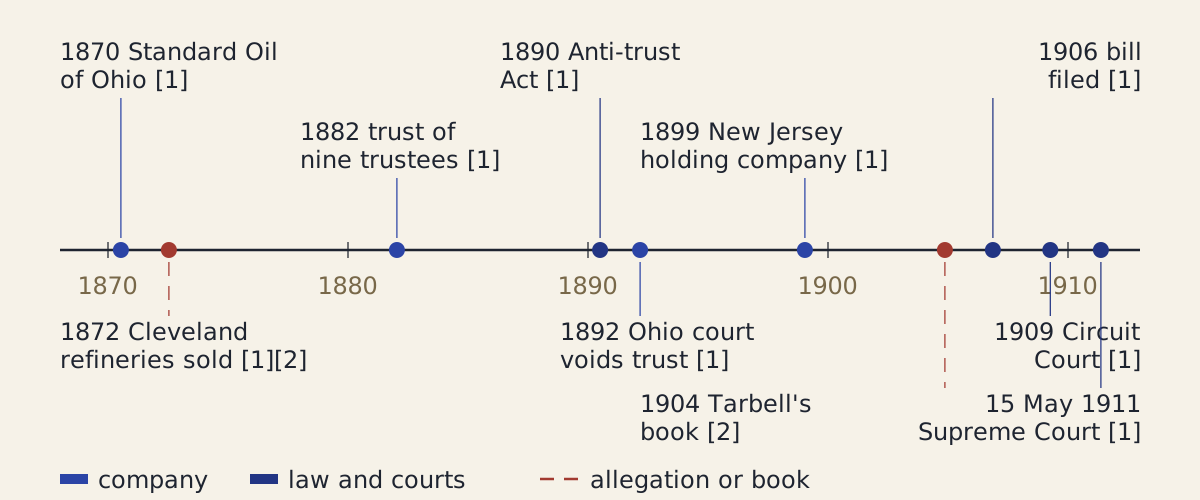
Figure: Dated steps from the Ohio company of 1870 to the Supreme Court's decision of 15 May 1911. Dashed marks are an allegation in the government's bill and a date from Tarbell's book.
Diagram: Treaties & Tradeoffs. CC BY 4.0. Open full size
Reuse credit
Diagram: Treaties & Tradeoffs, "Standard Oil: from the Ohio company to the 1911 decision, 1870–1911" — https://treatiesandtradeoffs.com/case-studies/standard-oil/, CC BY 4.0 (https://creativecommons.org/licenses/by/4.0/)
Data: Dates: Standard Oil Co. of New Jersey v. United States, 221 U.S. 1 (1911); Ida M. Tarbell, The History of the Standard Oil Company (1904), for 1872 and 1904
The timeline as text
- 1870: the Standard Oil Company of Ohio is organized [1][2].
- 1872: Cleveland refineries sell out to Standard, by the government's allegation and by Tarbell's account, which give different counts [1][2].
- January 1882: a trust agreement places the stock of 40 corporations with nine trustees [1].
- 2 July 1890: the Anti-trust Act, known as the Sherman Act, is approved [1].
- 2 March 1892: the Supreme Court of Ohio holds the trust agreement void [1].
- January 1899: the charter of the Standard Oil Company of New Jersey is amended and its capital raised to $110,000,000 [1].
- November 1904: Ida Tarbell's book is published [2].
- 15 November 1906: the United States files its bill [1].
- 5 to 10 April 1909: a Circuit Court of four judges hears the case; it later decides for the United States, on a date the opinion does not give [1].
- 15 May 1911: the Supreme Court affirms the decree with changes [1].
The timeline with sources (CSV) Source and license notes (JSON) Data: Standard Oil Co. of New Jersey v. United States, 221 U.S. 1 (1911), United States Reports, accessed 2026-11-02, public domain (U.S. court opinion); Ida M. Tarbell, The History of the Standard Oil Company (New York: McClure, Phillips & Co., 1904), Project Gutenberg eBook #60692, accessed 2026-11-02, public domain
On 15 May 1911, the Supreme Court gave Standard Oil at least six months to take its combination apart. Chief Justice White, writing for the Court, called the record “inordinately voluminous”: 23 volumes and about 12,000 printed pages, covering nearly forty years of business [1]. The lower court had allowed 30 days. Justice Harlan agreed that the combination broke the law, but he objected to how the majority reached that answer [1].
What did the government allege against Standard Oil?
Reported: The United States filed its bill on 15 November 1906 in the Circuit Court for the Eastern District of Missouri. It named nine Standard Oil companies, 62 other corporations and partnerships, and seven individuals. It charged a conspiracy formed in or about 1870 by John D. Rockefeller, William Rockefeller and Henry M. Flagler [1]. The bill divided the story into three periods: 1870 to 1882, 1882 to 1899, and 1899 to the filing of the bill [1].
Reported: For the first period, the bill alleged that by 1872 the combination held substantially all but three or four of the 35 or 40 oil refineries in Cleveland, and that railroad rebates drove rivals to join or quit. It then alleged that the combination had gained “a complete mastery over the oil industry, controlling 90 per cent of the business of producing, shipping, refining and selling petroleum and its products” [1]. For the later periods it described the trust of January 1882 and an Ohio court decree of 2 March 1892 against it. The bill also described the move in 1899 into a New Jersey holding company, whose capital stock rose from $10,000,000 to $110,000,000 [1].
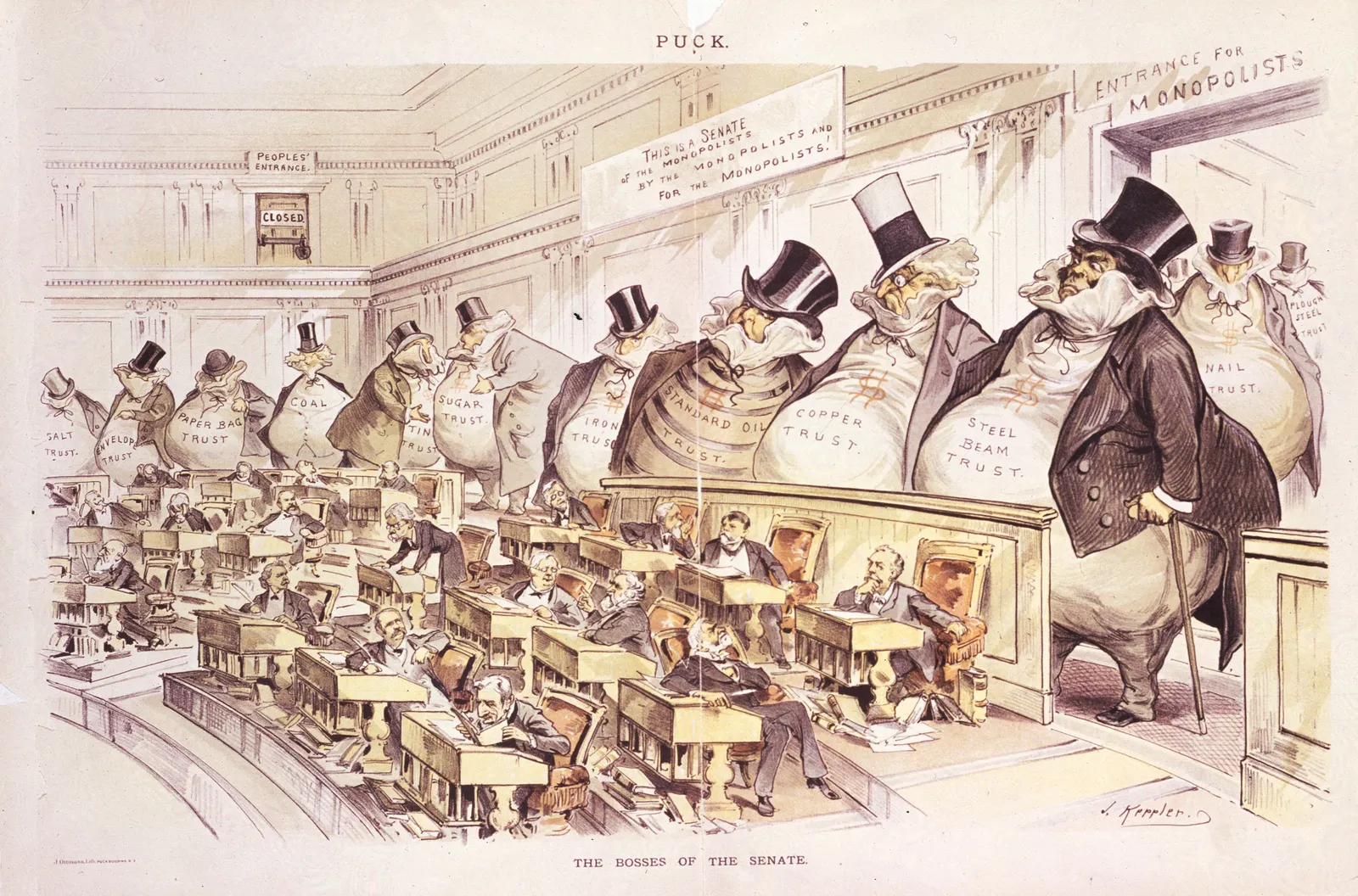
Figure: The Bosses of the Senate, Joseph Keppler's cartoon for Puck, January 1889, the year before the Anti-trust Act; the trusts are drawn as money bags, one of them labelled Standard Oil Trust.
"The Bosses of the Senate" by Joseph Keppler — https://commons.wikimedia.org/wiki/File:The_Bosses_of_the_Senate_by_Joseph_Keppler.jpg — Public domain (author d. 1894; published in the US in 1889; US and EU; United States Senate collection, Cat. no. 38.00392)

Reported: The bill also charged that the country had been divided into districts, each left to one company of the combination, and it cited what it called “enormous and unreasonable profits” [1]. It asked the court to find the combination illegal and to bar the New Jersey company from controlling the other companies through their stock [1].
Reported, with our check: From the filing of the bill to the decision was 1,642 days, or exactly 54 months [1].
What did the Court decide in 1911?
Reported: Section 1 of the Act declares illegal “every contract, combination in the form of trust or otherwise, or conspiracy, in restraint of trade” among the states [1]. White's opinion reasoned that the Act names broad classes of conduct without defining restraint of trade, and that Congress therefore meant courts to apply the standard of reason used in the common law [1]. Whether a given act falls inside the statute was left, in the opinion's words, “to be determined by the light of reason” [1].
Reported: The opinion calls this test “the rule of reason” and says it must be applied “in every case” [1]. The syllabus at the head of the report sums the holding up as a ban on contracts and combinations “which amount to an unreasonable or undue restraint of trade” [1]. Two earlier decisions whose wording seemed to rule out any appeal to reason were read down to fit [1]. The opinion traces the terms restraint of trade and monopolize to English and American law, though the Bubble Act of 1720 is not among the English authorities it discusses [1].
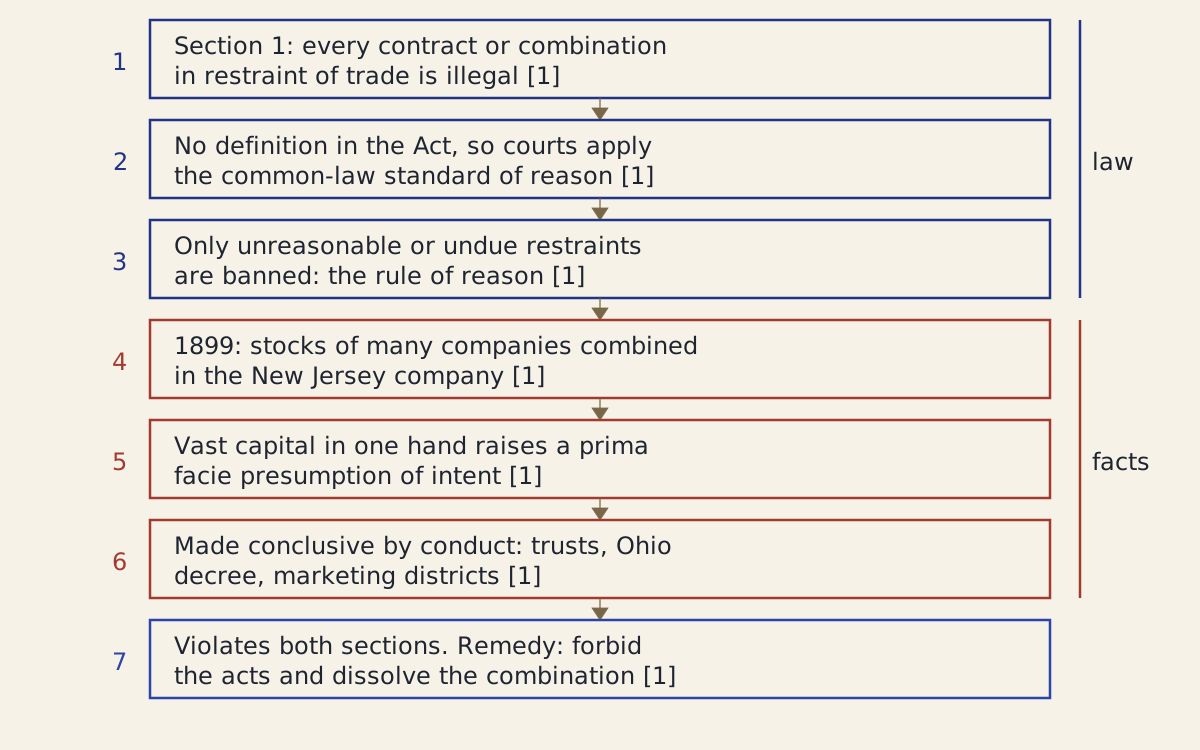
Figure: The steps of the 1911 opinion, from the text of the Act to the remedy. Blue boxes are the reading of the law, red boxes are the facts, and the last box is the result.
Diagram: Treaties & Tradeoffs. CC BY 4.0. Open full size
Reuse credit
Diagram: Treaties & Tradeoffs, "Standard Oil, 1911: the rule of reason step by step" — https://treatiesandtradeoffs.com/case-studies/standard-oil/, CC BY 4.0 (https://creativecommons.org/licenses/by/4.0/)
Data: Steps: Standard Oil Co. of New Jersey v. United States, 221 U.S. 1 (1911), pp. 49–81
The reasoning as text
- Section 1 makes illegal every contract or combination in restraint of trade among the states [1].
- The Act does not define restraint of trade, so courts apply the standard of reason from the common law [1].
- Only unreasonable or undue restraints are banned: the rule of reason [1].
- In 1899 the stocks of many companies were combined in the New Jersey company [1].
- Power over oil combined in one company with so vast a capital raises a prima facie presumption of intent to dominate the industry [1].
- Conduct before and after the trusts of 1879 and 1882, slow obedience to the Ohio decree and the marketing districts make the presumption conclusive [1].
- The combination violates both sections of the Act; the remedy is to forbid such acts and dissolve the combination [1].
Reported: Applied to Standard Oil, the reasoning ran through intent. The opinion held that combining so many companies, “aggregating so vast a capital,” in the New Jersey corporation gave rise “to the prima facie presumption of intent and purpose to maintain the dominancy over the oil industry” [1]. Conduct over the whole period made that presumption conclusive, in the Court's view, including the system that divided the country into marketing districts [1].
Assessed: The opinion does not say that size is lawful, and it does not say that size alone is unlawful. It treats the combined capital as the start of a presumption about purpose, then rests the case on conduct. Read that way, the rule of reason was the route by which the Court found against Standard Oil; it did not rescue the company.
Did the Court find that Standard Oil held 90 percent?
Reported: The figure of 90 percent appears once in the opinion, in the summary of the government's bill, and it covers the period from 1870 to 1882 [1]. When the Court came to the facts, it gave no percentage. It accepted as “established that a very small percentage of the crude oil produced was controlled by the combination,” and held that this did not help the defendants, because of “the absolute control which existed over the refined product” [1].
Reported: Ida Tarbell's 1904 book gives several figures, each for a different measure. By her account the Cleveland purchases of 1872 made Standard master of “over one-fifth” of American refining capacity, and an association formed in 1875 claimed within a year “ninety per cent. of the refining power of the country” [2]. She writes that it controlled 95 percent in less than four years, which she elsewhere calls the company's claim, then over 80 percent of oil manufacturing each year from 1879 and “about eighty-three per cent.” when she wrote [2]. For 1898 she cites the company's own report that it produced 35.58 percent of Eastern crude, says that all but about 10 percent of the region's crude passed into its custody, and puts its output at about 20 million of about 24 million barrels of products [2].
Reported, with our check: Her 1898 barrels give about 83.3 percent for Standard (20 ÷ 24), which agrees with her “about eighty-three,” and about 10.4 percent for the 2.5 million barrels she credits to independents [2].
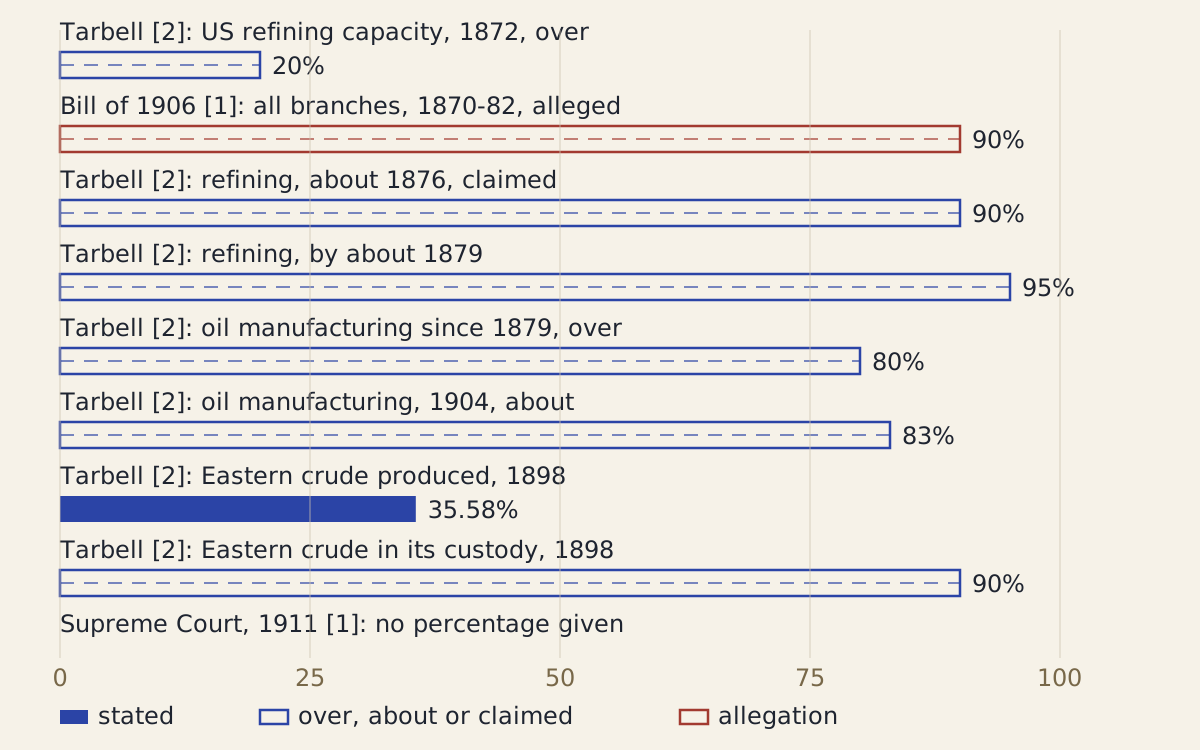
Figure: Share figures for Standard Oil, each with its source, measure and years. Outlined bars are figures given as over, about, claimed or alleged; the Court's opinion gives no percentage.
Diagram: Treaties & Tradeoffs. CC BY 4.0. Open full size
Reuse credit
Diagram: Treaties & Tradeoffs, "Standard Oil's share, as each source gave it" — https://treatiesandtradeoffs.com/case-studies/standard-oil/, CC BY 4.0 (https://creativecommons.org/licenses/by/4.0/)
Data: Figures: Standard Oil Co. of New Jersey v. United States, 221 U.S. 1 (1911); Ida M. Tarbell, The History of the Standard Oil Company (1904)
Every share figure with its measure and source (CSV) Source and license notes (JSON) Data: Standard Oil Co. of New Jersey v. United States, 221 U.S. 1 (1911), United States Reports, accessed 2026-11-02, public domain (U.S. court opinion); Ida M. Tarbell, The History of the Standard Oil Company (New York: McClure, Phillips & Co., 1904), Project Gutenberg eBook #60692, accessed 2026-11-02, public domain
| Claim in the 1906 bill | Years | What the 1911 opinion records |
|---|---|---|
| A combination formed about 1870 by the two Rockefellers and Flagler | 1870 | The Ohio company's creation is among facts proved “substantially as alleged” [1] |
| Substantially all but three or four of the 35 or 40 Cleveland refineries acquired | by 1872 | No separate finding; acts before the 1890 Act weigh only as evidence of intent [1] |
| Control of 90 percent of producing, shipping, refining and selling, as alleged | 1870–1882 | No percentage found; crude control “a very small percentage,” refined control “absolute” [1] |
| Rebates and preferences from railroads | 1870–1906 | Conduct before the 1879 and 1882 trusts weighed only as evidence of intent, not charge by charge [1] |
| The country divided into marketing districts | 1899–1906 | Named among facts that show purpose and intent [1] |
| The 1899 transfer of stocks to the New Jersey company was illegal | 1899–1906 | Upheld under both sections of the Act [1] |
| “Enormous and unreasonable profits” | 1882–1906 | No finding; the opinion mentions “enormous dividends” in passing [1] |
The bill's claims against the opinion, with pages (CSV) Source and license notes (JSON) Data: Standard Oil Co. of New Jersey v. United States, 221 U.S. 1 (1911), United States Reports, accessed 2026-11-02, public domain (U.S. court opinion)
Assessed: A 90 percent share is a striking number. The Court did not adopt it. The opinion's case rested on how the companies were combined and how they behaved, so quoting the 90 percent as a finding makes the decision look like a judgment on size that the text does not support.
What did the 1911 decree order the companies to do?
Reported: After a hearing on 5 to 10 April 1909, a Circuit Court of four judges decided for the United States. Its decree held the 1899 combination illegal, applied to seven individuals, the New Jersey company and 37 subsidiary companies, and dismissed the bill as to 33 other companies [1]. It barred the New Jersey company from voting the subsidiaries' stock and barred the subsidiaries from paying it dividends. It forbade them all to carry on interstate trade in oil until the combination was dissolved, and allowed 30 days to carry the decree out [1].
Reported: The Supreme Court described the remedy as two-fold: to forbid such acts in future and to dissolve the combination. It added that one purpose of the Act is “to protect, not to destroy, rights of property” [1]. It affirmed the order to transfer the subsidiaries' stock back to the stockholders entitled to it, and the bar on voting the stock or taking dividends. The section against combining again it read narrowly: the companies kept “the power to make normal and lawful contracts or agreements,” but could not recreate the combination “by any device whatever” [1].
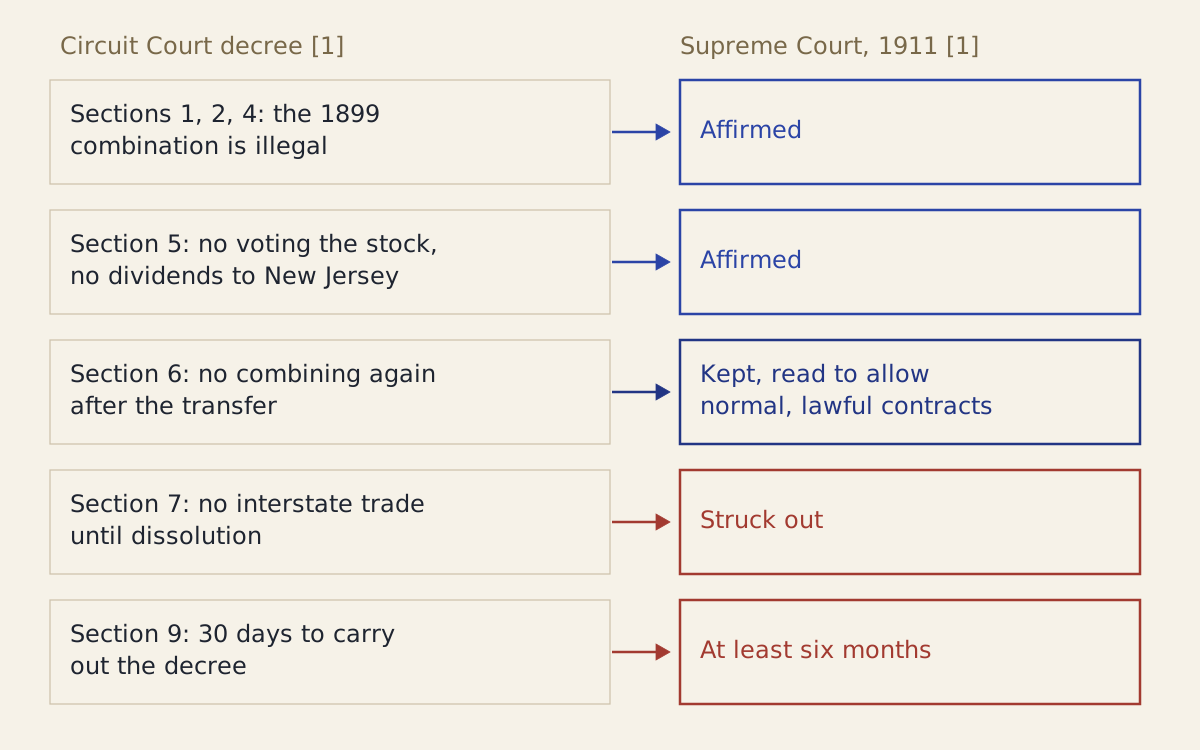
Figure: The lower court's decree, section by section, beside what the Supreme Court did with each part on 15 May 1911.
Diagram: Treaties & Tradeoffs. CC BY 4.0. Open full size
Reuse credit
Diagram: Treaties & Tradeoffs, "Standard Oil, 1911: how the Supreme Court changed the decree" — https://treatiesandtradeoffs.com/case-studies/standard-oil/, CC BY 4.0 (https://creativecommons.org/licenses/by/4.0/)
Data: Decree and changes: Standard Oil Co. of New Jersey v. United States, 221 U.S. 1 (1911), pp. 44–45, 77–82

Figure: Illustration of a dissolution: one combined holding cut into separate companies, some still free to join pipe lines.
Illustration: Treaties & Tradeoffs. Generated schematic image — not a photograph or historical record. © Treaties & Tradeoffs, all rights reserved.
The decree changes as text
- Sections 1, 2 and 4, holding the 1899 combination illegal: affirmed [1].
- Section 5, no voting of the subsidiaries' stock and no dividends to the New Jersey company: affirmed [1].
- Section 6, no combining again after the transfer: kept, but read to allow normal and lawful contracts [1].
- Section 7, no interstate trade until the dissolution was complete: should not have been awarded [1].
- Section 9, 30 days to carry out the decree: too short, extended to at least six months [1].
Reported: The Court gave two examples of agreements the narrowed section would allow. Separate pipe line owners might join their lines into a continuous line, and the Union Tank Line Company, owner of practically all the combination's tank cars, might agree with the others on how to distribute them [1]. It called the 30 days “too short” and extended the time to “a period of at least six months,” and it struck the ban on interstate trade because a stop in commerce in petroleum could seriously injure the public [1].
The card at the top of this page applies what we call the known-then test: score the choice only on what its makers could know at the time, with each piece of that knowledge tied to a source. On 15 May 1911 the companies knew these terms and the time allowed. The opinion does not record how they would carry the transfer out.
Was the break-up necessary?
Reported: Justice Harlan wrote that the Court was unanimous in holding that the things done by Standard Oil were illegal, “whether those things were in reasonable or unreasonable restraint” of commerce [1]. He would have affirmed the decree “without qualification,” warned that the changes “may prove to be mischievous,” and called the reading of “unreasonable” or “undue” into the Act a form of “judicial legislation” [1].
Reported: Later scholars returned to the case. John S. McGee's 1958 article is titled “Predatory Price Cutting: The Standard Oil (N. J.) Case,” and Elizabeth Granitz and Benjamin Klein published “Monopolization by ‘Raising Rivals' Costs': The Standard Oil Case” in 1996 [3][4]. We read only the publication records of these two articles, so we give their titles and do not summarize their arguments.
Assessed: The sources we read do not settle whether dissolution was the right remedy. They show the Justices agreeing that the combination was illegal and disagreeing over the reasoning and the details of the decree. Calling the break-up obviously right or obviously pointless from what came later adds what this site calls the hindsight premium: the share of a decision's apparent wisdom or folly that is added only after the outcome is known.
Which companies and men did the decree name?
Reported: The seven individuals named in the decree were John D. Rockefeller, William Rockefeller, Henry H. Rogers, Henry M. Flagler, John D. Archbold, Oliver H. Payne and Charles M. Pratt [1]. The 37 companies found to be parties included Standard Oil companies of California, Indiana, Iowa, Kansas, Kentucky, Nebraska, New York and Ohio, a string of pipe line companies, the Union Tank Line Company, the Vacuum Oil Company and the Anglo-American Oil Company, Limited; the opinion counts 36 of them as domestic and one as foreign [1]. By its counsel's account, the Standard Oil Company of Iowa had already been liquidated [1].
Reported, with our check: Section 4 of the decree lists the New Jersey company's holdings with their capital stock. It held dollar stock in 37 companies with total capital stock of $148,090,450, of which it owned $143,654,730, or 97.0 percent, and it owned the whole of 16 of them. It also held £999,740 of the Anglo-American company's £1,000,000 [1]. The decree adds that the New Jersey company had issued more than $90,000,000 of its own stock in exchange for the stocks it held [1].
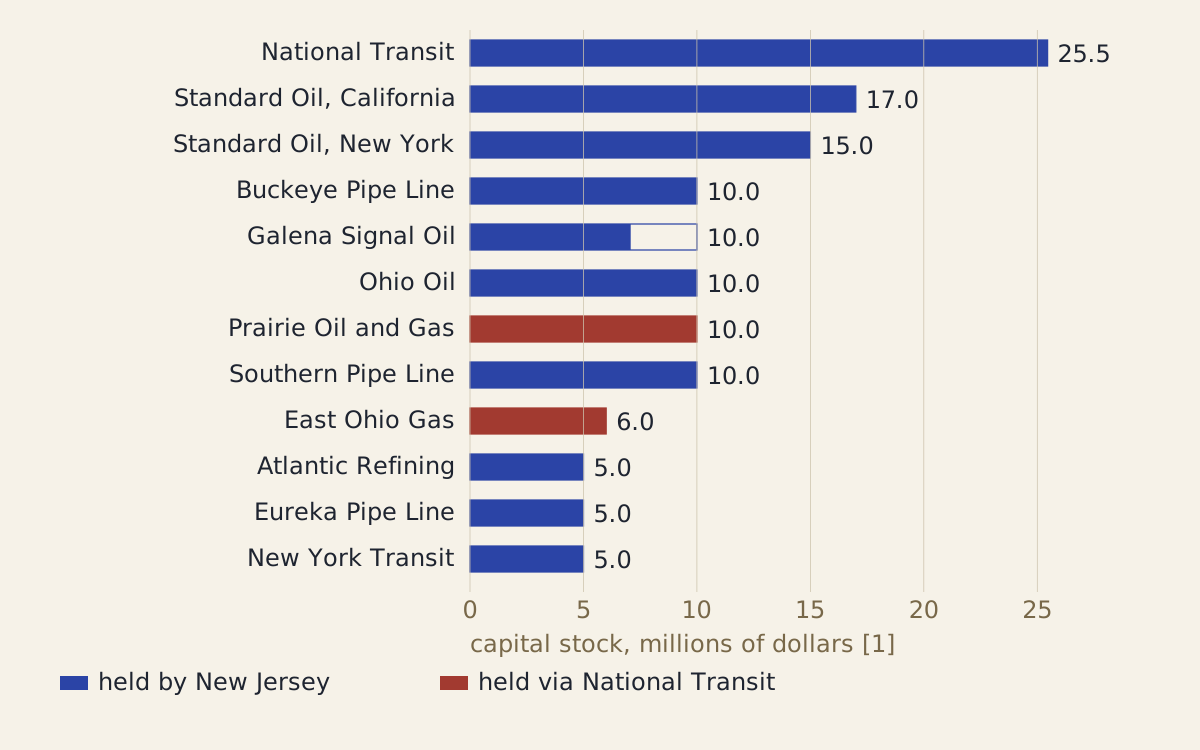
Figure: Companies in the decree's list with capital stock of $5 million or more, showing the part owned by the New Jersey company or by its National Transit Company.
Diagram: Treaties & Tradeoffs. CC BY 4.0. Open full size
Reuse credit
Diagram: Treaties & Tradeoffs, "Standard Oil, 1911: the largest companies in the decree's list" — https://treatiesandtradeoffs.com/case-studies/standard-oil/, CC BY 4.0 (https://creativecommons.org/licenses/by/4.0/)
Data: Capital stock and holdings: decree section 4, as printed in Standard Oil Co. of New Jersey v. United States, 221 U.S. 1 (1911), pp. 71–73
All companies in the decree, with capital stock and holdings (CSV) Source and license notes (JSON) Data: Decree sections 2 and 4, as printed in Standard Oil Co. of New Jersey v. United States, 221 U.S. 1 (1911), pp. 71–74, United States Reports, accessed 2026-11-02, public domain (U.S. court opinion)
Reported: The section 4 list is not the same as the list of 37 defendant companies. It includes gas companies that are not among the defendants, and it gives no capital figures for three defendants: the Corsicana Refining Company, the Manhattan Oil Company and the Security Oil Company [1]. These dollar sums are given as the decree gives them. We found no same-place, same-period wage series to set them against, so we do not convert them.
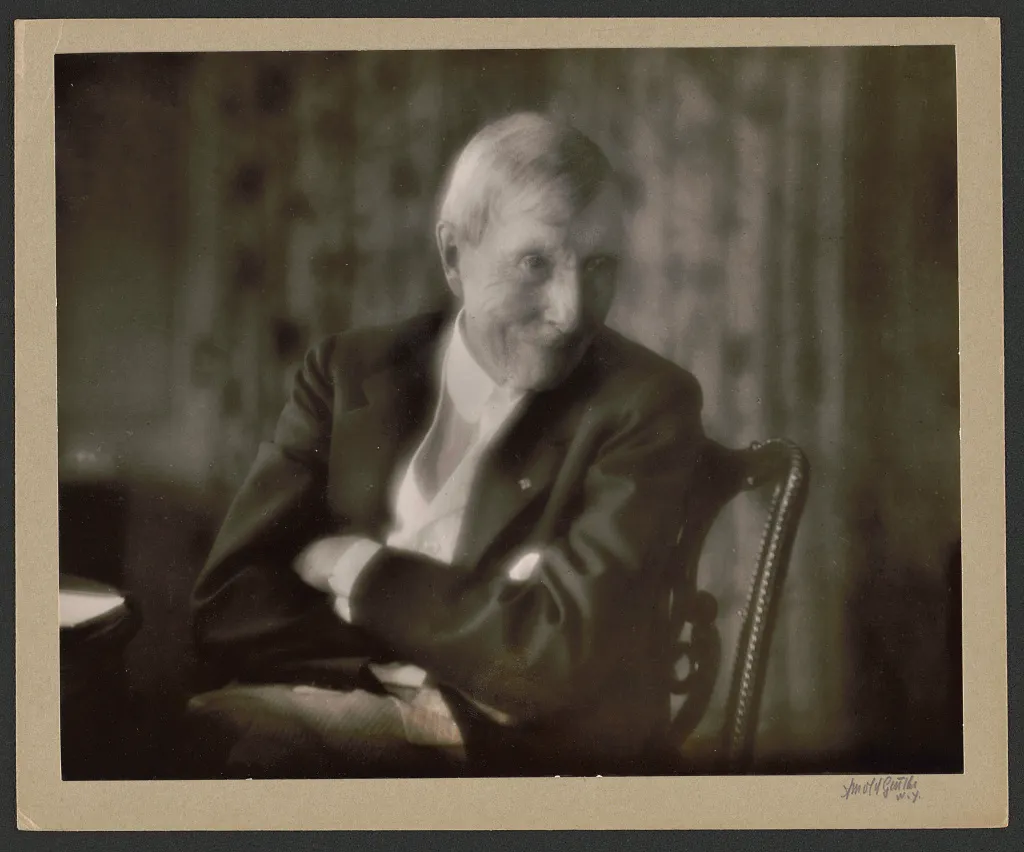
Figure: John D. Rockefeller in a portrait by Arnold Genthe that the Library of Congress dates to 1918, seven years after the decision.
"John D. Rockefeller" by Arnold Genthe — https://commons.wikimedia.org/wiki/File:John_D._Rockefeller_in_1918.jpg — Public domain (author d. 1942; US: published 1918 or, if unpublished, life plus 70 years; EU: life plus 70 years; Library of Congress, Arnold Genthe Collection)

What did Ida Tarbell report?
Reported: Ida M. Tarbell's The History of the Standard Oil Company appeared in two volumes in November 1904. Its preface says it grew out of an effort by the editors of McClure's Magazine to deal with the trust question, and its copyright notices run from 1902 to 1904 [2]. She writes that early in 1872 there were 26 refineries in Cleveland, and that within about three months at least 21 had sold out to Standard, using a railroad rebate plan called the South Improvement Company as pressure [2]. In her account, Standard's capacity rose from probably not over 1,500 barrels of crude a day to 10,000 [2].
Reported: Tarbell's count differs from the government's. The bill, as the opinion summarizes it, spoke of 35 or 40 Cleveland refineries, substantially all but three or four of them acquired by 1872, while Tarbell counts 26 [1][2]. Her own tally also shifts: a later chapter says that of the 26 firms six were left, and that Standard had absorbed 20 plants [2]. The sources disagree, and we have not found a third count to settle it.
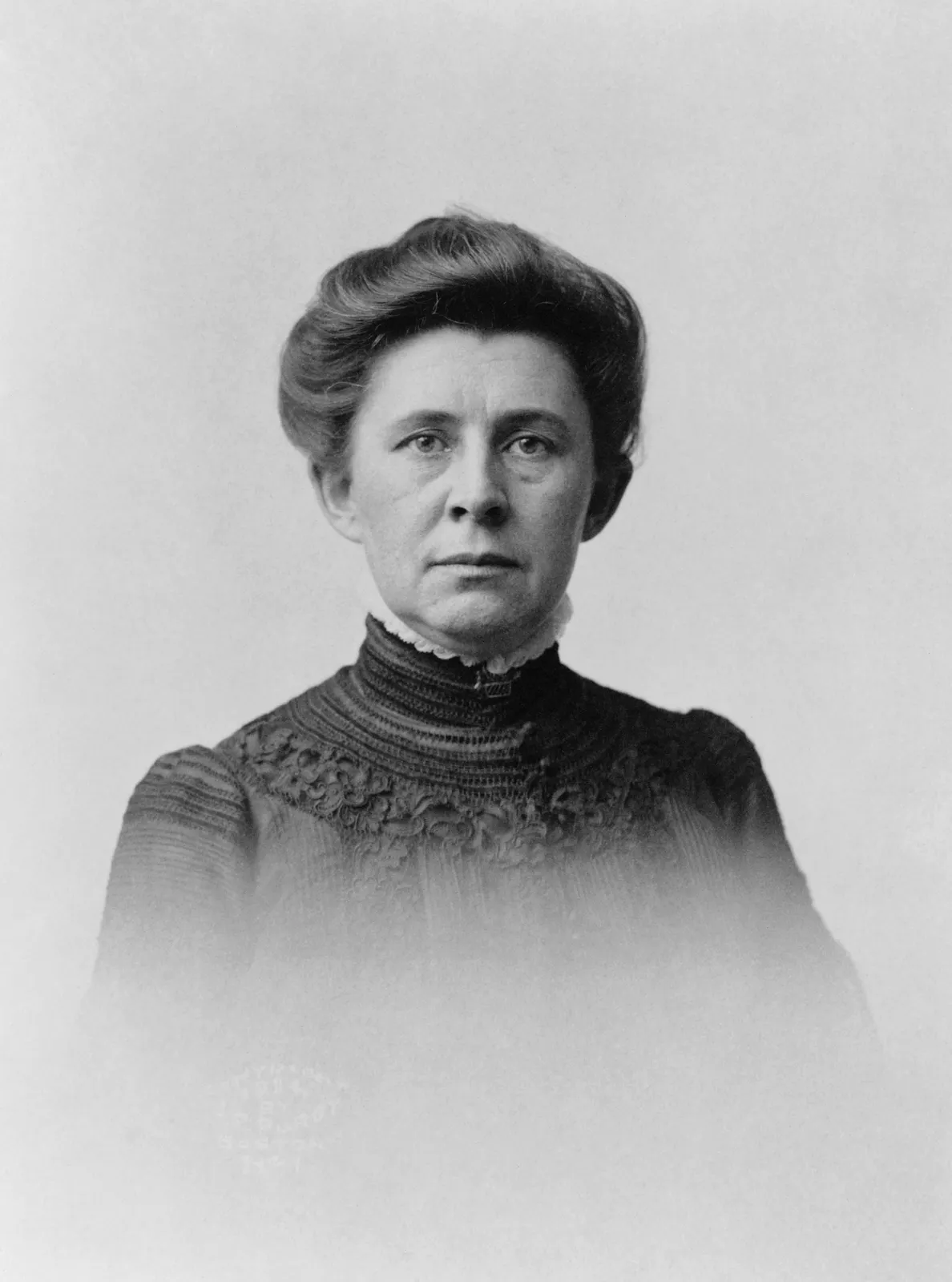
Figure: Ida M. Tarbell, photographed by J. E. Purdy in Boston in 1904, the year her book appeared.
"Ida M. Tarbell" by James E. Purdy — https://commons.wikimedia.org/wiki/File:Ida_M._Tarbell.jpg — Public domain (author d. 1933; published in the US in 1904 (Copyright 1904 by J. E. Purdy, Boston); US and EU; Library of Congress Prints and Photographs, cph.3c17943)

Reported: Tarbell also wrote about the company's strengths. She writes: “Something besides illegal advantages has gone into the making of the Standard Oil Trust.” In her words, it played its game “with consummate ability, daring and address” [2]. Her conclusion puts transport first: “the crucial question is still a transportation question,” and the trust question will last until the country solves “free and equal transportation” [2].
Assessed: Tarbell's book is one side's record, built as a magazine series about the trust question. Her percentages are her own reckonings or the company's reports as she cites them. The 1911 opinion does not cite her. Her book and the government's bill tell the same broad story of rebates and absorption, but the Court decided the case on its own reading of the record and the Act.
Sources
- Standard Oil Co. of New Jersey v. United States, 221 U.S. 1 (1911), argued 14–16 March 1910, reargued 12–17 January 1911, decided 15 May 1911; opinion of the Court by Chief Justice White, Justice Harlan concurring in part and dissenting in part. https://tile.loc.gov/storage-services/service/ll/usrep/usrep221/usrep221001/usrep221001.pdfRead: full text of the report, including the syllabus, the opinion of the Court and Justice Harlan's opinion (United States Reports, pp. 1–106)
- Ida M. Tarbell, The History of the Standard Oil Company, 2 vols. (New York: McClure, Phillips & Co., 1904). https://www.gutenberg.org/ebooks/60692Read: full text of the 1904 edition, both volumes (second impression, 1905)
- John S. McGee, “Predatory Price Cutting: The Standard Oil (N. J.) Case,” The Journal of Law and Economics 1 (October 1958): 137–169. https://doi.org/10.1086/466547Read: bibliographic record only
- Elizabeth Granitz and Benjamin Klein, “Monopolization by ‘Raising Rivals' Costs’: The Standard Oil Case,” The Journal of Law and Economics 39, no. 1 (April 1996): 1–47. https://doi.org/10.1086/467342Read: bibliographic record only
Cite this page
Treaties & Tradeoffs. “Standard Oil: Court Upheld Its Break-Up by a Rule of Reason.” published 2026-11-02. https://treatiesandtradeoffs.com/case-studies/standard-oil/. Accessed [the date you read it].
Plain citation; add the date you consulted the page. No DOI is assigned.