Business Case HistoriesCase review
Kodak Digital Camera: It Led US Sales in 2004, IDC Said
Treaties & Tradeoffs Filed
Kodak's filings do not show a company that missed the digital camera: its annual report for 2005, citing the research firm IDC, said Kodak led US digital camera sales in 2004 with a 21.9 percent share, and Kodak had patented an electronic still camera in 1978. The same filings point to a different problem: its consumer digital unit lost money in 2004 and 2005 while film still earned it, and the company filed for Chapter 11 bankruptcy protection on 19 January 2012 [3][4][5][6].
Order of business (6 sections)
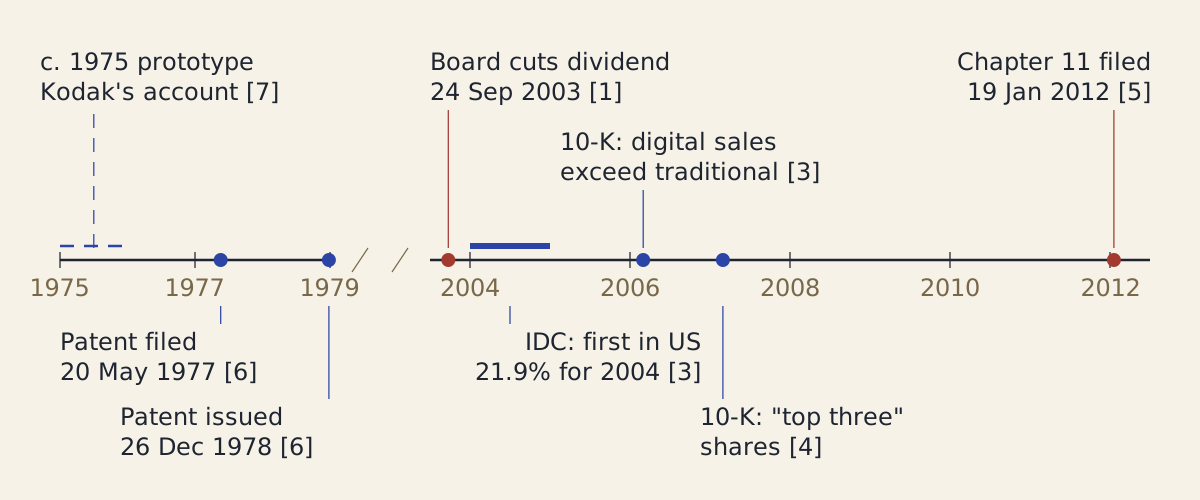
Figure: Kodak and the digital camera, 1975 to 2012, from Kodak's patent and SEC filings. The dashed 1975 mark rests on Kodak's own account.
Diagram: Treaties & Tradeoffs. CC BY 4.0. Open full size
Reuse credit
Diagram: Treaties & Tradeoffs, "Kodak and the digital camera: a timeline, 1975–2012" — https://treatiesandtradeoffs.com/case-studies/kodak-digital-camera/, CC BY 4.0 (https://creativecommons.org/licenses/by/4.0/)
Data: Dates: US Patent 4,131,919, "Electronic Still Camera" (filed 20 May 1977, issued 26 December 1978); Eastman Kodak Company, Form 10-K for fiscal 2003 (filed 15 March 2004); Eastman Kodak Company, Form 10-K for fiscal 2005 (filed 2 March 2006), citing IDC; Eastman Kodak Company, Form 10-K for fiscal 2006 (filed 1 March 2007); Eastman Kodak Company, Form 8-K dated 19 January 2012, with Exhibit 99.1, accessed 2026-11-02, SEC filings, text under Eastman Kodak copyright; facts and figures only; 1975: Kodak, "Milestones" page (kodak.com), the company's own account, accessed 2026-11-02, one fact paraphrased, page text not reused
The timeline as text
- 1975: Kodak's prototype digital camera, by Kodak's own account [7].
- 20 May 1977: Kodak files the application for an electronic still camera, later US Patent 4,131,919 [6].
- 26 December 1978: US Patent 4,131,919 is issued to Eastman Kodak [6].
- 25 July 2003: Kodak signs its 10-Q for the second quarter, reporting falling film sales and rising digital camera sales [2].
- 24 September 2003: Kodak's board cuts the annual dividend to $0.50 a share [1].
- 2004: IDC's full-year study puts Kodak first in US digital cameras with 21.9 percent, as Kodak's 10-K reports [3].
- 2 March 2006: Kodak files its 10-K for 2005, reporting that digital revenue exceeded traditional revenue [3].
- 1 March 2007: Kodak files its 10-K for 2006, claiming a top-three share in digital still cameras and other major markets [4].
- 19 January 2012: Kodak and its US subsidiaries file Chapter 11 petitions in New York [5].
The dated events, with sources (CSV) Source and license notes (JSON) Data: US Patent 4,131,919, "Electronic Still Camera" (filed 20 May 1977, issued 26 December 1978); Eastman Kodak Company, Form 10-Q for the quarter ended 30 June 2003 (signed 25 July 2003); Eastman Kodak Company, Form 10-K for fiscal 2003 (filed 15 March 2004); Eastman Kodak Company, Form 10-K for fiscal 2005 (filed 2 March 2006); Eastman Kodak Company, Form 10-K for fiscal 2006 (filed 1 March 2007); Eastman Kodak Company, Form 8-K dated 19 January 2012, with Exhibit 99.1, accessed 2026-11-02, SEC filings, text under Eastman Kodak copyright; facts and figures only
On 24 September 2003, Kodak's board cut the company's annual dividend to 50 cents a share. In April the same board had declared $0.90 a share for half a year alone [1]. The 10-K that Kodak filed the next spring records the cut and, in another section, a new strategy that Kodak said it had recently announced: a three-year transition from leading the traditional photographic industry to a leading place in digital imaging, with the traditional businesses run for cash [1]. Kodak's 10-K for 2005 dates that strategy to 2003 [3].
What did Kodak build in the 1970s?
Reported: Kodak's own history page says the company invented the first digital camera in 1975, as a prototype [7]. That claim is Kodak's account of itself. We did not read an independent record of the 1975 prototype for this article.
Reported: The patent record is firmer. On 20 May 1977, Gareth A. Lloyd and Steven J. Sasson of Rochester, New York, filed an application for an “Electronic Still Camera,” assigned to Eastman Kodak, and US Patent 4,131,919 was issued on 26 December 1978 [6]. The patent describes a camera that turns light on a charge-coupled device (a chip of light-sensitive cells) into digital words, holds them in a memory and records them on audio-grade magnetic tape for playback on an ordinary television set [6].
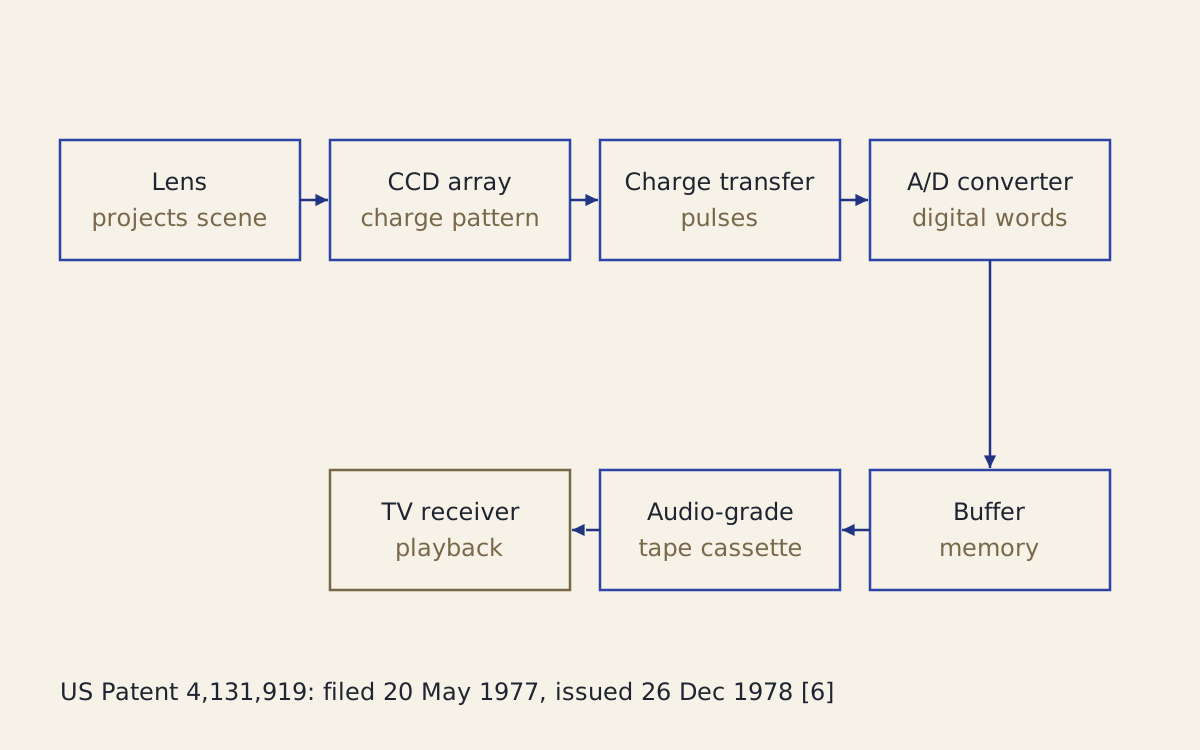
Figure: The signal path described in US Patent 4,131,919 (filed 1977, issued 1978), redrawn as a simple flow from the patent's own summary.
Diagram: Treaties & Tradeoffs. CC BY 4.0. Open full size
Reuse credit
Diagram: Treaties & Tradeoffs, "The signal path in US Patent 4,131,919" — https://treatiesandtradeoffs.com/case-studies/kodak-digital-camera/, CC BY 4.0 (https://creativecommons.org/licenses/by/4.0/)
Data: US Patent 4,131,919, "Electronic Still Camera" (filed 20 May 1977, issued 26 December 1978), abstract, accessed 2026-11-02, patent text typically not subject to copyright (USPTO)
The signal path as text
- A lens projects the scene onto a charge-coupled device, an array of light-sensitive elements [6].
- A charge-transfer circuit reads the charge pattern out as a stream of electrical pulses [6].
- An analog-to-digital converter turns each pulse into a multi-bit digital word [6].
- A digital buffer memory holds the words and passes them on at a slower rate [6].
- An audio-grade magnetic tape cassette records the words [6].
- On playback, the words are read from the tape and converted for an ordinary television receiver [6].
Assessed: Read with the ending in mind, the patent looks like a warning that went unheeded. That reading carries what we call the hindsight premium: the share of a decision's apparent wisdom or folly that is added only after the outcome is known. In 1978 the patent described a tape-and-television device, and nothing in it priced a consumer market. Owning the idea early is a fact; failing to see digital is a separate charge, and it needs its own evidence.
How did Kodak make money from film?
An advertisement dated 1891 by the Tekniska museet in Stockholm sells “The Kodak Camera” in “Eight Styles and Sizes,” all loaded with “Transparent Films,” under the line “You press the button, we do the rest.” The advertisement sells the camera and, in the same breath, the film inside it and the work done after the button is pressed.
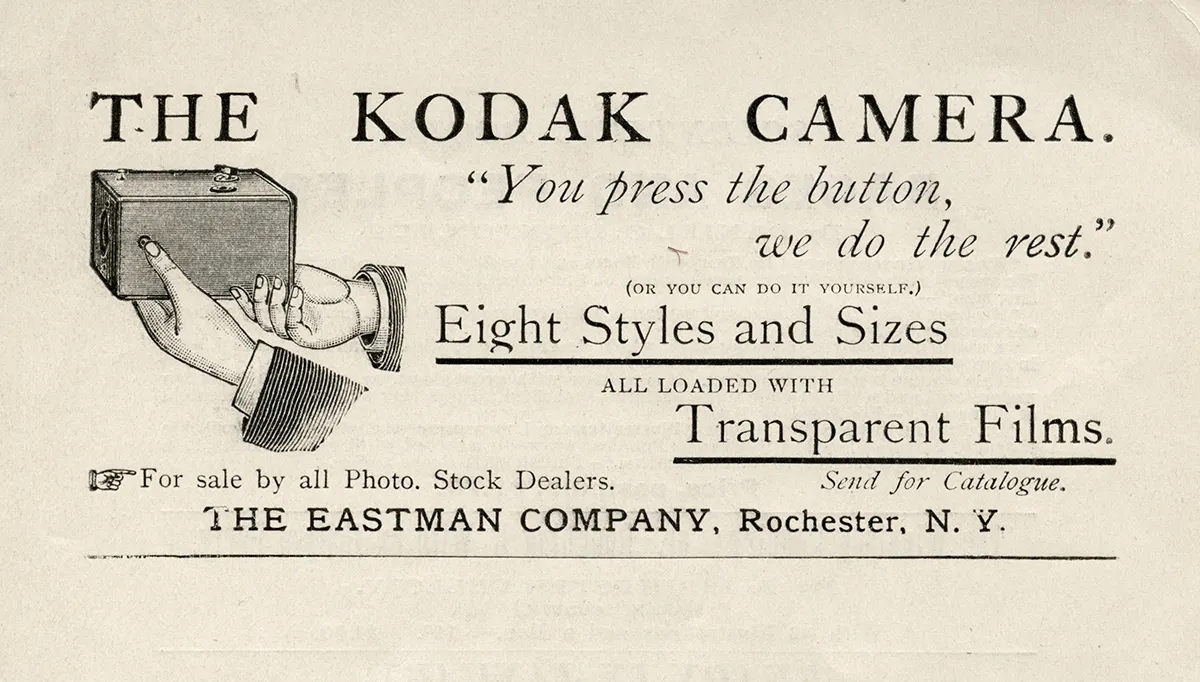
Figure: An 1891 advertisement for the Kodak camera, from the collection of the Tekniska museet, Stockholm.
""You press the button, we do the rest"" by Tekniska museet — https://commons.wikimedia.org/wiki/File:%22You_press_the_button,_we_do_the_rest%22_(37249349200).jpg — CC BY 2.0 (https://creativecommons.org/licenses/by/2.0/)
Reported: The rest was film, paper, chemicals and processing. In the summer of 2003, Kodak's 10-Q still reported consumer film sales, color paper volumes and photofinishing sales line by line [2]. Its digital side by then included the EasyShare camera line and the Ofoto online photo service, which had more than 8 million members [2]. Kodak's traditional products brought in $8,931 million in 2003, against $3,978 million from digital products, out of total sales of $12,909 million, as Kodak's 10-K for 2005 reports them [3].
Reported, with our check: Those two figures add up to the 2003 total, and digital products made up about 30.8 percent of the company's sales that year [3]. The comparison has limits. Kodak counted medical and printing products in both columns, so digital here is not the same thing as digital cameras.
Reported: Traditional products still made up most of Kodak's sales in 2003 [3], and its managers still defended film. Kodak's Photography segment, which combined film, paper, processing and cameras, had sales of $9,002 million in 2002 [1]. In the 10-Q for the second quarter of 2003, Kodak's management said it remained confident of holding its full-year US film share, as it had for several years in a row [2]. Even film was being scanned: at Qualex's wholesale labs, the rate of rolls scanned averaged 7.4 percent in the second quarter of 2003, up from 7.0 percent a year earlier [2].
What did Kodak's board decide in September 2003?
Reported: The board's decision of 24 September 2003 had two parts that the 10-K records on the same date. It cut the annual dividend to $0.50 a share, and it declared a half-year payment of $0.25, paid in December [1].
Reported: Kodak's 10-K for 2003 sets out the new strategy in a different section from the dividend. The filing does not say that the cut was made to pay for the strategy. Kodak would manage its traditional businesses “to maximize cash generation over an extended period of time,” grow its digital products, make tightly focused acquisitions and look for longer-term growth in areas such as displays and inkjet. Kodak said it expected a balanced digital and traditional portfolio by the end of 2006 [1].
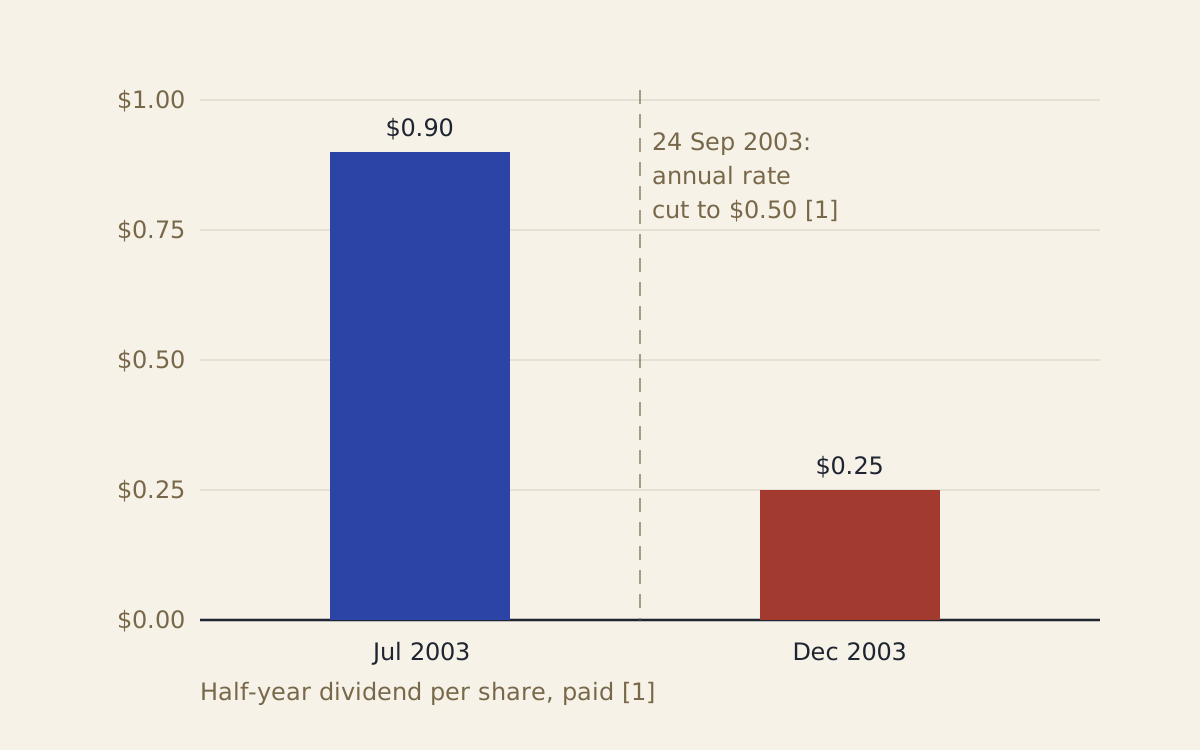
Figure: Kodak's two half-year dividends of 2003, before and after the board's decision of 24 September.
Diagram: Treaties & Tradeoffs. CC BY 4.0. Open full size
Reuse credit
Diagram: Treaties & Tradeoffs, "Kodak's half-year dividends, 2003" — https://treatiesandtradeoffs.com/case-studies/kodak-digital-camera/, CC BY 4.0 (https://creativecommons.org/licenses/by/4.0/)
Data: Eastman Kodak Company, Form 10-K for fiscal 2003 (filed 15 March 2004), Item 7, liquidity, accessed 2026-11-02, SEC filings, text under Eastman Kodak copyright; facts and figures only
Reported, with our check: The April declaration of $0.90 was for half a year, so the old rate came to $1.80 a year if repeated; the new annual rate of $0.50 was about 72 percent lower [1].
What did the July 10-Q tell the board?
The card at the top of this page applies the known-then test: score the choice only on what its makers could know at the time, with each piece of that knowledge tied to a source. The facts in its Known then list come from Kodak's 10-Q for the second quarter of 2003, signed on 25 July 2003, two months before the vote [2]. The April dividend and the options come from Kodak's 10-K for 2003 [1].

Figure: Film and digital side by side on a boardroom table: a cut-paper sketch, not a picture of Kodak's meeting.
Illustration: Treaties & Tradeoffs. Generated schematic image — not a photograph or historical record. © Treaties & Tradeoffs, all rights reserved.
Reported: That 10-Q told the board that worldwide sales of consumer film fell 6 percent in the quarter and US sales 9 percent [2]. The market data Kodak cited pointed to a 7 to 8 percent fall in US film industry volume for all of 2003, most of it from digital substitution [2]. US photofinishing sales at Qualex, Kodak's processing business, fell 22 percent. In the same quarter, sales of Kodak's consumer digital cameras rose 65 percent, and Kodak said it still held one of the top US share positions in the channels that report share data [2].
Assessed: On that record, the board saw the threat clearly enough to act on it. You are in the room with a falling film line and a camera line that is growing fast, and the choice on the table is how much of the film cash to keep paying out. The board chose to pay out less of it; the filing does not say what the saved cash was for, though its strategy section points to digital products and acquisitions. The record from that week does not show a company blind to digital; whether the bet was the right one is a separate question.
Assessed: The three options on the card each had a case on that record. Keeping the dividend would have spent film cash on shareholders while US film industry volume was expected to fall 7 to 8 percent in 2003, by the market data Kodak cited [2]. Running film for cash, the third option, would raise money without settling how much of it the fast-growing camera line would get. The board's choice, a smaller dividend, fits what the July numbers pointed to, so on this record it scores well on the known-then test.
Assessed: What the card cannot show is whether digital cameras would earn what film had. That is where the later filings come in.
How much of the US digital camera market did Kodak hold?
Reported: Kodak's 10-K for 2003 says that, in the channels reporting share data, Kodak finished 2003 third in US digital camera share after taking the top spot in the fourth quarter alone. The same filing warns that some of Kodak's largest channels did not report share data [1]. Kodak's 10-K for 2005 then states: “According to market research firm IDC's full year 2004 digital camera study, Kodak leads the industry in the U.S. with a 21.9 percent market share” [3].
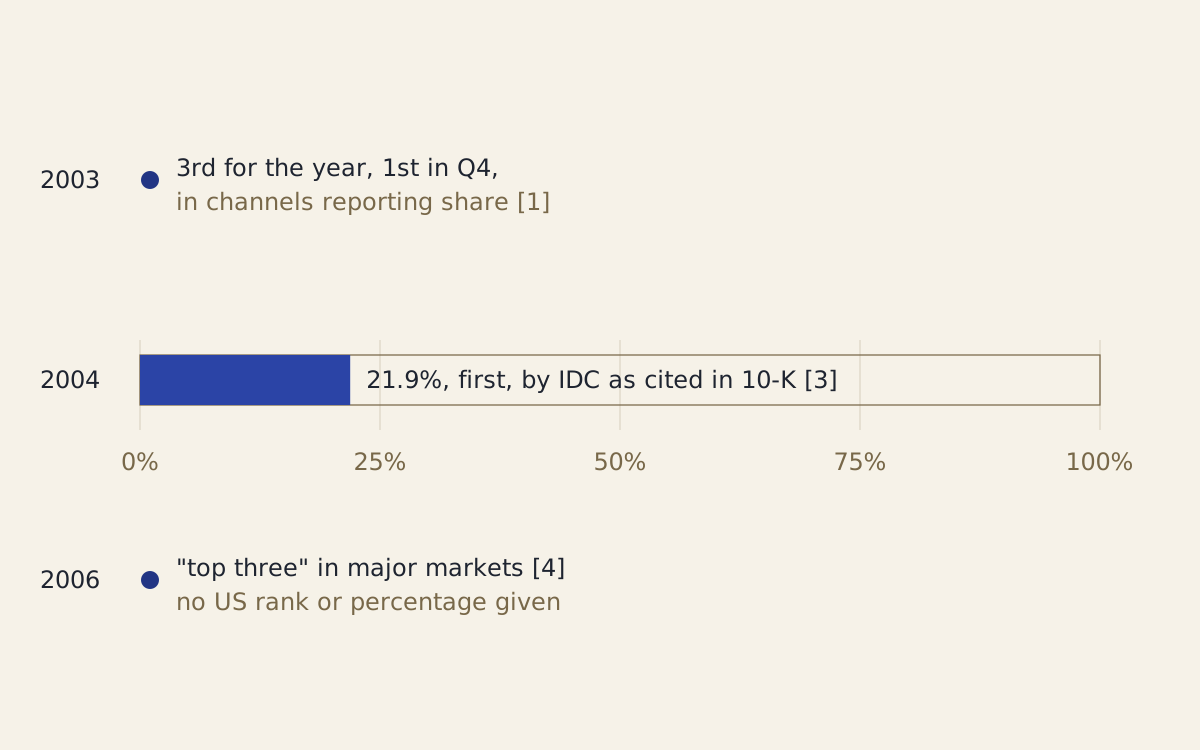
Figure: Kodak's digital camera position as its own filings describe it: third in the US for 2003 in channels reporting share data, 21.9 percent and first in the US for 2004 by IDC's study, and top three in its major markets in 2006.
Diagram: Treaties & Tradeoffs. CC BY 4.0. Open full size
Reuse credit
Diagram: Treaties & Tradeoffs, "Kodak's digital camera position, 2003–2006, as its filings describe it" — https://treatiesandtradeoffs.com/case-studies/kodak-digital-camera/, CC BY 4.0 (https://creativecommons.org/licenses/by/4.0/)
Data: Eastman Kodak Company, Form 10-K for fiscal 2003 (filed 15 March 2004); Eastman Kodak Company, Form 10-K for fiscal 2005 (filed 2 March 2006), citing IDC's full-year 2004 digital camera study; Eastman Kodak Company, Form 10-K for fiscal 2006 (filed 1 March 2007), accessed 2026-11-02, SEC filings, text under Eastman Kodak copyright; facts and figures only
Reported: We did not read IDC's study itself, so 21.9 percent is the figure as Kodak reported it. By its 10-K for 2006, Kodak no longer claimed first place. It said it held one of the top three shares in its major markets, such as digital still cameras, snapshot printers, retail photo kiosks and online imaging services [4].
Assessed: A company that led US digital camera sales in 2004, by IDC's count, did not miss the format. Share figures come from channels and studies that Kodak chose to cite, so they show position, not profit. The question the filings raise is whether leading in that market paid.
Did digital cameras make money for Kodak?
Reported: Kodak's 10-K for 2006 splits its consumer business into a Consumer Digital Imaging Group, which held digital cameras along with kiosks, home printing and online imaging services, and a Film and Photofinishing Systems Group [4]. The consumer digital group's sales rose from $2,366 million in 2004 to $3,215 million in 2005, then fell to $2,920 million in 2006. It reported a loss before interest, other charges and taxes of $189 million in 2004 and $131 million in 2005, and earnings of $1 million in 2006 [4].
Reported: An earlier filing reads more hopefully. Kodak's 10-K for 2003 says consumer digital cameras were profitable on a fully allocated basis in the second half of 2003 [1]. The two statements cover different periods and different groupings of products, and both are listed here.
Reported: The film group shrank but still made money. Its sales fell from $7,051 million in 2004 to $5,325 million in 2005 and $4,156 million in 2006, while it earned $854 million, $540 million and $358 million before interest, other charges and taxes [4]. Gross margin, the share of sales left after the cost of making the goods, was 19.6 percent in 2004 and 18.6 percent in 2005 for the digital group, against 30.9 and 30.6 percent for film [4].
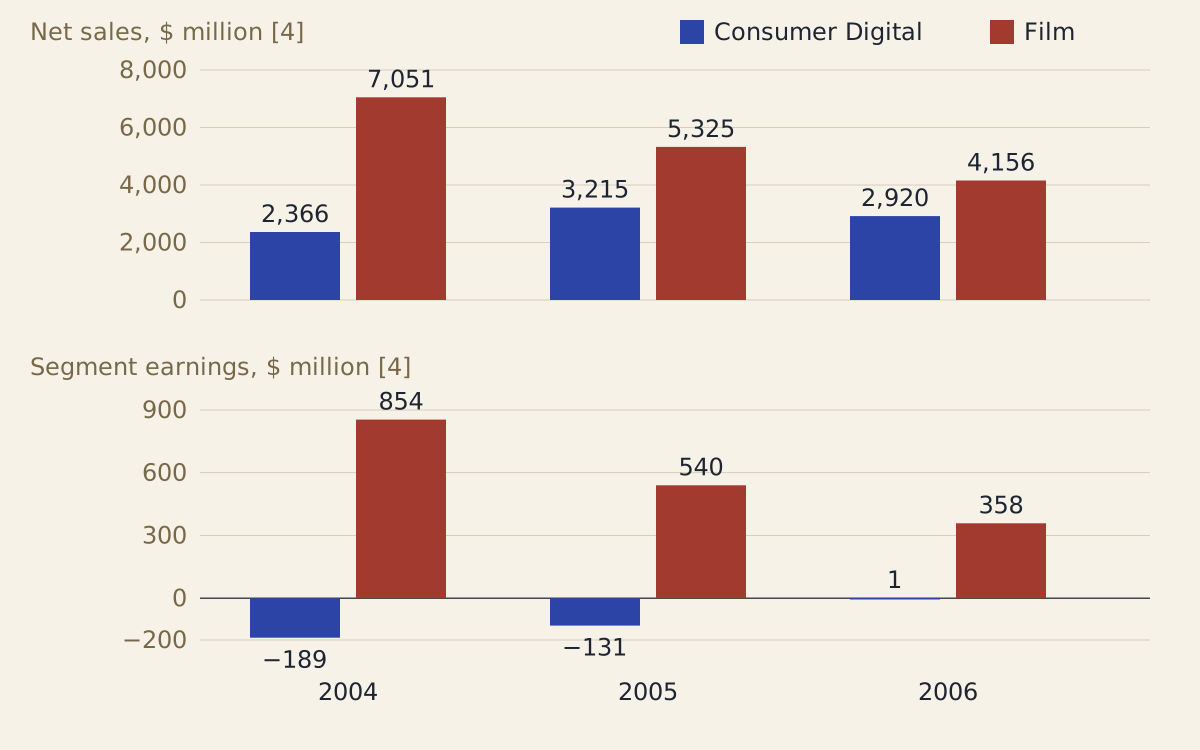
Figure: Sales and segment earnings of Kodak's Consumer Digital Imaging Group and Film and Photofinishing Systems Group, 2004 to 2006, as Kodak's 10-K for 2006 reports them.
Diagram: Treaties & Tradeoffs. CC BY 4.0. Open full size
Reuse credit
Diagram: Treaties & Tradeoffs, "Kodak's consumer digital and film groups, 2004–2006" — https://treatiesandtradeoffs.com/case-studies/kodak-digital-camera/, CC BY 4.0 (https://creativecommons.org/licenses/by/4.0/)
Data: Eastman Kodak Company, Form 10-K for fiscal 2006 (filed 1 March 2007), Items 1 and 7, accessed 2026-11-02, SEC filings, text under Eastman Kodak copyright; facts and figures only
Reported, with our check: We reran the margins from the gross profit and sales figures in the same filing. They match to one decimal place. Film group sales in 2006 were about 41 percent below 2004 [4]. Kodak's 2006 filing credits most of the digital group's better margin in 2006 to new and extended license arrangements, not to camera sales [4].
How did digital sales compare with traditional sales?
| Year | Digital products ($ million) | Traditional products ($ million) | Digital share of sales | Filing |
|---|---|---|---|---|
| 2003 | 3,978 | 8,931 | 30.8% | 10-K for 2005 [3] |
| 2004 | 5,532 | 7,985 | 40.9% | 10-K for 2005 [3] |
| 2005 | 7,757 | 6,511 | 54.4% | 10-K for 2005 [3] |
| 2005, as restated | 7,428 | 6,840 | 52.1% | 10-K for 2006 [4] |
| 2006 | 7,736 | 5,538 | 58.3% | 10-K for 2006 [4] |
Digital and traditional sales by year, with sources (CSV) Source and license notes (JSON) Data: Eastman Kodak Company, Form 10-K for fiscal 2005 (filed 2 March 2006), Item 7; Eastman Kodak Company, Form 10-K for fiscal 2006 (filed 1 March 2007), Item 7, accessed 2026-11-02, SEC filings, text under Eastman Kodak copyright; facts and figures only
Reported: The two filings give the same 2005 total but split it differently, and the 2006 filing notes that certain prior-period amounts were reclassified, so both versions are listed side by side. Either way, digital passed traditional in 2005, and Kodak's 10-K for 2005 says so [3][4]. Much of the 2005 rise came from buying printing businesses, KPG and Creo, which are not cameras [3]. With those purchases, Kodak's 10-K for 2005 says, it had all but finished the $3 billion investment and acquisition plan of the 2003 strategy [3].
Segment sales, gross profit and earnings, 2004–2006 (CSV) Source and license notes (JSON) Data: Eastman Kodak Company, Form 10-K for fiscal 2006 (filed 1 March 2007), Items 1 and 7, accessed 2026-11-02, SEC filings, text under Eastman Kodak copyright; facts and figures only
Assessed: This is where the popular story and the filings part ways. Kodak's consumer digital group, home to its cameras, sold in volume and lost money in 2004 and 2005, while a shrinking film business still produced the profits. Digital margins below 20 percent in those years could not replace film margins above 30 percent on the same scale.
Assessed: This site reads the record as a problem of how digital cameras earned money, not of whether Kodak saw them. Other explanations, such as costs, debt or management choices after 2006, lie outside the filings read for this article. The reading is a judgment on these filings, not a law about every firm that loses its main product.
No wage-day conversion appears on this page. These are company revenues, not prices that a worker of the time paid, and we found no matching wage series to set them against.
What happened in January 2012?
Reported: On 19 January 2012, Eastman Kodak and its US subsidiaries filed voluntary petitions under Chapter 11 of the US Bankruptcy Code in the Southern District of New York, as Kodak's 8-K of that date reports [5]. The 8-K attaches a summary that Kodak had given to some holders of its second-lien notes, the 9.75 percent notes due 2018 and the 10.625 percent notes due 2019. It describes proposed debtor-in-possession financing of up to $950 million, the borrowing a company in Chapter 11 can use to keep operating [5].
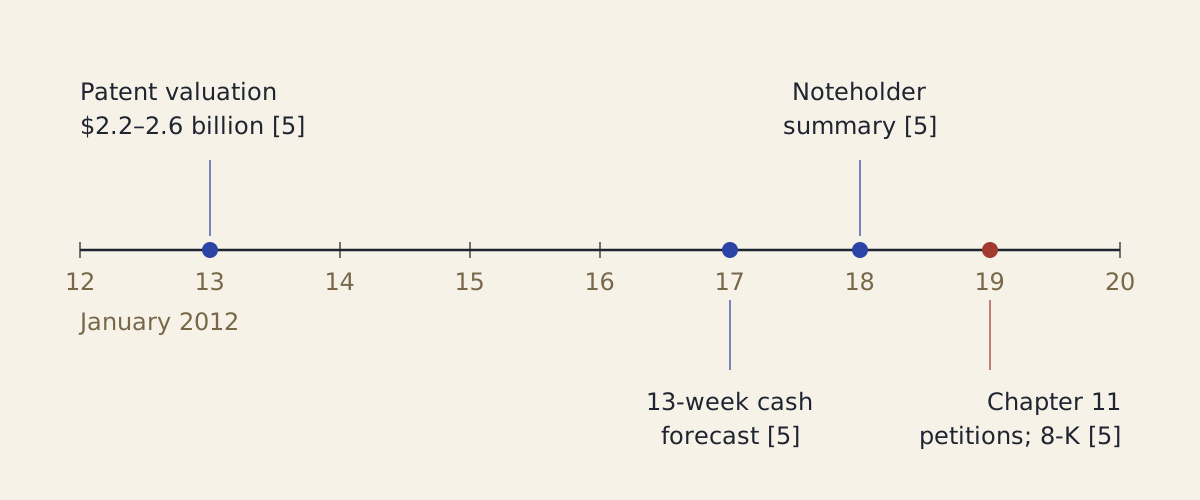
Figure: The days before Kodak's Chapter 11 filing, as dated in the 8-K of 19 January 2012 and its exhibit.
Diagram: Treaties & Tradeoffs. CC BY 4.0. Open full size
Reuse credit
Diagram: Treaties & Tradeoffs, "Kodak's Chapter 11 filing: the dated items, January 2012" — https://treatiesandtradeoffs.com/case-studies/kodak-digital-camera/, CC BY 4.0 (https://creativecommons.org/licenses/by/4.0/)
Data: Eastman Kodak Company, Form 8-K dated 19 January 2012, with Exhibit 99.1, accessed 2026-11-02, SEC filings, text under Eastman Kodak copyright; facts and figures only
The sequence as text
- 13 January 2012: the date of 284 Partners' valuation of Kodak's digital imaging patents, at $2.2 billion to $2.6 billion [5].
- 17 January 2012: the date of a draft 13-week cash forecast for Kodak and its US subsidiaries [5].
- 18 January 2012: the date on the summary given to the second-lien noteholders [5].
- 19 January 2012: Kodak and its US subsidiaries file Chapter 11 petitions; the 8-K is signed the same day [5].
Reported: The same exhibit reports that 284 Partners, LLC valued Kodak's digital imaging patent portfolio at $2.2 billion to $2.6 billion as of 13 January 2012 [5]. The filing came less than six years after Kodak's 10-K had cited IDC's 21.9 percent, and about eight years and four months after the dividend cut of 2003.
Assessed: The exhibit filed with the bankruptcy notice singles out a digital asset for an outside valuation: Kodak's imaging patents. That fits poorly with the claim that Kodak never took digital seriously. It fits better with the reading above: Kodak owned the ideas and sold the cameras, and neither made up for what film had earned.
The popular version against the record
| Popular version | Where it appears | What the record shows |
|---|---|---|
| Kodak missed the digital photography revolution | Title of Lucas and Goh's 2009 article [8] | Kodak's 10-K says it led US digital camera sales in 2004, by IDC's study [3]; Kodak's camera sales rose 65 percent in the second quarter of 2003 [2] |
| Kodak led US digital camera sales | Kodak's 10-K for 2005, citing IDC [3] | Supported for 2004 by IDC's count, as Kodak reports it; third for 2003 in channels reporting share data [1]; top three in its major markets by 2006 [4] |
| Digital revenue overtook traditional revenue | Kodak's 10-K for 2005 [3] | Supported in both filings for 2005, though they split the same total differently [3][4]; much of the rise came from printing acquisitions [3] |
Full table with sources (CSV) Source and license notes (JSON) Data: Henry C. Lucas Jr. and Jie Mein Goh (2009), article title only (bibliographic record, Crossref); Eastman Kodak Company, Form 10-K for fiscal 2003 (filed 15 March 2004); Eastman Kodak Company, Form 10-Q for the quarter ended 30 June 2003 (signed 25 July 2003); Eastman Kodak Company, Form 10-K for fiscal 2005 (filed 2 March 2006); Eastman Kodak Company, Form 10-K for fiscal 2006 (filed 1 March 2007), accessed 2026-11-02, SEC filings, text under Eastman Kodak copyright; facts and figures only
Reported: The 2009 article by Henry C. Lucas Jr. and Jie Mein Goh in the Journal of Strategic Information Systems is titled “Disruptive technology: How Kodak missed the digital photography revolution” [8]. We read only its bibliographic record, so this page cites its title as an instance of the missed-digital framing and does not summarize its argument.
Assessed: Kodak's own 1975 story, repeated on its history page, can feed the same framing from the other side: the inventor who let the invention slip [7]. The filings read here support a narrower charge. Kodak saw digital, built and sold it, and could not make it pay like film. Like the directors of the South Sea Company in 1720, Kodak's board is judged on this site by the record of its own day, not by the ending.
Sources
- Eastman Kodak Company, Annual Report on Form 10-K for the fiscal year ended 31 December 2003 (filed 15 March 2004), SEC EDGAR. https://www.sec.gov/Archives/edgar/data/31235/000003123504000049/ek10-k2003.txtRead: full text
- Eastman Kodak Company, Quarterly Report on Form 10-Q for the quarter ended 30 June 2003 (signed 25 July 2003), SEC EDGAR. https://www.sec.gov/Archives/edgar/data/31235/000003123503000050/ek10q0306.txtRead: full text
- Eastman Kodak Company, Annual Report on Form 10-K for the fiscal year ended 31 December 2005 (filed 2 March 2006), SEC EDGAR. https://www.sec.gov/Archives/edgar/data/31235/000120677406000357/ek111562.htmRead: full text
- Eastman Kodak Company, Annual Report on Form 10-K for the fiscal year ended 31 December 2006 (filed 1 March 2007), SEC EDGAR. https://www.sec.gov/Archives/edgar/data/31235/000120677407000543/kodak_10k.htmRead: full text
- Eastman Kodak Company, Current Report on Form 8-K dated 19 January 2012 (Item 7.01), with Exhibit 99.1, "Certain Information Disclosed to Restricted Noteholders," SEC EDGAR. https://www.sec.gov/Archives/edgar/data/31235/000119312512016440/d285421d8k.htmRead: full text
- Gareth A. Lloyd and Steven J. Sasson, "Electronic Still Camera," US Patent 4,131,919, filed 20 May 1977, issued 26 December 1978, assigned to Eastman Kodak Company. https://image-ppubs.uspto.gov/dirsearch-public/print/downloadPdf/4131919Read: full text (page images)
- Eastman Kodak Company, "Milestones," company history page, kodak.com. https://www.kodak.com/en/company/page/milestones/Read: full page
- Henry C. Lucas Jr. and Jie Mein Goh, "Disruptive technology: How Kodak missed the digital photography revolution," Journal of Strategic Information Systems 18, no. 1 (2009): 46–55. doi:10.1016/j.jsis.2009.01.002. https://doi.org/10.1016/j.jsis.2009.01.002Read: bibliographic record only
Cite this page
Treaties & Tradeoffs. “Kodak Digital Camera: It Led US Sales in 2004, IDC Said.” published 2026-11-02. https://treatiesandtradeoffs.com/case-studies/kodak-digital-camera/. Accessed [the date you read it].
Plain citation; add the date you consulted the page. No DOI is assigned.