Historic NegotiationsNegotiation review
Louisiana Purchase: US Envoys Were Told to Buy New Orleans
Treaties & Tradeoffs Filed
The Louisiana Purchase began with narrower orders: the US envoys' instructions of 2 March 1803 were to buy New Orleans and the Floridas, not all of Louisiana [2]. On 11 April 1803, by Robert Livingston's report, the French foreign minister Talleyrand asked whether the United States wanted the whole territory, and Livingston said no [1]. The treaty and two conventions signed on 30 April 1803 ceded Louisiana for 60 million francs, and the United States also took on up to 20 million francs in American claims against France [5][6][7].
Order of business (5 sections)
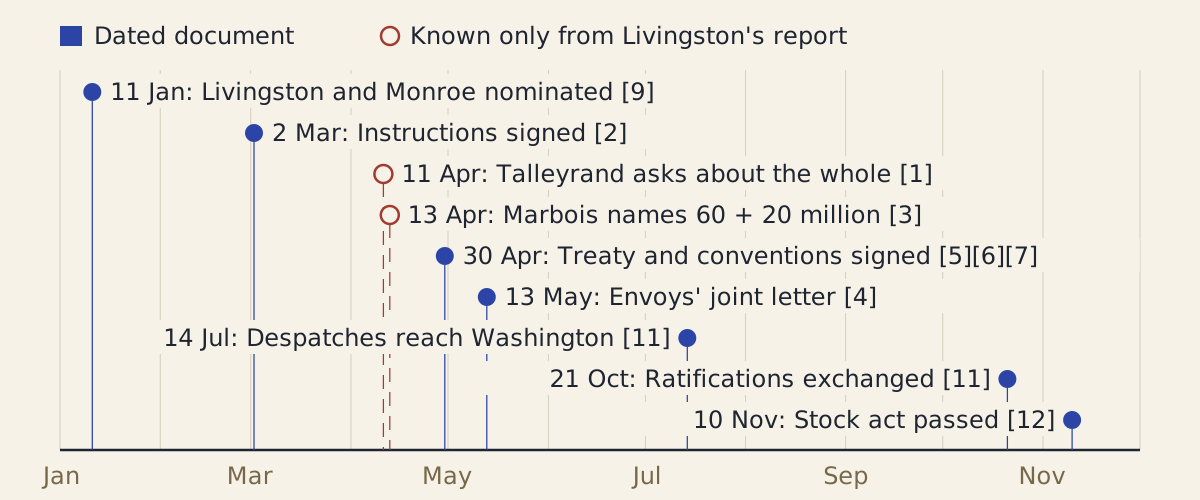
Figure: The Louisiana negotiation and its ratification in date order, January to November 1803. Blue marks are dated documents; open red marks with dashed lines are known only from Livingston's report.
Diagram: Treaties & Tradeoffs. CC BY 4.0. Open full size
Reuse credit
Diagram: Treaties & Tradeoffs, "Louisiana Purchase: negotiation and ratification, January to November 1803" — https://treatiesandtradeoffs.com/negotiation/louisiana-purchase/, CC BY 4.0 (https://creativecommons.org/licenses/by/4.0/)
Data: Dates: American State Papers, Foreign Relations, vol. II (Washington: Gales and Seaton, 1832), pp. 540–544, 552–554, 558–560; treaty and conventions of 30 April 1803 and Hunter Miller's notes, in Treaties and Other International Acts of the United States of America, vol. 2 (1931); Jefferson's message of 11 January 1803; 2 Stat. 245; accessed 2026-11-02, public domain
The sequence as text
- 11 January 1803: Jefferson nominates Livingston and James Monroe to treat with France over the Mississippi and the territories east of it [9].
- 2 March 1803: Madison signs the instructions: New Orleans and West and East Florida, up to 50 million livres tournois [2].
- 11 April 1803: Talleyrand asks whether the United States wants the whole of Louisiana, and Livingston says no, by Livingston's report [1].
- 13 April 1803: Marbois names 60 million francs plus 20 million in American claims, by Livingston's report [3].
- 30 April 1803: the treaty and two conventions are signed in Paris [5][6][7].
- 13 May 1803: Livingston and Monroe write to explain why they bought the whole [4].
- 14 July 1803: the despatches with the treaty reach Washington [11].
- 21 October 1803: ratifications are exchanged in Washington [11].
- 10 November 1803: an act of Congress creates the stock that paid France [12].
The 1803 timeline, step by step with sources (CSV) Source and license notes (JSON) Data: American State Papers, Foreign Relations, vol. II (1832), pp. 540–544, 552–554, 558–560; treaty and conventions of 30 April 1803 and Hunter Miller's notes (1931); Jefferson's message to the Senate of 11 January 1803; 2 Stat. 245; accessed 2026-11-02, public domain
On 11 April 1803, France's foreign minister put a question to the American envoy that Washington's instructions had not contemplated. Robert Livingston, the US minister in Paris, had been pressing France for New Orleans and the Floridas. Now, by his own account, Talleyrand asked him whether the United States wished to have the whole of Louisiana [1]. The Louisiana Purchase was signed 19 days later.
What were the envoys told to buy?
Reported: On 11 January 1803, President Jefferson asked the Senate to approve Livingston and James Monroe as joint envoys to France. Their task, in his words, was to secure “our rights and interests in the river Mississippi and in the Territories eastward thereof” [9]. The same message pointed to “the late suspension of our right of deposit at New Orleans,” the right of American traders to land goods there [9].
Reported: Secretary of State James Madison signed the envoys' instructions on 2 March 1803. Their object was “a cession to the United States of New Orleans and of West and East Florida, or as much thereof as the actual proprietor can be prevailed on to part with” [2]. In the published American State Papers, the instructions fill pages 540 to 544 of the second Foreign Relations volume [2]. Their draft treaty had France cede the land east of the Mississippi, “comprehending the two Floridas, the island of New Orleans,” while France kept all her territory on the west side of the river [2].
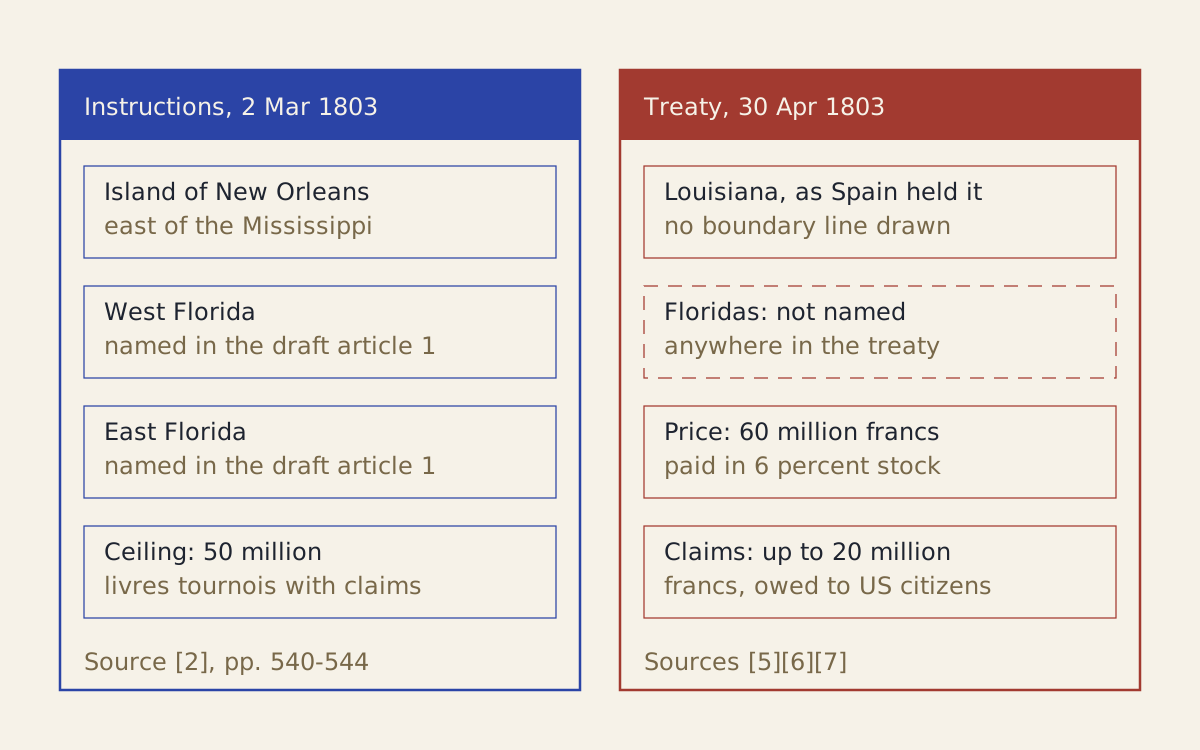
Figure: What the instructions of 2 March 1803 asked for, set beside what the treaty and two conventions of 30 April 1803 contained.
Diagram: Treaties & Tradeoffs. CC BY 4.0. Open full size
Reuse credit
Diagram: Treaties & Tradeoffs, "Louisiana Purchase: the instructions of March 1803 beside the treaty of April 1803" — https://treatiesandtradeoffs.com/negotiation/louisiana-purchase/, CC BY 4.0 (https://creativecommons.org/licenses/by/4.0/)
Data: Instructions of 2 March 1803, American State Papers, Foreign Relations, vol. II (1832), pp. 540–544; treaty and two conventions of 30 April 1803, text in Hunter Miller (ed.), Treaties and Other International Acts of the United States of America, vol. 2 (1931); accessed 2026-11-02, public domain
The comparison as text
- Territory: the instructions ask for the island of New Orleans and West and East Florida [2]; the treaty cedes Louisiana with the extent it had under Spain and under France, and draws no boundary line [5].
- The Floridas: named in the draft treaty [2]; not named anywhere in the treaty or the two conventions [5][6][7].
- Price: a ceiling of 50 million livres tournois, claims included [2]; 60 million francs, paid in 6 percent stock [6].
- Claims of American citizens against France: to be paid inside the gross sum [2]; up to 20 million francs more, interest included [7].
Reported: In the printed text the draft's sums are blank, though the notes on it speak of “the gross sum expressed in the article” [2]. On page 543 the instructions set a limit: if France made a greater sum an ultimatum, “the President has made up his mind to go as far as fifty millions of livres tournois, rather than lose the main object” [2]. The draft's gross sum included the claims the United States would take over. The instructions also priced the parts: the two Floridas together at one-fourth the value of the island of New Orleans, and East Florida at half the value of West Florida [2].
Reported: Monroe got a separate letter. On the same day, Madison wrote to him that “the Floridas, or even either of them, without the island of New Orleans, on proportionate terms, will be a valuable acquisition” [8]. In Paris, Livingston already knew Monroe was coming: on 3 March 1803 he acknowledged a letter from Madison of 18 January that announced the appointment [8].
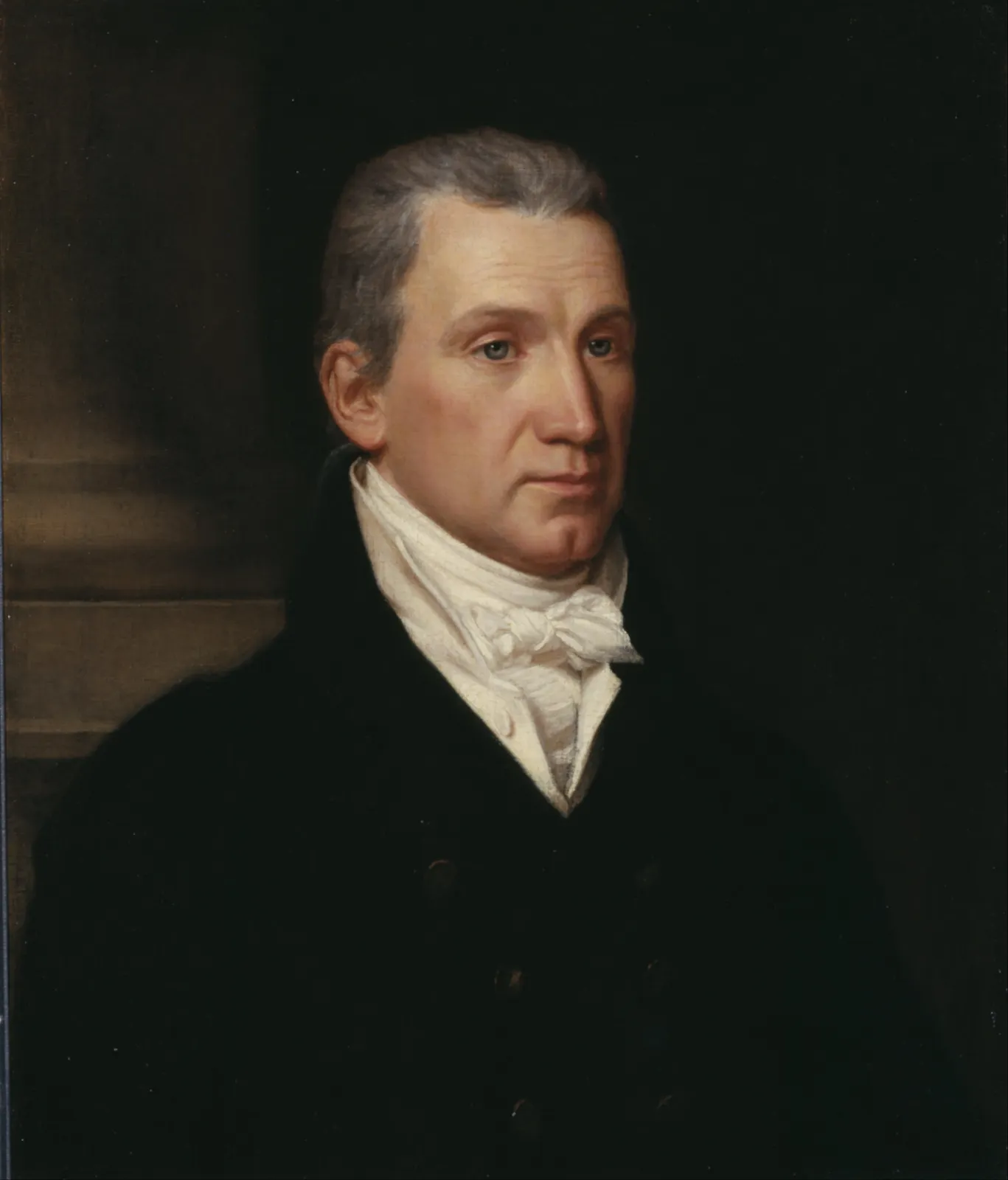
Figure: James Monroe, who carried the March 1803 instructions to Paris, in a portrait painted by John Vanderlyn in 1816.
"James Monroe" by John Vanderlyn — https://commons.wikimedia.org/wiki/File:John_Vanderlyn_-_James_Monroe_-_Google_Art_Project.jpg — Public domain (John Vanderlyn d. 1852; painted 1816; US and EU: author died more than 70 years ago; faithful reproduction of a two-dimensional work, National Portrait Gallery, Washington, NPG.70.59)

Assessed: The instructions planned a narrow purchase. They said outright that they assumed France would cede “the whole of the island of New Orleans, and both the Floridas,” or some part of that [2]. Nothing in them dealt with buying the land west of the river.
What did each side offer?
Reported: Livingston's letter of 11 April 1803 tells the first exchange. Talleyrand asked him, he wrote, “whether we wished to have the whole of Louisiana. I told him no; that our wishes extended only to New Orleans and the Floridas” [1]. Talleyrand then wished to know “what we would give for the whole” [1].
Reported: Livingston wrote that he supposed “we should not object to twenty millions, provided our citizens were paid,” without naming a currency [1].
Reported: Talleyrand called that too low and added that he did not speak from authority [1]. Livingston put off any further offer until Monroe reached Paris, which he expected within two days [1]. He had, he wrote, nothing to offer “but money, and commercial advantages” [1].
Reported: Two days later, at midnight, Livingston wrote again. François Barbé-Marbois, the French treasury minister, had called on him, and later that night repeated a remark of Bonaparte, then First Consul: “let them give you one hundred millions of Francs, and pay their own claims, and take the whole country” [3]. Asked what he thought would be reasonable, Marbois said that “if we would name sixty millions, and take upon us the American claims, to the amount of twenty more, he would try how far this would be accepted” [3]. Livingston called this beyond American means, then wrote: “The field opened to us is infinitely larger than our instructions contemplated” [3].
| Date | Who | Figure | Unit | What it covered | Record |
|---|---|---|---|---|---|
| 2 Mar 1803 | Madison's instructions, for the President | 50,000,000 | livres tournois | New Orleans and the Floridas, claims included; a ceiling | Instructions [2] |
| 11 Apr 1803 | Livingston | 20,000,000 | not stated | The whole, if American claims were paid | By Livingston's report [1] |
| 13 Apr 1803 | Bonaparte, as Marbois repeated it | 100,000,000 | francs | The whole, with the claims paid on top | By Livingston's report [3] |
| 13 Apr 1803 | Marbois | 60,000,000 + 20,000,000 | francs | The whole; the 20 million to be American claims | By Livingston's report [3]; joint letter [4] |
| 30 Apr 1803 | Both sides | 60,000,000 + up to 20,000,000 | francs | Louisiana; the claims capped | First and second conventions [6][7] |
Every figure with its unit, qualifier and source (CSV) Source and license notes (JSON) Data: American State Papers, Foreign Relations, vol. II (Washington: Gales and Seaton, 1832), pp. 542–543, 552–553, 558–559, accessed 2026-11-02, public domain; Treaty and two conventions of 30 April 1803, text in Hunter Miller (ed.), Treaties and Other International Acts of the United States of America, vol. 2 (Washington: GPO, 1931), accessed 2026-11-02, public domain; Bureau of Land Management, Public Land Statistics 2024, Table 1-1, accessed 2026-11-02, US government work
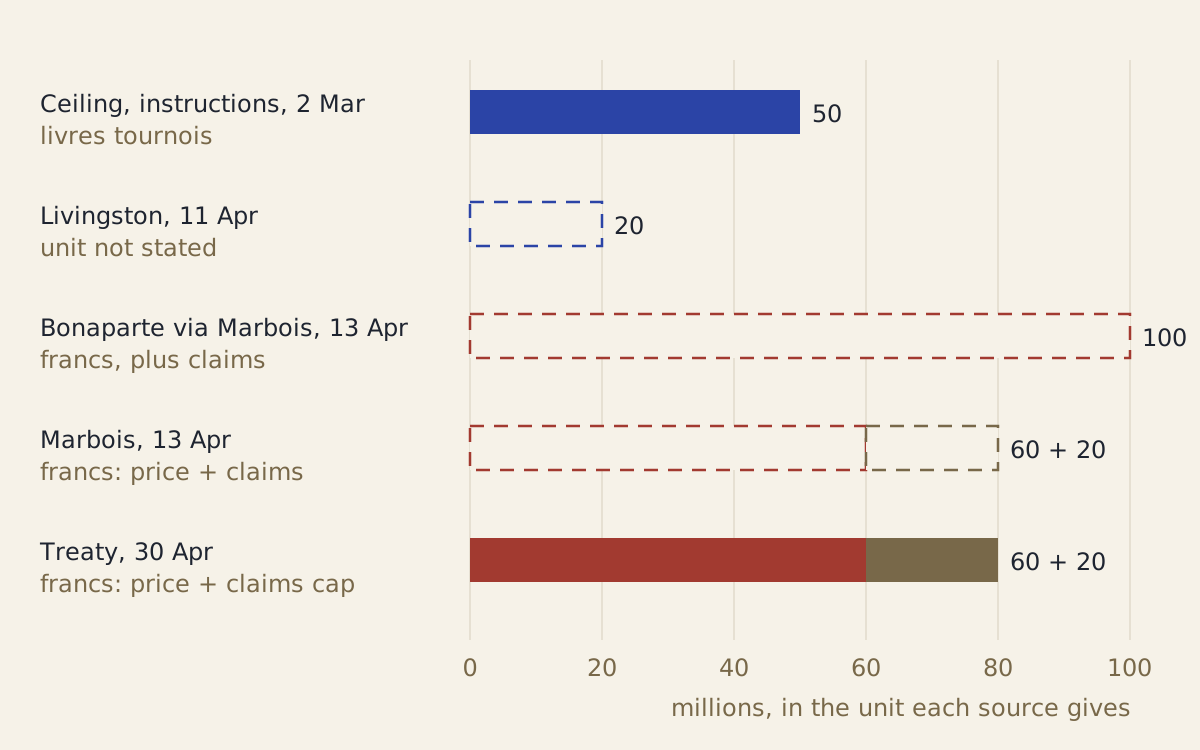
Figure: Each figure named for New Orleans or Louisiana from March to April 1803, in the unit its source gives; dashed bars are known only from Livingston's letters.
Diagram: Treaties & Tradeoffs. CC BY 4.0. Open full size
Reuse credit
Diagram: Treaties & Tradeoffs, "Louisiana Purchase: figures named from March to April 1803" — https://treatiesandtradeoffs.com/negotiation/louisiana-purchase/, CC BY 4.0 (https://creativecommons.org/licenses/by/4.0/)
Data: American State Papers, Foreign Relations, vol. II (1832), pp. 542–543, 552–553, 558–559; first and second conventions of 30 April 1803 (Hunter Miller, ed., 1931); accessed 2026-11-02, public domain
Figure: Illustration of a negotiation across a table; it shows no real meeting, person or document.
Illustration: Treaties & Tradeoffs. Generated schematic image — not a photograph or historical record. © Treaties & Tradeoffs, all rights reserved.
Reported: The treaty was signed on 30 April. In their joint letter of 13 May, Livingston and Monroe conceded that “an acquisition of so great an extent was, we well know, not contemplated by our appointment” [4]. They wrote that Marbois was “absolutely restricted to the disposition of the whole” [4].
Reported: His first proposition, by the same letter, was eighty millions, sixty of it in cash, with the whole paid in Paris within a year and French and Spanish goods free of foreign duties forever in the ports of the ceded territory [4]. The final terms changed the form of payment to stock and cut the duty period to twelve years, but “from the quantum he never would depart” [4].
Assessed: By the envoys' own account, the price did not move. Marbois's 60 million francs plus 20 million in claims, named on 13 April by Livingston's report, are the figures in the two conventions, with the claims now a ceiling [3][6][7]. What the Americans changed was the form: stock instead of cash, and a 12-year limit on the duty privilege [4][5]. Every French move in this section comes from American letters; no French record of these talks was among the sources read for this page.
Why did France sell, and what could each side fall back on?
One way to read these weeks is to start with each side's BATNA, the best alternative to a negotiated agreement, meaning what a side could do if the talks failed. This site uses it as an order of analysis. It is not offered as a rule that the side with the better alternative wins.
Reported: The American fallbacks were written into the instructions. If France would not cede the whole island of New Orleans, the envoys were to take as large a part as they could, or at least ground enough “for a large commercial town” near the mouth of the river [2]. Failing that, they were to improve the right of deposit and seek deposits at the mouths of rivers running through the Floridas [2]. Jefferson had also asked for powers for Monroe and Charles Pinckney to treat with Spain, in case the province was still Spain's to give [9].
Reported: The French side appears only through Livingston. On 11 April he wrote that war between France and Britain was very near, and that he had argued Louisiana was indefensible without the Floridas [1]. When Livingston called on Talleyrand again, by his letter of 13 April, the minister said he must answer evasively “because Louisiana was not theirs”: France had it in view but did not yet hold it [3].
Reported: Livingston also believed the decision to sell had already been taken: in council on the Saturday, by his letter of 11 April, or on the Sunday, by his letter of 13 April [1][3]. The joint letter says that before talks began, the envoys learned that Bonaparte had decided to offer “the whole of Louisiana, and not a part of it” [4].
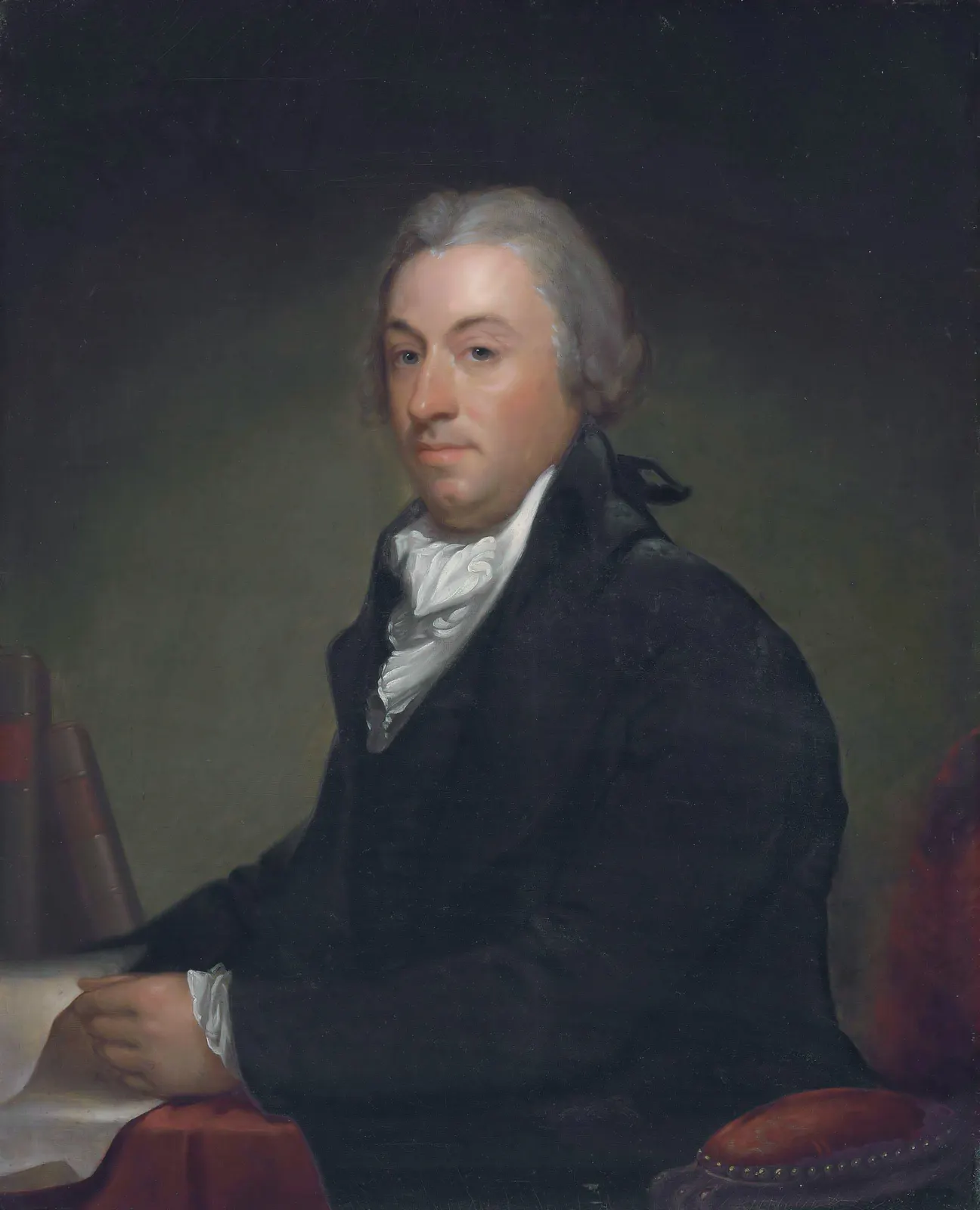
Figure: Robert R. Livingston, the US minister in Paris whose letters are the only record read here of the talks of 11 to 13 April 1803; portrait attributed to Gilbert Stuart.
"Robert R. Livingston" by attributed to Gilbert Stuart — https://commons.wikimedia.org/wiki/File:Robert_R_Livingston,_attributed_to_Gilbert_Stuart_(1755-1828).jpg — Public domain (attributed to Gilbert Stuart, d. 1828; US and EU: author died more than 70 years ago; faithful reproduction of a two-dimensional work (photograph supplied by Christie's))
Assessed: On why Bonaparte sold, the records read for this page are American, so they show only what the envoys were told and what they guessed: a war with Britain about to start, a province France did not yet hold, and a government whose first proposition asked for cash within a year [4]. We do not rank those reasons, and we found no French cabinet record to settle them.
Assessed: On the American side, the fallback was weak but cheap: a smaller site on the river, or a better right of deposit. France's fallback, by Livingston's account, was to keep a province not yet occupied while a war with Britain loomed [1][3].
Assessed: Apply what this site calls the known-then test, which scores a choice only on what its makers could know at the time, with each piece of that knowledge tied to a source. On 11 April, Livingston had no instructions for the whole, Monroe was not yet in Paris, and Talleyrand had said he was not speaking from authority, so his “no” fits what he knew [1][3]. Reading the deal backward, as a bold plan from the start, adds what we call the hindsight premium, the share of a decision's apparent wisdom or folly added only after the outcome is known.
How much did the Louisiana Purchase cost?
Reported: The first convention set the price at sixty million francs, to be paid by creating a stock of $11,250,000 at 6 percent interest [6]. The second convention covered debts France owed to American citizens; with interest, they “cannot exceed the Sum of twenty millions of Francs” [7]. The convention also fixed the dollar at “five livres eight sous tournois” [6].
Reported, with our check: Sixty million francs for $11,250,000 works out to exactly 5⅓ francs to the dollar [6].
Method: To put the claims in dollars, we use that same rate: francs × 3/16. The ceiling in the instructions is converted at the rate in the instructions' own draft article, $1.10 for every six livres tournois [2]. Neither figure is a modern dollar value.
Reported, with our conversion: The claims ceiling of 20 million francs comes to $3,750,000, so the stock and the claims together came to at most $15,000,000, not counting the interest on the stock [6][7]. The claims part could be lower; the sum actually paid out is not in the sources read for this page. The President's ceiling of 50 million livres tournois comes to about $9,166,667 [2].
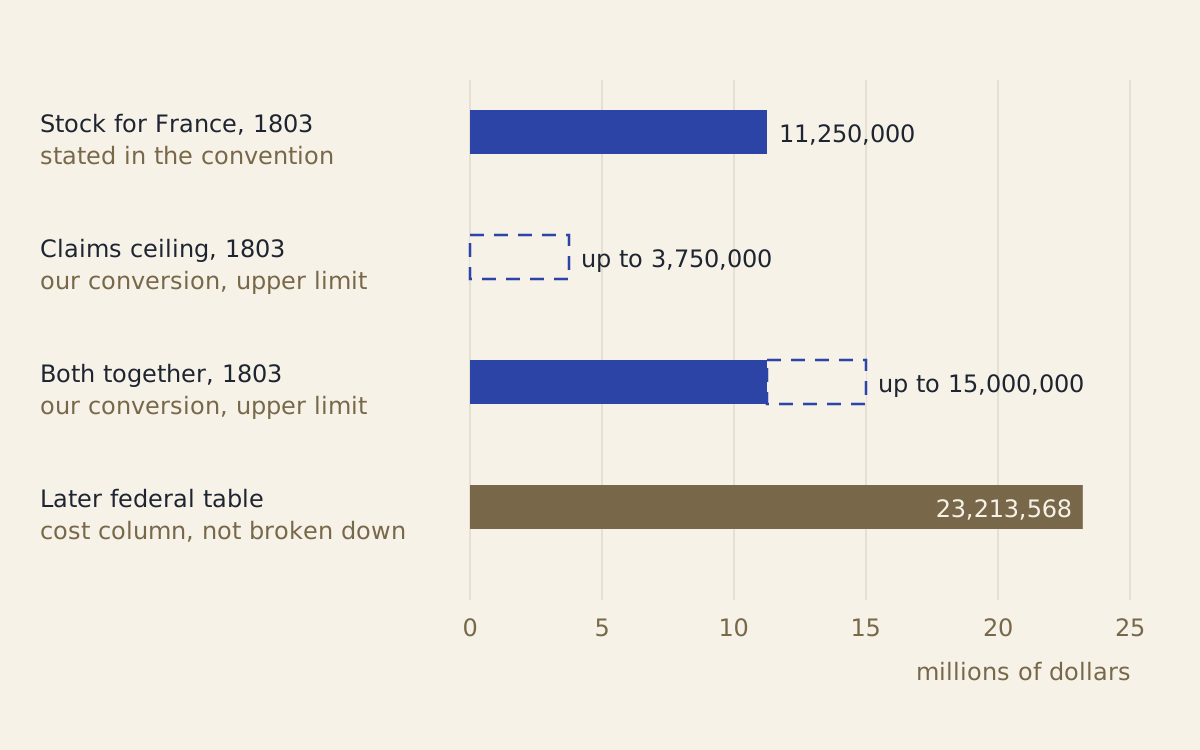
Figure: The 1803 price in dollars, with the claims shown as an upper limit, beside the cost given in a later federal table that does not break its figure down.
Diagram: Treaties & Tradeoffs. CC BY 4.0. Open full size
Reuse credit
Diagram: Treaties & Tradeoffs, "Louisiana Purchase: the cost in dollars" — https://treatiesandtradeoffs.com/negotiation/louisiana-purchase/, CC BY 4.0 (https://creativecommons.org/licenses/by/4.0/)
Data: First and second conventions of 30 April 1803 (Hunter Miller, ed., 1931), with our conversion of the claims ceiling at the first convention's rate; Bureau of Land Management, Public Land Statistics 2024, Table 1-1; accessed 2026-11-02, public domain
Reported: A later federal table gives a different number. The Bureau of Land Management's Public Land Statistics 2024 lists the Louisiana Purchase at a cost of $23,213,568, a figure it takes from a 1939 US Geological Survey publication [13]. The table does not say what that sum includes, so this page does not try to explain the gap.
Reported: The treaty gave no acreage and drew no boundary. It ceded Louisiana “with the Same extent that it now has in the hand of Spain, & that it had when France possessed it” [5]. Hunter Miller, editor of the 1931 government edition of the treaty, notes that its limits remained under discussion for the next fifteen years [11]. The same 2024 federal table puts the area at 529,911,680 acres of land and water, based on findings adopted in 1912 and leaving out areas given up in the 1819 treaty with Spain [13].
Reported, with our conversion: That is 827,987 square miles, or 2,144,476 square kilometers [13].
Method: A deal between two governments, paid largely in long-dated stock, has no matching wage series for that place and period, so this page converts no sums into days of wages or modern money. Its only conversions are into dollars of 1803, at the rates set in the conventions and the instructions.
How was it paid?
Reported: The stock was to be handed to France within three months after the exchange of ratifications, once the United States had taken possession of Louisiana [6]. Interest was payable every half-year in London, Amsterdam or Paris. The principal was to be repaid at the US Treasury in annual payments of not less than $3,000,000 each, the first one fifteen years after ratifications were exchanged [6]. The claims were to be paid by orders on the Treasury, due 60 days after the exchange and the handover [7].
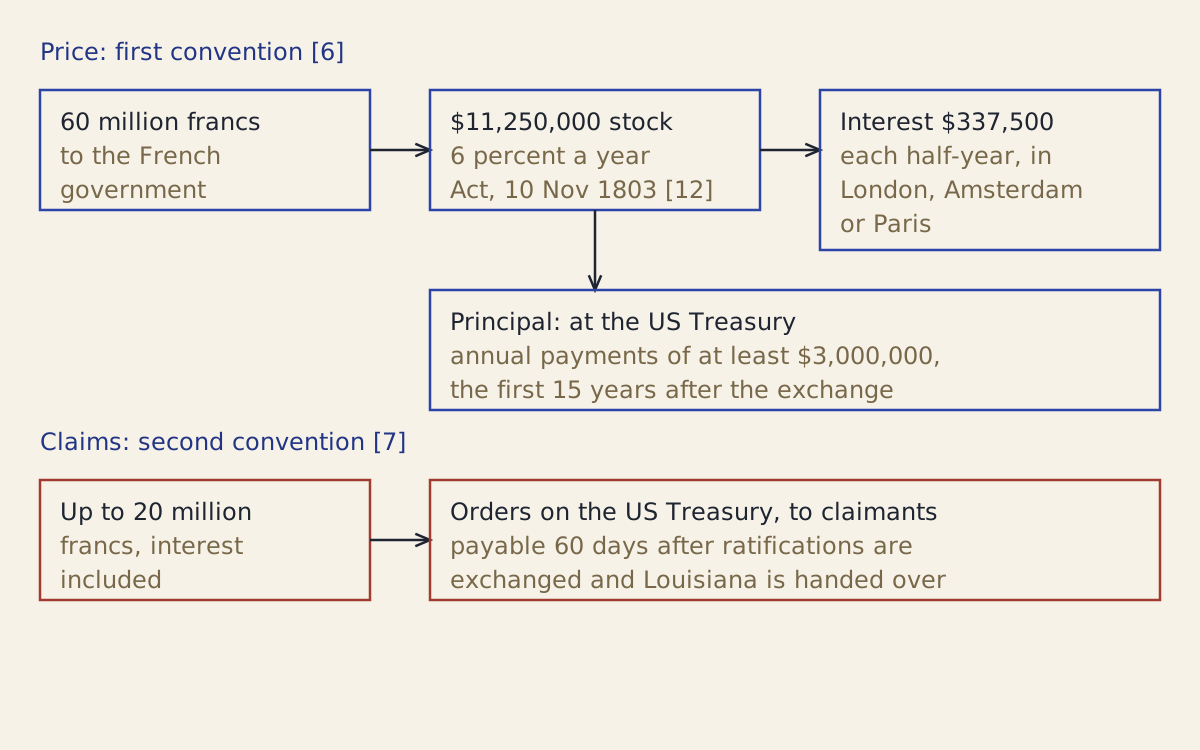
Figure: How the two conventions arranged payment: the price through 6 percent stock, the claims through orders on the US Treasury.
Diagram: Treaties & Tradeoffs. CC BY 4.0. Open full size
Reuse credit
Diagram: Treaties & Tradeoffs, "Louisiana Purchase: how the price and the claims were to be paid" — https://treatiesandtradeoffs.com/negotiation/louisiana-purchase/, CC BY 4.0 (https://creativecommons.org/licenses/by/4.0/)
Data: First and second conventions of 30 April 1803, text in Hunter Miller (ed.), Treaties and Other International Acts of the United States of America, vol. 2 (1931); Act of 10 November 1803, 2 Stat. 245; accessed 2026-11-02, public domain
The payment plan as text
- Price: 60 million francs, paid by creating $11,250,000 in stock at 6 percent a year [6].
- Interest: $337,500 every half-year, payable in London, Amsterdam or Paris [6].
- Principal: repaid at the US Treasury in annual payments of at least $3,000,000, the first fifteen years after the exchange of ratifications [6].
- Authority: the act of 10 November 1803 that created the stock [12].
- Claims: up to 20 million francs, interest included, paid by orders on the US Treasury 60 days after the exchange and the handover [7].
Reported, with our check: Six percent of $11,250,000 is $675,000 a year, or $337,500 each half-year, the amount the convention states [6].
Reported: The envoys' despatches reached Washington on 14 July 1803, 75 days after the signing, by Miller's account [11]. Jefferson sent the treaty and conventions to the Senate on 17 October, with the instructions of 2 March among the papers attached [10]. The Senate approved them on 20 October, and ratifications were exchanged in Washington on 21 October [11].
Reported, with our check: That was 174 days after the signing, inside the six months that Article 10 of the treaty allowed [5].
Reported: The act of 10 November 1803 authorized the stock and added $700,000 a year to the sinking fund that paid down the public debt [12].
Assessed: Under the conventions, France received stock whose principal would not start to be repaid for fifteen years, and the United States settled its citizens' claims through its own Treasury. By the envoys' account, that form of payment was the part they changed. Leaving one part of a bill open was not unique to 1803; the Treaty of Versailles also left the total of German reparations to be fixed later.
Sources
- Robert R. Livingston to James Madison, Paris, 11 April 1803, in American State Papers: Documents, Legislative and Executive, of the Congress of the United States, Class I, Foreign Relations, vol. II (Washington: Gales and Seaton, 1832), p. 552. https://archive.org/details/americanstatepap_12unitRead: full text of the letter (p. 552)
- James Madison, Secretary of State, to Robert R. Livingston and James Monroe, general instructions, Department of State, 2 March 1803, in American State Papers: Documents, Legislative and Executive, of the Congress of the United States, Class I, Foreign Relations, vol. II (Washington: Gales and Seaton, 1832), pp. 540–544. https://archive.org/details/americanstatepap_12unitRead: full text of the instructions (pp. 540–544)
- Robert R. Livingston to James Madison, Paris, 13 April 1803, midnight, in American State Papers: Documents, Legislative and Executive, of the Congress of the United States, Class I, Foreign Relations, vol. II (Washington: Gales and Seaton, 1832), pp. 552–554. https://archive.org/details/americanstatepap_12unitRead: full text of the letter (pp. 552–554)
- Robert R. Livingston and James Monroe to James Madison, Paris, 13 May 1803, in American State Papers: Documents, Legislative and Executive, of the Congress of the United States, Class I, Foreign Relations, vol. II (Washington: Gales and Seaton, 1832), pp. 558–560. https://archive.org/details/americanstatepap_12unitRead: full text of the letter (pp. 558–560)
- Treaty between the United States of America and the French Republic (cession of Louisiana), signed at Paris, 30 April 1803; English text in Treaties and Other International Acts of the United States of America, ed. Hunter Miller, vol. 2 (Washington: Government Printing Office, 1931), Document 28. https://avalon.law.yale.edu/19th_century/louis1.aspRead: full text of the treaty
- Convention between the United States of America and the French Republic (payment of 60 million francs), signed at Paris, 30 April 1803; English text in Treaties and Other International Acts of the United States of America, ed. Hunter Miller, vol. 2 (Washington: Government Printing Office, 1931), Document 29. https://avalon.law.yale.edu/19th_century/louis2.aspRead: full text of the convention
- Convention between the United States of America and the French Republic (debts due by France to citizens of the United States), signed at Paris, 30 April 1803; English text in Treaties and Other International Acts of the United States of America, ed. Hunter Miller, vol. 2 (Washington: Government Printing Office, 1931), Document 30. https://avalon.law.yale.edu/19th_century/louis3.aspRead: full text of the convention
- James Madison to James Monroe, Department of State, 2 March 1803 (extract), and Robert R. Livingston to James Madison, Paris, 3 March 1803, in American State Papers: Documents, Legislative and Executive, of the Congress of the United States, Class I, Foreign Relations, vol. II (Washington: Gales and Seaton, 1832), pp. 537–538. https://archive.org/details/americanstatepap_12unitRead: full text of both letters (pp. 537–538)
- Thomas Jefferson, message to the Senate, 11 January 1803, nominating Robert R. Livingston and James Monroe; text in James D. Richardson (ed.), A Compilation of the Messages and Papers of the Presidents. https://avalon.law.yale.edu/19th_century/tj003.aspRead: full text of the message
- Thomas Jefferson, messages to the Senate, 17 October 1803, and to the Senate and House, 21 October 1803, with the list of papers communicated, in American State Papers: Documents, Legislative and Executive, of the Congress of the United States, Class I, Foreign Relations, vol. II (Washington: Gales and Seaton, 1832), pp. 506–507. https://archive.org/details/americanstatepap_12unitRead: full text of both messages and the list of papers (pp. 506–507)
- Hunter Miller, notes to Document 28 (Louisiana Purchase treaty), in Treaties and Other International Acts of the United States of America, ed. Hunter Miller, vol. 2 (Washington: Government Printing Office, 1931). https://avalon.law.yale.edu/19th_century/louis1n.aspRead: full text of the notes; dates and facts only
- An Act authorizing the creation of a stock, to the amount of eleven millions two hundred and fifty thousand dollars, for the purpose of carrying into effect the convention of the thirtieth of April, one thousand eight hundred and three, approved 10 November 1803, 2 Stat. 245. https://avalon.law.yale.edu/19th_century/2us245a.aspRead: full text of the act
- U.S. Department of the Interior, Bureau of Land Management, Public Land Statistics 2024 (Washington, 2025), Table 1-1, "Acquisition of the Public Domain, 1781–1867". https://www.blm.gov/sites/default/files/docs/2025-07/BLM-Public-Land-Statistics-2024.pdfRead: Table 1-1 and its notes
Cite this page
Treaties & Tradeoffs. “Louisiana Purchase: US Envoys Were Told to Buy New Orleans.” published 2026-11-02. https://treatiesandtradeoffs.com/negotiation/louisiana-purchase/. Accessed [the date you read it].
Plain citation; add the date you consulted the page. No DOI is assigned.