Historic NegotiationsNegotiation review
Cuban Missile Crisis: A Struck Line on Turkey in RFK's Memo
Treaties & Tradeoffs Filed
The Cuban Missile Crisis ended in public on 28 October 1962: Khrushchev said the weapons in Cuba would go home, after Kennedy's assurances against an invasion [6][8]. In private, by his own memo, the President's brother Robert Kennedy told the Soviet ambassador on 27 October that “there could be no quid pro quo” over US missiles in Turkey, yet the memo has a crossed-out line about “four or five months” [1]. By Arthur Schlesinger's account, he handed back a Khrushchev letter on 30 October; no record of that meeting has been found [10].
Order of business (5 sections)
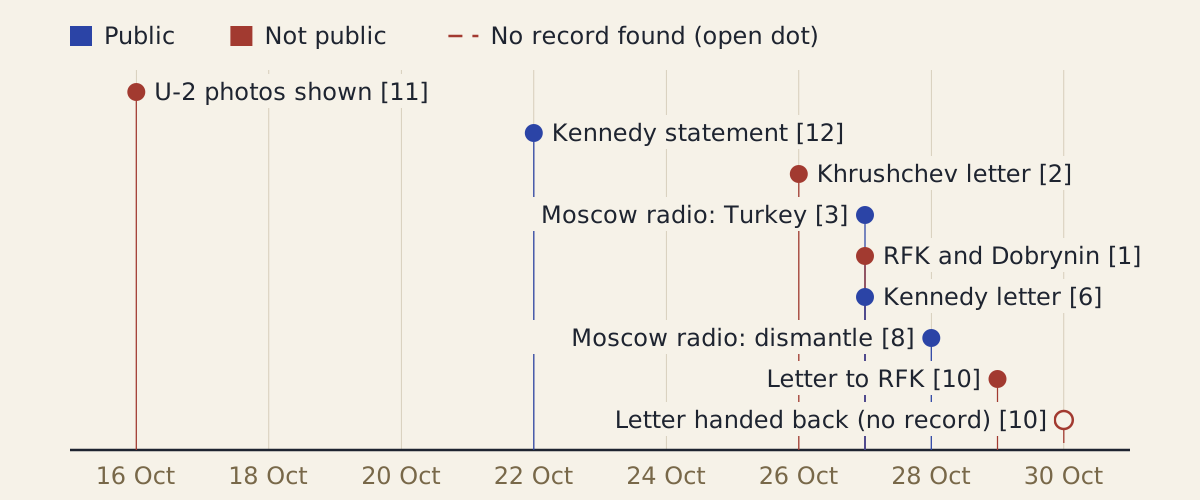
Figure: Proposals and channels in date order, 16 to 30 October 1962. Blue marks were public, red were not; the dashed mark is known only from a later account.
Diagram: Treaties & Tradeoffs. CC BY 4.0. Open full size
Reuse credit
Diagram: Treaties & Tradeoffs, "Cuban Missile Crisis: proposals and channels, 16 to 30 October 1962" — https://treatiesandtradeoffs.com/negotiation/cuban-missile-crisis/, CC BY 4.0 (https://creativecommons.org/licenses/by/4.0/)
Data: Dates: Foreign Relations of the United States, 1961–1963, vol. XI (Office of the Historian), docs. 18, 44, 84, 91, 95, 96, 102, and vol. VI, doc. 70, accessed 2026-11-02, public domain
The sequence as text
- 16 October 1962: McGeorge Bundy tells the President about U-2 photographs of missile sites, and the first meeting starts at 11:50 a.m. [11].
- 22 October 1962: Kennedy writes to Khrushchev that a copy of the statement he is making that night has been handed to the Soviet ambassador [12].
- 26 October 1962: Khrushchev's private letter reaches the US Embassy in Moscow [2].
- 27 October 1962: Moscow radio broadcasts a Khrushchev message naming the US missiles in Turkey [3].
- 27 October 1962: Robert Kennedy meets Ambassador Dobrynin at the Justice Department at about 7:45 p.m., by his own memo [1].
- 27 October 1962: Kennedy's letter accepting the 26 October terms, already handed to the Soviet Embassy and released, is cabled to Moscow at 8:05 p.m. [6].
- 28 October 1962: Moscow radio broadcasts Khrushchev's order to dismantle the weapons and return them [8].
- 29 October 1962: Dobrynin forwards a Khrushchev letter dated 28 October to Robert Kennedy [10].
- 30 October 1962: Robert Kennedy hands the letter back, by Schlesinger's account; no record of the meeting has been found [10].
Robert Kennedy's memo puts his call to the Soviet ambassador at about 7:15 p.m. on 27 October 1962. He asked him over and, by the memo, told him that in the last two hours Washington had learned that a U-2 had been shot down over Cuba and its pilot killed [1]. That same day Moscow radio had put a new price on the Cuban Missile Crisis: the US missiles in Turkey [3]. That evening he had to answer it.
From 16 October, when the President first heard about the photographs, to 28 October, the day of the public settlement, is 13 days, counting both ends [8][11]. That matches the title of Robert Kennedy's memoir, Thirteen Days, which the FRUS editors cite for the meetings of 27 October [4]. FRUS, short for Foreign Relations of the United States, is the State Department's published series of declassified records. Almost every fact below comes from it.
What did each side offer?
Reported: Khrushchev's letter of 26 October reached the US Embassy in Moscow at 4:43 p.m. Moscow time and, in the embassy's translation, offered a narrow bargain [2]. Soviet ships bound for Cuba would carry no arms, and the United States would declare that it would not invade Cuba or support any forces intending to invade; then the need for Soviet military specialists there would disappear [2]. The letter said nothing about Turkey [2].
Reported: On 27 October a second message, broadcast over Moscow radio, raised the price [3]. In the State Department's official translation, Khrushchev wrote, “Your missiles are located in Turkey” [3]. He proposed that the Soviet Union remove from Cuba the means the United States called offensive, while the United States removed “its analogous means from Turkey” [3]. Persons entrusted by the UN Security Council could then inspect, and he proposed agreeing on a time limit “within two or three weeks, not longer than a month” [3].
Reported: President Kennedy's answer that evening built its terms on the first letter. In a text handed to the Soviet Embassy and released to the press, he listed the key elements of the 26 October proposals “as I understand them”: Soviet weapons removed under UN observation, and in return the quarantine lifted and “assurances against an invasion of Cuba” [6]. Turkey was not named; the letter said that a settlement would let both sides work toward “a more general arrangement regarding ‘other armaments’” later, as proposed in the second, public message [6].
Reported: The President had named the risk of that wording himself. At the afternoon meeting he predicted that if the letter left out Turkey, Khrushchev would write back offering to settle Cuba once Turkey was included. That exchange, he said, would cost 24 hours while work on the bases went on [5]. He added to the draft an offer to discuss the proposals Moscow had made public, and he predicted that Khrushchev would say his proposal had been rejected [5].
Reported: Why Moscow sent two different offers was a puzzle in the room. At the morning meeting Bundy suggested that harder-line Soviet officials might have pushed the public demand, while the private letter may have been drafted by people who were less hard-nosed [4]. The President saw a different pattern: proposals arriving so fast that they formed a kind of shield, behind which work on the missile sites went on [4].
Which offers were made in public?
| Date | From | Channel | Public or not | Turkey named | Document |
|---|---|---|---|---|---|
| 26 Oct 1962 | Khrushchev | Private letter, embassy translation | Not public | No | FRUS XI doc. 84 [2] |
| 27 Oct 1962 | Khrushchev | Message broadcast over Moscow radio | Public | Yes | FRUS XI doc. 91 [3] |
| 27 Oct 1962 | President Kennedy | Letter handed over and released to the press | Public | No | FRUS XI doc. 95 [6] |
| 27 Oct 1962 | Robert Kennedy | Meeting with Dobrynin, his memo dated 30 October | Not public | Yes | FRUS XI doc. 96 [1] |
| 28 Oct 1962 | Khrushchev | Message broadcast over Moscow radio | Public | No | FRUS XI doc. 102 [8] |
| 28 Oct 1962 | President Kennedy | Reply released by the White House | Public | No | FRUS XI doc. 104 [9] |
| 29 Oct 1962 | Khrushchev | Letter forwarded to Robert Kennedy, Russian Embassy translation | Not public | Yes | FRUS VI doc. 70 [10] |
| 30 Oct 1962 | Robert Kennedy | Letter handed back, by Schlesinger's account | Not public | Yes | FRUS VI doc. 70, editors' note [10] |
Every proposal with its channel, wording and source (CSV) Source and license notes (JSON) Data: Foreign Relations of the United States, 1961–1963, vol. XI, docs. 84, 91, 95, 96, 102, 104, and vol. VI, doc. 70 (Russian Embassy translation summarized; editorial note citing Arthur M. Schlesinger Jr., Robert Kennedy and His Times, 1978), accessed 2026-11-02, public domain
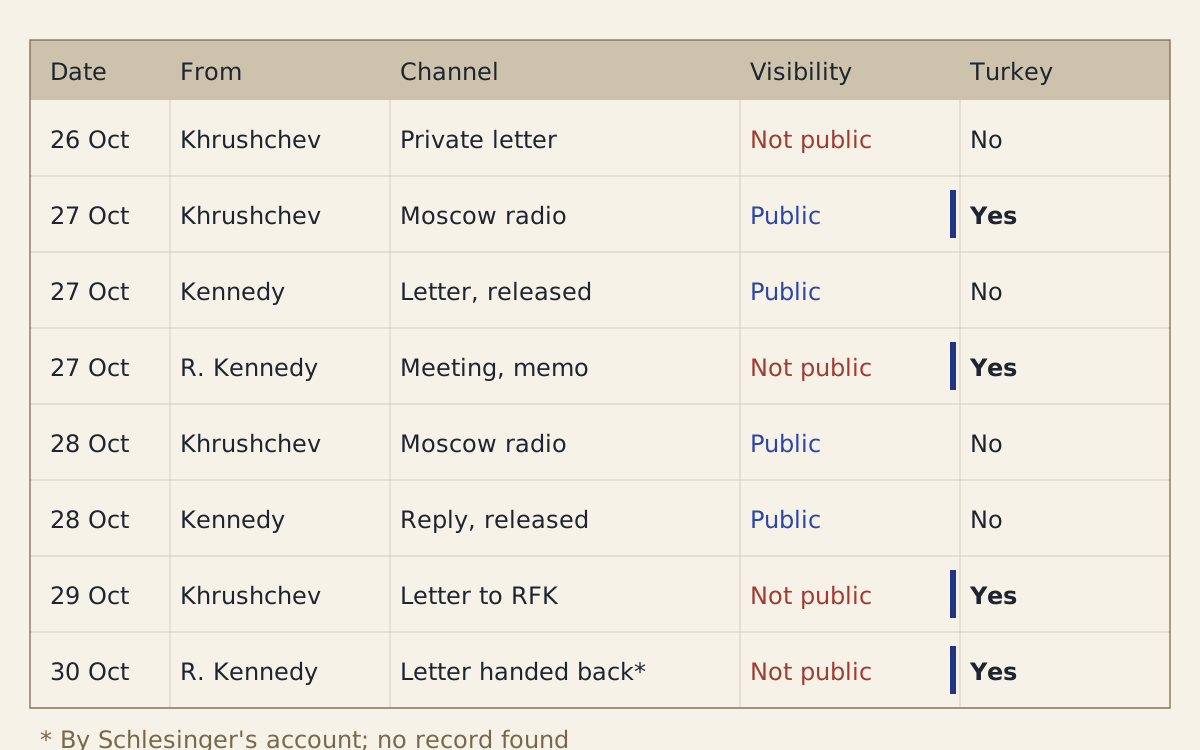
Figure: The eight proposals and replies by date, sender, channel and visibility, with a bar beside each one that named Turkey; the 30 October entry is known only from Schlesinger's later account.
Diagram: Treaties & Tradeoffs. CC BY 4.0. Open full size
Reuse credit
Diagram: Treaties & Tradeoffs, "Cuban Missile Crisis: eight proposals and replies, 26 to 30 October 1962" — https://treatiesandtradeoffs.com/negotiation/cuban-missile-crisis/, CC BY 4.0 (https://creativecommons.org/licenses/by/4.0/)
Data: Foreign Relations of the United States, 1961–1963, vol. XI, docs. 84, 91, 95, 96, 102, 104, and vol. VI, doc. 70, accessed 2026-11-02, public domain
Reported: On 28 October Moscow radio carried Khrushchev's reply: the Soviet government had given “a new order to dismantle the arms which you described as offensive, and to crate and return them to the Soviet Union,” and UN representatives could verify the dismantling [8]. The message did not mention Turkey [8]. Kennedy's reply, released by the White House at 4:35 p.m., called it “an important contribution to peace” [9].
Assessed: Read only through the public documents, the deal looks like the one Khrushchev offered on 26 October: no invasion for no missiles. The table shows why that reading is incomplete. Of the four exchanges that named Turkey, only one was public, and it is the one the United States did not answer in kind.
Why did the missiles in Turkey matter?
Reported: The weapons in question were Jupiter missiles. A declassified US Army briefing chart lists a government-to-government agreement of 28 October 1959, one squadron of 15 missiles, and a deployment site at Cigli, near Izmir [20]. In the ExComm meeting on the morning of 27 October, Defense Secretary Robert McNamara pointed out that the missiles belonged to Turkey and that only the nuclear warheads were under total US control [4]. The ExComm was the Executive Committee of the National Security Council [4].
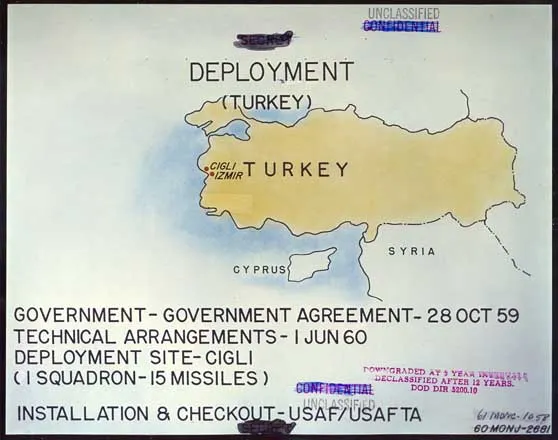
Figure: A US Army briefing chart on the Jupiter deployment in Turkey, with its classification stamps struck through when it was declassified.
"Jupiter missile deployment in Turkey" by U.S. Army Missile Command — https://commons.wikimedia.org/wiki/File:Jupiter_missile_deployment_in_Turkey.jpg — Public domain (U.S. federal government work, 17 U.S.C. §105; U.S. Army Missile Command briefing chart)

Reported: Washington had seen the comparison coming: on 24 October Secretary of State Dean Rusk cabled the US ambassadors in Turkey and at NATO that a settlement might involve “dismantling and removal Jupiters,” asked for an assessment of the consequences, and told them not to discuss it with any foreigners [13]. The US ambassador to NATO, Finletter, answered on 25 October. Turkey regarded the Jupiters as a symbol of the alliance's resolve, he wrote, and the fact that they were obsolescent and vulnerable did not seem to change Turkish thinking. Any arrangement without the prior support of the Turkish government would be “most damaging” [14].
Reported: On 27 October the record shows how little room the Soviet broadcast left. The President remarked that the missiles were ones “which, for a long time, we have considered to be obsolete,” but that the public proposal left no chance to talk privately to the Turks [4]. McGeorge Bundy, the President's national security adviser, said the United States could not appear “to sell out an ally” [4]. During the same meeting word came that the Turkish government had issued a press statement calling the Soviet proposal on the Jupiters not conceivable [4].
Reported: That night the President kept the subject away from the allies as well. At the 9 p.m. meeting he agreed that the US ambassador to NATO would brief the North Atlantic Council and ask for its views. He was not to bring up a possible withdrawal of the Jupiters from Turkey [7]. The US ambassador in Ankara, Hare, would not raise it with the Turks either; the State Department would only tell him, for his own information, what was being considered [7].
Assessed: The Jupiters mattered less as weapons than as a promise. To the President's advisers they were old and exposed; to Ankara, by Finletter's report, they showed that the alliance would defend Turkey. A public trade would have spent that promise in front of every NATO capital. The documents put no price on the missiles, so this page converts no sums into wages.
What could each side fall back on?
A useful way to read the evening of 27 October is to look first at each side's BATNA, the best alternative to a negotiated agreement, meaning what a side could do if talks failed. This is an order of analysis, not a rule that the better alternative wins; time pressure and the shooting over Cuba mattered too.
Reported: The US fallback was written down. At the ExComm meeting that afternoon, General Maxwell Taylor reported that the Joint Chiefs recommended a major air strike on Monday, 29 October, followed seven days later by an invasion, unless the missiles were defused at once [5]. McNamara said a limited strike was no longer possible because reconnaissance planes were being fired on, and he spoke of 500 sorties on the first day [5]. At 9 p.m. the President approved calling up 24 air reserve squadrons, 14,000 personnel and 300 troop carriers, which McNamara called necessary to the invasion plan [7].
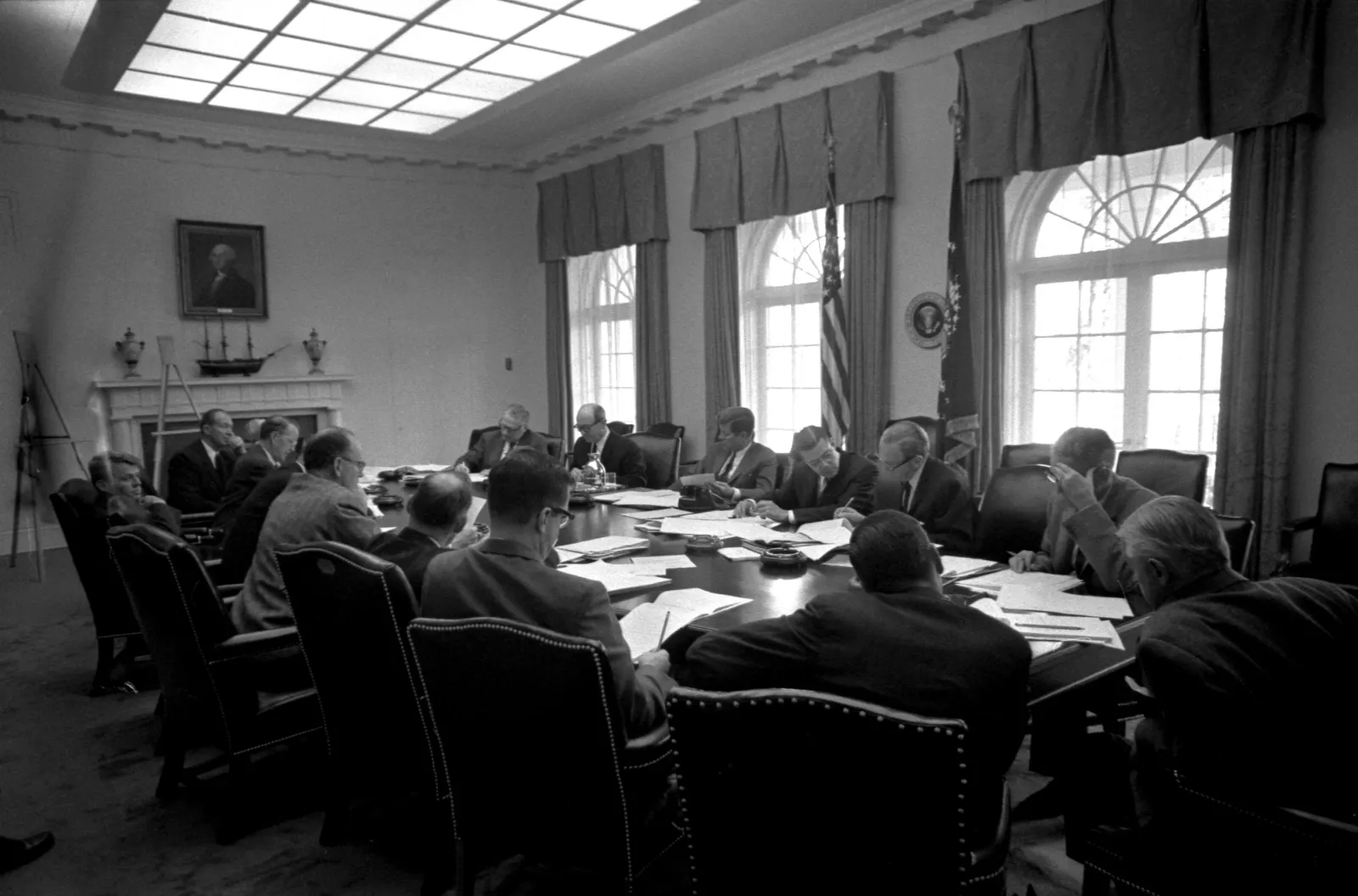
Figure: President Kennedy meets the Executive Committee of the National Security Council in the Cabinet Room, 29 October 1962, the day after the public settlement.
"EXCOMM meeting, Cuban Missile Crisis, 29 October 1962" by Cecil Stoughton — https://commons.wikimedia.org/wiki/File:EXCOMM_meeting,_Cuban_Missile_Crisis,_29_October_1962.jpg — Public domain (U.S. federal government work, 17 U.S.C. §105; White House photographer, John F. Kennedy Presidential Library ST-A26-25-62)

Reported: Those records also show what the fallback would cost. McNamara told the afternoon meeting that if US missiles stayed in Turkey, the Soviets might attack Turkey, and the United States would then have to respond in the NATO area [5]. After the meeting formally ended, Vice President Lyndon Johnson asked why the United States would not trade the Turkish missiles if it was ready to give up their use; Under Secretary of State George Ball answered that the Jupiters could be replaced by Polaris submarines, and that the week before, a trade had seemed acceptable if it would save Berlin [5]. Berlin had been the test of an earlier standoff, the one told in the Berlin Airlift.
Reported: The meeting also shows some doubt about what Moscow wanted. Rusk asked whether the Russians were trying at the last minute to get more of a quid pro quo, or only to weaken the US position in public [5].
Reported: The Soviet fallback is not in the US documents read for this page. What they record is Khrushchev's statement that the missiles in Cuba were in the hands of Soviet officers and for defense only, and his offer to send representatives to the UN in New York [3]. Apart from Khrushchev's letter dated 28 October, discussed below, no Soviet account of the 27 October talks was among the sources read for this page.
Assessed: On the US side, the alternative to a deal was a war plan with a date on it, and its own authors warned that it could spread to Turkey. That made a quiet answer on the Jupiters cheaper than either refusing outright or trading in public. It does not follow that the private channel decided the crisis: the US record cannot show how much weight Khrushchev gave it against the strike he could see being prepared.
What did Robert Kennedy write down?
Reported: Robert Kennedy's memo to Rusk, dated 30 October 1962, records the meeting of three days earlier [1]. He telephoned Dobrynin “at approximately 7:15 p.m.” at Rusk's request, met him at the Justice Department at a quarter to eight, and told him that the bases in Cuba had to go and that the United States needed a commitment “by at least tomorrow” [1]. Asked about Khrushchev's other proposal, on Turkey, he wrote that he “replied that there could be no quid pro quo,” and that the matter was for NATO to decide [1].
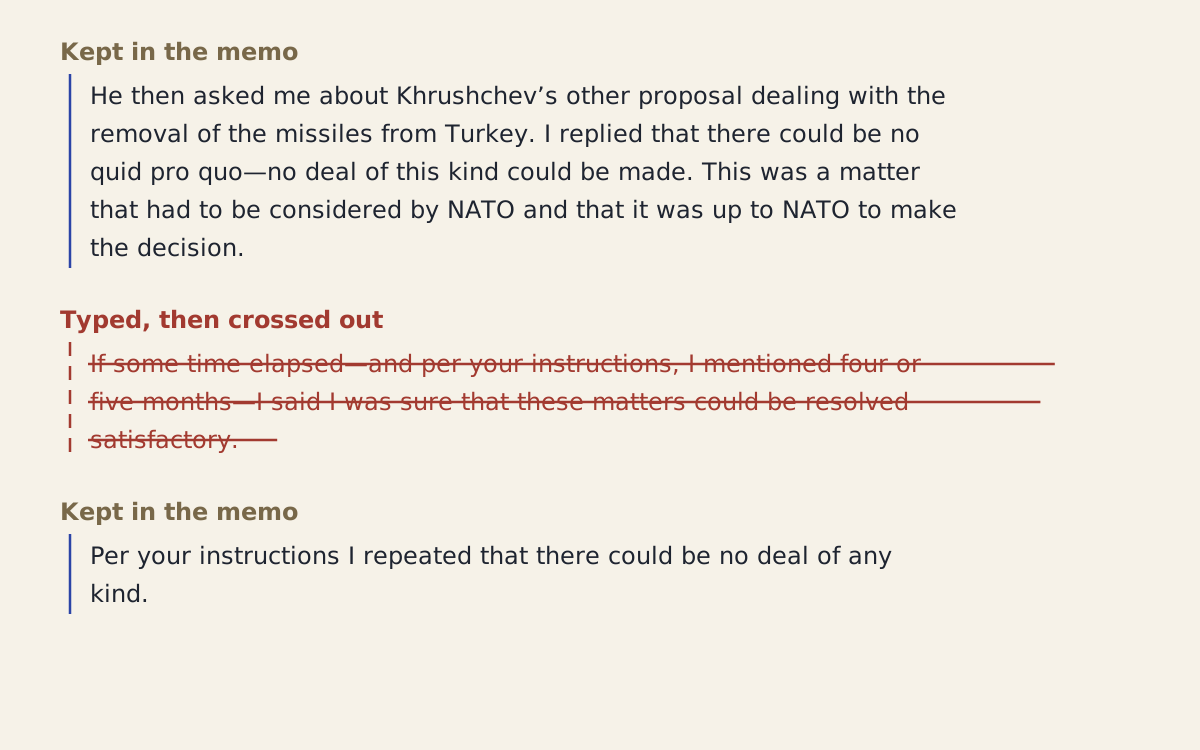
Figure: Three passages from Robert Kennedy's memo of 30 October 1962, with the typed sentence that was crossed out set between the sentences that stayed.
Diagram: Treaties & Tradeoffs. CC BY 4.0. Open full size
Reuse credit
Diagram: Treaties & Tradeoffs, "Robert Kennedy's memo of 30 October 1962: kept and crossed-out sentences" — https://treatiesandtradeoffs.com/negotiation/cuban-missile-crisis/, CC BY 4.0 (https://creativecommons.org/licenses/by/4.0/)
Data: Text: Foreign Relations of the United States, 1961–1963, vol. XI, doc. 96, accessed 2026-11-02, public domain
The memo passages as text
- Kept: “He then asked me about Khrushchev's other proposal dealing with the removal of the missiles from Turkey. I replied that there could be no quid pro quo” [1].
- Typed, then crossed out: “If some time elapsed—and per your instructions, I mentioned four or five months—I said I was sure that these matters could be resolved satisfactory” [1].
- Kept: “Per your instructions I repeated that there could be no deal of any kind” [1].
Reported: The FRUS editors print the deleted line in a note: “The following typed sentence at the end of this paragraph was crossed out” [1]. The memo is addressed to Rusk, so “your instructions” refers to the Secretary of State [1]. Who crossed the sentence out, and when, the document does not say.
Reported: The Soviet side tells the same part of the story in other words. FRUS prints Khrushchev's letter dated 28 October from an unofficial translation that the Russian Embassy prepared for publication in 1992 [10]. It says Robert Kennedy had explained why the bases in Turkey could not be discussed in public, and that their removal would take 4 to 5 months [10]. Dobrynin forwarded that letter to Robert Kennedy on 29 October [10].
Reported: What happened next rests on a single later account. According to the FRUS editors, Robert Kennedy studied the letter overnight and on 30 October asked Dobrynin to come to his office and “take it back because it involved a quid pro quo,” citing Arthur M. Schlesinger Jr.'s Robert Kennedy and His Times (1978), p. 546 [10]. The editors add: “No record of the meeting has been found” [10].
Assessed: Two records made on opposite sides, one American and one Soviet, name the same span of four or five months. That match is the strongest evidence here that a timetable was mentioned. Neither shows a signed commitment, and the American memo was edited so that no timetable remained. What the record supports is a timetable spoken and then struck from the memo, not a treaty, and the return of the letter stays Schlesinger's account.
When did the Jupiters go?
Reported: In private, the United States told Turkey there had been no deal. On 29 October the Turkish ambassador thanked the State Department for President Kennedy's refusal of any “deal” over the bases, and Assistant Secretary William Tyler assured him again “that there had been no ‘deal’ regarding Turkey” [15].
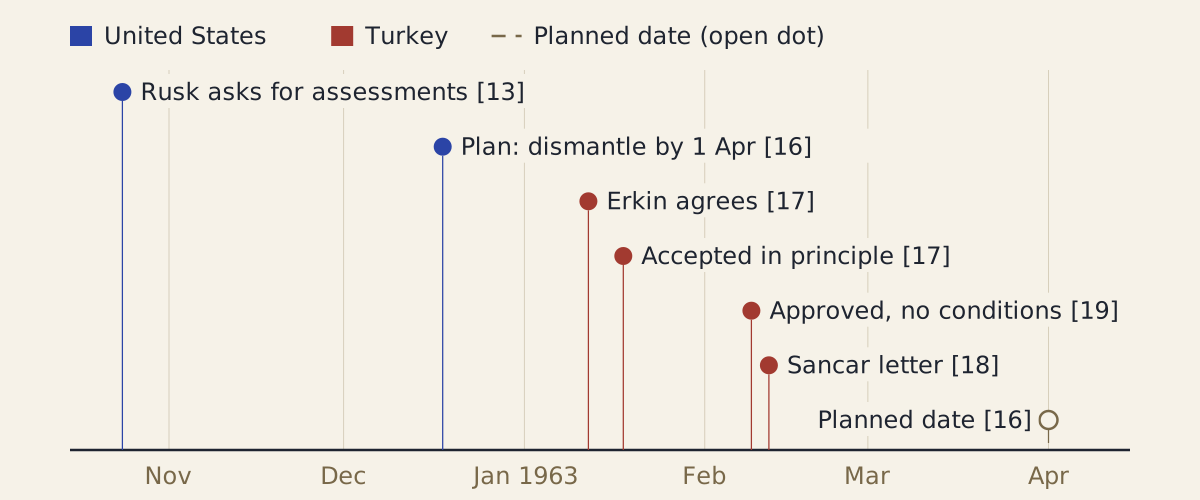
Figure: The documents on the Jupiter removal plan in date order; the dashed mark on 1 April 1963 is a planned date, not a record of completion.
Diagram: Treaties & Tradeoffs. CC BY 4.0. Open full size
Reuse credit
Diagram: Treaties & Tradeoffs, "Jupiter missiles in Turkey: the removal plan, October 1962 to April 1963" — https://treatiesandtradeoffs.com/negotiation/cuban-missile-crisis/, CC BY 4.0 (https://creativecommons.org/licenses/by/4.0/)
Data: Foreign Relations of the United States, 1961–1963, vol. XI, doc. 56, and vol. XVI, docs. 384, 388, 393, 394, accessed 2026-11-02, public domain
The removal plan as text
- 24 October 1962: Rusk asks the ambassadors in Turkey and at NATO to assess the consequences of removing the Jupiters [13].
- 18 December 1962: the State Department reports McNamara's proposal to dismantle the Jupiters by April 1 and replace them with Polaris in the Mediterranean [16].
- 12 January 1963: Foreign Minister Erkin agrees with the United States on removal, by an embassy telegram the FRUS editors summarize [17].
- 18 January 1963: a meeting chaired by Prime Minister Inonu accepts the replacement in principle, with conditions [17].
- 9 February 1963: Erkin tells the embassy that the Turkish government approves the replacement and attaches no conditions [19].
- 12 February 1963: Defense Minister Sancar's letter accepts the withdrawal but links it to supplies for the Turkish forces [18].
- 1 April 1963: the planned date for dismantling under the December proposal [16].
The removal plan, document by document (CSV) Source and license notes (JSON) Data: Foreign Relations of the United States, 1961–1963, vol. XI, doc. 56, and vol. XVI, docs. 384, 388, 393, 394, accessed 2026-11-02, public domain
Reported: The plan appears in FRUS on 18 December 1962. A State Department cable reports that McNamara had proposed “dismantling of the Jupiters by April 1,” with Polaris submarines stationed in the Mediterranean to replace them, explained as a way to modernize the alliance's missiles and remove a vulnerable system [16]. The cable said the Jupiters had offered an “inviting target” to the Soviets during the crisis, had the United States been forced to act against Cuba [16].
Reported: Foreign Minister Erkin agreed in January, and on 9 February the Turkish government approved the replacement and, by the embassy's report, “attached no conditions” [17][19]. Defense Minister Sancar's letter of 12 February raised supply questions; Erkin said Sancar had no authority to impose such conditions [18].
Reported, with our check: The planned date of 1 April 1963 fell 104 days after the December cable and 156 days after the meeting of 27 October [1][16]. That is about five months, close to the four or five months in the crossed-out line [1].
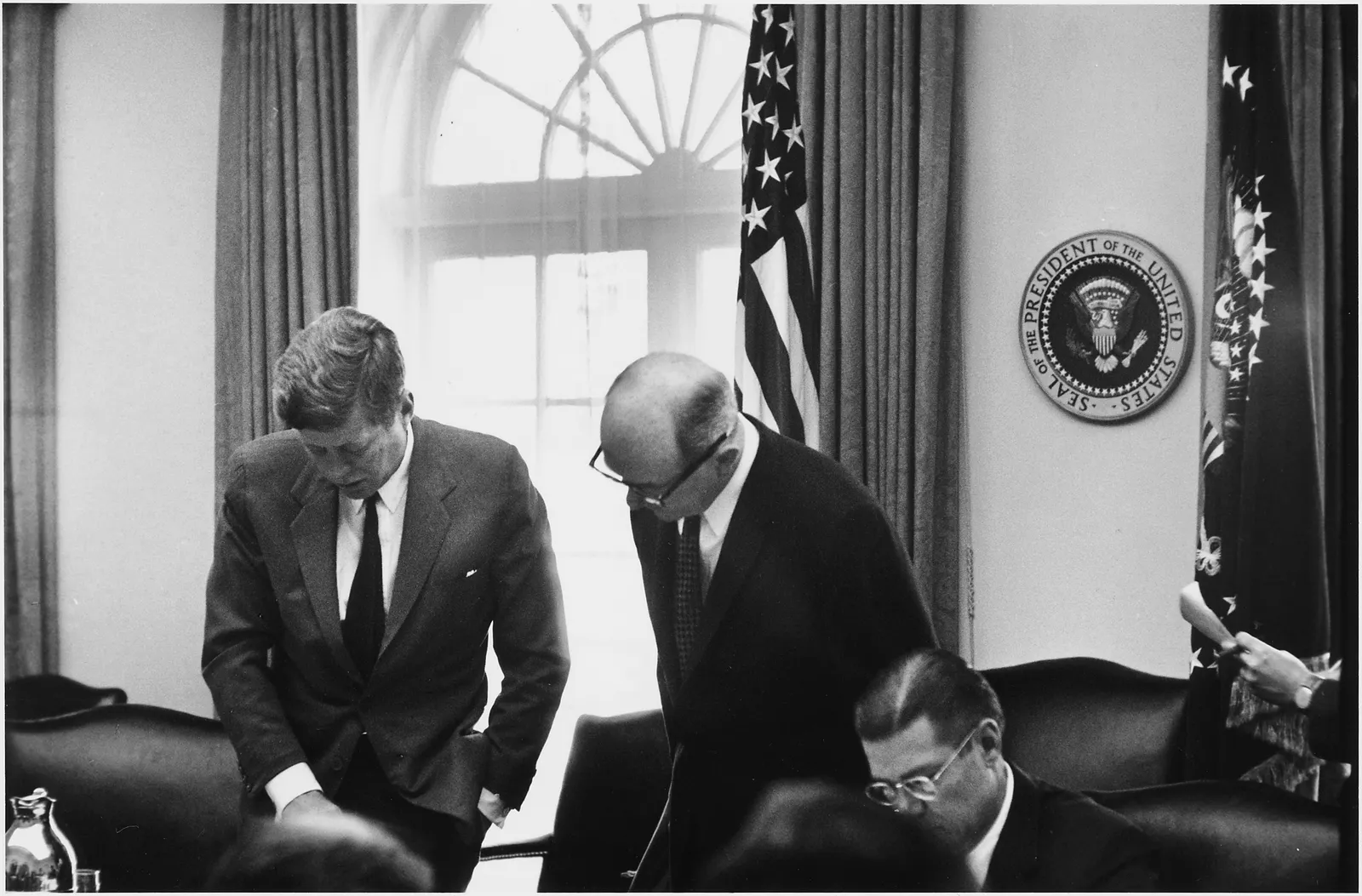
Figure: President Kennedy and Secretary of State Dean Rusk at an ExComm meeting on 29 October 1962, the day the Turkish ambassador was told there had been no deal.
"Meeting of the Executive Committee of the National Security Council, Cuba Crisis" by Cecil W. Stoughton — https://commons.wikimedia.org/wiki/File:Meeting_of_the_Executive_Committee_of_the_National_Security_Council-_Cuba_Crisis._President_Kennedy,_Secretary_of..._-_NARA_-_194246.jpg — Public domain (U.S. federal government work, 17 U.S.C. §105; National Archives Identifier 194246)

Reported: When the last Jupiter actually left Turkey is not stated in the FRUS documents read for this page. Philip Nash's study The Other Missiles of October: Eisenhower, Kennedy, and the Jupiters, 1957–1963 (1997) traces the withdrawal; we could not read it and cite it here only as the place to look [21].
Assessed: Apply what this site calls the known-then test, which scores a choice only on what its makers could know at the time, with each piece of that knowledge tied to a source. On the evening of 27 October the President's men knew the Jupiters were old. They knew Turkey had called a trade not conceivable, and that their own fallback was an air strike within two days. Keeping the Turkey answer private and unwritten fits that list, and the December plan is consistent with an answer that was meant.
Assessed: What looks like a calm, finished bargain in retellings carries what we call the hindsight premium, the share of a decision's apparent wisdom or folly added only after the outcome is known. At 9 p.m. that night the same group was calling up reserve squadrons, and Robert Kennedy was advising them to hold off one more day before deciding on the trade [7]. For how a negotiated price can split into what was signed and what was meant, compare the Allied bill to Germany in the Treaty of Versailles.
Sources
- Foreign Relations of the United States, 1961–1963, vol. XI, Cuban Missile Crisis and Aftermath, Document 96, Memorandum From Attorney General Kennedy to Secretary of State Rusk, Washington, 30 October 1962. Office of the Historian, U.S. Department of State. https://history.state.gov/historicaldocuments/frus1961-63v11/d96Read: full text, with the editors' note on the crossed-out sentence
- Foreign Relations of the United States, 1961–1963, vol. XI, Document 84, Telegram From the Embassy in the Soviet Union to the Department of State (Khrushchev's letter of 26 October 1962, embassy translation). Office of the Historian, U.S. Department of State. https://history.state.gov/historicaldocuments/frus1961-63v11/d84Read: full text
- Foreign Relations of the United States, 1961–1963, vol. XI, Document 91, Message From Chairman Khrushchev to President Kennedy, Moscow, 27 October 1962 (Department of State official translation). Office of the Historian, U.S. Department of State. https://history.state.gov/historicaldocuments/frus1961-63v11/d91Read: full text
- Foreign Relations of the United States, 1961–1963, vol. XI, Document 90, Summary Record of the Seventh Meeting of the Executive Committee of the National Security Council, Washington, 27 October 1962, 10 a.m.. Office of the Historian, U.S. Department of State. https://history.state.gov/historicaldocuments/frus1961-63v11/d90Read: full text
- Foreign Relations of the United States, 1961–1963, vol. XI, Document 94, Summary Record of the Eighth Meeting of the Executive Committee of the National Security Council, Washington, 27 October 1962, 4 p.m.. Office of the Historian, U.S. Department of State. https://history.state.gov/historicaldocuments/frus1961-63v11/d94Read: full text
- Foreign Relations of the United States, 1961–1963, vol. XI, Document 95, Telegram From the Department of State to the Embassy in the Soviet Union, Washington, 27 October 1962, 8:05 p.m. (President Kennedy's letter to Khrushchev). Office of the Historian, U.S. Department of State. https://history.state.gov/historicaldocuments/frus1961-63v11/d95Read: full text
- Foreign Relations of the United States, 1961–1963, vol. XI, Document 97, Summary Record of the Ninth Meeting of the Executive Committee of the National Security Council, Washington, 27 October 1962, 9 p.m.. Office of the Historian, U.S. Department of State. https://history.state.gov/historicaldocuments/frus1961-63v11/d97Read: full text
- Foreign Relations of the United States, 1961–1963, vol. XI, Document 102, Message From Chairman Khrushchev to President Kennedy, Moscow, 28 October 1962. Office of the Historian, U.S. Department of State. https://history.state.gov/historicaldocuments/frus1961-63v11/d102Read: full text
- Foreign Relations of the United States, 1961–1963, vol. XI, Document 104, Telegram From the Department of State to the Embassy in the Soviet Union, Washington, 28 October 1962 (President Kennedy's reply). Office of the Historian, U.S. Department of State. https://history.state.gov/historicaldocuments/frus1961-63v11/d104Read: full text
- Foreign Relations of the United States, 1961–1963, vol. VI, Kennedy-Khrushchev Exchanges, Document 70, Letter From Chairman Khrushchev to President Kennedy, Moscow, 28 October 1962, with the editors' note (citing Arthur M. Schlesinger Jr., Robert Kennedy and His Times, Boston: Houghton Mifflin, 1978, p. 546). Office of the Historian, U.S. Department of State. https://history.state.gov/historicaldocuments/frus1961-63v06/d70Read: full text of the editors' note; the letter itself in an unofficial Russian Embassy translation
- Foreign Relations of the United States, 1961–1963, vol. XI, Document 18, Transcript of a Meeting at the White House, Washington, 16 October 1962, 11:50 a.m.. Office of the Historian, U.S. Department of State. https://history.state.gov/historicaldocuments/frus1961-63v11/d18Read: editors' headnote
- Foreign Relations of the United States, 1961–1963, vol. XI, Document 44, Letter From President Kennedy to Chairman Khrushchev, Washington, 22 October 1962. Office of the Historian, U.S. Department of State. https://history.state.gov/historicaldocuments/frus1961-63v11/d44Read: opening paragraph and headnote
- Foreign Relations of the United States, 1961–1963, vol. XI, Document 56, Telegram From the Department of State to the Embassy in Turkey, Washington, 24 October 1962. Office of the Historian, U.S. Department of State. https://history.state.gov/historicaldocuments/frus1961-63v11/d56Read: full text
- Foreign Relations of the United States, 1961–1963, vol. XI, Document 75, Telegram From the Embassy in France to the Department of State (Polto 506, Finletter), Paris, 25 October 1962. Office of the Historian, U.S. Department of State. https://history.state.gov/historicaldocuments/frus1961-63v11/d75Read: full text
- Foreign Relations of the United States, 1961–1963, vol. XVI, Eastern Europe; Cyprus; Greece; Turkey, Document 381, Memorandum of Conversation, Washington, 29 October 1962 (Turkish Missiles and the Cuban Crisis). Office of the Historian, U.S. Department of State. https://history.state.gov/historicaldocuments/frus1961-63v16/d381Read: full text
- Foreign Relations of the United States, 1961–1963, vol. XVI, Document 384, Telegram From the Department of State to the Embassy in Turkey, Washington, 18 December 1962. Office of the Historian, U.S. Department of State. https://history.state.gov/historicaldocuments/frus1961-63v16/d384Read: full text
- Foreign Relations of the United States, 1961–1963, vol. XVI, Document 388, Telegram From the Embassy in Turkey to the Department of State, Ankara, 18 January 1963, with the editors' note. Office of the Historian, U.S. Department of State. https://history.state.gov/historicaldocuments/frus1961-63v16/d388Read: full text
- Foreign Relations of the United States, 1961–1963, vol. XVI, Document 393, Telegram From the Embassy in Turkey to the Department of State, Ankara, 16 February 1963. Office of the Historian, U.S. Department of State. https://history.state.gov/historicaldocuments/frus1961-63v16/d393Read: full text
- Foreign Relations of the United States, 1961–1963, vol. XVI, Document 394, Telegram From the Embassy in Turkey to the Department of State, Ankara, 18 February 1963. Office of the Historian, U.S. Department of State. https://history.state.gov/historicaldocuments/frus1961-63v16/d394Read: full text
- U.S. Army Missile Command, "Deployment (Turkey)," declassified briefing chart on the Jupiter deployment, 1960s. Wikimedia Commons. https://commons.wikimedia.org/wiki/File:Jupiter_missile_deployment_in_Turkey.jpgRead: the chart image
- Philip Nash, The Other Missiles of October: Eisenhower, Kennedy, and the Jupiters, 1957–1963 (Chapel Hill: University of North Carolina Press, 1997). https://uncpress.org/book/9780807846476/the-other-missiles-of-octoberRead: bibliographic record only
Cite this page
Treaties & Tradeoffs. “Cuban Missile Crisis: A Struck Line on Turkey in RFK's Memo.” published 2026-11-02. https://treatiesandtradeoffs.com/negotiation/cuban-missile-crisis/. Accessed [the date you read it].
Plain citation; add the date you consulted the page. No DOI is assigned.