Historic NegotiationsNegotiation review
Treaty of Versailles: It Set No Reparations Total in 1919
Treaties & Tradeoffs Filed
The Treaty of Versailles, signed on 28 June 1919, made Germany liable for reparations but set no total: Article 233 left the amount to a Reparation Commission, to be notified by 1 May 1921 [1][3]. Meanwhile Article 235 asked for 20 billion gold marks [1]. The commission fixed the total at 132 billion gold marks in April 1921, split in May into bonds of 12, 38 and 82 billion, in the schedule as printed by Keynes [14][19].
Order of business (6 sections)
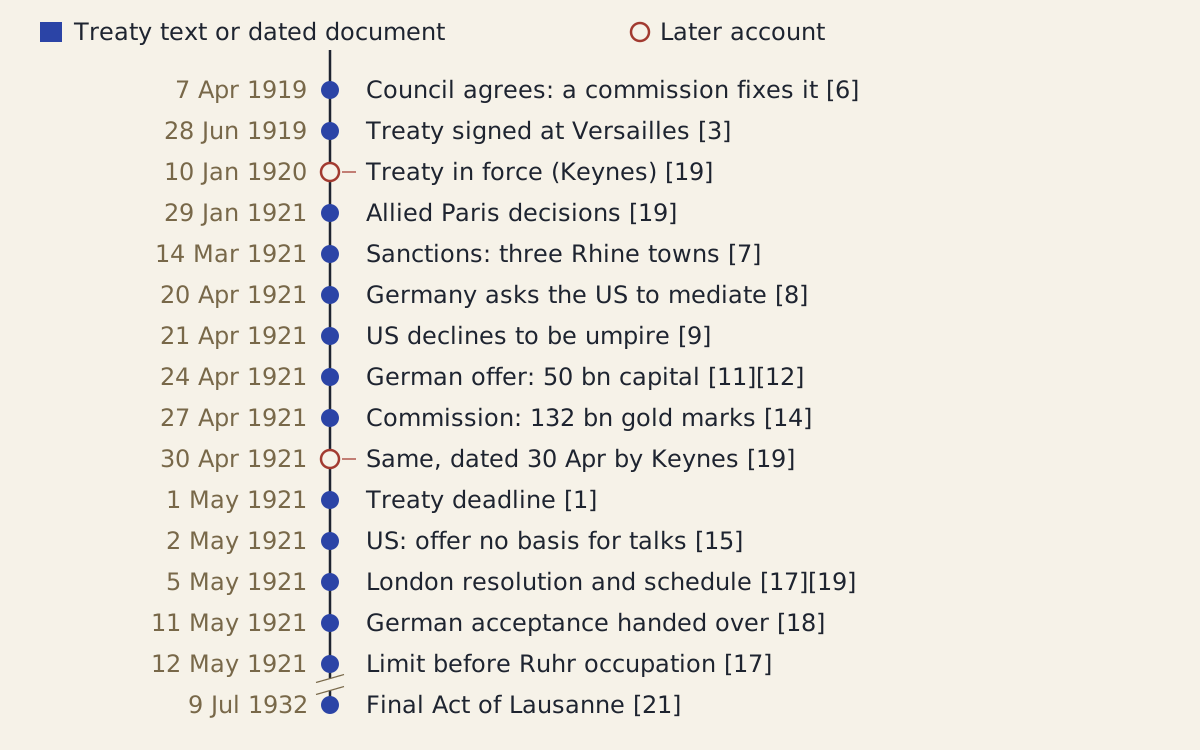
Figure: The reparations question from the clause agreed in April 1919 to the Lausanne Final Act of July 1932, in date order and not to scale; open red marks are later accounts, not dated documents.
Diagram: Treaties & Tradeoffs. CC BY 4.0. Open full size
Reuse credit
Diagram: Treaties & Tradeoffs, "Treaty of Versailles reparations: from the clause of April 1919 to Lausanne, 1932" — https://treatiesandtradeoffs.com/negotiation/treaty-of-versailles/, CC BY 4.0 (https://creativecommons.org/licenses/by/4.0/)
Data: Dates: Treaty of Versailles, 28 June 1919, Parts VIII, XIV and XV; Papers Relating to the Foreign Relations of the United States: The Paris Peace Conference, 1919, vol. V (1946), doc. 6; Papers Relating to the Foreign Relations of the United States, 1921, vol. II (1936), docs. 39, 44, 47, 50, 58, 59, 61, 64, 65; J. M. Keynes, A Revision of the Treaty (1922), Appendix of Documents and Excursus V; Foreign Relations of the United States, 1932, vol. I (1948), doc. 480; accessed 2026-11-02, public domain
The sequence as text
- 7 April 1919: the Council in Paris agrees a clause that leaves the amount to an inter-Allied commission, to report by 1 May 1921 [6].
- 28 June 1919: the treaty is signed at Versailles [3].
- 10 January 1920: the treaty is ratified and in force, by Keynes's account [19].
- 29 January 1921: the Allied Paris decisions propose 42 fixed annuities plus 12 percent of German exports [19].
- 14 March 1921: a British memorandum reports sanctions, including the occupation of Duisburg, Ruhrort and Düsseldorf [7].
- 20 April 1921: Germany asks the US President to mediate and fix the sum [8].
- 21 April 1921: the United States declines to act as umpire [9].
- 24 April 1921: Germany proposes 50 billion gold marks of capital, or annuities totalling 200 billion [11][12].
- 27 April 1921: the commission notifies the German delegation in Paris of 132 billion gold marks [14].
- 30 April 1921: the date Keynes gives for the commission's announcement [19].
- 1 May 1921: the treaty deadline for the total and for the 20 billion [1].
- 2 May 1921: the United States finds the German proposals no basis for discussion [15].
- 5 May 1921: the London resolution and the Schedule of Payments [17][19].
- 11 May 1921: the German ambassador in London hands over an unconditional acceptance [18].
- 12 May 1921: the limit the London resolution set before an occupation of the Ruhr [17].
- 9 July 1932: the Final Act of the Lausanne Conference is signed [21].
The timeline, with the kind of record behind each date (CSV) Source and license notes (JSON) Data: Treaty of Versailles, 28 June 1919, Parts VIII, XIV and XV; Papers Relating to the Foreign Relations of the United States: The Paris Peace Conference, 1919, vol. V (1946), doc. 6; Papers Relating to the Foreign Relations of the United States, 1921, vol. II (1936), docs. 39, 44, 47, 50, 58, 59, 61, 64, 65; J. M. Keynes, A Revision of the Treaty (1922), Appendix of Documents and Excursus V; Foreign Relations of the United States, 1932, vol. I (1948), doc. 480; accessed 2026-11-02, public domain
On 28 June 1919, Germany signed a treaty that made it liable for reparations without naming a sum. The bill came 673 days later, if the deadline of 1 May 1921 is the end point. In between sat a commission, an interim payment and a stack of bonds held as security. This replay of the Treaty of Versailles follows what its text left open, and who filled the gap.
What did the treaty say about reparations?
Reported: Part VIII of the treaty opens with Article 231. In it, “the Allied and Associated Governments affirm and Germany accepts the responsibility of Germany and her allies for causing all the loss and damage” of the war [1]. Article 232 then concedes that Germany's resources “are not adequate” for complete reparation, and limits the demand to damage done to civilians and their property, as listed in Annex I [1].
Reported: Article 233 holds the missing number. The amount “shall be determined by an Inter-Allied Commission, to be called the Reparation Commission”, and its findings were to be notified to Germany “on or before May 1, 1921” [1]. The commission was also to draw up a schedule for discharging the whole obligation within 30 years from that date. Article 234 let it extend dates later, but not cancel any part without the authority of the governments [1].
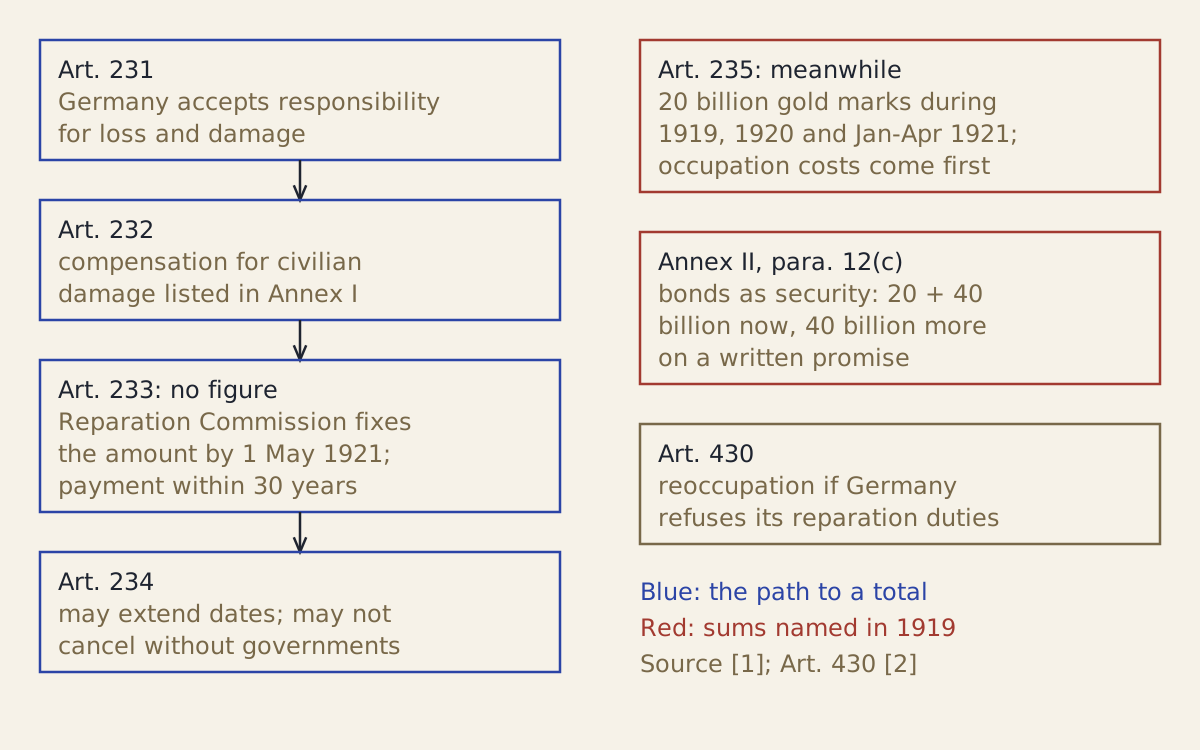
Figure: How Part VIII of the treaty handled reparations: a path to a total that the treaty does not state, and the sums it did name in 1919.
Diagram: Treaties & Tradeoffs. CC BY 4.0. Open full size
Reuse credit
Diagram: Treaties & Tradeoffs, "Treaty of Versailles: how Part VIII handled reparations" — https://treatiesandtradeoffs.com/negotiation/treaty-of-versailles/, CC BY 4.0 (https://creativecommons.org/licenses/by/4.0/)
Data: Treaty of Versailles, 28 June 1919, Parts VIII, XIV and XV, Articles 231–235, Annex II para. 12(c) and Article 430; accessed 2026-11-02, public domain
The articles as text
- Article 231: Germany accepts responsibility for the loss and damage of the war [1].
- Article 232: Germany's resources are not adequate; it will compensate damage to civilians and their property, as listed in Annex I [1].
- Article 233: the Reparation Commission fixes the amount and notifies it by 1 May 1921; payment within 30 years from that date [1].
- Article 234: the commission may extend dates, but may not cancel any part without the governments [1].
- Article 235: 20 billion gold marks during 1919, 1920 and the first four months of 1921; occupation costs come first [1].
- Annex II, paragraph 12(c): bonds of 20 and 40 billion gold marks issued at once, and a written promise of 40 billion more [1].
- Article 430: the areas named in Article 429 will be reoccupied, in whole or part, if the commission finds that Germany refuses its reparation obligations [2].
Each article and its deadline or sum (CSV) Source and license notes (JSON) Data: Treaty of Versailles, 28 June 1919, Parts VIII, XIV and XV, text as published by the Avalon Project; accessed 2026-11-02, public domain
Reported: The treaty did name two sums. Article 235 asked for 20 billion gold marks before the total was known, and Annex II asked Germany to hand over bearer bonds as “security for and acknowledgment of her debt” [1]. The bonds came in three parts: 20 billion without interest, 40 billion at interest, and a written undertaking to issue 40 billion more [1].
Reported, with our check: Those three parts add up to 100 billion gold marks. Annex II, though, calls them a “first installment” of security, not a total [1]. Article 430 added an enforcement clause: if the commission found that Germany refused its reparation obligations, the areas named in Article 429, in whole or part, would be reoccupied immediately [2].
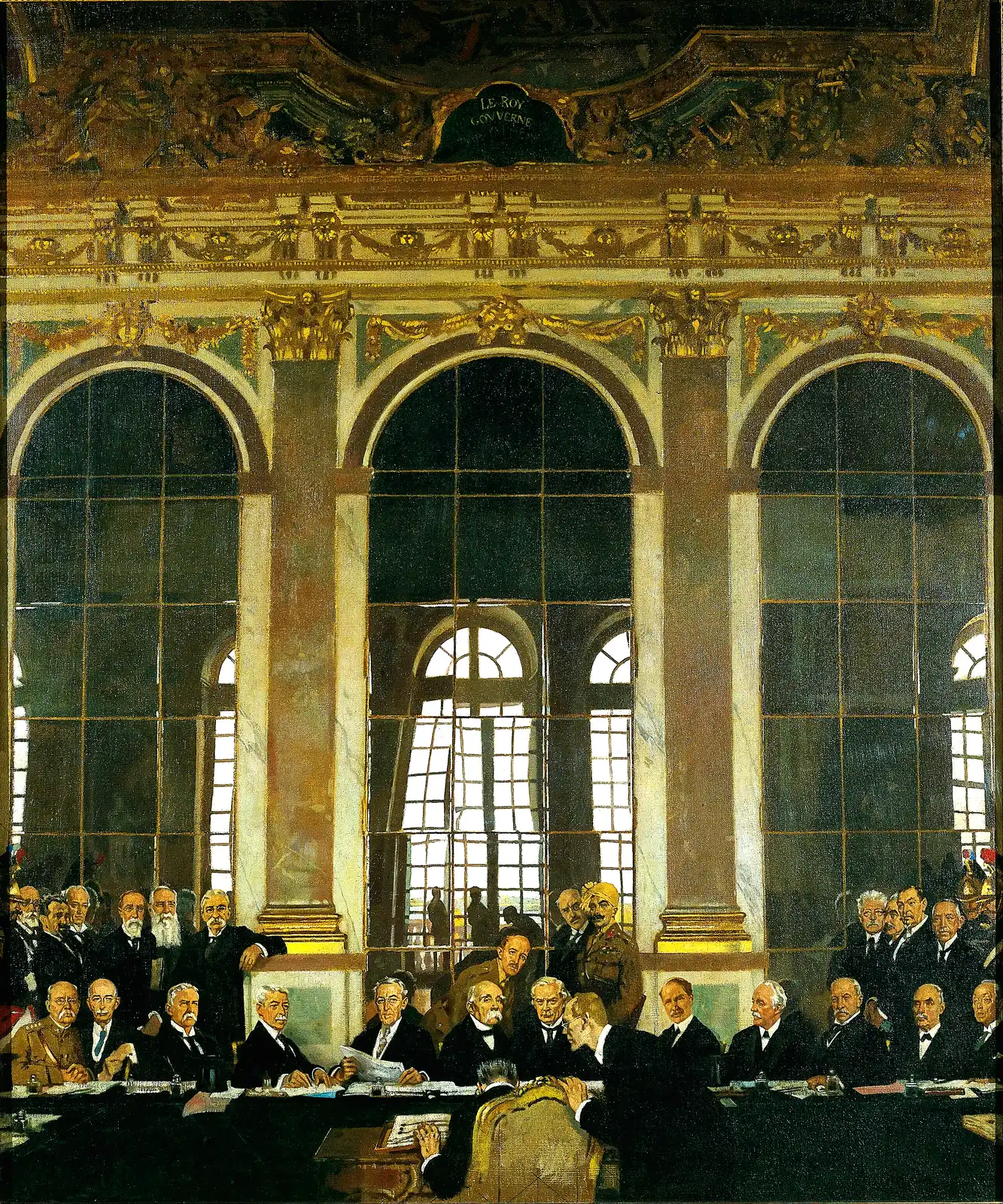
Figure: “The Signing of Peace in the Hall of Mirrors, Versailles, 28th June 1919,” painted by William Orpen in 1919, now in the Imperial War Museum, London.
“The Signing of Peace in the Hall of Mirrors, Versailles, 28th June 1919” by William Orpen. Public Domain Mark.
Full credit
"The Signing of Peace in the Hall of Mirrors, Versailles, 28th June 1919" by William Orpen — https://commons.wikimedia.org/wiki/File:Orpen,_William_(Sir)_(RA)_-_The_Signing_of_Peace_in_the_Hall_of_Mirrors,_Versailles,_28th_June_1919_-_Google_Art_Project.jpg — Public domain (William Orpen d. 1931; painted 1919; EU: author died more than 70 years ago; US: exhibited at the Royal Academy in 1920 and in the public domain whether treated as published before 1931 or as unpublished (life plus 70 years); faithful reproduction of a two-dimensional work, Imperial War Museum, London, Art.IWM ART 2856)
Who wanted what at the table in 1919?
Reported: The meeting notes of 5 April 1919 show the leaders split on what the commission should calculate [4]. Klotz, speaking for the French delegation, argued that whatever Germany could not pay within 30 years should still be owed. Norman Davis, one of the American financial experts, read the draft as limiting the bill to what Germany could pay in about 30 years [4]. David Lloyd George said that 30 years was an expression of opinion about what Germany could pay, not a cap on the total [4].
Reported: At the afternoon session, by the same notes, Davis gave a history of the expert talks. The experts had worked from what Germany could pay, and their estimates ranged from 25 billion to 50 billion dollars [5]. Because no agreement on a figure could be reached, and fixing one seemed unwise, the meeting turned to another method [5]. Lloyd George then gave a history that, by the same notes, differed somewhat from Davis's [5].
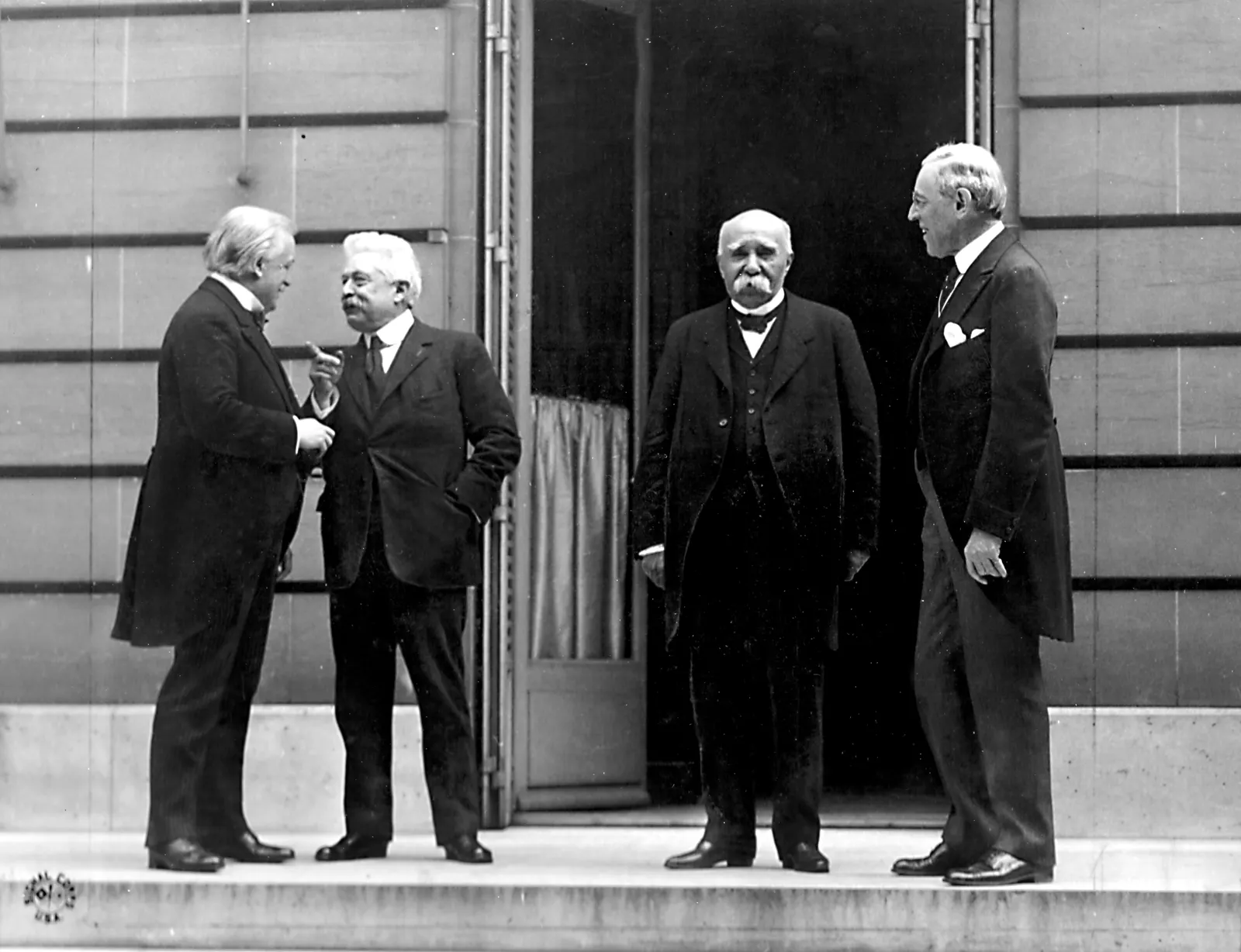
Figure: David Lloyd George, Vittorio Orlando, Georges Clemenceau and Woodrow Wilson in Paris on 27 May 1919, a month before the signing; photograph by Edward N. Jackson of the US Army Signal Corps.
“The Big Four at the Paris Peace Conference, 27 May 1919” by Edward N. Jackson. Public domain.
Full credit
"The Big Four at the Paris Peace Conference, 27 May 1919" by Edward N. Jackson — https://commons.wikimedia.org/wiki/File:Big_four.jpg — Public domain (U.S. federal government work, 17 U.S.C. §105 (photograph by a US Army Signal Corps photographer in the course of official duties))

Reported: On 7 April 1919, the Council approved the wording that became Articles 231 to 233 [6]. The amount was to be fixed by a commission and notified “on or before May 1st, 1921” [6]. John Maynard Keynes is listed among the British delegation present [6]. The treaty was signed 82 days later [3][6].
Reported: Keynes left an account of why no figure went in. In The Economic Consequences of the Peace, he wrote that the treaty “fixes no definite sum as representing Germany's liability” [20]. In his view, any figure close to expert estimates of Germany's capacity would have fallen “hopelessly far short of popular expectations” in Britain and France [20]. He put the total claim at about $40,000,000,000, with his own margin of $32 billion to $44 billion, and proposed fixing the payment at $10,000,000,000 [20].
Assessed: Keynes was a participant who had become a critic, so his account is one side of this question, not a settled verdict. What the meeting notes and the text agree on is narrower: the leaders could not agree on a number in April 1919, and Article 233 moved that choice to a commission and a date [5][6].
What was due before the total?
Reported: Article 235 asked Germany to pay “the equivalent of 20,000,000,000 gold marks” during 1919, 1920 and the first four months of 1921 [1]. The costs of the armies of occupation since the Armistice came out of that sum first, and food and raw materials the Allied governments judged essential could, with their approval, also be paid for from it [1]. The balance would count towards reparation [1].
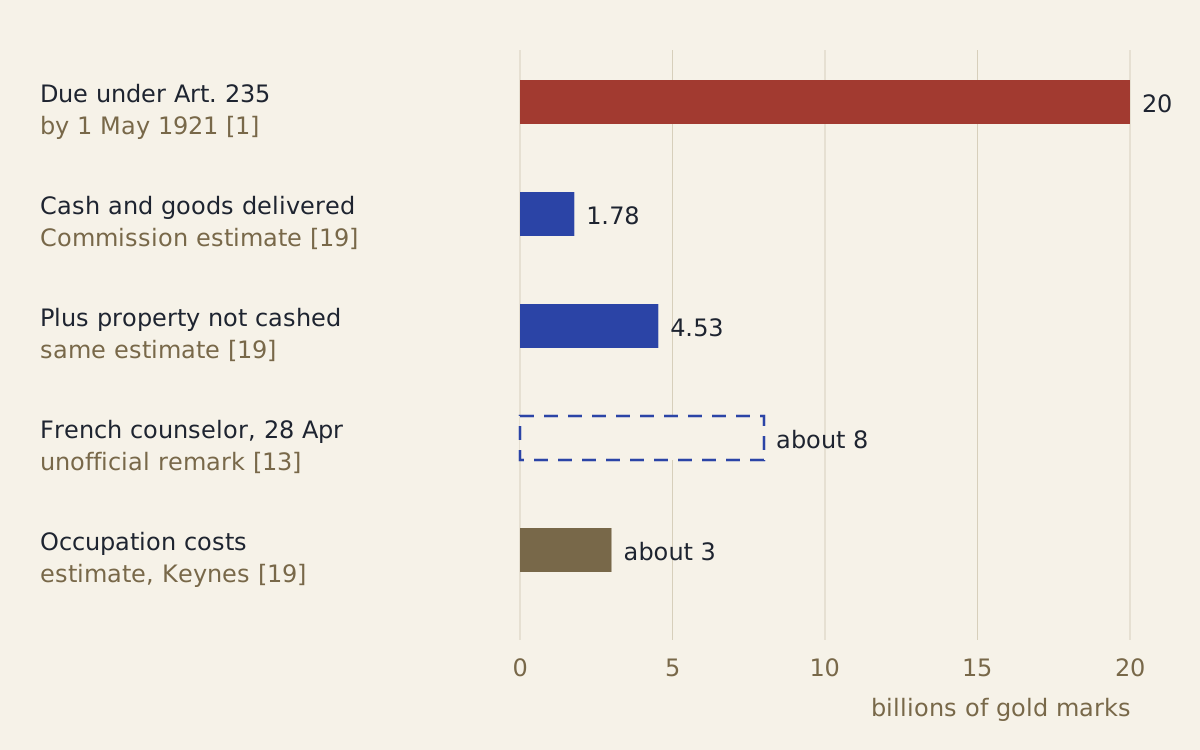
Figure: The 20 billion gold marks due by 1 May 1921, beside estimates of what Germany had delivered by the end of April 1921 and of what the occupation had cost; the dashed bar is an unofficial remark.
Diagram: Treaties & Tradeoffs. CC BY 4.0. Open full size
Reuse credit
Diagram: Treaties & Tradeoffs, "Treaty of Versailles: the 20 billion due by 1 May 1921 and what was delivered" — https://treatiesandtradeoffs.com/negotiation/treaty-of-versailles/, CC BY 4.0 (https://creativecommons.org/licenses/by/4.0/)
Data: Treaty of Versailles, 28 June 1919, Parts VIII, XIV and XV, Article 235; J. M. Keynes, A Revision of the Treaty (1922), Excursus V (Reparation Commission's approximate statement to 30 April 1921; occupation costs); Papers Relating to the Foreign Relations of the United States, 1921, vol. II (1936), doc. 56; accessed 2026-11-02, public domain
Reported: The sources disagree about how much had been delivered. Keynes printed an approximate statement by the Reparation Commission of deliveries from 11 November 1918 to 30 April 1921 [19]. It lists cash, ships, coal, dyestuffs and other goods worth 1,780,688,000 gold marks, and 4,534,792,000 once property and assets not yet turned into cash are included [19].
Reported: A French figure was higher. On 28 April 1921, the US Secretary of State recorded a counselor of the French embassy saying, in remarks the counselor called personal and unofficial, that Germany had given about eight billion “in equivalent” [13]. The counselor said the German offer of one billion more would bring the total to only nine billion of the 20 due [13].
Reported, with our check: The commission's larger figure, 4,534,792,000 gold marks, is 22.7 percent of the 20 billion [1][19]. Keynes reported an estimate of about three billion gold marks for the occupation costs over the same period, and noted that conversion rates were disputed [19].
Every figure with its unit, qualifier and source (CSV) Source and license notes (JSON) Data: Treaty of Versailles, 28 June 1919, Parts VIII, XIV and XV, accessed 2026-11-02, public domain; Papers Relating to the Foreign Relations of the United States: The Paris Peace Conference, 1919, vol. V (1946), doc. 4, accessed 2026-11-02, public domain; Papers Relating to the Foreign Relations of the United States, 1921, vol. II (1936), docs. 50, 51, 56, 58, 59, accessed 2026-11-02, public domain; J. M. Keynes, A Revision of the Treaty (1922), Appendix of Documents and Excursus V, PG eBook #46037, accessed 2026-11-02, public domain; J. M. Keynes, The Economic Consequences of the Peace (1920 edition), PG eBook #15776, accessed 2026-11-02, public domain; Foreign Relations of the United States, 1932, vol. I (1948), docs. 480, 516, accessed 2026-11-02, public domain
Assessed: The two figures measure different things and come from different hands, so this page shows both rather than choosing. On either count, the 20 billion had not been paid by the deadline. The London resolution of 5 May 1921 named the 1 May payment as one of Germany's defaults [17].
What did each side offer in 1921?
Reported: The Allied Paris decisions of 29 January 1921, as printed by Keynes, asked for 42 fixed annuities rising from 2 to 6 billion gold marks, plus 12 percent of the value of German exports [19].
Reported, with our check: The fixed annuities alone add up to 226 billion gold marks. The export share comes on top [19].
Reported: Germany's counter-offer went through Washington. On 20 April 1921, the German government asked the US President to mediate and fix the sum [8]. The United States answered the next day that it “could not agree to mediate the question of reparations with a view to acting as umpire” [9]. On 24 April, Germany proposed to acknowledge a liability of 50 billion gold marks, or to pay annuities totalling 200 billion, with one billion at once [11].
Reported: A correction of 28 April called the 50 billion “capital” and the annuities an alternative [12].
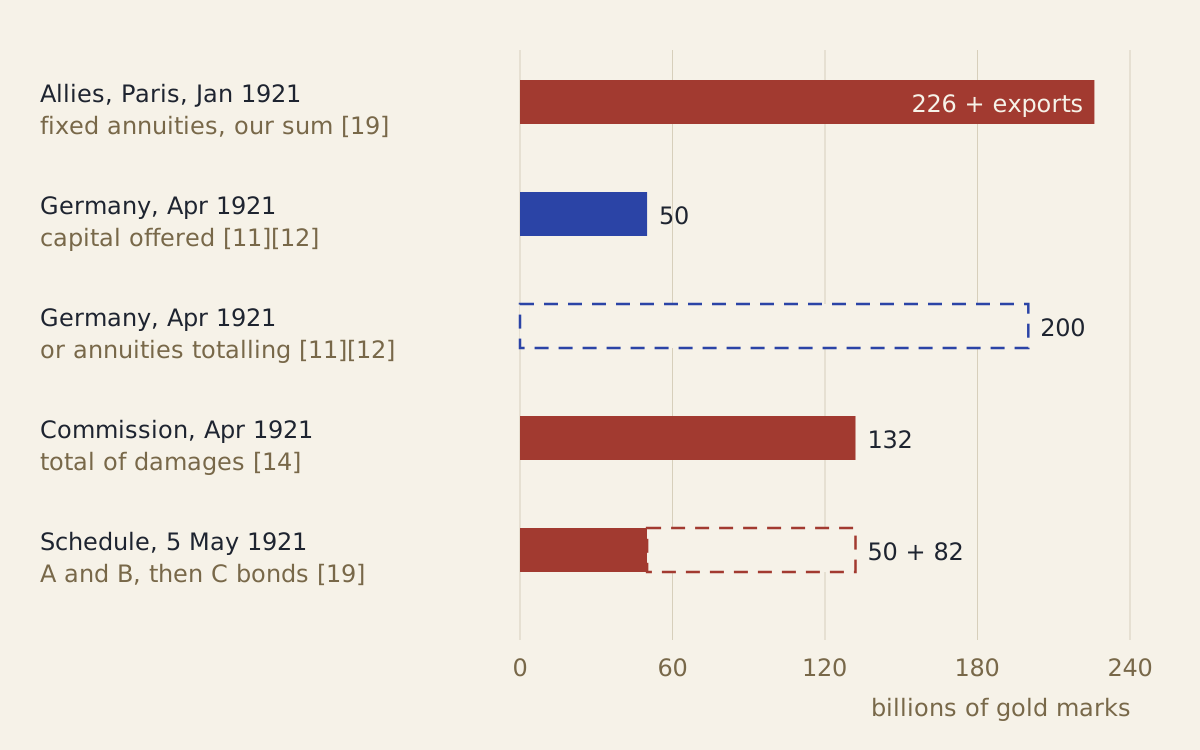
Figure: Reparation figures named in 1921 by the Allies, Germany, the commission and the schedule, in billions of gold marks; the figures are of different kinds, as each label says, and dashed bars are alternatives or conditional parts.
Diagram: Treaties & Tradeoffs. CC BY 4.0. Open full size
Reuse credit
Diagram: Treaties & Tradeoffs, "Treaty of Versailles: reparation figures named in 1921" — https://treatiesandtradeoffs.com/negotiation/treaty-of-versailles/, CC BY 4.0 (https://creativecommons.org/licenses/by/4.0/)
Data: Papers Relating to the Foreign Relations of the United States, 1921, vol. II (1936), docs. 50, 58, 59; J. M. Keynes, A Revision of the Treaty (1922), Appendix of Documents, II, VI and VII, with our sum of the Paris annuities; accessed 2026-11-02, public domain

Figure: Illustration of a negotiation over a divided bill; it shows no real meeting, person or document.
Illustration: Treaties & Tradeoffs. Generated schematic image — not a photograph or historical record. © Treaties & Tradeoffs, all rights reserved.
Reported: On 27 April, by the telegram of the US ambassador in Paris, the commission told the German delegation it had decided “to fix at 132 billion gold marks” the damages due [14]. That was 4 days before the treaty deadline. Keynes prints the same decision under the date 30 April 1921 [19]. The commission left out Germany's separate duty to repay Belgium's war loans [14].
Reported: On 2 May, the United States told Germany that it could not see in the proposals “a basis for discussion acceptable to the Allied Governments” [15]. In a note dated 4 May, Germany replied that it could not now work out new proposals that would satisfy the Allies [16].
What could each side fall back on?
One way to read May 1921 is to start with each side's BATNA, the best alternative to a negotiated agreement, meaning what a side could do if the talks failed. This site uses it as an order of analysis, not as a rule that the side with the better alternative wins; the same order runs through the Cuban Missile Crisis replay.
Reported: The Allied fallback was written into their resolution of 5 May 1921. If Germany did not comply by 12 May, the Allies would proceed “to the occupation of the Valley of the Ruhr” and take other military and naval measures, in the text Keynes printed [17][19]. Germany had six days from receiving the commission's decision to declare that it would carry out its obligations “without reserve or condition” [17][19]. The window from 5 May to 12 May was 7 days.
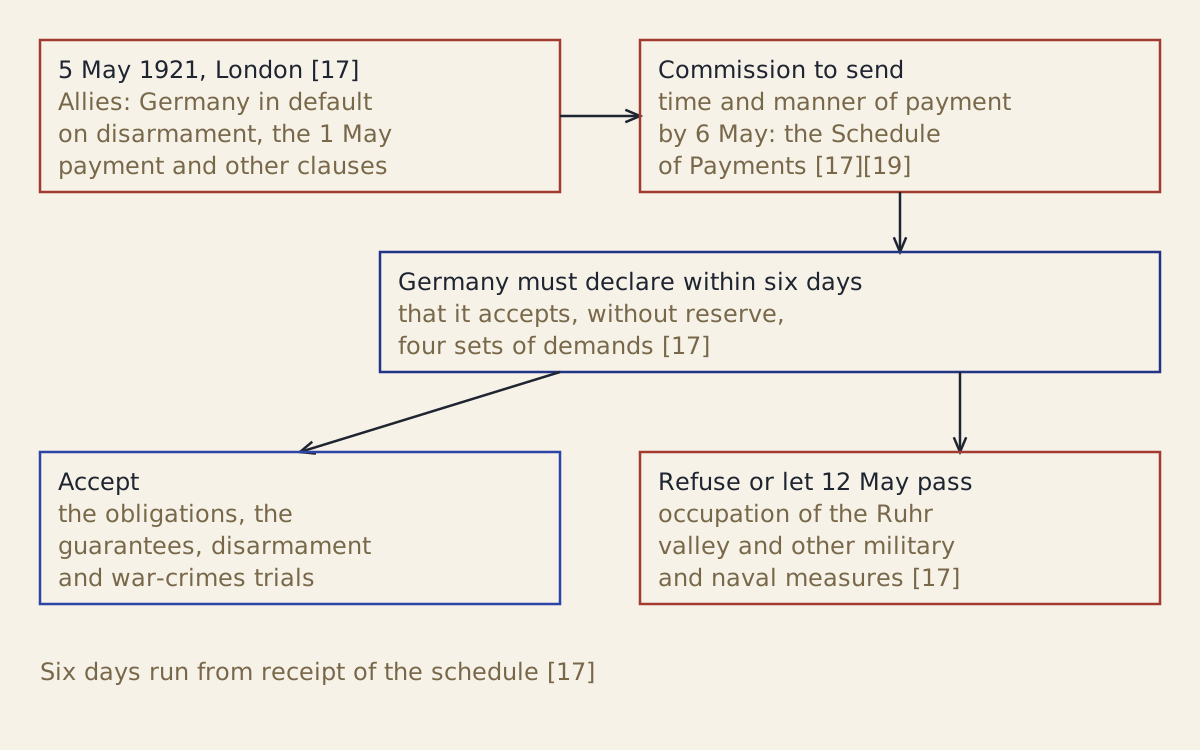
Figure: The London resolution of 5 May 1921 as a sequence: the demand, the commission's schedule, the six-day limit, and the two outcomes the resolution named.
Diagram: Treaties & Tradeoffs. CC BY 4.0. Open full size
Reuse credit
Diagram: Treaties & Tradeoffs, "Treaty of Versailles: the London resolution of 5 May 1921" — https://treatiesandtradeoffs.com/negotiation/treaty-of-versailles/, CC BY 4.0 (https://creativecommons.org/licenses/by/4.0/)
Data: Resolution of 5 May 1921, in Papers Relating to the Foreign Relations of the United States, 1921, vol. II (1936), doc. 64, and in J. M. Keynes, A Revision of the Treaty (1922), Appendix of Documents, VII; accessed 2026-11-02, public domain
The resolution as text
- The Allies declare Germany in default on disarmament, the payment due on 1 May 1921 under Article 235, war-crimes trials and other clauses [17].
- The Reparation Commission is to send the time and manner of payment by 6 May [17].
- Germany must declare within six days that it accepts, without reserve, the obligations and guarantees (without condition) and the disarmament measures and trials (without delay) [17].
- If it has not done so by 12 May, the Allies will occupy the Ruhr valley and take other military and naval measures [17].
Reported: Germany's appeal for American mediation had been refused, and its offer had been judged no basis for talks [9][15]. In March, the Allies had already decided to occupy Duisburg, Ruhrort and Düsseldorf as a sanction [7]. Simons, the German minister for foreign affairs who had put the April offer, told the US commissioner on 24 April that he had handed the Chancellor his resignation [10].
Reported: On 11 May 1921, the German ambassador in London handed the British Prime Minister a note in the name of a new German government [18]. It declared that Germany would carry out, without reserve or condition, the obligations defined by the Reparation Commission, and the British ambassador's covering letter described it as an unconditional acceptance [18].
Assessed: By May, Germany's fallback had narrowed. Apply what this site calls the known-then test, which scores a choice only on what its makers could know at the time, with each piece of that knowledge tied to a source. In the first week of May, Berlin knew the total, the threat to the Ruhr and the refusal from Washington, and had no new offer that its own note said could satisfy the Allies [14][15][16][17]. Reading the acceptance as either wise or weak from the start adds what we call the hindsight premium, the share of a decision's apparent wisdom or folly added only after the outcome is known.
How was the 132 billion bill split, and what happened next?
Reported: The Schedule of Payments, printed in full by Keynes, split the total into three series of bonds [19]. Germany was to deliver 12 billion gold marks of Series A bonds by 1 July 1921 and 38 billion of Series B by 1 November 1921 [19]. The last 82 billion, Series C, were to be delivered without coupons and issued only when the commission judged that Germany's payments could carry their interest and sinking fund [19].
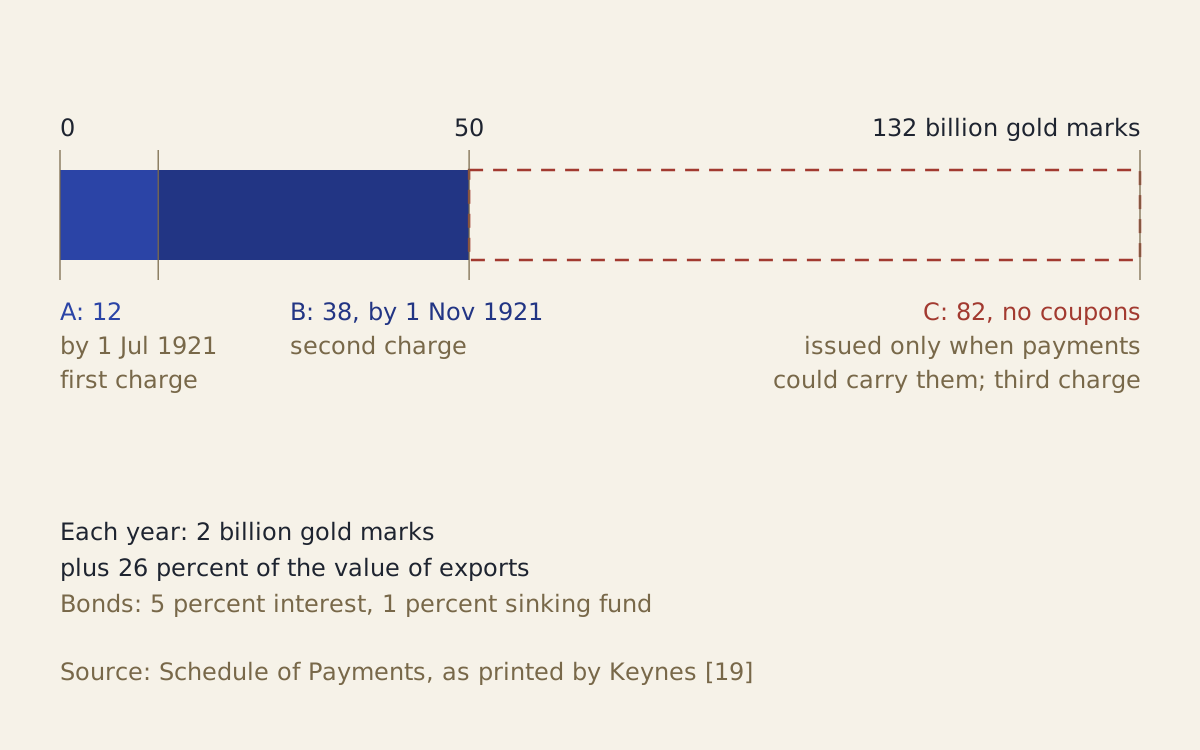
Figure: The Schedule of Payments of 5 May 1921 as Keynes printed it: Series A, B and C bonds, with the dashed part issued only on a later finding by the commission.
Diagram: Treaties & Tradeoffs. CC BY 4.0. Open full size
Reuse credit
Diagram: Treaties & Tradeoffs, "Treaty of Versailles: the Schedule of Payments of May 1921" — https://treatiesandtradeoffs.com/negotiation/treaty-of-versailles/, CC BY 4.0 (https://creativecommons.org/licenses/by/4.0/)
Data: Schedule of Payments, 5 May 1921, as printed in J. M. Keynes, A Revision of the Treaty (1922), Appendix of Documents, VII; accessed 2026-11-02, public domain
Reported: Each year, until the bonds were redeemed, Germany was to pay 2 billion gold marks plus a sum equal to 25 percent of the value of its exports, and a further 1 percent [19].
Reported, with our check: The two export shares make 26 percent, the figure Keynes also uses [19]. Series A and B together come to 50 billion gold marks, and A, B and C to 132 billion [19].
Reported: Keynes made a pointed observation about those 50 billion. The face value of the A and B bonds, he wrote, matched the sum at which Germany had offered in April to have its liability assessed [19]. He judged it probable that, sooner or later, the C bonds would be cancelled, not merely postponed [19].
Assessed: By the text of the schedule, the 132 billion had a working core of 50 billion and a conditional 82 billion. That reading follows the schedule's own terms for Series C. How much of the 82 billion anyone expected to be paid in 1921 is a question the sources read here answer only through Keynes, a critic of the whole settlement.
Reported: The sources read for this page jump to 1932. By the editors' note in the State Department's published papers, a Final Act was signed at the Lausanne Conference on 9 July 1932, 13 years after the treaty [21]. By a French government note of December 1932, the arrangement cut Germany's debt to a lump sum of three billion marks [22]. A side agreement initialed by the creditor governments said the Lausanne agreement would not take final effect until ratified [21].
Method: The sources read for this page give no total of what Germany actually paid between 1919 and 1932, so this page gives none. A debt between governments, set in gold marks across a currency collapse, has no matching wage series, so no sum here is converted into days of wages.
Assessed: Whether the reparations clauses helped bring on a second war is a separate question from what the treaty said. Keynes argued in 1919 that the settlement would do lasting harm, but his book is one side's case, and the sources read for this page stop in 1932 [20]. This page does not settle that question. On the narrower one, the record is plain: in June 1919 the treaty named an interim sum and a stack of security bonds, and left the total to 1921 [1].
Sources
- Treaty of Peace between the Allied and Associated Powers and Germany, signed at Versailles, 28 June 1919, Part VIII (Reparation), Articles 231–247 and Annexes I–VII. https://avalon.law.yale.edu/imt/partviii.aspRead: full text of Part VIII
- Treaty of Versailles, 28 June 1919, Part XIV (Guarantees), Articles 428–433. https://avalon.law.yale.edu/imt/partxiv.aspRead: full text of Part XIV
- Treaty of Versailles, 28 June 1919, Part XV (Miscellaneous Provisions) and final clauses. https://avalon.law.yale.edu/imt/partxv.aspRead: full text of Part XV and the final clauses
- Notes of a Meeting Held in President Wilson's House, Paris, 5 April 1919, 11 a.m. (IC-170H), in Papers Relating to the Foreign Relations of the United States: The Paris Peace Conference, 1919, vol. V (Washington: Government Printing Office, 1946), Document 3. https://history.state.gov/historicaldocuments/frus1919Parisv05/d3Read: full text of the notes
- Notes of a Meeting Held at President Wilson's House, Paris, 5 April 1919, 4 p.m. (IC-170I), in Papers Relating to the Foreign Relations of the United States: The Paris Peace Conference, 1919, vol. V (Washington: Government Printing Office, 1946), Document 4. https://history.state.gov/historicaldocuments/frus1919Parisv05/d4Read: full text of the notes
- Notes of a Meeting Held at Mr. Lloyd George's Flat, 23 Rue Nitot, Paris, 7 April 1919, 4 p.m. (IC-170K), in Papers Relating to the Foreign Relations of the United States: The Paris Peace Conference, 1919, vol. V (Washington: Government Printing Office, 1946), Document 6. https://history.state.gov/historicaldocuments/frus1919Parisv05/d6Read: full text of the notes
- The British Embassy to the Department of State, memorandum, Washington, 14 March 1921, in Papers Relating to the Foreign Relations of the United States, 1921, vol. II (Washington: Government Printing Office, 1936), Document 39. https://history.state.gov/historicaldocuments/frus1921v02/d39Read: full text
- The Commissioner at Berlin (Dresel) to the Secretary of State, telegram, 20 April 1921 (German memorandum asking the President to mediate), in Papers Relating to the Foreign Relations of the United States, 1921, vol. II (Washington: Government Printing Office, 1936), Document 44. https://history.state.gov/historicaldocuments/frus1921v02/d44Read: full text
- The Secretary of State to the Commissioner at Berlin (Dresel), telegram, 21 April 1921, in Papers Relating to the Foreign Relations of the United States, 1921, vol. II (Washington: Government Printing Office, 1936), Document 47. https://history.state.gov/historicaldocuments/frus1921v02/d47Read: full text
- The Commissioner at Berlin (Dresel) to the Secretary of State, telegram, 24 April 1921, in Papers Relating to the Foreign Relations of the United States, 1921, vol. II (Washington: Government Printing Office, 1936), Document 49. https://history.state.gov/historicaldocuments/frus1921v02/d49Read: full text
- The Commissioner at Berlin (Dresel) to the Secretary of State, telegrams of 24 and 25 April 1921 (German reparation proposals, sections 1 and 2), in Papers Relating to the Foreign Relations of the United States, 1921, vol. II (Washington: Government Printing Office, 1936), Documents 50 and 51. https://history.state.gov/historicaldocuments/frus1921v02/d50Read: full text of both sections
- The Commissioner at Berlin (Dresel) to the Secretary of State, telegram, 28 April 1921 (correction to clause 1 of the German memorandum), in Papers Relating to the Foreign Relations of the United States, 1921, vol. II (Washington: Government Printing Office, 1936), Document 58. https://history.state.gov/historicaldocuments/frus1921v02/d58Read: full text
- Memorandum by the Secretary of State of a Conversation with the Counselor of the French Embassy (De Béarn), 28 April 1921, in Papers Relating to the Foreign Relations of the United States, 1921, vol. II (Washington: Government Printing Office, 1936), Document 56. https://history.state.gov/historicaldocuments/frus1921v02/d56Read: full text
- The Ambassador in France (Wallace) to the Secretary of State, telegram, Paris, 28 April 1921, 9 p.m., in Papers Relating to the Foreign Relations of the United States, 1921, vol. II (Washington: Government Printing Office, 1936), Document 59. https://history.state.gov/historicaldocuments/frus1921v02/d59Read: full text
- The Secretary of State to the Commissioner at Berlin (Dresel), telegram, 2 May 1921, in Papers Relating to the Foreign Relations of the United States, 1921, vol. II (Washington: Government Printing Office, 1936), Document 61. https://history.state.gov/historicaldocuments/frus1921v02/d61Read: full text
- The Commissioner at Berlin (Dresel) to the Secretary of State, telegram, 5 May 1921 (German memorandum of 4 May), in Papers Relating to the Foreign Relations of the United States, 1921, vol. II (Washington: Government Printing Office, 1936), Document 63. https://history.state.gov/historicaldocuments/frus1921v02/d63Read: full text
- Resolution of the Supreme Council of the Allied Powers, London, 5 May 1921, in Papers Relating to the Foreign Relations of the United States, 1921, vol. II (Washington: Government Printing Office, 1936), Document 64. https://history.state.gov/historicaldocuments/frus1921v02/d64Read: full text
- The British Ambassador (Geddes) to the Secretary of State, Washington, 11 May 1921 (German note of acceptance), in Papers Relating to the Foreign Relations of the United States, 1921, vol. II (Washington: Government Printing Office, 1936), Document 65. https://history.state.gov/historicaldocuments/frus1921v02/d65Read: full text
- John Maynard Keynes, A Revision of the Treaty: Being a Sequel to The Economic Consequences of the Peace (New York: Harcourt, Brace and Company, 1922), including the Appendix of Documents. https://www.gutenberg.org/ebooks/46037Read: full text of the 1922 edition
- John Maynard Keynes, The Economic Consequences of the Peace (New York: Harcourt, Brace and Howe, 1920). https://www.gutenberg.org/ebooks/15776Read: full text of the 1920 American edition
- The Consul at Basel (Cochran) to the Secretary of State, telegram, 12 July 1932 (text of the Gentlemen's Agreement of 8 July), with the editors' note on the Final Act of the Lausanne Conference, in Foreign Relations of the United States: Diplomatic Papers, 1932, vol. I (Washington: Government Printing Office, 1948), Document 480. https://history.state.gov/historicaldocuments/frus1932v01/d480Read: full text, with the editors' notes
- The French Embassy to the Department of State, note of 1 December 1932 (translation), in Foreign Relations of the United States: Diplomatic Papers, 1932, vol. I (Washington: Government Printing Office, 1948), Document 516. https://history.state.gov/historicaldocuments/frus1932v01/d516Read: full text
Cite this page
Treaties & Tradeoffs. “Treaty of Versailles: It Set No Reparations Total in 1919.” published 2026-11-02. https://treatiesandtradeoffs.com/negotiation/treaty-of-versailles/. Accessed [the date you read it].
Plain citation; add the date you consulted the page. No DOI is assigned.