Patterns in StrategyCase review
Hannibal After Cannae: Livy Says Rome Turned His Envoy Away
Treaties & Tradeoffs Filed
After Hannibal destroyed a Roman army at Cannae in 216 BC, he sent a Carthaginian noble, Carthalo, toward Rome with envoys of the captives, Livy writes, to offer terms if Rome leaned toward peace. In Livy's account a lictor met Carthalo with the dictator's order to leave Roman territory before nightfall, and both Livy and Polybius report that the Senate refused to ransom the captives. Rome fought on for 14 more years, until Hannibal's defeat at Zama in 202 BC [1][4][5].
Order of business (6 sections)
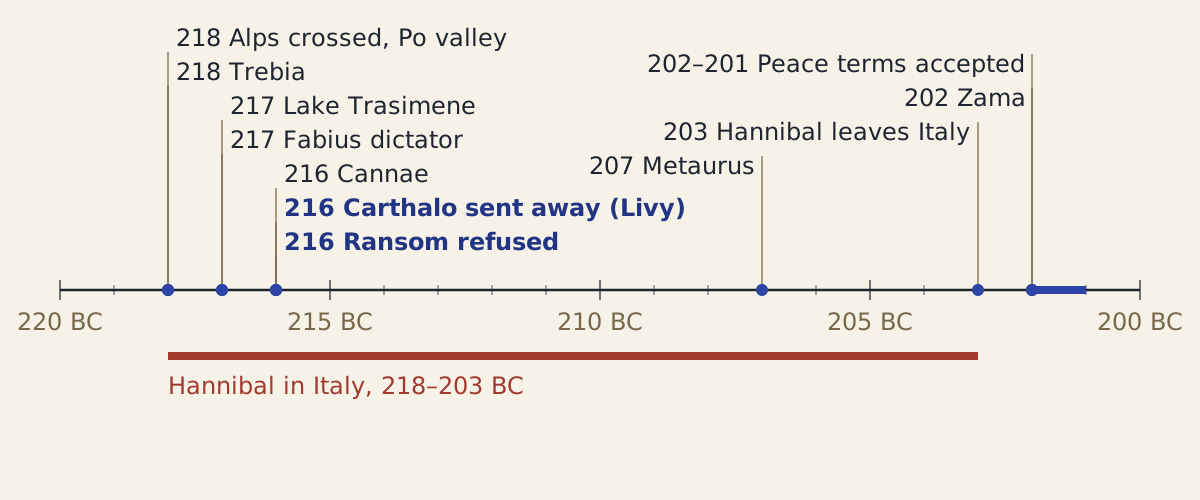
Figure: The war with Hannibal from his arrival in Italy in 218 BC to the peace of 202–201 BC, with years as dated in the margins of Shuckburgh's 1889 translation of Polybius.
Diagram: Treaties & Tradeoffs. CC BY 4.0. Open full size
Reuse credit
Diagram: Treaties & Tradeoffs, "The war with Hannibal, 218–201 BC" — https://treatiesandtradeoffs.com/patterns/hannibal/, CC BY 4.0 (https://creativecommons.org/licenses/by/4.0/)
Data: Polybius, The Histories, trans. Evelyn S. Shuckburgh (1889), Project Gutenberg eBooks #44125 and #44126, accessed 2026-11-02, public domain; Livy, The History of Rome, trans. D. Spillan and Cyrus Edmonds, Project Gutenberg eBooks #10907 and #12582, accessed 2026-11-02, public domain
The timeline as text
- 218 BC: Hannibal reaches the Po valley after five months on the march and 15 days in the Alps [4].
- December 218 BC: battle of the Trebia [4].
- 217 BC: battle at Lake Trasimene; Rome names Quintus Fabius dictator, and later that year gives Marcus Minucius equal power [4].
- 216 BC, at harvest time: battle of Cannae [1][4].
- 216 BC, days after the battle: in Livy's account, Carthalo is ordered out of Roman territory [1]; the Senate refuses to ransom the captives [1][4].
- 207 BC: battle of the Metaurus, where Hasdrubal, marching to join his brother, is defeated and falls [5].
- 203 BC: Hannibal leaves Italy for Africa [2][5].
- 202 BC: battle of Zama [5].
- 202–201 BC: Carthage accepts Scipio's terms on Hannibal's advice [5].
The timeline with a source for each row (CSV) Source and license notes (JSON) Data: Polybius, The Histories, trans. Evelyn S. Shuckburgh (1889), Project Gutenberg eBooks #44125 and #44126, accessed 2026-11-02, public domain; Livy, The History of Rome, trans. D. Spillan and Cyrus Edmonds, Project Gutenberg eBooks #10907 and #12582, accessed 2026-11-02, public domain
In 216 BC, days after Cannae, a Carthaginian noble set out for Rome to learn whether it would talk. Hannibal had just destroyed the Roman army in the field, and he sent Carthalo along with ten Roman prisoners who had sworn to come back [1]. The prisoners were to ask the Senate to buy them back. Carthalo, Livy writes, was to offer terms “if perchance their minds were inclined towards peace” [1].
What happened at Cannae?
Reported: Polybius, a Greek statesman born around 203 BC by his translator's reckoning, gives the fullest account [4]. At harvest time in 216 BC, he writes, Hannibal seized the citadel of Cannae, where the Romans stored grain from the district, and the Senate ordered its consuls to give battle [4]. The Romans drew up 80,000 foot and a little more than 6,000 horse, facing south, with their own cavalry on the right along the river Aufidus and their maniples packed deeper than usual [4]. Hannibal had not more than 40,000 foot and 10,000 horse, and he set his Iberian and Celtic foot in a crescent that bulged toward the Romans, with Libyan heavy infantry on either side [4].
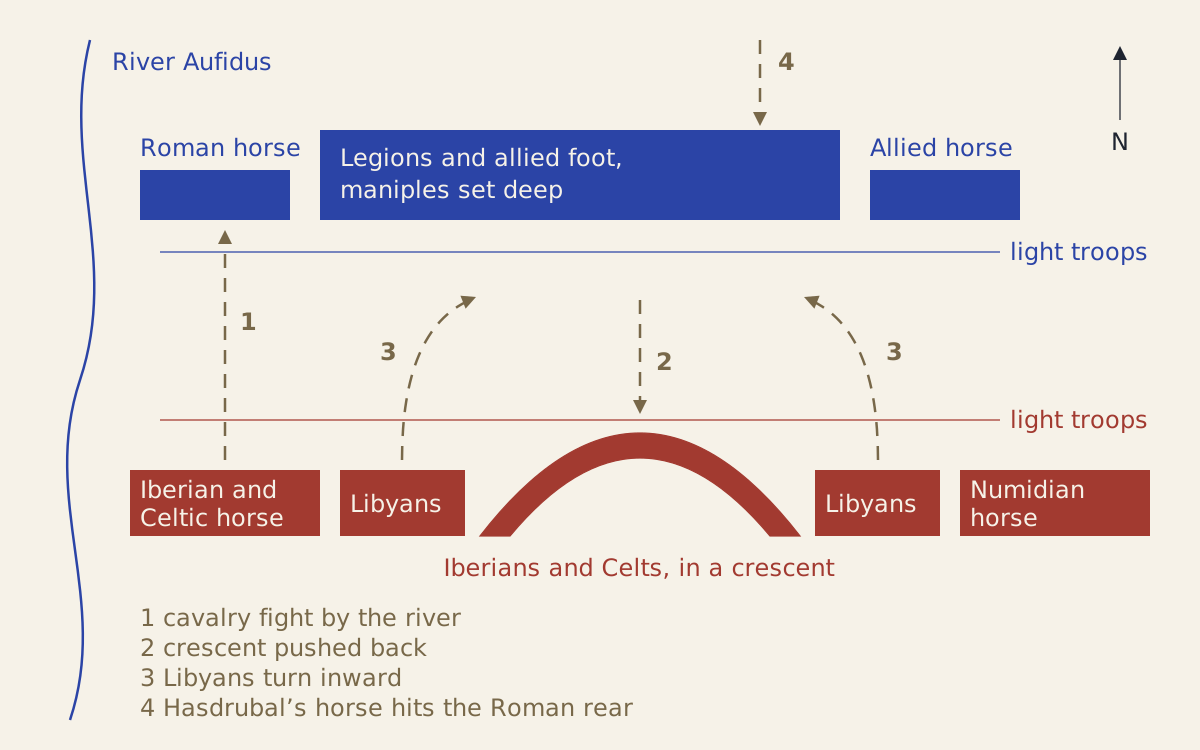
Figure: The lines at Cannae as Polybius describes them, with the later moves numbered; relative positions only, not to scale.
Diagram: Treaties & Tradeoffs. CC BY 4.0. Open full size
Reuse credit
Diagram: Treaties & Tradeoffs, "The lines at Cannae, after Polybius" — https://treatiesandtradeoffs.com/patterns/hannibal/, CC BY 4.0 (https://creativecommons.org/licenses/by/4.0/)
Data: Polybius, The Histories 3.113–116, trans. Evelyn S. Shuckburgh (1889), Project Gutenberg eBook #44125, accessed 2026-11-02, public domain
The battle order as text
- Roman right, by the river: Roman horse [4].
- Roman centre: legions and allied foot, with maniples deeper than their front [4].
- Roman left: allied horse; light troops in front of the whole line [4].
- Carthaginian left, by the river: Iberian and Celtic horse under Hasdrubal [4].
- Carthaginian centre: Iberian and Celtic foot in a crescent, with half the Libyans on each side [4].
- Carthaginian right: Numidian horse, under Hanno in Polybius and under Maharbal in Livy [1][4].
- Move 1: Hasdrubal's horse beats the Roman horse by the river [4].
- Move 2: the Roman foot pushes the crescent back [4].
- Move 3: the Libyans on each side turn inward onto the Roman flanks [4].
- Move 4: Hasdrubal's horse, after helping scatter the allied horse, charges the legions from behind [4].
Reported: The battle went as Hannibal had planned, in Polybius's telling. The Roman foot broke the crescent and pressed into the gap, the Libyans closed on both flanks, and Hasdrubal's cavalry, done with the Roman horse, struck the legions from the rear [4]. Livy follows the same outline, though he names Maharbal, not Hanno, as commander of the Carthaginian right [1]. He also adds a detail Polybius lacks: a wind the local people called the Vulturnus blew clouds of dust into the Romans' faces, so that they could not see far [1].
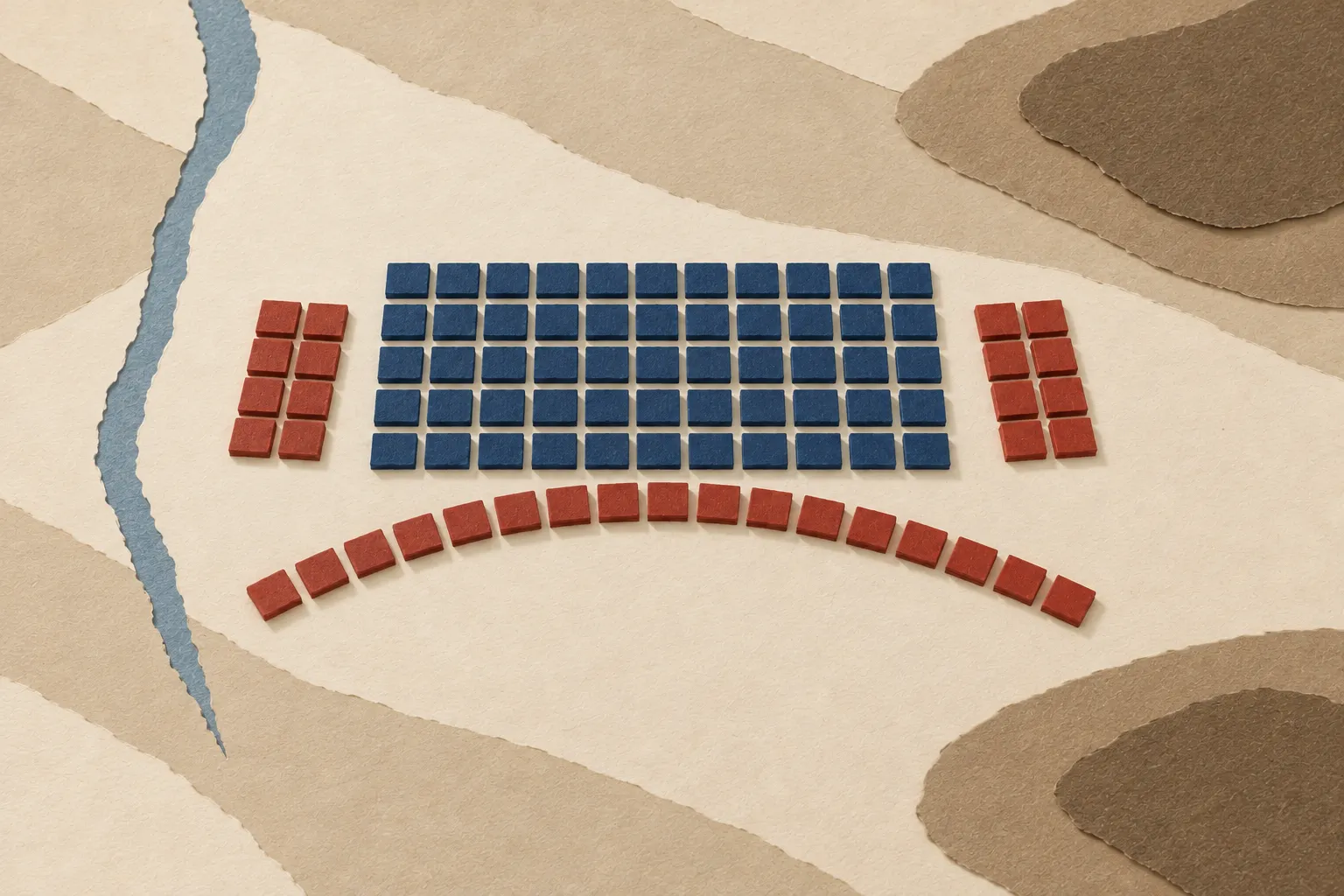
Figure: A sand-table sketch of a crescent line, with groups on both flanks, closing on a deep block: the shape Polybius describes at Cannae.
Illustration: Treaties & Tradeoffs. Generated schematic image — not a photograph or historical record. © Treaties & Tradeoffs, all rights reserved.
Assessed: On the sources we read, the tactics are hard to fault. In this site's terms, Cannae was an operational victory, a win in a battle or campaign, which is not the same thing as a strategic victory, a win in the war. The rest of this page tests whether that gap is a pattern or just this case.
How many died at Cannae?
Reported: Polybius says that of about 6,000 Roman horse, only 70 escaped with the consul Varro and about 300 allied horsemen reached nearby towns. Of the foot in the battle, perhaps 3,000 escaped and the rest died, to the number of 70,000 [4]. Another 10,000 had been left to guard the Roman camp; Hannibal killed 2,000 of them and took the rest, that is, 8,000, the figure Polybius gives in a later book [4].
Reported: Polybius gives no count of Roman horsemen killed. On Hannibal's side he counts 4,000 Celts, 1,500 Iberians and Libyans and about 200 horse, which adds up to 5,700 [4].
Reported: Livy gives smaller Roman figures and a larger Carthaginian one. The Latin text of the Oxford edition reads 45,500 foot and 2,700 horse killed, 3,000 foot and 1,500 horse taken in the battle, and about 8,000 of Hannibal's men dead [3]. The 19th-century English translation by Spillan and Edmonds prints 40,000 foot killed and 300 horse captured at the same places; this page follows the Latin [1][3].
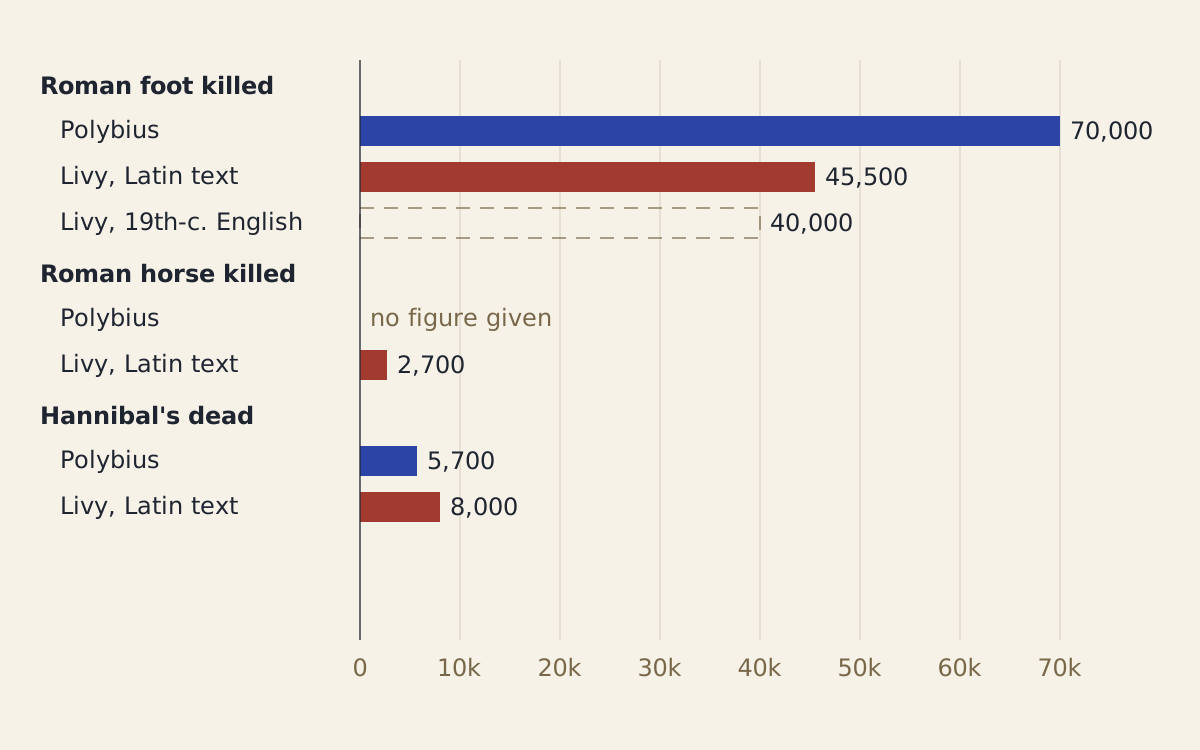
Figure: Deaths at Cannae in Polybius and in Livy, with the 19th-century English translation of Livy shown as a dashed bar where it differs from the Latin.
Diagram: Treaties & Tradeoffs. CC BY 4.0. Open full size
Reuse credit
Diagram: Treaties & Tradeoffs, "Deaths at Cannae in Polybius and Livy" — https://treatiesandtradeoffs.com/patterns/hannibal/, CC BY 4.0 (https://creativecommons.org/licenses/by/4.0/)
Data: Polybius, The Histories 3.117, trans. Evelyn S. Shuckburgh (1889), Project Gutenberg eBook #44125, accessed 2026-11-02, public domain; Livy 22.49 and 22.52, Latin text ed. C. F. Walters and R. S. Conway (Oxford, 1929), figures only, accessed 2026-11-02; Livy 22.49, trans. D. Spillan and Cyrus Edmonds, Project Gutenberg eBook #10907, accessed 2026-11-02, public domain
Reported, with our check: Polybius's own parts do not quite close. His 70,000 dead, about 3,000 escaped and 10,000 in the camp add up to 83,000, against the 80,000 foot he gives for the army, and he does not say whether the camp guard is inside that 80,000 [4]. The captives' spokesman in Livy put the dead at 50,000 when he spoke to the Senate [1][3].
Assessed: The sources disagree. Neither count can be settled from the texts we read. On any of them, the Senate faced tens of thousands of dead from a single day.
Assessed: The two writers deserve different kinds of trust. Polybius was born about 13 years after the battle, and for Hannibal's numbers in 218 BC he cites a bronze tablet that Hannibal himself set up, which Polybius says he found [4]. But he also tells the ransom story, in his own words, as “a practical illustration of the perfection and power of the Roman polity,” so his account of the Senate has a thesis to prove [4]. Livy, born in 59 BC, wrote nearly two centuries after the battle, drew on earlier writers he does not always name, and says openly when they disagree, as he does over the captives [1].
Every casualty figure, with its source (CSV) Source and license notes (JSON) Data: Polybius, The Histories 3.113–117, 6.58 and 15.14, trans. Evelyn S. Shuckburgh (1889), Project Gutenberg eBooks #44125 and #44126, accessed 2026-11-02, public domain; Livy 22.49, 22.52 and 22.59, Latin text ed. C. F. Walters and R. S. Conway (Oxford, 1929), figures only, accessed 2026-11-02; Livy 22.49, trans. D. Spillan and Cyrus Edmonds, Project Gutenberg eBook #10907, accessed 2026-11-02, public domain
Why did Rome refuse to talk?
Reported: In Livy's account, the first firm news in Rome was a letter from Varro. His colleague Aemilius Paulus and the army were dead, he was at Canusium gathering about 10,000 scattered men, and Hannibal was still at Cannae, bargaining over the price of captives and booty [1][3]. The Senate limited public mourning to 30 days, sent Marcus Claudius Marcellus to take over the army, and had a dictator, Marcus Junius, named [1].
Reported: Junius, Livy writes, enrolled young men from the age of 17 into four new legions and 1,000 horse, and Marcellus sent 1,500 men from the fleet to guard the city [1][3]. The state also bought 8,000 slaves and armed them, after asking each one whether he was willing to serve [1][3]. Livy notes that the Senate preferred these troops even though it could have ransomed the captives for less [1].
Reported: Hannibal, meanwhile, let the captives choose ten envoys and set a ransom. In Livy's Latin the price was 500 quadrigati for a horseman, 300 for a foot soldier and 100 for a slave; the English translation turns the coin into denarii [1][3]. When word came that the party had reached Rome, a lictor met Carthalo with the dictator's words: leave Roman territory before night [1].
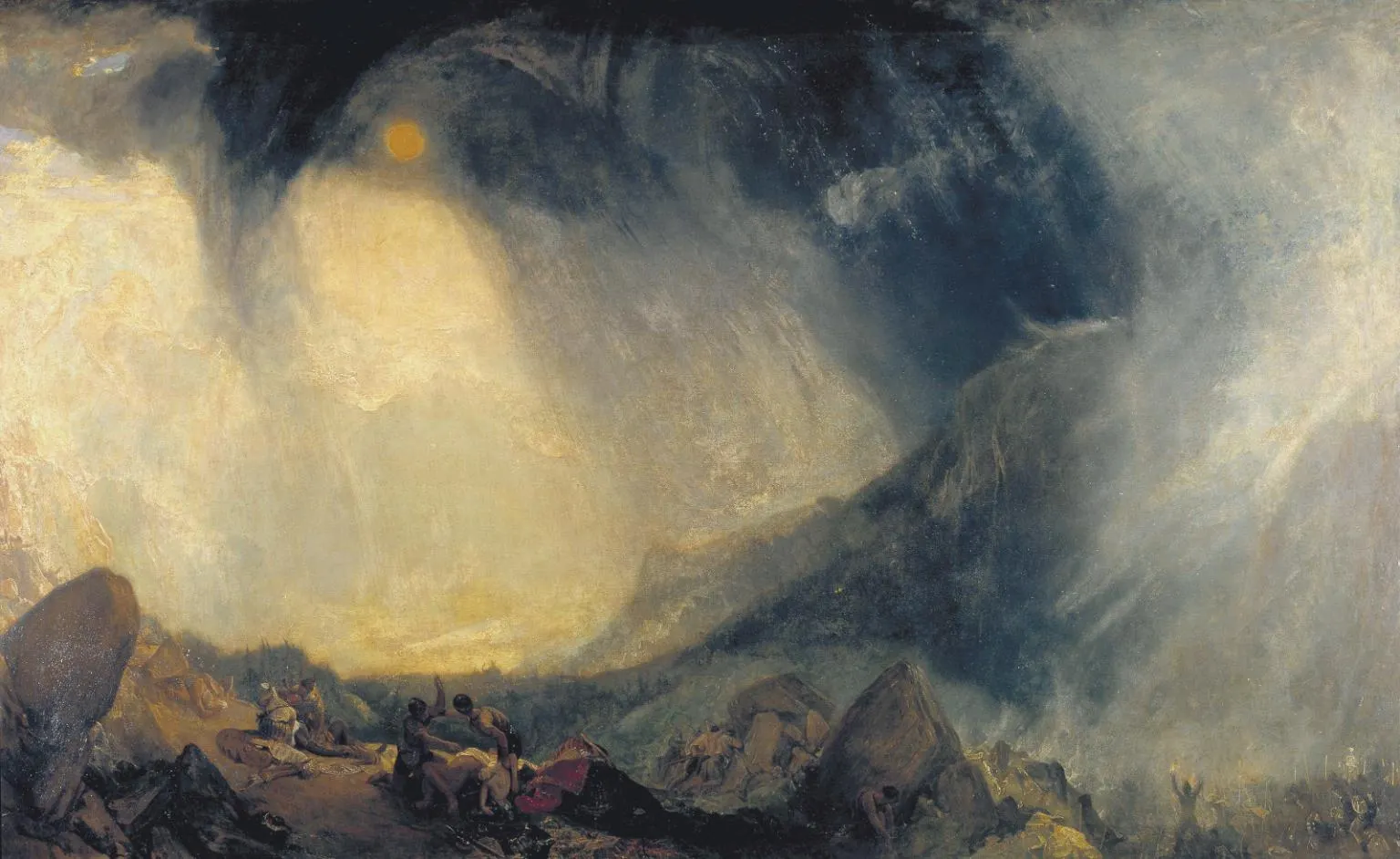
Figure: Snow Storm: Hannibal and his Army Crossing the Alps, oil on canvas by J. M. W. Turner, 1810–12 (Tate, London).
“Snow Storm: Hannibal and his Army Crossing the Alps” by J. M. W. Turner. Public Domain Mark.
Full credit
"Snow Storm: Hannibal and his Army Crossing the Alps" by J. M. W. Turner — https://commons.wikimedia.org/wiki/File:Joseph_Mallord_William_Turner_081.jpg — Public domain (J. M. W. Turner d. 1851; painted 1810–1812; US and EU: author died more than 70 years ago; faithful reproduction of a two-dimensional work, Tate N00490)

Reported: The Senate then heard the envoys. Some senators wanted the captives ransomed at public cost, Livy writes, and others proposed loans to their families, before Titus Manlius Torquatus argued that men who had surrendered did not deserve it [1]. In the end, by Livy's account, the Senate would neither drain a treasury already spent on slaves nor hand Hannibal money he was reported to need, and it refused [1]. Polybius, who does not mention Carthalo, gives the ransom as three minae a head and reports the same refusal [4].
Reported: Livy also found another version, in which the Senate first debated whether to admit the envoys at all, and he admits that the authors differ too much to fix the truth [1]. Polybius gives his own reason for the refusal: the Senate saw through Hannibal's purpose, which was to raise money and to show the troops facing him that even the beaten could hope to get home, so it set the rule that Roman soldiers must win or die [4].
Reported: Livy closes the episode with a broader claim. Even with the losses and the defections of allies, he writes, no mention of peace was made in Rome, either before Varro returned to the city or after, and crowds of every rank went out to thank the defeated consul because he had not despaired of the Republic [1].
Method: We do not convert the ransom into days' wages, because we found no readable wage series for Rome in 216 BC; the sums stay in Livy's quadrigati and Polybius's minae.
Did the Senate know enough to say no?
The card at the top of this page applies what this site calls the known-then test: score the choice only on what its makers could know at the time, with each piece of that knowledge tied to a source. You are in the Senate house in 216 BC, days after the battle. You hold a consul's letter, a list of new levies and a crowd of relatives at the door, and you do not know where Hannibal will march next.
Assessed: On that list, refusing to talk was not reckless. Rome still had about 10,000 men at Canusium, four legions forming, 8,000 slaves under arms, and rolls that had counted hundreds of thousands of men nine years before [1][4]. It was not free of risk either: Polybius writes that Rome had lost roughly all its allies at that moment, and Livy lists the peoples who went over to Hannibal [1][4]. Calling the refusal plainly wise is partly what this site calls the hindsight premium, the share of a decision's apparent wisdom or folly that is added only after the outcome is known; in 216 BC, Zama was 14 years away.
How many men could Rome call?
Reported: Polybius sets out the figures in his second book, under the year 225 BC, when Rome feared a Gallic invasion and ordered lists of every citizen of military age, so that readers can see “how great the power was which Hannibal subsequently ventured to attack” [4]. He names the armies in the field, the reserves in Rome and the rolls sent in by the allied peoples. He puts the men able to bear arms, Romans and allies, at “over 700,000 foot and 70,000 horse,” and Hannibal's force when he invaded Italy at less than 20,000 [4]. The list dates from 9 years before Cannae: it counts men who could be called up, not an army Rome had in the field in 216 BC.
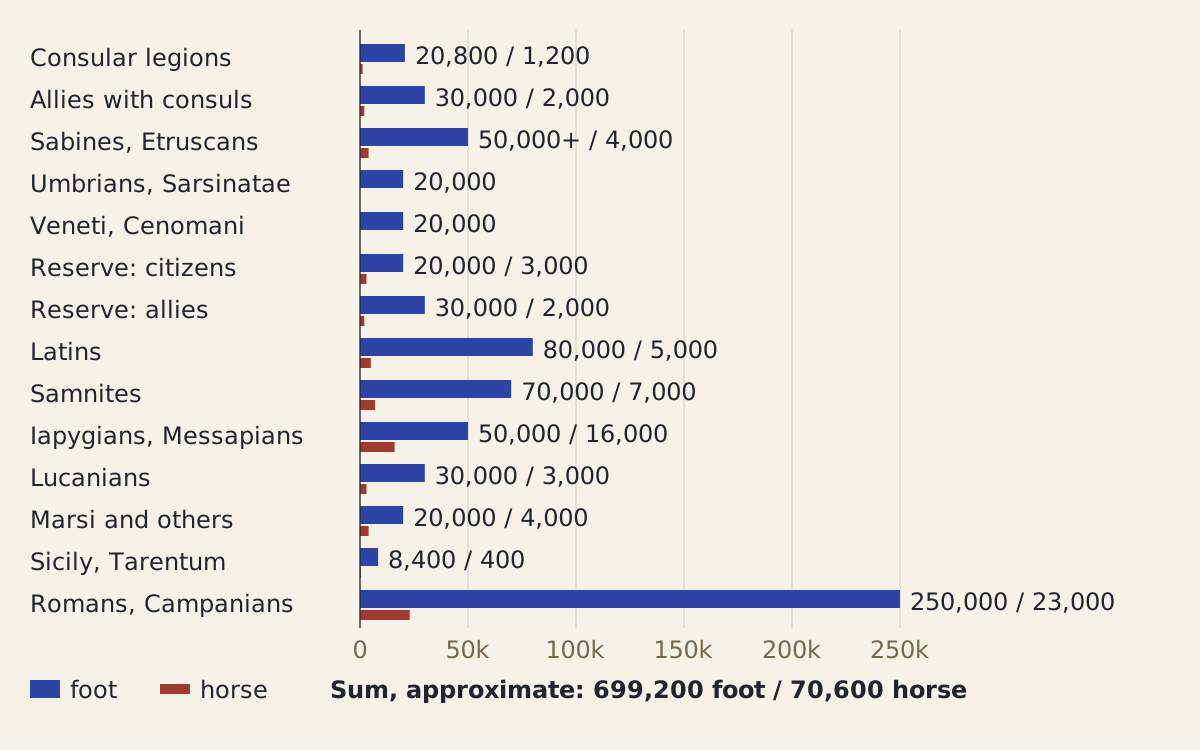
Figure: Polybius's list of 225 BC, line by line, in foot and horse; two lines that give no split are counted as foot.
Diagram: Treaties & Tradeoffs. CC BY 4.0. Open full size
Reuse credit
Diagram: Treaties & Tradeoffs, "Polybius's manpower list of 225 BC, line by line" — https://treatiesandtradeoffs.com/patterns/hannibal/, CC BY 4.0 (https://creativecommons.org/licenses/by/4.0/)
Data: Polybius, The Histories 2.24, trans. Evelyn S. Shuckburgh (1889), Project Gutenberg eBook #44125, accessed 2026-11-02, public domain
| Line in Polybius 2.24 | Foot | Horse |
|---|---|---|
| Consular legions (4 × 5,200 and 300) | 20,800 | 1,200 |
| Allies with the consuls | 30,000 | 2,000 |
| Sabines and Etruscans (foot: “more than”) | 50,000 | 4,000 |
| Umbrians and Sarsinatae (no split) | 20,000 | – |
| Veneti and Cenomani (no split) | 20,000 | – |
| Reserve in Rome: citizens | 20,000 | 3,000 |
| Reserve in Rome: allies | 30,000 | 2,000 |
| Rolls: Latins | 80,000 | 5,000 |
| Rolls: Samnites | 70,000 | 7,000 |
| Rolls: Iapygians and Messapians | 50,000 | 16,000 |
| Rolls: Lucanians | 30,000 | 3,000 |
| Rolls: Marsi, Marrucini, Ferentani, Vestini | 20,000 | 4,000 |
| Legions in Sicily and Tarentum (2 × about 4,200 and 200) | 8,400 | 400 |
| Rolls: Romans and Campanians | 250,000 | 23,000 |
| Sum of the 14 lines, our addition (approximate) | 699,200 | 70,600 |
| Polybius's stated total | over 700,000 | 70,000 |
Polybius's list with our sum (CSV) Source and license notes (JSON) Data: Polybius, The Histories 2.24, trans. Evelyn S. Shuckburgh (1889), Project Gutenberg eBook #44125, accessed 2026-11-02, public domain
Reported, with our check: We added Polybius's 14 lines. Read with the allies of the two consuls as one body of 30,000 foot and 2,000 horse, they come to 699,200 foot and 70,600 horse, close to his stated totals [4]. Read as 30,000 with each consul, which the English wording allows, the foot rises to 729,200.
Reported, with our check: Two lines say “more than” or “about,” and two give no split between foot and horse, so the sum is approximate, not exact. Shuckburgh notes that the editors Hultsch, Mommsen and Strachan-Davidson bracket the clause on the forces defending Rome, so we leave that clause out [4].
Assessed: The list does not show that Rome would win. It shows why the Senate could treat tens of thousands of dead as a loss from a pool that, on paper, held many times more. It says nothing about how many of those men Rome could arm, pay and lead in 216 BC.
What did Hannibal have in Italy?
Reported: Hannibal entered the Po valley in 218 BC with 12,000 Libyan and 8,000 Iberian foot and not more than 6,000 horse, Polybius writes, after five months on the march from New Carthage and 15 days in the Alps [4]. Polybius took those numbers from the record Hannibal set up on the promontory of Lacinium, a bronze tablet that Polybius says he found there himself [4]. At Cannae two years later, with Celtic allies in the line, the Carthaginian army stood at not more than 40,000 foot and 10,000 horse [4].
Reported, with our check: The Libyan and Iberian foot alone come to 20,000 before any horse is counted, while the second book puts Hannibal's whole force on entering Italy at less than 20,000 [4]. Polybius's two figures disagree. He does not reconcile them.
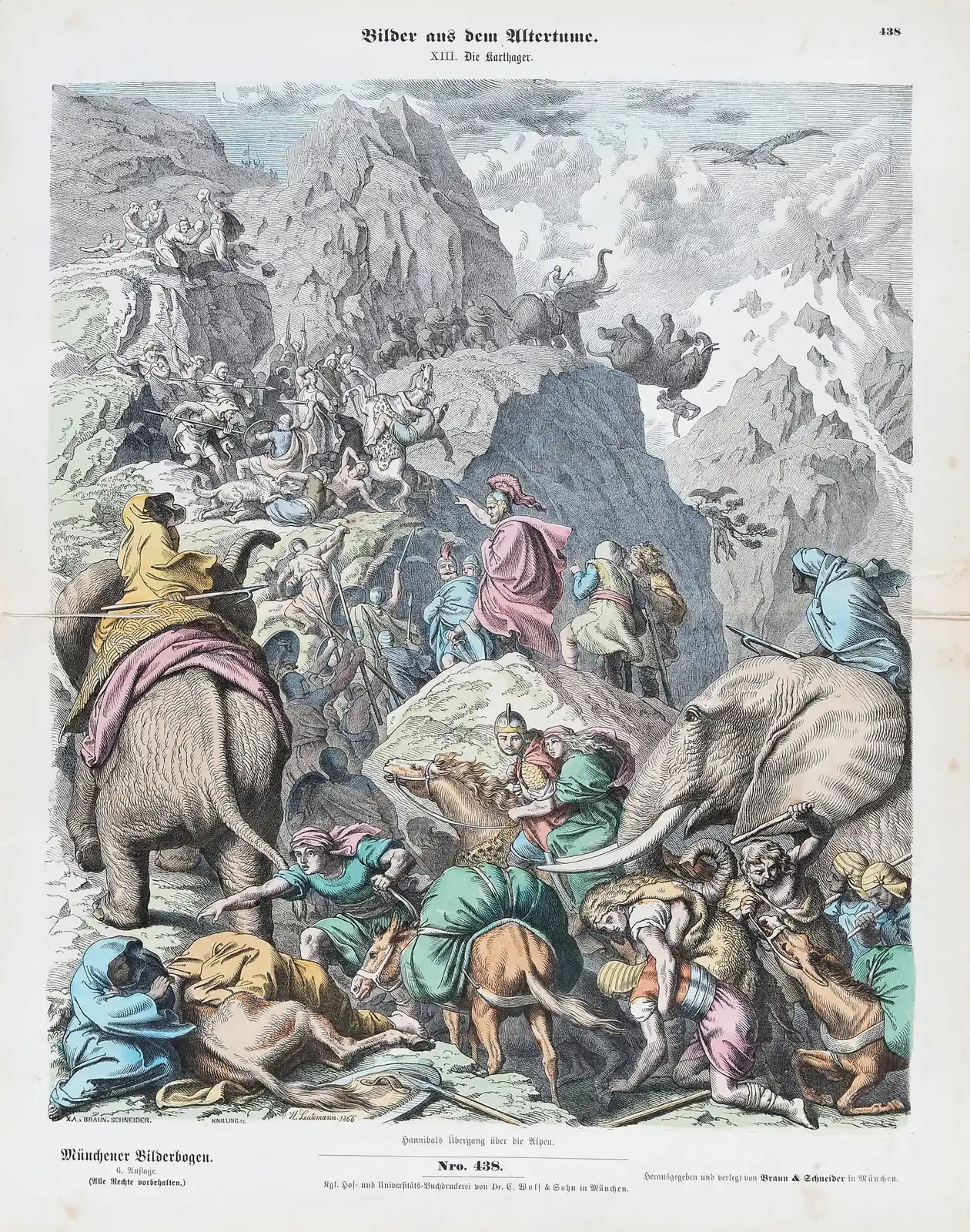
Figure: Hannibal's crossing of the Alps, a hand-coloured wood engraving by Heinrich Leutemann, published in the “Münchener Bilderbogen” in 1866.
"Hannibals Übergang über die Alpen" by Heinrich Leutemann — https://commons.wikimedia.org/wiki/File:Heinrich_Leutemann_-_Hannibals_%C3%9Cbergang_%C3%BCber_die_Alpen.jpg — Public domain (Heinrich Leutemann d. 1905; US: published 1866, before 1931; EU: author died more than 70 years ago; faithful reproduction of a two-dimensional work (Münchener Bilderbogen no. 438))

Reported: Livy tells a story from the day of the battle. Maharbal, Hannibal's cavalry commander, urged an immediate march on Rome and, when Hannibal asked for time to think, said: “You know how to conquer, Hannibal; but you do not know how to make use of your victory” [1]. Livy adds that the day's delay was firmly believed to have saved the city.
Reported: Polybius's account of the aftermath, in his third book, has no such scene [4]. What Polybius does report is the effect of the victory in the south: the Tarentines submitted at once, the people of Arpi and some Campanian towns invited Hannibal in, and the Carthaginians began to hope they could take Rome itself by assault [4].
Reported: Livy returns to the theme when Hannibal leaves Italy in 203 BC. In a speech he introduces with “It is said,” Hannibal blames the Carthaginian senate for cutting off his supplies and money; in a scene he introduces with “It is related,” Hannibal curses himself for not leading his troops to Rome straight from Cannae [2].
Assessed: The sources we read do not give Hannibal's own reasons for staying away from Rome in 216 BC, so this page does not score that choice. They do show the gap the Senate could see: a field army of not more than 50,000, far from home, against a state whose lists ran to hundreds of thousands. Livy's two scenes were written with the ending known, which is where the hindsight premium does most of its work.
Where does the pattern break?
Assessed: The pattern this page tests is that a crushing operational victory does not, by itself, win a war. Cannae fits it. Rome lost an army, refused to talk and fought on until 202 BC [1][4][5]. But Zama, fought 14 years later in Africa, is a counterexample from inside the same war.
Reported: At Zama in 202 BC, Polybius writes, Scipio's army killed over 20,000 Carthaginians and took almost as many prisoners, for a Roman loss of over 1,500 [5]. Before the battle, Hannibal had met Scipio to seek terms. Afterward Scipio set conditions that included handing over all warships but ten triremes, waging no war outside Libya and none inside it without Rome's consent, and paying 10,000 talents of silver over 50 years [5]. In a story Polybius passes on, Hannibal pulled down a Carthaginian senator who rose to oppose the terms and urged the assembly to accept; it did [5].
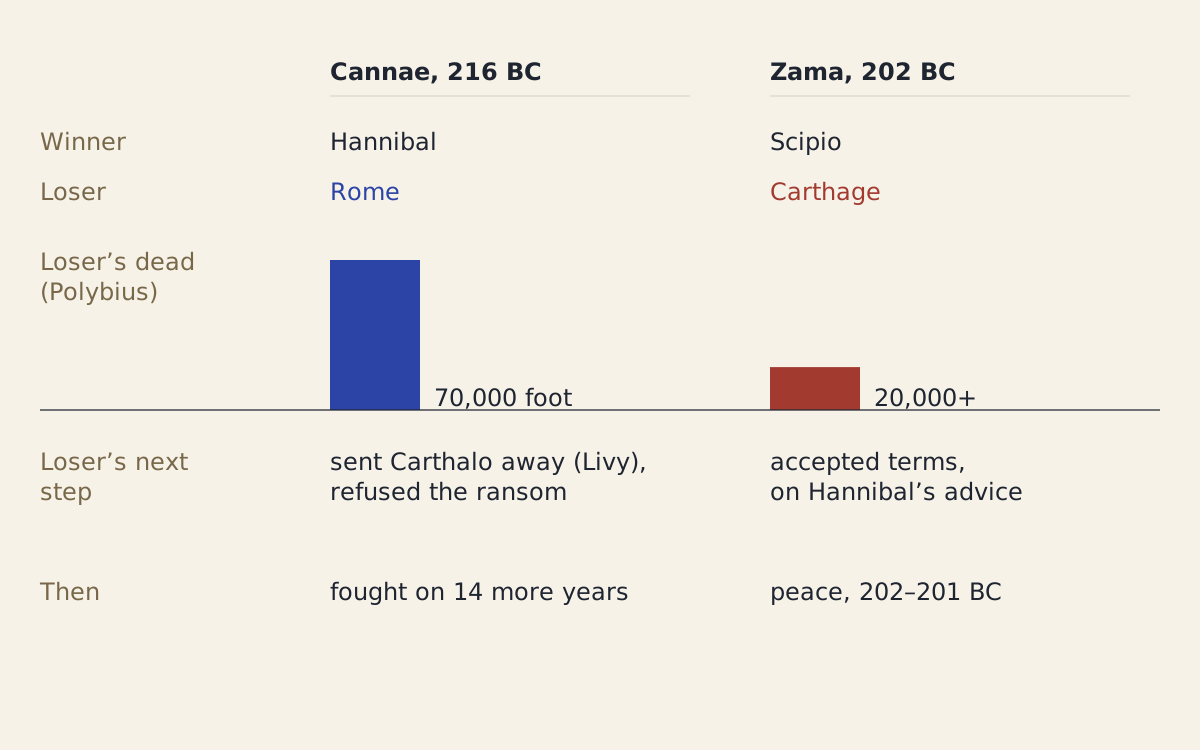
Figure: Cannae and Zama side by side: the loser's dead as Polybius counts them (for Cannae, the foot killed in the battle), and what the loser did next.
Diagram: Treaties & Tradeoffs. CC BY 4.0. Open full size
Reuse credit
Diagram: Treaties & Tradeoffs, "Cannae and Zama compared" — https://treatiesandtradeoffs.com/patterns/hannibal/, CC BY 4.0 (https://creativecommons.org/licenses/by/4.0/)
Data: Polybius, The Histories 3.117, 6.58 and 15.14–19, trans. Evelyn S. Shuckburgh (1889), Project Gutenberg eBooks #44125 and #44126, accessed 2026-11-02, public domain; Livy 22.58–61, trans. D. Spillan and Cyrus Edmonds, Project Gutenberg eBook #10907, accessed 2026-11-02, public domain
The comparison as text
- Cannae, 216 BC: Hannibal won; Rome lost 70,000 foot by Polybius's count [4].
- Rome's next step: in Livy's account, it sent Carthalo away [1]; both writers report that it refused the ransom [1][4].
- Then: Rome fought on for 14 more years [5].
- Zama, 202 BC: Scipio won; Carthage lost over 20,000 dead and almost as many prisoners [5].
- Carthage's next step: it accepted Scipio's terms on Hannibal's advice [5].
- Then: peace, in 202–201 BC [5].
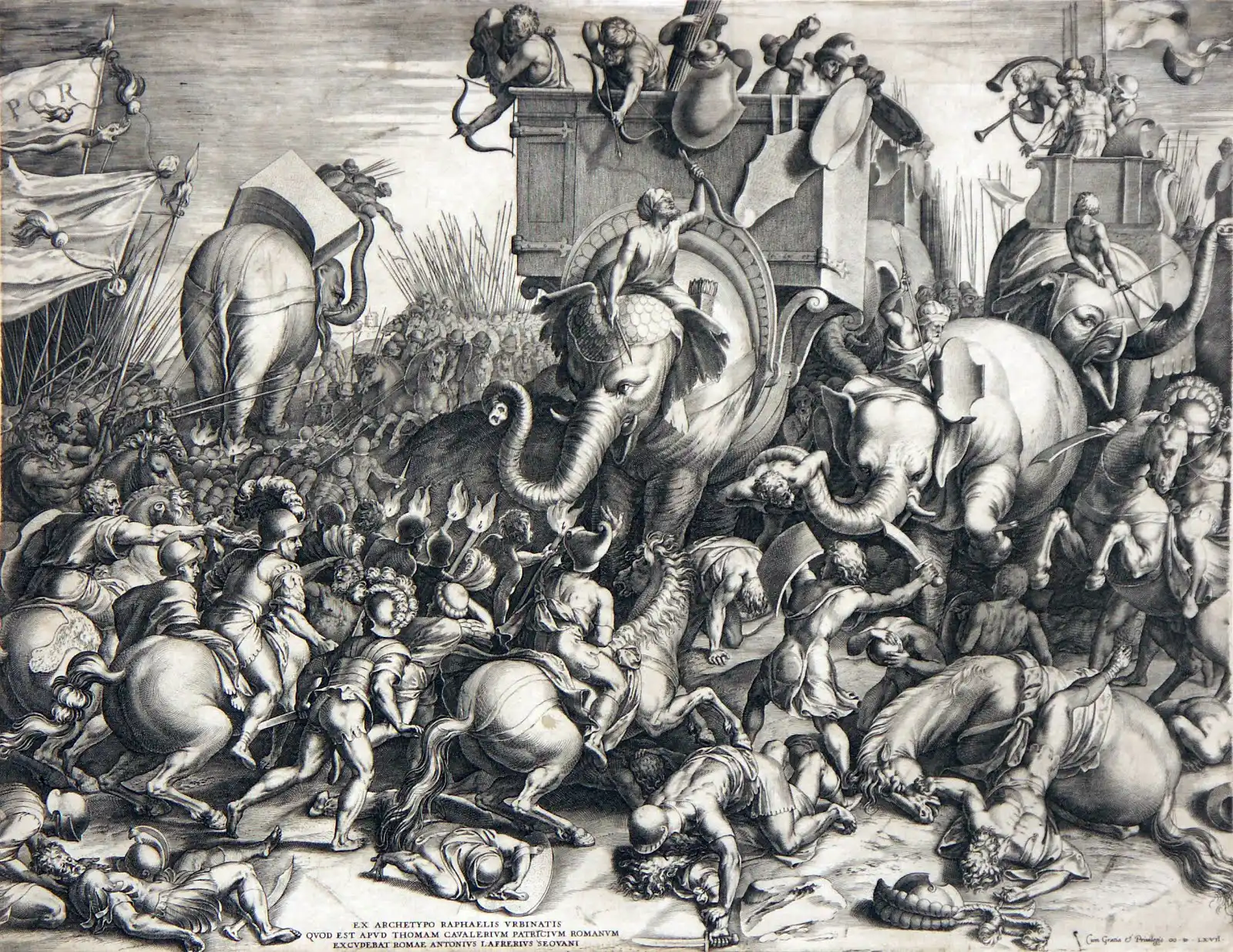
Figure: The Battle of Zama, engraving by Cornelis Cort, 1567, published in Rome by Antonio Lafreri; the inscription credits a design by Raphael (Hunterian Museum and Art Gallery).
"Battle of Zama" by Cornelis Cort — https://commons.wikimedia.org/wiki/File:Slaget_ved_Zama_-_Cornelis_Cort,_1567.jpg — Public domain (Cornelis Cort d. 1578; US: published 1567, before 1931; EU: author died more than 70 years ago; faithful reproduction of a two-dimensional work, Hunterian Museum and Art Gallery)

Assessed: So the pattern holds inside narrower limits than it first seems. In this war a single battle did end the fighting, once the beaten side's own leading general told its senate to accept terms. Rome in 216 BC had a government that refused talks and lists that held many times the men it had lost, and the pattern has nothing to say about a loser whose leaders choose to settle. Polybius credits Rome's refusal to its constitution, an explanation this site can neither confirm nor rule out from these texts [4].
Assessed: Refusing to talk did not end the war on its own, either. On the record read here, Rome defeated Hasdrubal's army at the Metaurus in 207 BC as it marched to join Hannibal, and the Carthaginians, pressed by Scipio's victories in Africa, called Hannibal home in 203 BC [2][5]. A refusal bought time; other campaigns used it.
Assessed: Rome's other answer to Hannibal came a year before Cannae, when Rome named Quintus Fabius dictator in 217 BC and he chose not to risk a battle [4]; how that command was later split is the subject of the Fabian strategy replay. The same known-then test is applied to a 20th-century defence plan in the Maginot Line replay.
Sources
- Livy, The History of Rome, Books 9–26, translated by D. Spillan and Cyrus Edmonds (19th century). Project Gutenberg eBook #10907. https://www.gutenberg.org/ebooks/10907Read: full text of book 22 in this translation
- Livy, The History of Rome, Books 27–36, translated by Cyrus Edmonds (1850). Project Gutenberg eBook #12582. https://www.gutenberg.org/ebooks/12582Read: book 30, chapter 20, in this translation
- Livy, Ab Urbe Condita, vol. 3, books 21–25, edited by C. F. Walters and R. S. Conway, Oxford Classical Texts (Oxford: Clarendon Press, 1929; reprinted with corrections). https://archive.org/details/titiliviaburbeco03livyRead: Latin text of book 22, chapters 49–59
- Polybius, The Histories of Polybius, vol. 1, translated by Evelyn S. Shuckburgh (London: Macmillan, 1889). Project Gutenberg eBook #44125. https://www.gutenberg.org/ebooks/44125Read: full text of books 2, 3 and 6 in this translation
- Polybius, The Histories of Polybius, vol. 2, translated by Evelyn S. Shuckburgh (London: Macmillan, 1889). Project Gutenberg eBook #44126. https://www.gutenberg.org/ebooks/44126Read: books 11 and 15 in this translation
Cite this page
Treaties & Tradeoffs. “Hannibal After Cannae: Livy Says Rome Turned His Envoy Away.” published 2026-11-02. https://treatiesandtradeoffs.com/patterns/hannibal/. Accessed [the date you read it].
Plain citation; add the date you consulted the page. No DOI is assigned.