Logistics & EconomicsLogistics arithmetic
Berlin Airlift: About Two-Thirds Coal, by Air Force Count
Treaties & Tradeoffs Filed
By the US Air Force's 1949 summary, the Berlin Airlift carried about 2.3 million tons into Berlin from 26 June 1948 to 30 September 1949, and approximately two-thirds of it was coal [1]. Food was approximately 20 percent in the summary's words, or 23.1 percent by our arithmetic from its own table. By weight, the planes carried far more coal than food.
Order of business (7 sections)
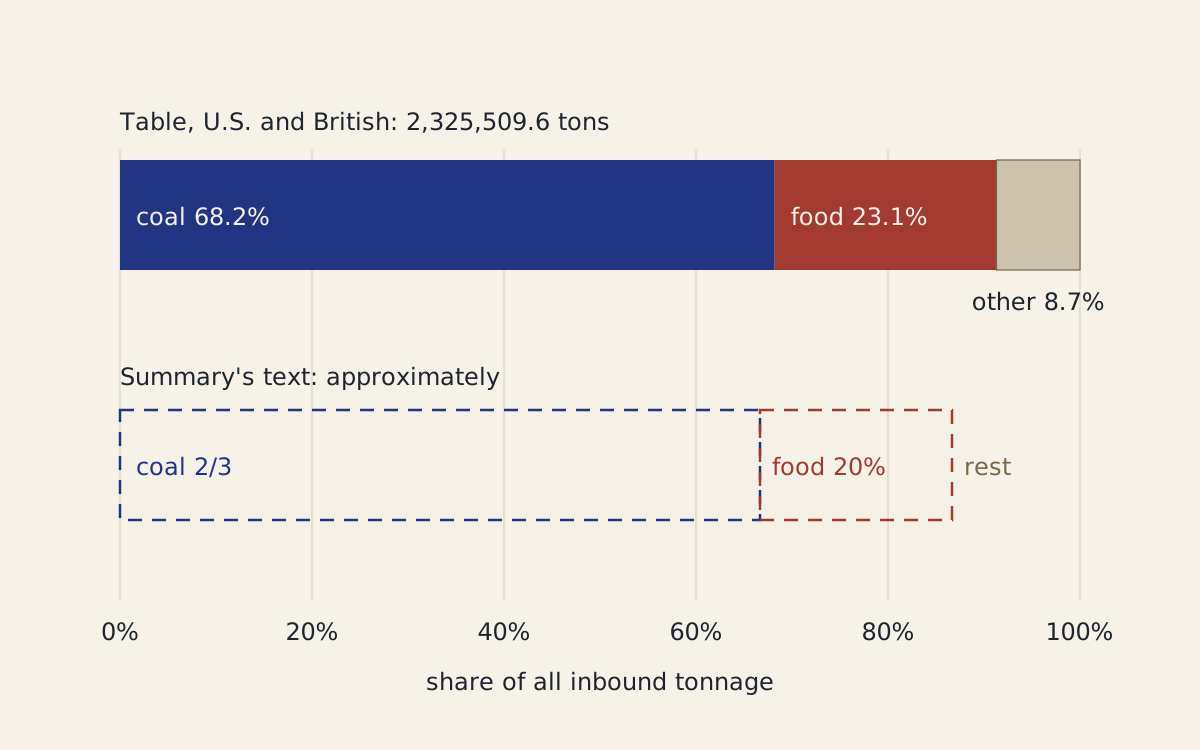
Figure: Inbound tonnage by commodity in the summary's table of combined US and British operations, set against the rounded shares its text gives, which are drawn as dashed outlines.
Diagram: Treaties & Tradeoffs. CC BY 4.0. Open full size
Reuse credit
Diagram: Treaties & Tradeoffs, "Berlin Airlift cargo by commodity: the summary table against its text" — https://treatiesandtradeoffs.com/logistics/berlin-airlift/, CC BY 4.0 (https://creativecommons.org/licenses/by/4.0/)
Data: Tonnage: Headquarters, U.S. Air Forces in Europe, Berlin Airlift: A USAFE Summary (1949), chart "Summary of combined operations" and the section Commodities Airlifted, accessed 2026-11-02, U.S. government work, public domain; shares are this site's arithmetic
The chart as text
- Table, US and British combined: 2,325,509.6 tons inbound [1].
- Coal: 1,586,029.3 tons, 68.2 percent of the total, by our arithmetic [1].
- Food: 536,705.3 tons, 23.1 percent [1].
- Other cargo: 202,775.0 tons, 8.7 percent [1].
- The summary's text: coal approximately 2/3, food approximately 20 percent [1].
On 25 June 1948, Soviet authorities announced they would not supply food to the Western sectors of Berlin. Some 2,500,000 people lived there, and surface traffic from the Western zones had already been suspended, by the account of US Air Forces in Europe (USAFE) [1]. Before the blockade, about 12,000 tons a day had reached the city by rail, barge and truck [1]. The airlift began the next day, and USAFE's own summary, issued in 1949, is the source of every tonnage on this page.
What did the Berlin Airlift carry?
Reported: The summary sums up the mission as “a total of 2.3 million tons of food, fuel, and supplies transported to Berlin” [1]. Its traffic chapter says that “coal constituted approximately 2/3 of all tonnage lifted” [1]. About 20 percent was food, and the rest ran from liquid fuel to mail, newsprint, machinery and empty sacks [1]. The summary warns that its figures cover US operations only unless it says otherwise, and this sentence does not say [1].
Reported, with our check: A table headed “Summary of combined operations,” on page 12 of the summary, gives the exact figures: 2,325,509.6 tons inbound [1]. US units carried 1,783,572.7 tons and British units 541,936.9, and for each the food, coal and other lines add up exactly to the total [1]. Adding the US and British lines, coal comes to 1,586,029.3 tons, or 68.2 percent, and food to 536,705.3 tons, or 23.1 percent. The text's two-thirds fits the table; its 20 percent for food runs about three points low, so this page gives both.
| Carrier | Coal, tons | Food, tons | Other, tons | Total, tons |
|---|---|---|---|---|
| US units | 1,421,118.8 (79.7%) | 296,319.3 (16.6%) | 66,134.6 (3.7%) | 1,783,572.7 |
| British units | 164,910.5 (30.4%) | 240,386.0 (44.4%) | 136,640.4 (25.2%) | 541,936.9 |
| Both, US plus British lines | 1,586,029.3 (68.2%) | 536,705.3 (23.1%) | 202,775.0 (8.7%) | 2,325,509.6 |
Tonnage by commodity, one claim per row (CSV) Source and license notes (JSON) Data: Headquarters, U.S. Air Forces in Europe, Berlin Airlift: A USAFE Summary (1949), chart "Summary of combined operations", Operations and Procedures, Introduction, and Traffic, Commodities Airlifted, accessed 2026-11-02, U.S. government work, public domain
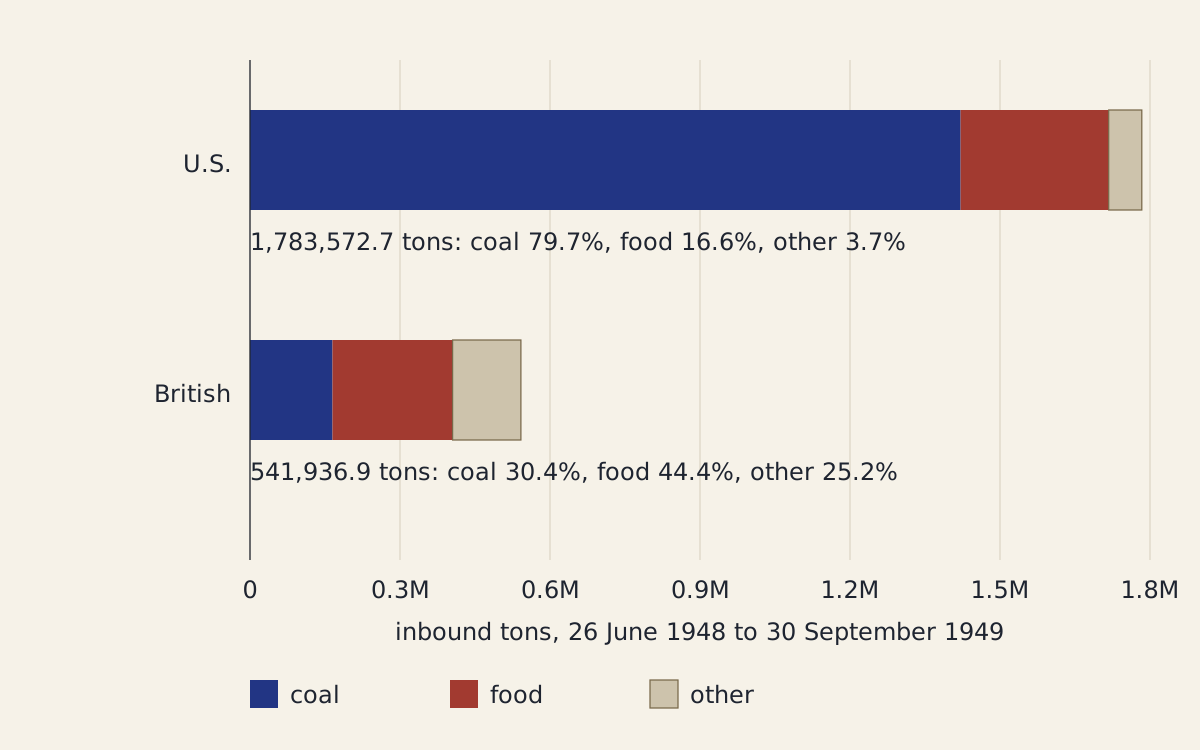
Figure: Inbound tonnage by commodity for US and British units over the whole airlift, from the summary's table of combined operations.
Diagram: Treaties & Tradeoffs. CC BY 4.0. Open full size
Reuse credit
Diagram: Treaties & Tradeoffs, "Berlin Airlift: inbound tonnage by commodity, US and British units" — https://treatiesandtradeoffs.com/logistics/berlin-airlift/, CC BY 4.0 (https://creativecommons.org/licenses/by/4.0/)
Data: Tonnage: Headquarters, U.S. Air Forces in Europe, Berlin Airlift: A USAFE Summary (1949), chart "Summary of combined operations", accessed 2026-11-02, U.S. government work, public domain; shares are this site's arithmetic
Assessed: The split by carrier shows why the round numbers need care. Coal was 79.7 percent of what US units flew in. British units carried more food than coal, and the summary says they “excelled in hauling specialized commodities such as liquid fuels” [1]. Two-thirds coal fits the combined lift, which is the reading this page takes.
How much did Berlin need each day?
Reported: USAFE's first task was to fix “the minimum amount of supplies required to sustain the life of the civilian and military population” [1]. The figure also had to keep the city's key industries partly running. Berlin's basic requirement was set at 4,500 tons per day, with strict rationing inside the city [1]. It was later raised to a minimum comfort requirement of 5,620 tons per day [1].
Method: We keep the summary's unit, the ton, and do not convert it to metric tonnes. Where the summary names the unit, in its chronology, it counts short tons of 2,000 pounds [1]. For figures per person we assume that weight. No prices appear in these sources, so nothing here is turned into days of wages.
Reported, with our conversion: The basic requirement was 37.5 percent of the approximately 12,000 tons a day that had come in before the blockade [1]. Spread over some 2,500,000 people, 4,500 tons is about 3.6 pounds a person a day, and 5,620 tons about 4.5 pounds [1]. Those pounds include coal, newsprint and the needs of the occupying forces, not food alone.
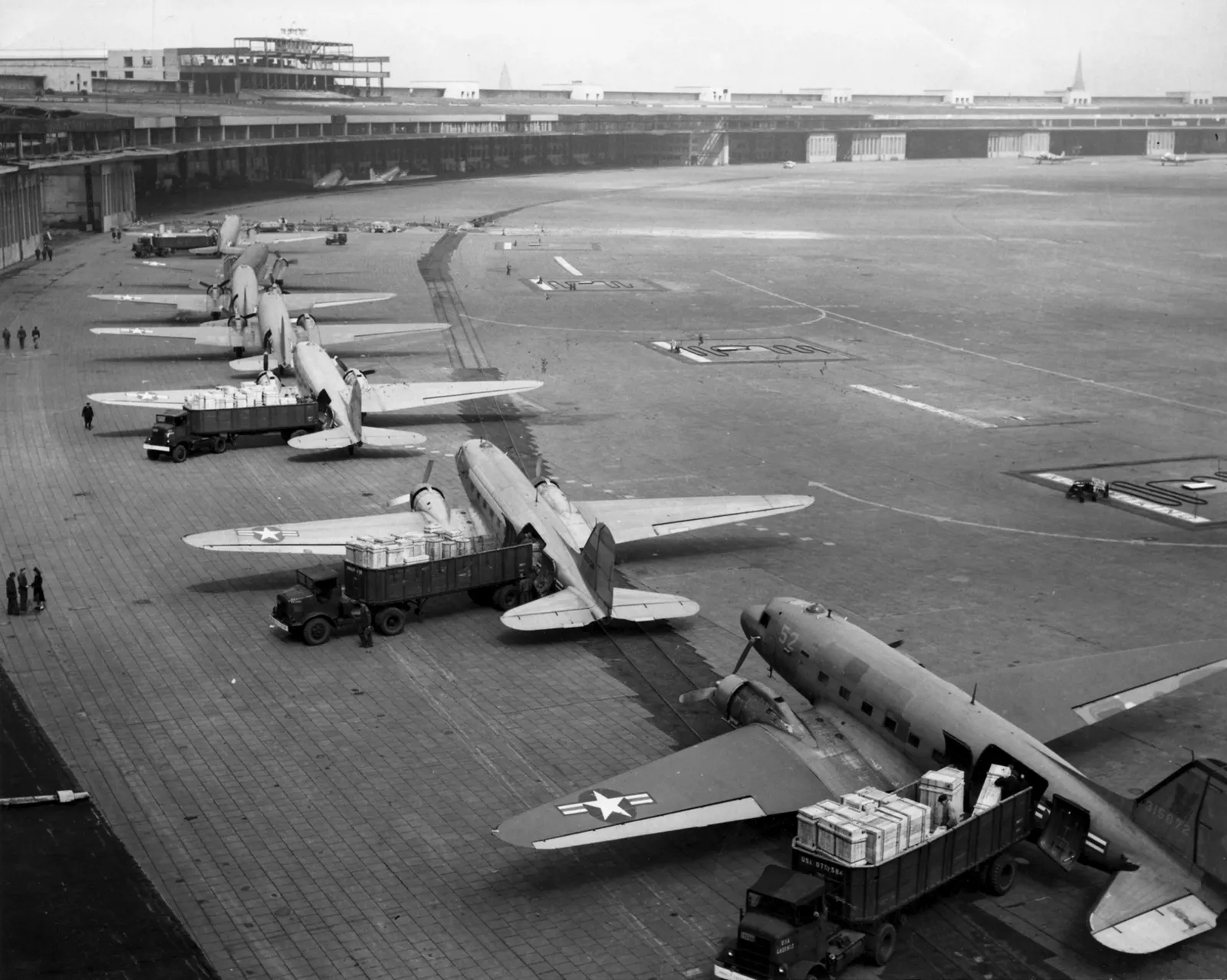
Figure: US Navy R4D and US Air Force C-47 aircraft unload at Tempelhof Airport during the Berlin Airlift, around 1948–49 (US Air Force photograph).
"C-47s at Tempelhof Airport Berlin 1948" by U.S. Air Force — https://commons.wikimedia.org/wiki/File:C-47s_at_Tempelhof_Airport_Berlin_1948.jpg — Public domain (U.S. federal government work, 17 U.S.C. §105; U.S. Air Force photograph, National Museum of the U.S. Air Force 050426-F-1234P-008; National Museum of Naval Aviation 2000.043.012)

Why was most of it coal?
Reported: In the 5,620-ton breakdown, coal for the German population came to 3,084 tons a day and food to 1,435 tons [1]. Then came commerce and industrial supplies at 255, newsprint at 35, liquid fuel at 16 and medical supplies at 2. Those six lines make a civilian subtotal of 4,827 tons. Another 763 tons a day were for the US, British and French military, and 30 for three passenger flights [1].
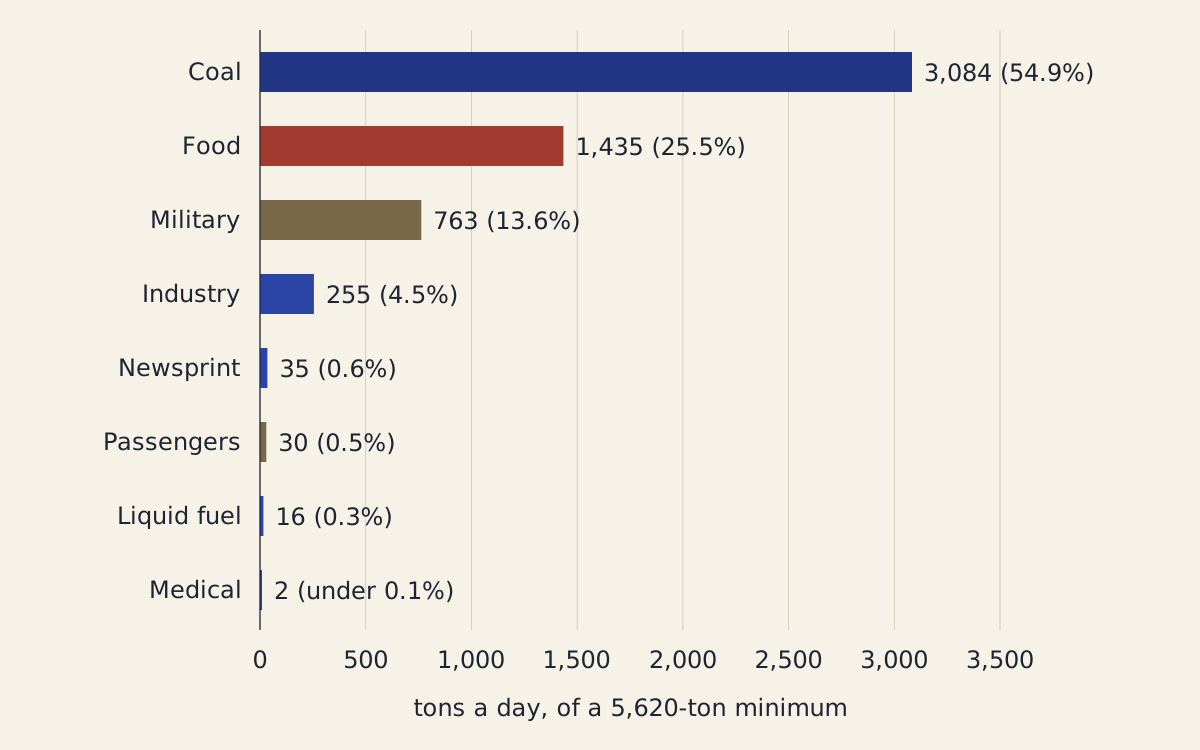
Figure: The minimum comfort requirement of 5,620 tons a day, line by line, as the summary's traffic chapter sets it out.
Diagram: Treaties & Tradeoffs. CC BY 4.0. Open full size
Reuse credit
Diagram: Treaties & Tradeoffs, "Berlin Airlift: the 5,620-ton daily minimum comfort requirement" — https://treatiesandtradeoffs.com/logistics/berlin-airlift/, CC BY 4.0 (https://creativecommons.org/licenses/by/4.0/)
Data: Requirement: Headquarters, U.S. Air Forces in Europe, Berlin Airlift: A USAFE Summary (1949), Traffic, Introduction, accessed 2026-11-02, U.S. government work, public domain; shares are this site's arithmetic
Reported, with our conversion: Coal was 54.9 percent of the whole requirement and 63.9 percent of the civilian part, while food was 25.5 percent of the whole [1].
The daily requirement, line by line (CSV) Source and license notes (JSON) Data: Headquarters, U.S. Air Forces in Europe, Berlin Airlift: A USAFE Summary (1949), Introduction, Operations, Introduction, and Traffic, Introduction, accessed 2026-11-02, U.S. government work, public domain
Reported: The chronology records the first coal flown to Berlin on 7 July 1948, “packed in duffel bags for industrial use” [1]. Coal was also the hardest load on the aircraft. A sharp, abrasive dust sifted out of the sacks into fuselages, wings and engines [1]. Paper sacks, good for three to five trips, cut the dust and carried more coal per load than heavy canvas or jute [1].
Assessed: Coal made up more of what was delivered (68.2 percent) than of the requirement (54.9 percent). The summary says the minimum was beaten daily from January on, and “all in excess of the city's requirements was for stockpiling” [1]. It does not split the stocks by commodity, so this source cannot show how much extra coal went into reserve.
Could the aircraft lift that much?
This section uses what we call the supply ceiling: the limit of distance and time that an army or a trade route could sustain, worked out under assumptions that are stated one by one. For an airlift the limit that matters is time: the tons a fleet could deliver in a day. It covers only cargo that can be weighed, as in the Roman legion dispatch.
Method: Multiply the aircraft by the cargo per round trip and by the round trips each could fly in a day, then set the result against the 4,500-ton and 5,620-ton needs [1]. The summary's planning chart counts 3.4 tons per 4-hour round trip for a C-47 and 9.7 tons per 3.3-hour trip for a C-54 [1]. Its maintenance chapter reports 8 to 10 flying hours a day per aircraft [1]. Applying that to the C-47s of June 1948 is our assumption.
| Assumption | Value | Unit | Source or basis |
|---|---|---|---|
| People to supply | 2,500,000 | people in the Western sectors | USAFE summary, Introduction [1] |
| Daily need | 4,500, later 5,620 | tons a day | USAFE summary [1] |
| Carriers, late June 1948 | 102 | C-47s available by 30 June 1948 | USAFE summary, Aircraft [1] |
| Carriers, from January 1949 | 225 | C-54-type aircraft, Air Force and Navy | USAFE summary, Aircraft; later between 209 and 228 available [1] |
| Load per carrier | 2.5 or 3.4 per C-47; 9.7 per C-54 | tons per trip | stated capacity and planning factors [1] |
| Flying time | 8 to 10 | hours a day per aircraft | reported for the airlift; our assumption for June 1948 [1] |
| Fodder for animals | not applicable | none | no animals; fuel burned is outside the cargo figures |
| Supply along the way | none | tons | surface traffic suspended [1] |
Reported, with our conversion: On these assumptions the 102 C-47s could lift 693.6 to 867.0 tons a day, or 510.0 to 637.5 tons at their stated 2½-ton capacity [1]. Flying 24 hours a day with no maintenance, an outer bound, they reach 2,080.8 tons, 46 percent of the need. To lift 4,500 tons, each C-47 would have had to fly 51.9 hours a day. The 225 C-54s give 5,290.9 to 6,613.6 tons a day, which takes 6.8 hours per aircraft for 4,500 tons and 8.5 hours for 5,620 [1].
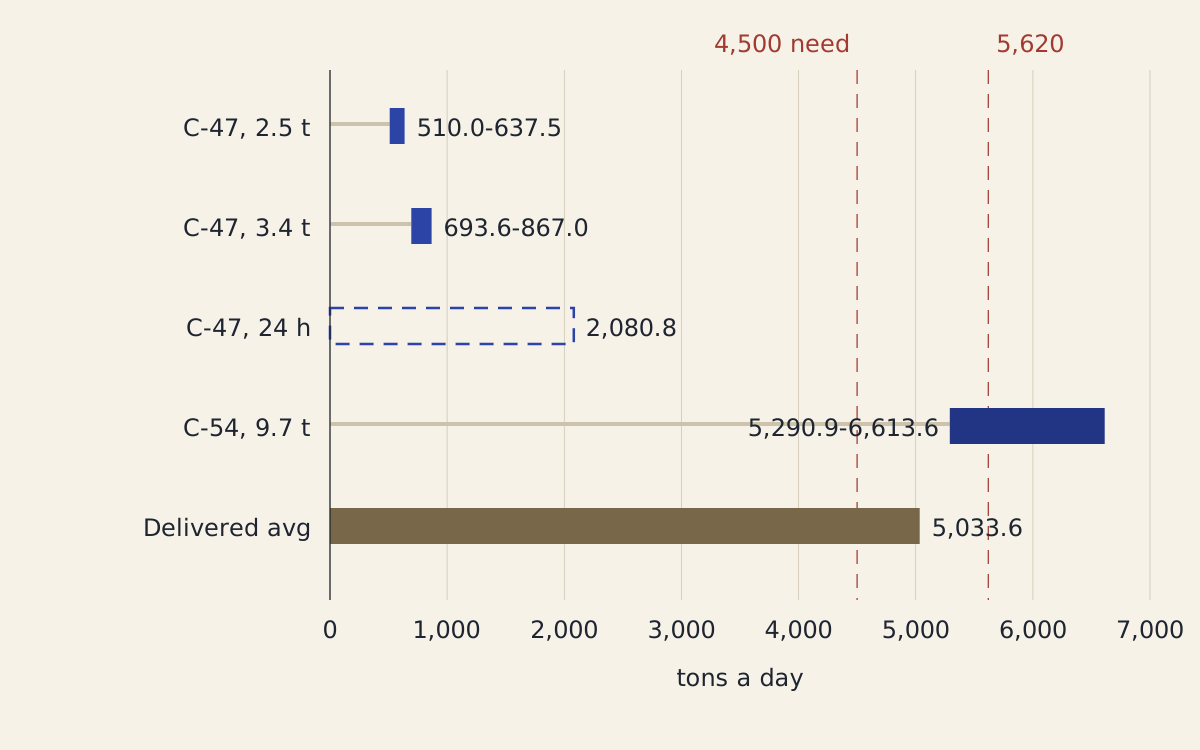
Figure: Tons a day each fleet could lift under the assumptions in the table, against the two requirements; the dashed bar is the round-the-clock outer bound and the brown bar the average actually delivered.
Diagram: Treaties & Tradeoffs. CC BY 4.0. Open full size
Reuse credit
Diagram: Treaties & Tradeoffs, "Berlin Airlift: the supply ceiling of the C-47 and C-54 fleets" — https://treatiesandtradeoffs.com/logistics/berlin-airlift/, CC BY 4.0 (https://creativecommons.org/licenses/by/4.0/)
Data: Aircraft, loads, hours and needs: Headquarters, U.S. Air Forces in Europe, Berlin Airlift: A USAFE Summary (1949), chapters Operations, Manpower and Requirements, Traffic, Plans and Maintenance, accessed 2026-11-02, U.S. government work, public domain; tons a day are this site's conversion
The supply ceiling, one assumption per row (CSV) Source and license notes (JSON) Data: Headquarters, U.S. Air Forces in Europe, Berlin Airlift: A USAFE Summary (1949), Introduction, Operations, Manpower and Requirements, Traffic, Plans, Maintenance and Chronology, accessed 2026-11-02, U.S. government work, public domain; applying the 8 to 10 flying hours to the C-47s of June 1948 is this site's assumption
Reported, with our check: Over the 462 days from 26 June 1948 to 30 September 1949, counting both ends, the combined table averages 5,033.6 tons a day [1]. The record day was 16 April 1949, when 12,940.9 tons were lifted in 24 hours [1]. That single day beat the roughly 12,000 tons a day that rail, barge and truck had delivered before the blockade.
Assessed: The ceiling says the C-47 fleet of late June 1948 could not have supplied the city alone. The C-54 fleet could, if each aircraft flew for most of a working day. The sum does not explain why the airlift held: the British share, weather, runways, crews and Soviet choices all sit outside it. The summary's own verdict is narrower, that the C-54 with its 10-ton load “operated more efficiently, economically, and effectively than the C-47” [1].
Assessed: Other networks were counted in other units. The Transcontinental Railroad dispatch counts the government bonds lent per mile of track, a measure of distance where Berlin's was a measure of tons per day.
How did the planes reach the city?
Reported: The blockade left one route open. By the USAFE account, official access was only by air, through three corridors 20 miles wide [1]. They ran from Berlin toward Hamburg and Hanover in the British zone and Frankfurt am Main in the American zone [1]. A four-power agreement of 1945 had defined them; in March 1948 the Soviets asked for changes that, the summary says, would have ended night and instrument flying, and the Western powers refused [1].
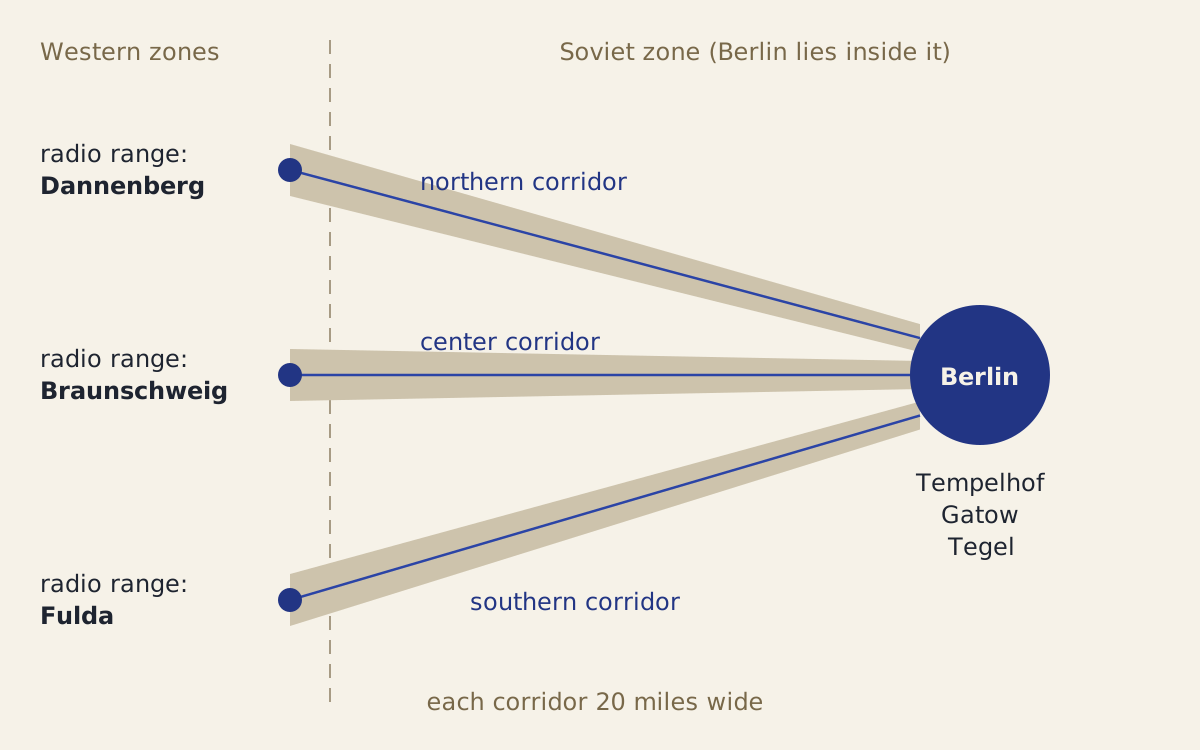
Figure: A relative-position diagram of the three air corridors as the summary names them, with the radio-range sites it lists at their zone ends and the three Berlin airfields; not to scale, and the angles are not from the source.
Diagram: Treaties & Tradeoffs. CC BY 4.0. Open full size
Reuse credit
Diagram: Treaties & Tradeoffs, "Berlin Airlift: the three air corridors, a relative-position diagram" — https://treatiesandtradeoffs.com/logistics/berlin-airlift/, CC BY 4.0 (https://creativecommons.org/licenses/by/4.0/)
Data: Corridors, radio ranges and airfields: Headquarters, U.S. Air Forces in Europe, Berlin Airlift: A USAFE Summary (1949), Introduction, Operations and Communications, accessed 2026-11-02, U.S. government work, public domain; positions are relative, not to scale
The diagram as text
- Northern corridor: radio range at Dannenberg on the zone side, and at Lubars on the Berlin side [1].
- Center corridor: radio range at Braunschweig on the zone side [1].
- Southern corridor: radio range at Fulda on the zone side, and at Tempelhof on the Berlin side [1].
- Each corridor: 20 miles wide [1].
- Berlin airfields: Tempelhof, the first US terminal; Tegel, built in the French sector and operated by the US Air Force; Gatow, an RAF station [1].
Reported: US aircraft flew first from Rhein/Main and Wiesbaden near Frankfurt. Later they also flew from the RAF stations at Fassberg and Celle [1]. From November through March, by the summary's count, instrument conditions prevailed between 70 and 80 percent of the time [1].
Assessed: The corridors fixed the shape of the problem. Pilots could not pick their route, so the limit was how many aircraft could pass through three lanes and land in Berlin. On flow control, the summary names “the maximum acceptance rate at the airhead bases as the determining factor” [1].
What did Washington weigh in June 1948?
The card at the top of this page applies the known-then test: score the choice only on what its makers could know at the time, with each piece of that knowledge tied to a source.
Reported: By USAFE's account, the United States had run an airlift once before. In early April 1948, after Soviet guards tried to search a US Army train, the United States airlifted all supplies required to fill Allied needs for 11 days [1]. After five coal trains were stopped on 10 June, the emergency airlift plan from that crisis was readied [1]. When the blockade came, USAFE gathered the C-47s of the 60th and 61st Troop Carrier Groups and of the pilot pool at Wiesbaden, each with a capacity of about 2½ tons [1].
Reported: On 25 June 1948 General Lucius D. Clay, the US Military Governor for Germany, cabled the Department of the Army [2]. He and his British counterpart, General Sir Brian Robertson, were weighing a request for talks with Marshal Sokolovsky, but Clay had “no real hope of reaching a solution” that way [2]. He warned that “the German population will begin to suffer in a few days and this suffering will become serious in two or three weeks” [2]. He was “still convinced that a determined movement of convoys with troop protection would reach Berlin,” though “once committed we could not withdraw” [2].
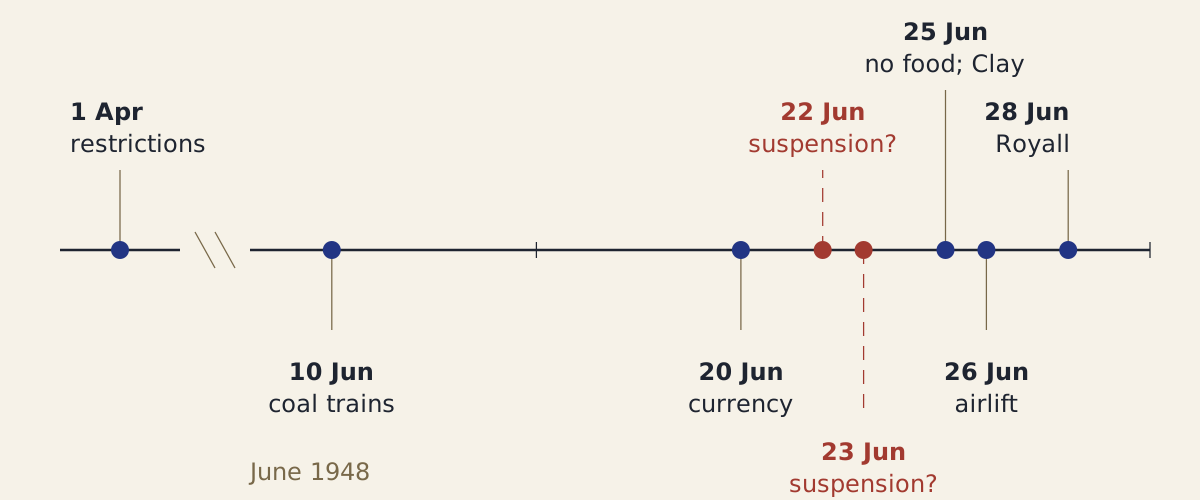
Figure: The run-up to the airlift as the USAFE summary and the State Department documents date it; the two red dashed marks are the two dates the summary gives for the suspension of surface traffic.
Diagram: Treaties & Tradeoffs. CC BY 4.0. Open full size
Reuse credit
Diagram: Treaties & Tradeoffs, "Berlin blockade: the run-up to the airlift, April to June 1948" — https://treatiesandtradeoffs.com/logistics/berlin-airlift/, CC BY 4.0 (https://creativecommons.org/licenses/by/4.0/)
Data: Dates: Headquarters, U.S. Air Forces in Europe, Berlin Airlift: A USAFE Summary (1949), Introduction and Chronology, accessed 2026-11-02, U.S. government work, public domain; Foreign Relations of the United States, 1948, vol. II, docs. 557, 562, 563, accessed 2026-11-02, public domain
The timeline as text
- 1 April 1948: Soviet restrictions on rail and road traffic from the British and US zones to Berlin [1].
- 10 June 1948: five Berlin-bound coal trains stopped at the British-Soviet border control point [1].
- 20 June 1948: currency reform takes effect in the Western zones [1][7]. For the Western sectors of Berlin the sources disagree: the summary's chronology includes them from this day [1], while a State Department editorial note says the reform did not apply to Berlin, and on 23 June the Western commandants announced they would bring the new currency into their sectors [7][8].
- 22 June 1948: the autobahn is closed to Allied traffic; the summary's introduction dates the suspension of all traffic to this day [1].
- 23 June 1948: the summary's chronology dates the suspension of all travel and traffic to this day [1].
- 25 June 1948: Soviet authorities announce they will not supply food to the Western sectors; Clay's cable; the meeting with the President [1][2][3].
- 26 June 1948: the full-scale airlift begins [1].
- 28 June 1948: Royall's reply to Clay [4].
Reported: The same day the President met Under Secretary of State Robert Lovett, Defense Secretary James Forrestal and Army Secretary Kenneth Royall, by Lovett's account as recorded by Jacob Beam [3]. They agreed Clay should not speak of a possible war over Berlin. They judged that retaliation outside Germany, or a lone US protest note, would not be fully effective, and weighed “what would happen to our anti-communist supporters were the US to leave” [3]. The memorandum records: “Determined steps should be taken by the US to stay in Berlin” [3].
Reported: Three days later Royall told Clay that Washington agreed the currency dispute was “probably just a phase in major Soviet effort drive Western Powers from Berlin,” and that the basic problem seemed “not currency but quadripartite authority” [4]. The documents read here do not record who ordered the airlift. The USAFE summary says only that on 25 June it “became apparent” that supplies would have to be airlifted and that USAFE was called upon [1].
Assessed: Scored on the card alone, flying was the one option that needed neither Soviet consent nor a convoy that, in Clay's words, could not be withdrawn. The card's own numbers pointed the other way: C-47s of about 2½ tons each, for a city that had received about 12,000 tons a day. USAFE says the airlift “was envisioned at first as a short-term expediency” [1]. Grading the choice by its outcome adds what we call the hindsight premium, the share of a decision's apparent wisdom or folly that is added only after the outcome is known.
When did the Berlin Airlift end?
Reported: The blockade ended by agreement. A four-power communiqué of 5 May 1949 said that all Soviet restrictions imposed since 1 March 1948 on traffic and trade with Berlin “will be removed on May 12, 1949” [5]. Western counter-restrictions would go the same day, and the Council of Foreign Ministers would meet in Paris on 23 May [5]. The State Department's editorial note adds that the Western draft had proposed 9 May; Malik, for the Soviet side, preferred 12 May [5].
Reported: The aircraft kept flying. On 26 June 1949 the lift was ordered to continue until reserve stocks reached a satisfactory level and the international situation clarified, and on 30 July its end was announced for 31 October 1949 [1]. The last C-54 left Rhein/Main for Berlin at 1845 hours on 30 September 1949, “one month ahead of schedule due to sufficient food stockpiles in Berlin” [1]. Another chapter of the same summary gives the official end as 1 October 1949 [1].
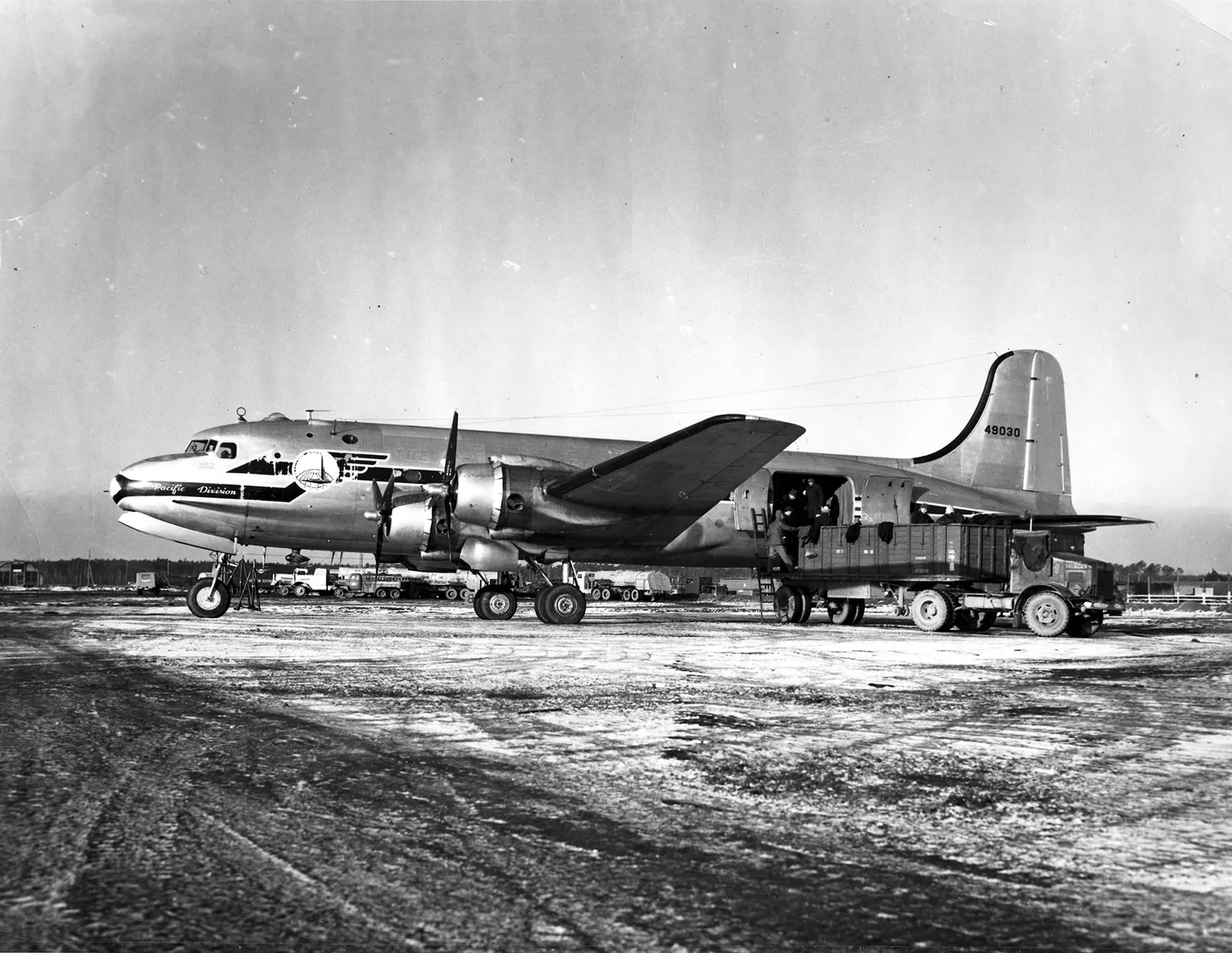
Figure: A US Air Force Douglas C-54E Skymaster used during the Berlin Airlift, around 1948 (US Air Force photograph).
"Douglas C-54E Skymaster during Berlin Airlift c1948" by U.S. Air Force — https://commons.wikimedia.org/wiki/File:Douglas_C-54E_Skymaster_during_Berlin_Airlift_c1948.jpg — Public domain (U.S. federal government work, 17 U.S.C. §105; U.S. Air Force photograph, National Museum of the U.S. Air Force 050426-F-1234P-007)

Reported, with our conversion: Counted to 12 May 1949, the blockade lasted 324 days from the introduction's 22 June, or 323 days from the chronology's 23 June [1][5]. The airlift then flew on for another 141 days.
Assessed: The records read here do not say why Moscow agreed to lift the blockade, and this page does not credit the airlift alone. The summary does show a lift running above the city's minimum and building stocks, one of the two conditions its chronology gives for stopping [1]. Berlin's access stayed a live question. In October 1962, during the Cuban Missile Crisis, Under Secretary Ball said a trade of the missiles in Turkey had seemed acceptable the week before “if such action would save Berlin” [6].
Sources
- Headquarters, United States Air Forces in Europe, Berlin Airlift: A USAFE Summary (cover: 26 June 1948 – 30 September 1949; Germany: Headquarters USAFE, printed by the USAFE Reproduction Center, 1949): Introduction; Operations (Introduction; Manpower and Requirements, Aircraft; table Summary of Combined Operations, p. 12; Operations and Procedures; Traffic, pp. 28–29); Communications; Plans; Maintenance; Chronology, pp. 185–189. https://archive.org/details/Berlinairlift00UnitRead: full text of the 1949 summary
- Foreign Relations of the United States, 1948, vol. II, Germany and Austria, Document 557, Telegram From the United States Military Governor for Germany (Clay) to the Department of the Army, Berlin, 25 June 1948. Office of the Historian, U.S. Department of State. https://history.state.gov/historicaldocuments/frus1948v02/d557Read: full text of the document
- Foreign Relations of the United States, 1948, vol. II, Germany and Austria, Document 562, Memorandum by the Chief of the Division of Central European Affairs (Beam), Washington, 28 June 1948, recording Under Secretary Lovett's account of the meeting with the President on 25 June 1948. Office of the Historian, U.S. Department of State. https://history.state.gov/historicaldocuments/frus1948v02/d562Read: full text of the document
- Foreign Relations of the United States, 1948, vol. II, Germany and Austria, Document 563, Telegram From the Secretary of the Army (Royall) to the United States Military Governor for Germany (Clay), Washington, 28 June 1948. Office of the Historian, U.S. Department of State. https://history.state.gov/historicaldocuments/frus1948v02/d563Read: full text of the document
- Foreign Relations of the United States, 1949, vol. III, Council of Foreign Ministers; Germany and Austria, Document 377, Editorial Note on the New York talks and the four-power communiqué of 5 May 1949. Office of the Historian, U.S. Department of State. https://history.state.gov/historicaldocuments/frus1949v03/d377Read: full text of the editorial note, with the communiqué
- Foreign Relations of the United States, 1961–1963, vol. XI, Cuban Missile Crisis and Aftermath, Document 94, Summary Record of the Eighth Meeting of the Executive Committee of the National Security Council, Washington, 27 October 1962. Office of the Historian, U.S. Department of State. https://history.state.gov/historicaldocuments/frus1961-63v11/d94Read: full text of the document
- Foreign Relations of the United States, 1948, vol. II, Germany and Austria, Document 548, Editorial Note on the currency reform letters of 18–21 June 1948. Office of the Historian, U.S. Department of State. https://history.state.gov/historicaldocuments/frus1948v02/d548Read: full text of the editorial note
- Foreign Relations of the United States, 1948, vol. II, Germany and Austria, Document 553, Telegram From the United States Political Adviser for Germany (Murphy) to the Secretary of State, Berlin, 23 June 1948, 8 p.m. Office of the Historian, U.S. Department of State. https://history.state.gov/historicaldocuments/frus1948v02/d553Read: full text of the document
Cite this page
Treaties & Tradeoffs. “Berlin Airlift: About Two-Thirds Coal, by Air Force Count.” published 2026-11-02. https://treatiesandtradeoffs.com/logistics/berlin-airlift/. Accessed [the date you read it].
Plain citation; add the date you consulted the page. No DOI is assigned.