Logistics & EconomicsLogistics arithmetic
Transcontinental Railroad: US Bonds Lent by the Mile, 1862
Treaties & Tradeoffs Filed
The Pacific Railroad act of 1 July 1862 (12 Stat. 489) lent the transcontinental railroad's builders sixteen US bonds of $1,000 per finished mile, treble that for 300 mountain miles and double between them [1]. By our conversion that is $16,000, $48,000 and $32,000 a mile, as a loan, not a gift. The rails met at Promontory on 10 May 1869, by the Central Pacific secretary's 1887 account [4].
Order of business (5 sections)
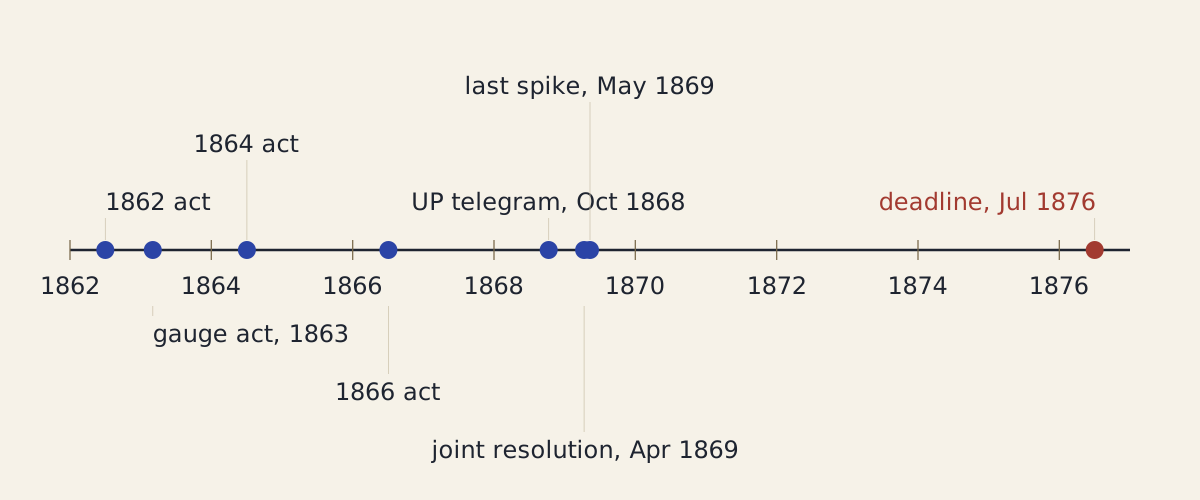
Figure: The Pacific railroad acts and the meeting of the lines, 1862 to 1869, with the 1876 deadline the first act set; the red mark is a deadline, not an event.
Diagram: Treaties & Tradeoffs. CC BY 4.0. Open full size
Reuse credit
Diagram: Treaties & Tradeoffs, "Pacific railroad acts and the meeting of the lines, 1862–1876" — https://treatiesandtradeoffs.com/logistics/transcontinental-railroad/, CC BY 4.0 (https://creativecommons.org/licenses/by/4.0/)
Data: Dates: Act of 1 July 1862 (12 Stat. 489), read in The Union Pacific Railroad: Acts of Congress Relating Thereto (Boston, 1874), accessed 2026-11-02, US federal law, public domain; Act of 2 July 1864 (13 Stat. 356), same compilation, accessed 2026-11-02, US federal law, public domain; Act of 3 March 1863, act of 3 July 1866 and joint resolution of 10 April 1869, same compilation, accessed 2026-11-02, US federal law, public domain; Report of the United States Pacific Railway Commission, Testimony, vol. 5 (Washington: Government Printing Office, 1887), accessed 2026-11-02, US government publication, public domain; company statements are reported as the companies' accounts
The timeline as text
- 1 July 1862: the Pacific Railroad act is approved (12 Stat. 489) [1].
- 3 March 1863: an act fixes the gauge at four feet eight and one-half inches [3].
- 2 July 1864: the amending act is approved (13 Stat. 356) [2].
- 3 July 1866: an act lets each company keep building until the two lines meet [3].
- 10 October 1868: a Union Pacific telegram offers Chinese workers $40 a month in gold [4].
- 10 April 1869: a joint resolution says the rails will meet at Promontory summit [3].
- 10 May 1869: the last spike at Promontory, by the Central Pacific secretary's 1887 statement [4].
- 1 July 1876: the deadline for a continuous line set by the 1862 act [1].
On 1 July 1862, Congress promised loans by the mile for a railroad whose route was still to be fixed. The act named a starting point somewhere on the 100th meridian in Nebraska Territory, to be chosen by the President after surveys, and an end at the western boundary of Nevada Territory, where the line would meet the Central Pacific Railroad Company of California [1]. What became the transcontinental railroad was paid for, in large part, by a schedule of bonds per finished mile.
What did the 1862 act lend per mile?
Reported: Section 5 of the act gave the Secretary of the Treasury his instructions. Once commissioners certified 40 finished miles, he was to issue the company bonds of the United States “of one thousand dollars each,” payable in 30 years at 6 percent interest, “to the amount of sixteen of said bonds per mile” [1]. The bonds were not a gift. Their issue was to “constitute a first mortgage on the whole line,” and the company had to repay them, with the interest the United States had paid [1].
Reported: Section 11 raised the count for the hardest ground. For 300 miles “most mountainous and difficult of construction,” 150 miles westward from the eastern base of the Rocky Mountains and 150 miles eastward from the western base of the Sierra Nevada, “said points to be fixed by the President,” the bonds were to be “treble the number per mile” [1]. Between those two stretches they were “double the number per mile first mentioned,” issued on every 20 finished miles, and the whole main line could receive “no more than fifty thousand of said bonds” [1].
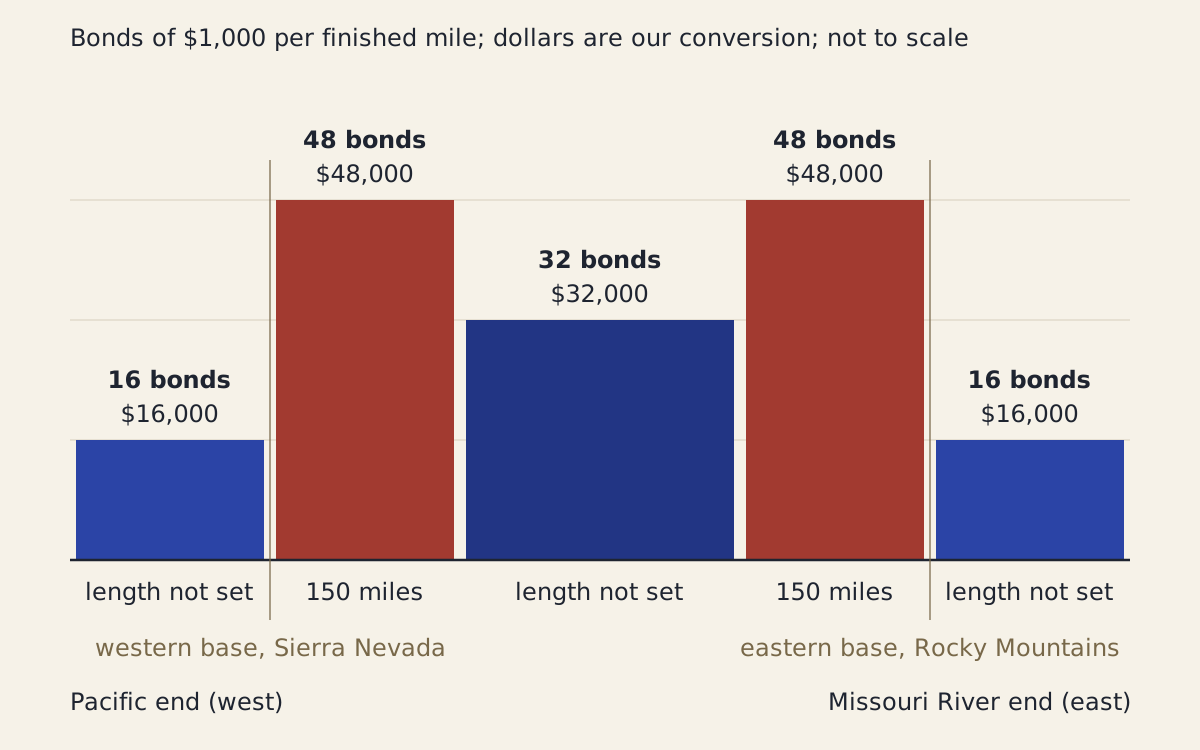
Figure: The 1862 bond schedule from west to east, in bonds per mile with our dollar conversion; the mountain bases were points the President was to fix, so the widths are not to scale.
Diagram: Treaties & Tradeoffs. CC BY 4.0. Open full size
Reuse credit
Diagram: Treaties & Tradeoffs, "Bonds per mile under the 1862 Pacific Railroad act" — https://treatiesandtradeoffs.com/logistics/transcontinental-railroad/, CC BY 4.0 (https://creativecommons.org/licenses/by/4.0/)
Data: Bond counts and multiples: Act of 1 July 1862 (12 Stat. 489), read in The Union Pacific Railroad: Acts of Congress Relating Thereto (Boston, 1874), accessed 2026-11-02, US federal law, public domain; dollar figures converted by this site
Reported, with our conversion: At $1,000 a bond, sixteen bonds come to $16,000 a mile, the doubled rate to $32,000 and the trebled rate to $48,000 [1]. The 300 mountain miles at the trebled rate add up to 14,400 bonds, or $14.4 million, and the cap of 50,000 bonds to $50 million. Each bond carried $60 a year in interest. The act gives the face value of a bond and the counts and multiples, not dollars per mile, so the dollar rates and totals in this paragraph are ours.
The bond schedule, section by section (CSV) Source and license notes (JSON) Data: Act of 1 July 1862 (12 Stat. 489), read in The Union Pacific Railroad: Acts of Congress Relating Thereto (Boston, 1874), accessed 2026-11-02, US federal law, public domain; Act of 2 July 1864 (13 Stat. 356), same compilation, accessed 2026-11-02, US federal law, public domain
Reported: Bonds were one of three kinds of aid. Section 2 granted a right of way 200 feet wide on each side of the road, with earth, stone and timber from the public lands nearby. Section 3 granted five alternate sections of public land per mile on each side, within ten miles of the line, mineral lands excepted [1]. Section 2 also said that “the United States shall extinguish, as rapidly as may be, the Indian titles” to the lands the act covered [1].
The card at the top of this page applies the known-then test: score the choice only on what its makers could know at the time, with each piece of that knowledge tied to a source. Its options are the levers the act itself uses; the debates in which other plans were argued are not among the sources we read.
Assessed: On the card's evidence, Congress knew which ranges made the work hard but not where the hard ground began, so it tied the trebled rate to base points the President would set later. The schedule paid by kind of ground, not by measured cost, which was the most the act could do before the President fixed those points. What the line later cost in the mountains is the hindsight a fair score of the 1862 schedule has to leave out.
How did the 1864 act change the terms?
Reported: The amending act of 2 July 1864 doubled the land grant, striking out “five” and “ten” in section 3 and putting in “ten” and “twenty” [2]. Section 10 let each company issue its own first-mortgage bonds, up to the amount of the US bonds and on the same terms, and made the lien of the US bonds “subordinate” to them [2]. The same section changed the unit of payment from 40 miles to “each and every section of not less than twenty” [2].
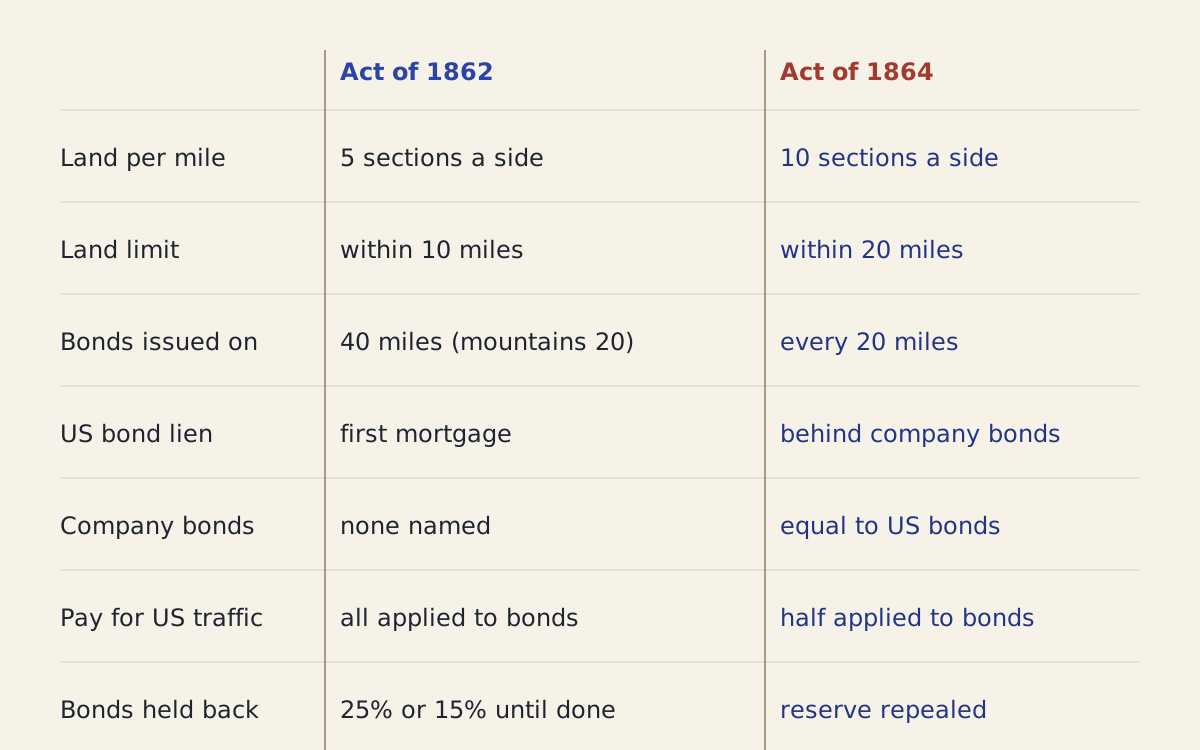
Figure: Seven terms of the 1862 act beside the changes made by the 1864 act.
Diagram: Treaties & Tradeoffs. CC BY 4.0. Open full size
Reuse credit
Diagram: Treaties & Tradeoffs, "Terms of the 1862 act beside the 1864 changes" — https://treatiesandtradeoffs.com/logistics/transcontinental-railroad/, CC BY 4.0 (https://creativecommons.org/licenses/by/4.0/)
Data: Act of 1 July 1862 (12 Stat. 489), read in The Union Pacific Railroad: Acts of Congress Relating Thereto (Boston, 1874), accessed 2026-11-02, US federal law, public domain; Act of 2 July 1864 (13 Stat. 356), same compilation, accessed 2026-11-02, US federal law, public domain
The comparison as text
- Land per mile: five alternate sections on each side in 1862 [1]; ten in 1864 [2].
- Land limit: within ten miles of the line in 1862 [1]; within twenty in 1864 [2].
- Bonds issued on: each 40 miles, or each 20 in the mountain and middle sections, in 1862 [1]; each section of 20 miles in 1864 [2].
- US bond lien: a first mortgage in 1862 [1]; behind the companies' own bonds in 1864 [2].
- Company bonds: none named in 1862 [1]; first-mortgage bonds up to the amount of the US bonds in 1864 [2].
- Pay for government traffic: all applied to the bonds in 1862 [1]; half in 1864 [2].
- Bonds held back: 25 percent east of the 100th meridian and west of the Sierra Nevada's western foot, 15 percent between those points, until the whole road was done, in 1862 [1]; that reserve repealed in 1864 [2].
Reported: The 1864 act also gave the companies another year and required the Central Pacific to build 25 miles a year. The act let the Treasury pay up to two-thirds of a 20-mile section's bonds in the mountain region once part of the grading was certified, before the track was finished [2]. West of Salt Lake City, no such advance could go to Union Pacific work more than 300 miles ahead of its finished line [2].
Reported: Leland Stanford, president of the Central Pacific, told a federal commission in 1887 why money was hard to raise. After the 1862 act passed, he said, “except a subscription for one lot of ten shares,” the company could not interest anybody in San Francisco, where money was earning 2 to 2½ percent a month. The company turned to the counties, he said, and Placer County subscribed $200,000 [4].
Assessed: Stanford's account comes 25 years later, from a man defending his company before an investigation, so it shows the builders' case, not an independent finding. Read with the act, it fits the shape of the 1864 changes, which moved the government from first lender to second and paid out sooner. The sources we read do not show whether Congress acted on that reasoning, and we leave it there.
How much did the bonds add up to?
Reported: In a statement the Central Pacific gave the commission in 1887, its secretary, E. H. Miller Jr., put the bonds the United States had issued at $27,236,512 to the Union Pacific and $27,855,680 to the Central and Western Pacific, $55,092,192 in all [4]. Stanford's own answer splits the second figure into $25,885,120 for the Central Pacific and $1,970,560 for the Western Pacific, its branch, and says the bonds were dated from 1865 to 1869, with a few in 1870 [4]. A commissioner questioning him said the government's reports put the first issue in 1866 [4].
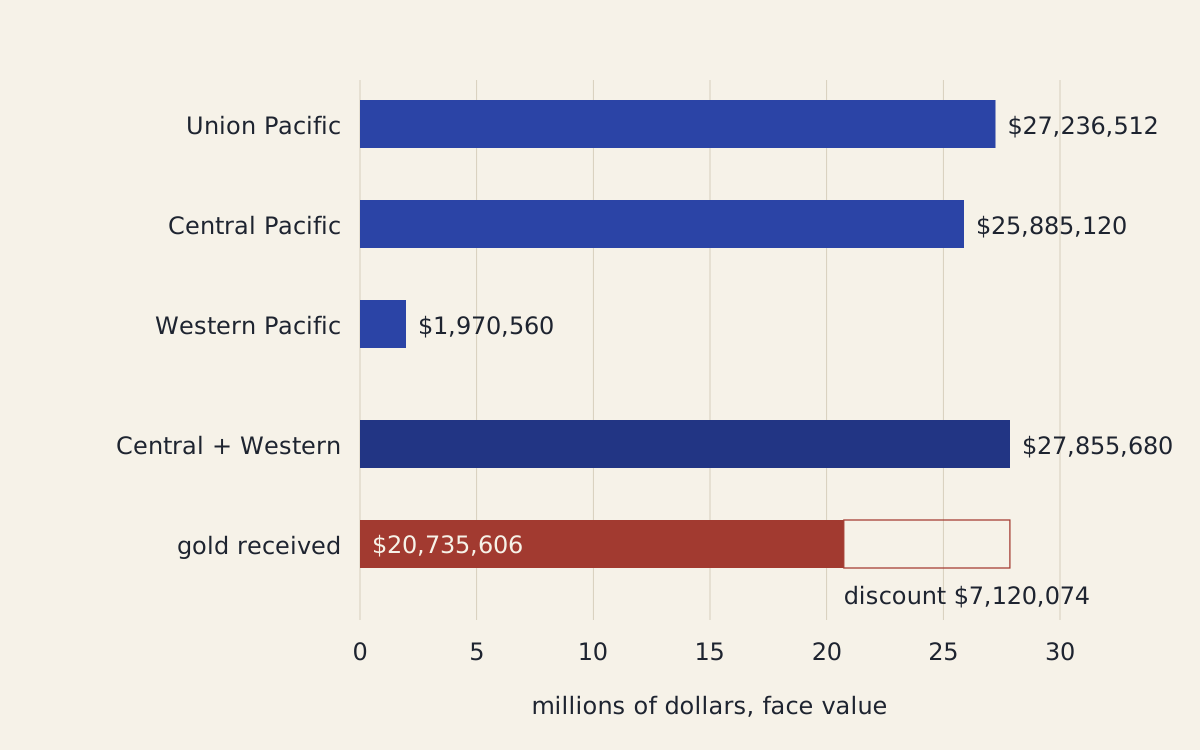
Figure: US bonds issued to the Pacific railroads at face value, and the gold the Central and Western Pacific say they received for theirs, by Central Pacific officials' 1887 figures.
Diagram: Treaties & Tradeoffs. CC BY 4.0. Open full size
Reuse credit
Diagram: Treaties & Tradeoffs, "US bonds issued to the Pacific railroads, by Central Pacific officials' 1887 figures" — https://treatiesandtradeoffs.com/logistics/transcontinental-railroad/, CC BY 4.0 (https://creativecommons.org/licenses/by/4.0/)
Data: Report of the United States Pacific Railway Commission, Testimony, vol. 5 (Washington: Government Printing Office, 1887), accessed 2026-11-02, US government publication, public domain; company statements are reported as the companies' accounts
Reported, with our check: The parts add up: $25,885,120 and $1,970,560 make $27,855,680, and the two companies' totals make $55,092,192 [4]. Stanford says the Central and Western Pacific sold their bonds for $20,735,606.45 in gold, or $744.44 for each $1,000 bond, a discount of $7,120,073.55 [4]. Face value less the gold is exactly that discount, and the gold comes to $744.39 per $1,000 of face value, five cents off his figure; two pages later his answer gives $744.40 [4].
Bonds issued and gold received, with the claimant in each row (CSV) Source and license notes (JSON) Data: Report of the United States Pacific Railway Commission, Testimony, vol. 5 (Washington: Government Printing Office, 1887), accessed 2026-11-02, US government publication, public domain; company statements are reported as the companies' accounts
Reported: The gap came from the currency, by Stanford's account. The US bonds were payable in “lawful money,” which Stanford says meant United States paper currency during construction, and he says the Central and Western Pacific had to pay gold coin for all wages, supplies and contracts on the Pacific coast [4]. He puts paper currency at 42.66 cents on the dollar in January 1865 and 83.68 cents in December 1869 [4].
Assessed: For the same reason, we do not count the bonds in days of a worker's wage. The wages we found on this line were paid in gold, by Stanford's account, such as the $4 a day for carpenters and $2.50 to $3 for laborers that the Central Pacific's superintendent of bridges and buildings recalled for snow-shed work in 1868. The bonds were paper dollars whose gold value moved month to month [4]. A wage-day figure would depend on which month's rate we chose, so we do not convert: no wage series matches the bonds in place, period and currency, and the bonds are given only in their own dollars.
Assessed: The 1887 totals for the two main companies, $53,121,632 together, run above the 50,000-bond cap of 1862, which limited the bonds issued “to aid in constructing the main line” [1][4]. The amending acts of 1864 and 1866 that we read leave that cap as it was and do not say how the main line was counted [2][3]. The sources we read do not explain the difference, which may lie in branches, later acts or how the companies counted, so we do not reconcile the two.
Who built the line, and how fast?
Reported: J. H. Strobridge, the Central Pacific's superintendent of construction, wrote a sworn statement to Stanford in 1887 that was filed with the commission [4]. He put the force at about 13,500 men in the snow winters of 1866–67 and 1867–68. He wrote that camps were carried away by snowslides and that men were buried, “many of them were not found until the snow melted the next summer,” and said track material was hauled on sleds over 18 feet of settled snow [4]. In his account, the 157 miles from Newcastle to Wadsworth took from February 1865 to July 1868, with an average force of 11,000 men, and the 555 miles from Wadsworth to Ogden took about ten months, with about 5,000 [4].
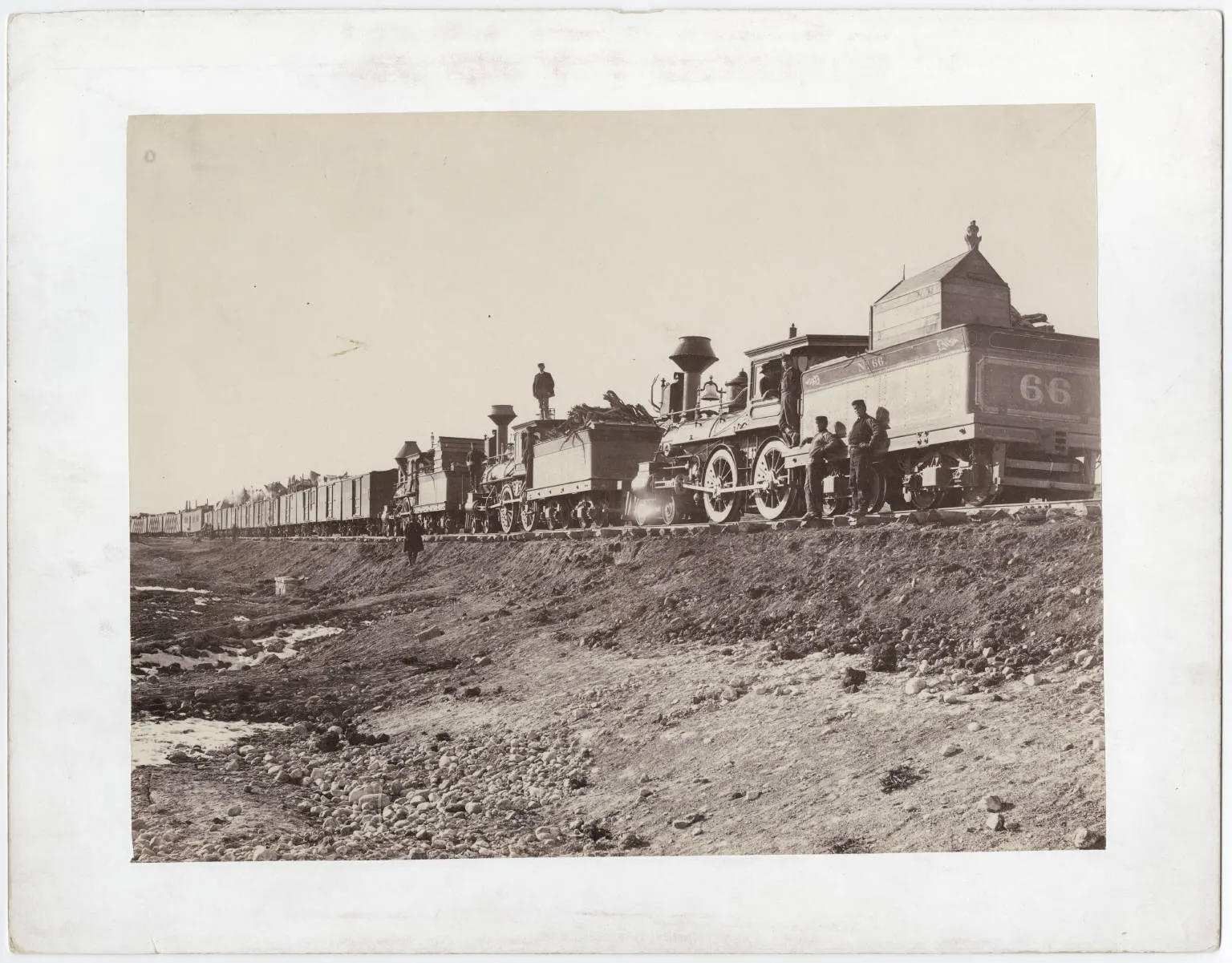
Figure: “Construction train, Bear River,” a photograph by Andrew J. Russell taken during the building of the Union Pacific, about 1864 to 1869 (Yale Collection of Western Americana).
“Construction train, Bear River” by Andrew J. Russell. Public Domain Mark.
Full credit
"Construction train, Bear River" by Andrew J. Russell — https://commons.wikimedia.org/wiki/File:Construction_train_Bear_River_Union_Pacific_Railroad_by_Andrew_J_Russell.jpg — Public domain (Andrew J. Russell d. 1902; US: photograph made about 1864–1869 and its author died more than 70 years ago, so it is out of copyright whether or not it was published; EU: author died more than 70 years ago; Yale Collection of Western Americana, Beinecke Rare Book and Manuscript Library)

Figure: Illustration of track being laid ahead of a work train; an imagined scene, not a record of any place or crew on the line.
Illustration: Treaties & Tradeoffs. Generated schematic image — not a photograph or historical record. © Treaties & Tradeoffs, all rights reserved.
Reported, with our conversion: Those figures give about 3.7 to 3.8 miles a month across the Sierra Nevada, depending on whether both end months count, and about 55.5 miles a month across the Nevada desert, a pace 14 to 15 times faster by his own numbers [4].
Assessed: Counting a supply effort by its rate, miles a month here, is the same habit as counting the Berlin Airlift in tons a day.
Reported: Who did the work is in the same testimony. Stanford said white laborers were scarce and often left for the mines, so the company took on Chinese workers [4]. A telegram of 10 October 1868, signed by the Union Pacific's vice-president, Thomas C. Durant, authorized Daniel W. Strong, one of the Central Pacific's original directors, to hire up to 2,000 Chinese workers for work east of Humboldt Wells, “to pay them in United States gold coin $40 per month for twenty-six working days,” and to “protect them from Indians with soldiers if necessary” [4]. Strong, from memory, put the request at three thousand [4].
Assessed: These are the employers' records, and they say little about the workers themselves: no names, no count of the dead under the snow, and no word from those hired. The pay offer is a single telegram, not a wage series, and it is in gold, so it does not change our decision not to convert.
Where did the two lines meet?
Reported: The 1862 act had the lines meet at the eastern boundary of California, with whichever company finished first allowed to continue [1]. An act of 3 July 1866 let each company build on “until they shall meet and connect,” and work up to 300 miles ahead of its continuous line where deep cuts and tunnels required it [3]. Strong, recalling the bill that let the two roads run on until they met, told the commission that “each one should have credit for the number of miles it would build” [4].
Reported: A joint resolution of 10 April 1869 settled the meeting point. The common terminus would be “at or near Ogden,” and the Union Pacific would build, and the Central Pacific “pay for and own,” the line from there “to Promontory summit, at which point the rails shall meet” [3]. The same resolution let the President hold back enough bonds from each company to secure the full completion of the road [3].
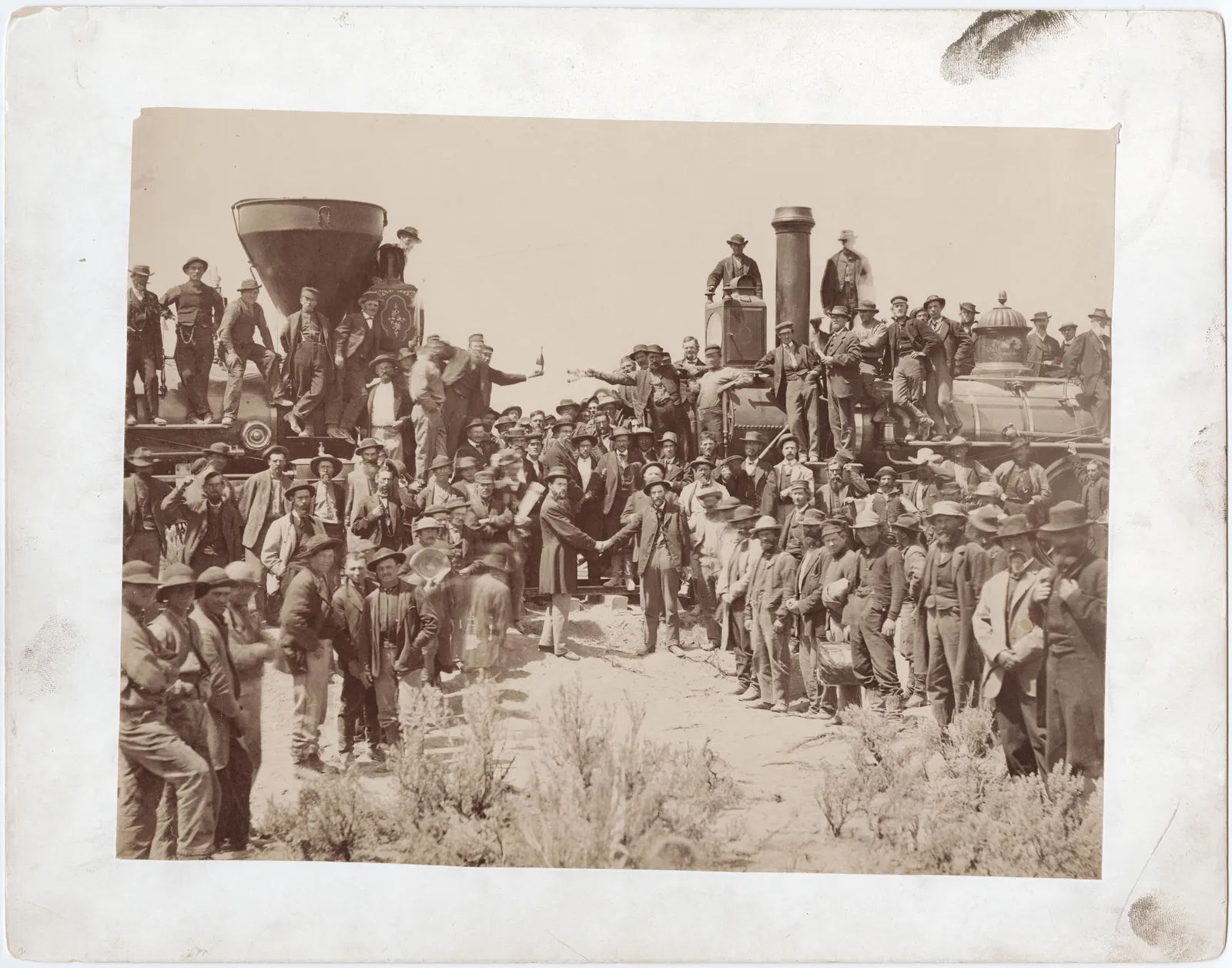
Figure: “East and West shaking hands at the laying of the last rail,” photograph by Andrew J. Russell, Promontory, 10 May 1869 (Yale Collection of Western Americana, Beinecke Library).
“East and West shaking hands at the laying of the last rail” by Andrew J. Russell. Public Domain Mark.
Full credit
"East and West shaking hands at the laying of the last rail" by Andrew J. Russell — https://commons.wikimedia.org/wiki/File:East_and_West_Shaking_hands_at_the_laying_of_last_rail_Union_Pacific_Railroad.jpg — Public domain (Andrew J. Russell d. 1902; US: published before 1931 (file page tag); EU: author died more than 70 years ago; Yale Collection of Western Americana, Beinecke Rare Book and Manuscript Library)

Reported: “The last spike was driven in the Pacific Railroad at Promontory Point on May 10, 1869,” Miller's statement says [4]. The sources disagree on the stretch the Union Pacific built. Miller put Promontory 52 miles from Ogden. Stanford said his company had graded “to Promontory, some 63 miles, I think,” and that in the settlement the Union Pacific took the whole government aid for those miles [4].
Reported, with our check: The 1862 act required a continuous line from the Missouri River to the Sacramento River by 1 July 1876 or the roads were forfeit [1]. From 10 May 1869 to that deadline is 2,609 days, or about 7.1 years, which matches Miller's claim that the line opened “over seven years” early [4].
Assessed: Miller made that claim to argue that the government had gained from early completion, and Strobridge's statement adds that speed raised the cost [4]. A schedule that paid by the finished mile rewarded each company for the miles it laid first, and the 1869 resolution had to draw the line between them by law. That is our reading of the acts side by side, not a finding of the commission.
Sources
- An Act to aid in the Construction of a Railroad and Telegraph Line from the Missouri River to the Pacific Ocean, approved 1 July 1862, 12 Stat. 489, sections 1–11 and 17; text as printed in The Union Pacific Railroad: Acts of Congress Relating Thereto, and Amendments (Boston: printed for the company, 1874), pp. 3–24. https://tile.loc.gov/storage-services/service/ll/llsl//llsl-c37/llsl-c37.pdfRead: full text of the act as printed in the 1874 compilation
- An Act to amend the Pacific Railroad act of 1 July 1862, approved 2 July 1864, 13 Stat. 356, sections 1–22, chiefly 4–8 and 10; text as printed in The Union Pacific Railroad: Acts of Congress Relating Thereto, and Amendments (Boston: printed for the company, 1874), pp. 25–47. https://archive.org/details/unionpacificrail00uniorichRead: full text of the act as printed in the 1874 compilation
- The Union Pacific Railroad: Acts of Congress Relating Thereto, and Amendments; By-laws of the Company, and Mortgages (Boston: printed for the company, 1874): act of 3 March 1863 on the gauge (p. 16, note), act of 3 July 1866, sections 1–2 (pp. 48–50), and joint resolution of 10 April 1869 (pp. 52–54). https://archive.org/details/unionpacificrail00uniorichRead: full text of the 1863 and 1866 acts and the 1869 joint resolution
- United States Pacific Railway Commission, Testimony Taken by the United States Pacific Railway Commission, vol. 5 (Senate Ex. Doc. 51, 50th Cong., 1st sess., pt. 6; Washington: Government Printing Office, 1887): Leland Stanford, pp. 2525–2529, 2619–2621, 2630–2631; Exhibit 10, statement of J. H. Strobridge, pp. 2580–2581; Exhibit 11, statement of Arthur Brown, pp. 2581–2583; Exhibit 11½, statement of E. H. Miller Jr., pp. 2583–2598; Daniel W. Strong, pp. 2869–2870, 2968; E. H. Miller Jr., p. 3037. https://archive.org/details/reportofunitedst05unitrichRead: full text of this volume of testimony; the commission's report volume not read
Cite this page
Treaties & Tradeoffs. “Transcontinental Railroad: US Bonds Lent by the Mile, 1862.” published 2026-11-02. https://treatiesandtradeoffs.com/logistics/transcontinental-railroad/. Accessed [the date you read it].
Plain citation; add the date you consulted the page. No DOI is assigned.