Logistics & EconomicsLogistics arithmetic
Roman Legion: Polybius's Wheat Ration, Converted to Tonnes
Treaties & Tradeoffs Filed
By our conversion of Polybius, who gives a Roman foot soldier about two-thirds of an Attic medimnus of wheat a month, the 4,200 infantry of a Roman legion in his day needed about 3.5 to 3.9 tonnes of grain a day [1]. The arithmetic takes the medimnus at 52.37 liters, from William Smith's dictionary of 1884, and a liter of wheat at an assumed 0.72 to 0.80 kg [2][5]. That is a floor, since the cavalry, their barley, the pack animals and any grain lost in store are left out.
Order of business (5 sections)
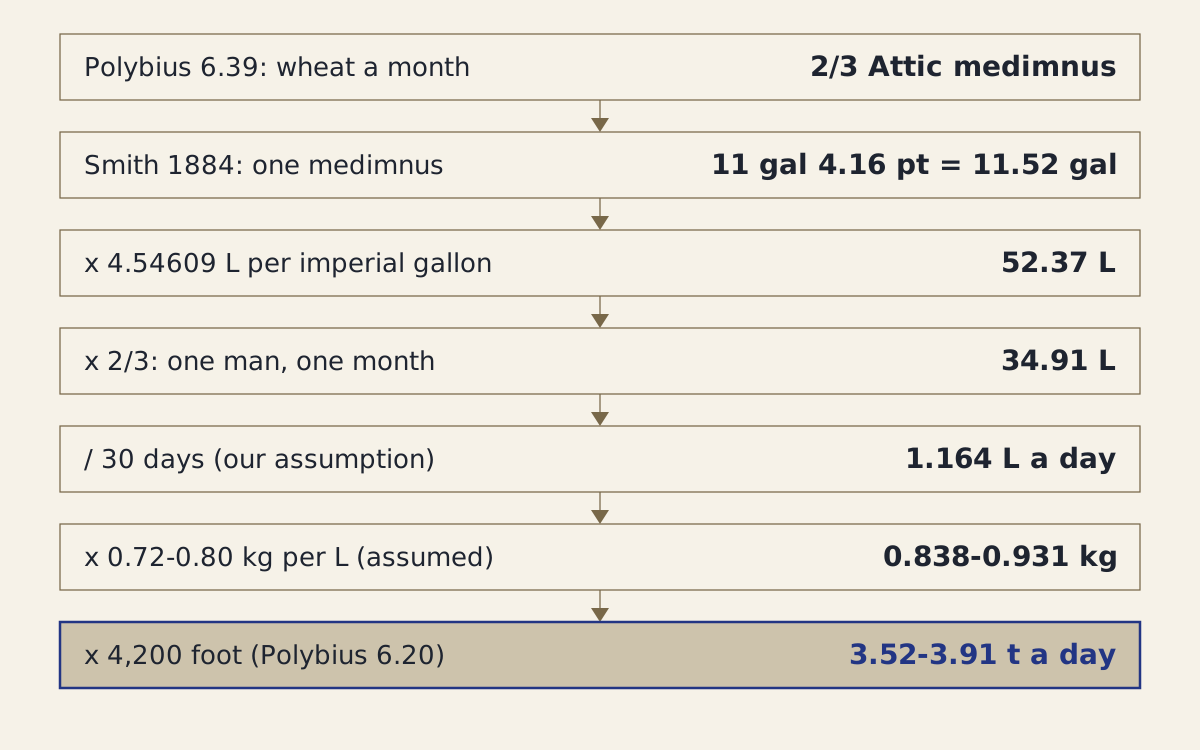
Figure: How a monthly ration in Attic medimni becomes tonnes of wheat a day, step by step, for the 4,200 foot soldiers of a legion in Polybius.
Diagram: Treaties & Tradeoffs. CC BY 4.0. Open full size
Reuse credit
Diagram: Treaties & Tradeoffs, "Roman legion grain: from Polybius's ration to tonnes a day" — https://treatiesandtradeoffs.com/logistics/roman-legion/, CC BY 4.0 (https://creativecommons.org/licenses/by/4.0/)
Data: Ration and legion size: Polybius, Histories 6.20 and 6.39, trans. E. S. Shuckburgh (1889), Project Gutenberg eBook #44125, accessed 2026-11-02, public domain; Medimnus: William Smith, A Smaller Dictionary of Greek and Roman Antiquities, 12th ed. (1884), Table IX, Project Gutenberg eBook #65909, accessed 2026-11-02, public domain; Gallon: Weights and Measures Act 1985 (UK), Schedule 1, accessed 2026-11-02; Wheat weight reference: USDA ERS, Agricultural Handbook No. 697 (1992), accessed 2026-11-02, U.S. government work
The conversion as text
- Polybius: a foot soldier's wheat ration is about 2/3 of an Attic medimnus a month [1].
- Smith, 1884: one Attic medimnus is 11 gallons 4.16 pints, or 11.52 imperial gallons [2].
- One imperial gallon is 4.54609 liters, so one medimnus is 52.37 liters [6].
- Two-thirds of a medimnus is 34.91 liters a month.
- Over a 30-day month, which is our assumption, that is 1.164 liters a day.
- At an assumed 0.72 to 0.80 kg per liter, that is 0.838 to 0.931 kg a day [5].
- For 4,200 foot soldiers, that is 3.52 to 3.91 tonnes a day [1].
In 58 BC, Caesar's army was two days from its grain issue, and the promised grain had not come. He had followed the Helvetii for about fifteen days, his grain boats on the Saône were out of reach, and his Aeduan allies kept saying their grain was on the road, by his own account [3]. Behind that moment sits a sum his readers never had to do: how much grain a Roman legion needed, and how long it could march on what it carried.
What did Polybius say a Roman soldier got?
Reported: Polybius was a Greek statesman who, by his translator's account, took part in public life from about 181 BC and was still active in 145 BC [1]. Book 6 of his Histories describes the Roman army of his day. In Evelyn Shuckburgh's 1889 translation, “The infantry receive a ration of wheat equal to about ⅔ of an Attic medimnus a month, and the cavalry 7 medimni of barley, and 2 of wheat” [1]. Allied infantry got the same as Roman infantry, and allied horsemen got 1⅓ medimni of wheat and 5 of barley [1].
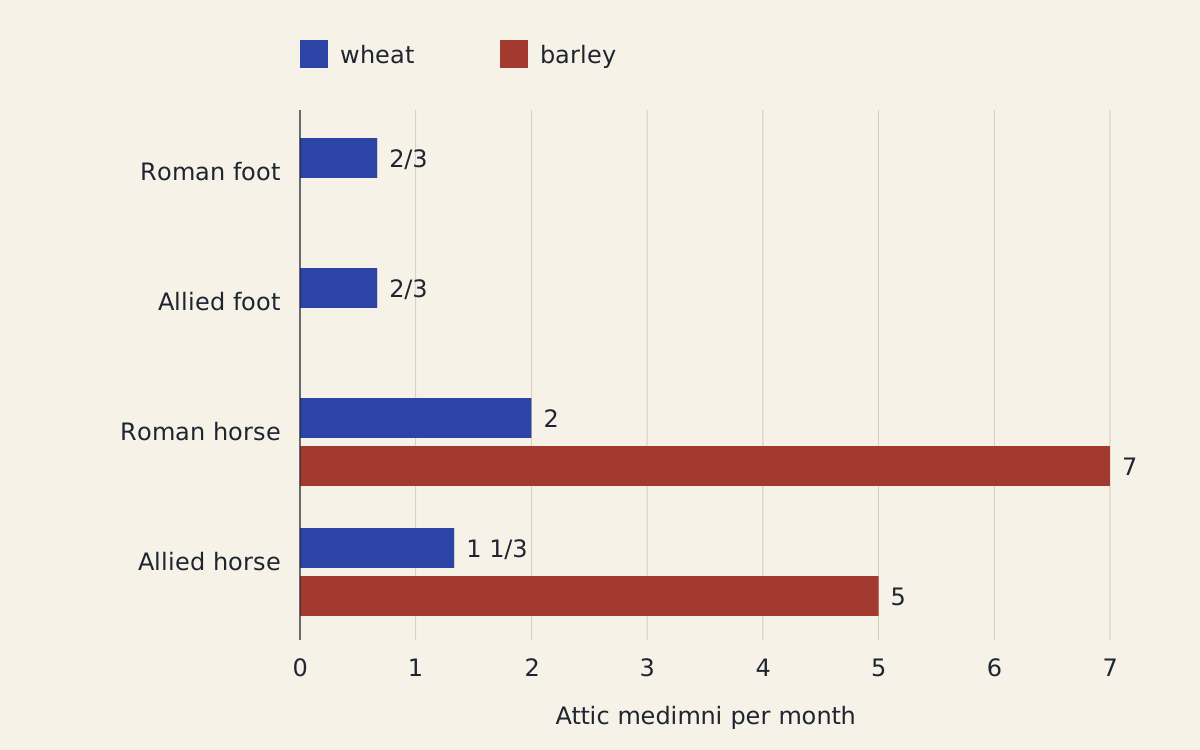
Figure: Monthly grain allowances in Polybius, in his own unit, the Attic medimnus; wheat in blue, barley in red.
Diagram: Treaties & Tradeoffs. CC BY 4.0. Open full size
Reuse credit
Diagram: Treaties & Tradeoffs, "Monthly grain rations in Polybius" — https://treatiesandtradeoffs.com/logistics/roman-legion/, CC BY 4.0 (https://creativecommons.org/licenses/by/4.0/)
Data: Rations: Polybius, Histories 6.39, trans. E. S. Shuckburgh (1889), Project Gutenberg eBook #44125, accessed 2026-11-02, public domain
Reported, with our conversion: The medimnus was the main Greek dry measure, equal to six Roman modii in Smith's dictionary, so the foot soldier's two-thirds comes to four Roman modii a month [1][2].
Reported, with our check: Smith's own entry on army pay glosses the ration as “⅔ of an Attic medimnus, or about 2 bushels of wheat” [2]. His table of measures puts the medimnus at 11.52 imperial gallons, and two-thirds of that is 7.68 gallons, or 0.96 of an imperial bushel of 8 gallons [2][6]. The gloss does not match his own table, so we follow the table.
Reported: Polybius adds that the allies received their grain as a free gift, while for Roman soldiers the quaestor deducted the price of their corn and clothes from their pay “at a fixed rate” [1]. He gives no price, so we do not convert the ration into days of a soldier's pay and report it only in its own units. The two restatements of the pay disagree. Smith gives a foot soldier two obols a day, or 3⅓ asses, while Shuckburgh's translation of Polybius gives 5⅓ asses [1][2].
Assessed: Polybius was active 87 to 123 years before Caesar's war with the Helvetii, so these are the rations of the legion he knew, not necessarily of Caesar's [1][3].
How much did a legion eat a day?
Method: Take two-thirds of a medimnus a month. Turn the medimnus into liters with Smith's 11 gallons 4.16 pints and the legal imperial gallon of 4.54609 liters, divide by a 30-day month, multiply by the weight of a liter of wheat, then by the number of men [1][2][6]. The weight is the weakest input. The USDA counts a bushel of wheat as 60 pounds and a bushel as 2,150.42 cubic inches, which works out to 0.77 kg per liter; ancient wheat differed in variety and moisture, so we use a range of 0.72 to 0.80 kg per liter around that reference [5].
Method: For the horsemen's barley the same handbook gives 48 pounds a bushel, or 0.62 kg per liter, and we use an assumed range of 0.58 to 0.66 kg per liter [5]. The horsemen's wheat is converted exactly like the infantry's.
Reported, with our conversion: One Attic medimnus comes to 52.37 liters, a foot soldier's month to 34.91 liters, and his day to 1.164 liters, or 0.838 to 0.931 kg of wheat [1][2][5][6]. For the 4,200 foot of a legion in Polybius 6.20, that makes 3.52 to 3.91 tonnes a day, or about 3.5 to 3.9 tonnes [1]. Add the wheat and barley of the legion's 300 horsemen and the total comes to 6.40 to 7.17 tonnes a day [1].
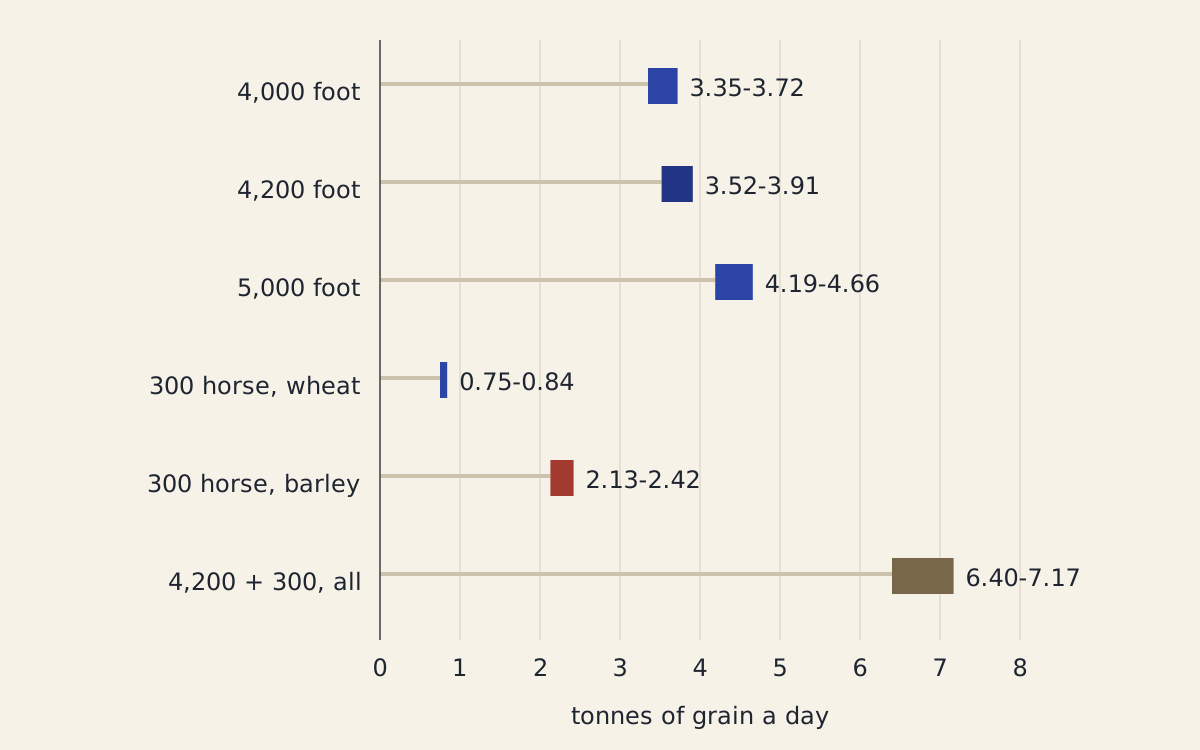
Figure: Daily grain for a legion at Polybius's rations, shown as ranges set by the assumed weight of a liter of grain.
Diagram: Treaties & Tradeoffs. CC BY 4.0. Open full size
Reuse credit
Diagram: Treaties & Tradeoffs, "Daily grain for a Roman legion at Polybius's rations" — https://treatiesandtradeoffs.com/logistics/roman-legion/, CC BY 4.0 (https://creativecommons.org/licenses/by/4.0/)
Data: Rations and legion sizes: Polybius, Histories 3.107, 6.20 and 6.39, trans. E. S. Shuckburgh (1889), Project Gutenberg eBook #44125, accessed 2026-11-02, public domain; Medimnus: William Smith, A Smaller Dictionary of Greek and Roman Antiquities, 12th ed. (1884), Table IX, accessed 2026-11-02, public domain; Grain weight references: USDA ERS, Agricultural Handbook No. 697 (1992), accessed 2026-11-02, U.S. government work; ranges are this site's assumption
Reported: Polybius does not give one size for the legion. In Book 6 the tribunes enroll 4,200 infantry for each legion, “or at times of special danger five thousand,” and 300 horsemen; in Book 3 each legion has about 4,000 foot and 200 horse, raised to 5,000 and 300 when necessity arises [1]. The two passages disagree, so the table keeps both.
| Group | Men | Grain | Tonnes a day | Source of the head count |
|---|---|---|---|---|
| Foot, Book 3 count | about 4,000 | wheat | 3.35 to 3.72 | Polybius 3.107 [1] |
| Foot, Book 6 count | 4,200 | wheat | 3.52 to 3.91 | Polybius 6.20 [1] |
| Foot, times of special danger | 5,000 | wheat | 4.19 to 4.66 | Polybius 6.20 [1] |
| Horse | 300 | wheat | 0.75 to 0.84 | Polybius 6.20 [1] |
| Horse | 300 | barley | 2.13 to 2.42 | Polybius 6.20 [1] |
| Foot and horse | 4,200 and 300 | wheat and barley | 6.40 to 7.17 | Polybius 6.20 [1] |
The conversion, step by step (CSV) Source and license notes (JSON) Data: Polybius, Histories 3.107, 6.20 and 6.39, trans. E. S. Shuckburgh (1889), Project Gutenberg eBook #44125, accessed 2026-11-02, public domain; William Smith, A Smaller Dictionary of Greek and Roman Antiquities, 12th ed. (1884), Project Gutenberg eBook #65909, accessed 2026-11-02, public domain; Weights and Measures Act 1985 (UK), Schedule 1, accessed 2026-11-02 (one defined constant); USDA ERS, Agricultural Handbook No. 697 (1992), accessed 2026-11-02, U.S. government work
Assessed: The 3.5 to 3.9 tonnes is a floor for the infantry, not the need of a legion on campaign. Polybius does not say who ate the horsemen's barley; horses are the likeliest eaters, but that is our reading, not his [1]. The pack animals, and any grain lost to damp or pests, are not in his figures at all. The 30-day month is also ours: a month of 29 or 31 days moves the daily figure by about 3 percent.
How far could a legion march on what it carried?
The answer uses what we call the supply ceiling: the limit of distance and time that an army or a trade route could sustain, worked out under assumptions that are stated one by one. It applies only to goods that can be counted and weighed, here wheat, and it marks a limit, not an explanation of what happened.
Method: Cicero, writing of the Roman army on the march, says its soldiers “carry more than a fortnight's provision” [4]. We read that provision as the grain ration, counted in whole days, which is our assumption: more than a fortnight of 14 days is then at least 15 days, and we take 15 as the floor. The sources we read give no load for a Roman pack animal, so the pack train stays out of this ceiling. None gives a standard day's march either, so the ceiling is counted in days rather than miles.
| Assumption | Value | Unit | Source or basis |
|---|---|---|---|
| People to feed | 4,200 | foot soldiers | Polybius 6.20 [1] |
| Ration per person | 0.838 to 0.931 | kg of wheat a day | our conversion of Polybius 6.39 [1][2][5] |
| Carriers | the soldiers themselves | none | Cicero, Tusculan Disputations, Book 2 [4] |
| Load per carrier | 12.6 to 14.0 | kg of wheat per man | at least 15 days' ration, after Cicero [4] |
| Fodder for animals | not counted | none | no animal loads in the sources read [1] |
| Grain found along the way | none | kg | Caesar in 58 BC: none to buy or take [3] |
Reported, with our conversion: Under these assumptions each man starts with 12.6 to 14.0 kg of wheat, and the 4,200 together carry 52.8 to 58.7 tonnes, enough for at least 15 days without a fresh issue [1][4].
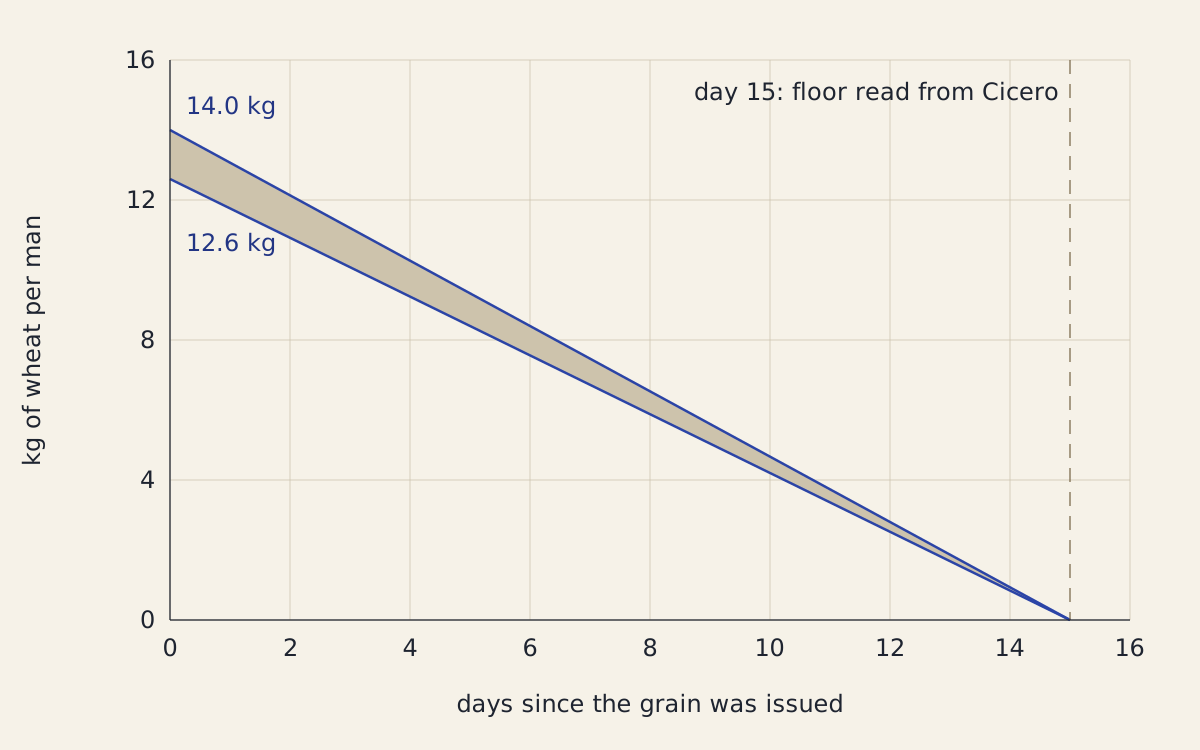
Figure: Wheat on each foot soldier's back, drawn down over 15 days, the least that Cicero's “more than a fortnight” allows in whole days, for the assumed range of grain weights.
Diagram: Treaties & Tradeoffs. CC BY 4.0. Open full size
Reuse credit
Diagram: Treaties & Tradeoffs, "The supply ceiling of a Roman legion's infantry" — https://treatiesandtradeoffs.com/logistics/roman-legion/, CC BY 4.0 (https://creativecommons.org/licenses/by/4.0/)
Data: Load: Cicero, Tusculan Disputations, Book 2, ch. 16, trans. C. D. Yonge (1877), Project Gutenberg eBook #14988, accessed 2026-11-02, public domain; Ration: Polybius, Histories 6.39, trans. E. S. Shuckburgh (1889), accessed 2026-11-02, public domain, converted by this site; Medimnus: William Smith, A Smaller Dictionary of Greek and Roman Antiquities, 12th ed. (1884), Table IX, Project Gutenberg eBook #65909, accessed 2026-11-02, public domain; Wheat weight reference: USDA ERS, Agricultural Handbook No. 697 (1992), accessed 2026-11-02, U.S. government work; range is this site's assumption
The supply ceiling, one assumption per row (CSV) Source and license notes (JSON) Data: Cicero, Tusculan Disputations, trans. C. D. Yonge (1877), Project Gutenberg eBook #14988, accessed 2026-11-02, public domain; Polybius, Histories, trans. E. S. Shuckburgh (1889), Project Gutenberg eBook #44125, accessed 2026-11-02, public domain; William Smith, A Smaller Dictionary of Greek and Roman Antiquities, 12th ed. (1884), Table IX, Project Gutenberg eBook #65909, accessed 2026-11-02, public domain; USDA ERS, Agricultural Handbook No. 697 (1992), accessed 2026-11-02, U.S. government work; Julius Caesar, The Gallic War, trans. W. A. McDevitte, Project Gutenberg eBook #10657, accessed 2026-11-02, public domain in the US, EU status of the translation not established; fact restated, not quoted
Reported: Cicero adds that the soldiers also carried stakes for the camp, and that they counted shield, sword and helmet as no more of a burden than their own limbs [4].
Assessed: Cicero is praising endurance, not weighing a pack, so his fortnight is the one number we take from him. For men living off their own packs, the ceiling is at least a fortnight. For the army as a whole that is a floor, because animals, wagons and boats could carry more, though the animals ate fodder of their own.
Assessed: Caesar's case shows the limits of the sum. He says he had followed the Helvetii for about fifteen days and that they had turned away from the river his boats were on, but he does not say when he last issued grain, so the fortnight cannot be laid over his march day by day [3]. A trade route raises the same question in another form, and the Silk Road dispatch counts its distances rather than its loads.
What did Caesar do in 58 BC?
The card at the top of this page applies the known-then test: score the choice only on what its makers could know at the time, with each piece of that knowledge tied to a source.
Reported: In Caesar's own account, the Helvetii set out in the consulship of Piso and Gabinius, which his translator dates to 58 BC [3]. Caesar followed them for about fifteen days, never more than five or six miles behind, with six legions, four of them veteran and two newly raised in Hither Gaul, and about 4,000 horse drawn from the Province, the Aedui and their allies [3]. He pressed the Aedui daily for the grain they had promised and summoned the Aeduan chiefs in his camp, he says, but the cold had left the corn in the fields unripe and fodder short, grain could be neither bought nor taken from the fields, and the grain he had shipped up the Saône was useless once the Helvetii turned away from the river [3]. With two days left before he had to issue grain, and Bibracte no more than 18 miles away, he turned from the Helvetii and marched there for supplies [3].
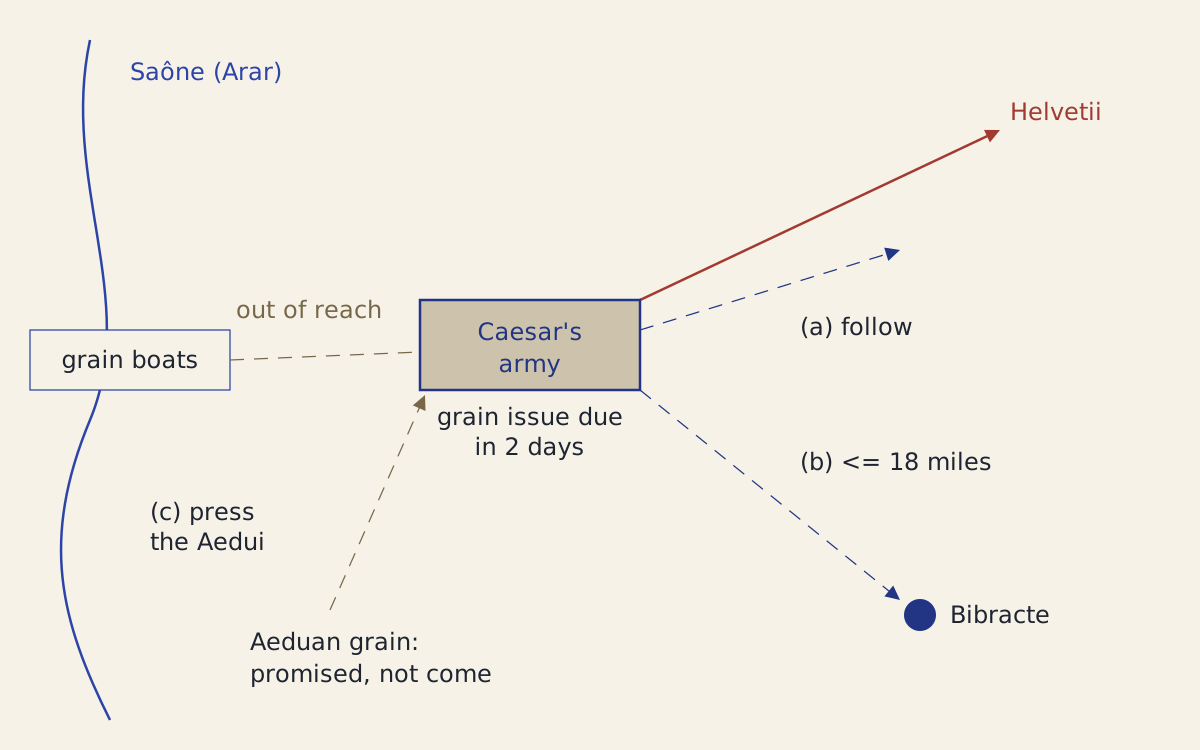
Figure: A relative-position diagram of Caesar's situation as his own account describes it, with the three options open to him; not to scale, and the directions are not from his account.
Diagram: Treaties & Tradeoffs. CC BY 4.0. Open full size
Reuse credit
Diagram: Treaties & Tradeoffs, "Caesar's options in 58 BC: relative-position diagram" — https://treatiesandtradeoffs.com/logistics/roman-legion/, CC BY 4.0 (https://creativecommons.org/licenses/by/4.0/)
Data: Positions and options as described in Julius Caesar, The Gallic War 1.15–1.23, trans. W. A. McDevitte, Project Gutenberg eBook #10657, accessed 2026-11-02, public domain in the US, EU status of the translation not established (facts only); relative positions only
The sketch as text
- The Helvetii marching ahead, with Caesar's army a few miles behind [3].
- Grain boats on the Saône, out of reach once the Helvetii left the river [3].
- Aeduan grain promised but not delivered [3].
- Grain issue due in two days [3].
- Option (a): keep following the Helvetii [3].
- Option (b): turn aside to Bibracte, no more than 18 miles away [3].
- Option (c): keep pressing the Aeduan chiefs [3].
Reported, with our conversion: Counting Caesar's miles as Roman miles, at Smith's 1,618 English yards to the Roman mile, Bibracte lay no more than about 26.6 km away [2][5].
Reported: Caesar tells the delay as a story of Aeduan politics. The chief magistrate Liscus, he writes, blamed private men of influence for keeping the people from handing over grain, and Caesar's own inquiries pointed to Dumnorix, the brother of the Aeduan Divitiacus [3]. When Caesar turned toward Bibracte, the Helvetii began to harass his rear, by his account either because they took it for a retreat or because they hoped to cut him off from his supplies [3].
Assessed: On what the card lists, the turn to Bibracte was the one option that did not wait on someone else's delivery, since the boats were out of reach and the Aeduan grain had not come. That reading rests on a single author with a stake in the story, who also assigns the blame for the shortfall. The sources we read hold no independent account of those days.
What did a legion look like on the march?
Reported: Polybius describes the start of a march: at the first bugle the men strike their tents and pack, at the second they load the beasts of burden, and each legion moves with its own baggage animals behind it [1]. The extraordinarii, picked troops drawn from the allies, usually lead the column, followed by the right wing of the allies and their pack animals, then the first legion with its baggage, then the second [1]. He gives no count of those animals and no load for them, which is why they stay outside the ceiling above.
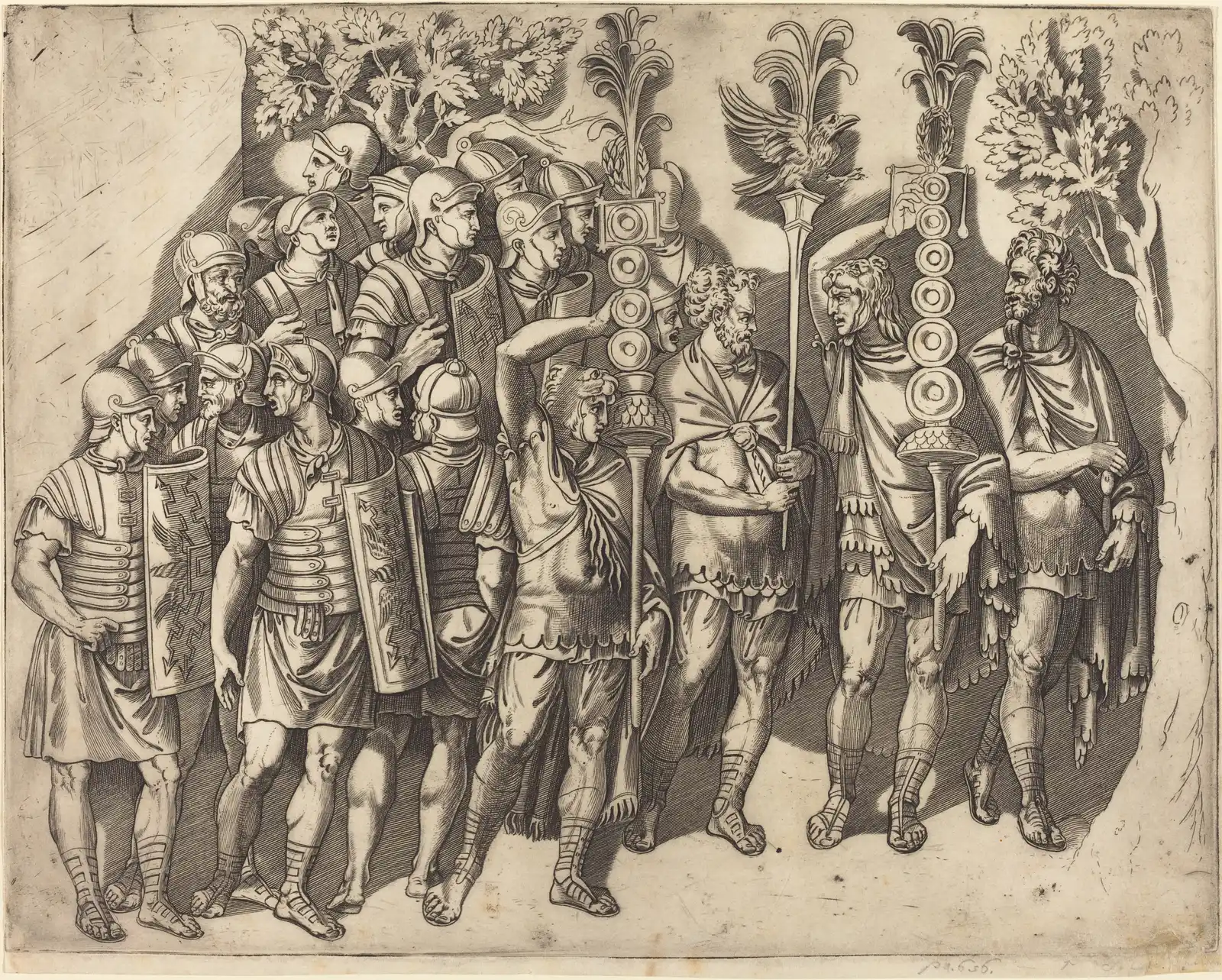
Figure: A Roman Legion, an engraving by Marco Dente made between 1515 and 1527 (National Gallery of Art, Washington).
"A Roman Legion" by Marco Dente — https://commons.wikimedia.org/wiki/File:Marco_Dente,_A_Roman_Legion,_1515-1527,_NGA_150374.jpg — CC0 1.0 (https://creativecommons.org/publicdomain/zero/1.0/)

Assessed: The print is a Renaissance image, not evidence for Polybius's legion. LACMA catalogues its own impression of it in a series titled Trajan's Column Prints, which suggests the armour, shields and standards were modelled on a monument of the imperial age, long after the army Polybius described [7]. It shows how the early sixteenth century pictured Roman soldiers. The rations above are what Polybius says the army of his own day was allotted.
Sources
- Polybius, The Histories of Polybius, vol. 1, trans. Evelyn S. Shuckburgh (London and New York: Macmillan, 1889), Book 3.107 and Book 6.20, 6.26, 6.39–6.40, with the translator's introduction. Project Gutenberg eBook #44125. https://www.gutenberg.org/ebooks/44125Read: full text of the 1889 translation
- William Smith, A Smaller Dictionary of Greek and Roman Antiquities, 12th ed. (London: John Murray, 1884), Table IX "Grecian Measures of Capacity" and the entries Medimnus, Modius, Milliare and Stipendium. Project Gutenberg eBook #65909. https://www.gutenberg.org/ebooks/65909Read: full text of the 1884 edition
- Julius Caesar, The Gallic War, Book 1, chapters 6 and 15–24, in "De Bello Gallico" and Other Commentaries, trans. W. A. McDevitte. Project Gutenberg eBook #10657. https://www.gutenberg.org/ebooks/10657Read: full text of the translation; facts only, not quoted
- Marcus Tullius Cicero, Tusculan Disputations, Book 2, chapter 16, trans. C. D. Yonge (New York: Harper & Brothers, 1877). Project Gutenberg eBook #14988. https://www.gutenberg.org/ebooks/14988Read: full text of the translation
- U.S. Department of Agriculture, Economic Research Service, Weights, Measures, and Conversion Factors for Agricultural Commodities and Their Products, Agricultural Handbook No. 697 (Washington, DC, June 1992). https://www.ers.usda.gov/publications/41881Read: full text
- Weights and Measures Act 1985 (UK), Schedule 1, Part VI, definition of the gallon (4.54609 cubic decimetres). https://www.legislation.gov.uk/ukpga/1985/72/schedule/1Read: the schedule's definitions of capacity
- Los Angeles County Museum of Art, record for Marco Dente, A Roman Legion, engraving, 1515–1527, M.88.91.222, series "Trajan's Column Prints" (as reproduced on Wikimedia Commons). https://commons.wikimedia.org/wiki/File:A_Roman_Legion_LACMA_M.88.91.222.jpgRead: museum record as given on the file page

Cite this page
Treaties & Tradeoffs. “Roman Legion: Polybius's Wheat Ration, Converted to Tonnes.” published 2026-11-02. https://treatiesandtradeoffs.com/logistics/roman-legion/. Accessed [the date you read it].
Plain citation; add the date you consulted the page. No DOI is assigned.