Ideas & TechnologyGenealogy of an idea
Shipping Container: Court Says Rail Cars Went to Sea by 1932
Treaties & Tradeoffs Filed
By the Supreme Court's account, Seatrain Lines was hoisting loaded railroad cars into its ships on an interstate route from 1932, after a predecessor company began a Louisiana-to-Cuba service in 1929. Those are the earliest dates we found in records we could read. The ships carried whole rail cars, not shipping containers, and the 1956 Ideal X voyage that Marc Levinson's history The Box puts at the start of container shipping came later [1][2][3].
Order of business (5 sections)
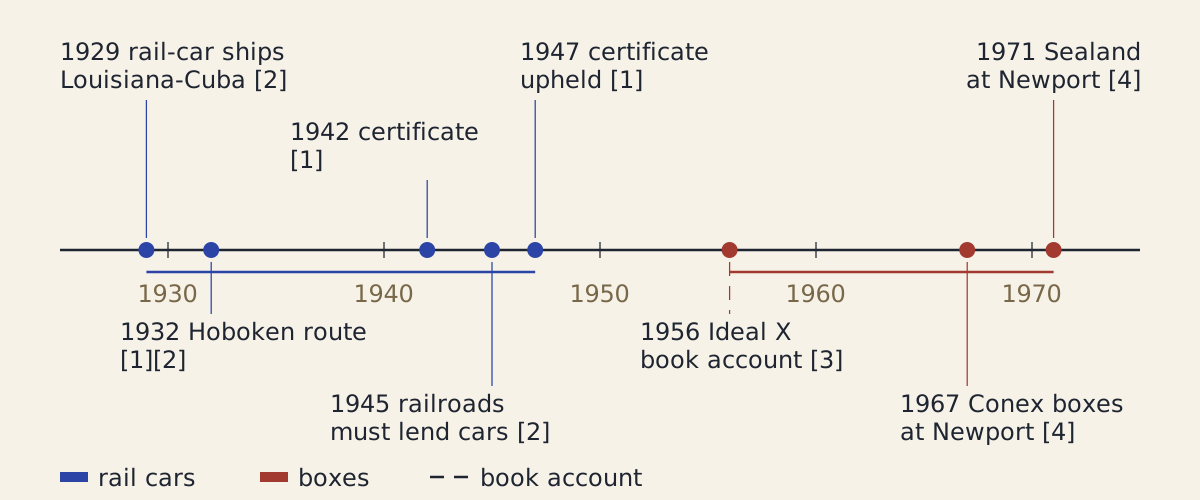
Figure: Dated steps from rail cars at sea to stacked boxes, 1929 to 1971. Blue marks rail-car records and red marks box records; the dashed mark is a book account.
Diagram: Treaties & Tradeoffs. CC BY 4.0. Open full size
Reuse credit
Diagram: Treaties & Tradeoffs, "Shipping container history: from rail cars at sea to stacked boxes, 1929–1971" — https://treatiesandtradeoffs.com/ideas/shipping-container/, CC BY 4.0 (https://creativecommons.org/licenses/by/4.0/)
Data: Dates: United States v. Pennsylvania R. Co., 323 U.S. 612 (1945); United States v. Seatrain Lines, 329 U.S. 424 (1947); U.S. Army photographs, National Archives 111-CCV-154; Marc Levinson, The Box (2006), for 1956 only
The lineage as text
- 1929: a predecessor of Seatrain Lines begins carrying loaded railroad cars by ship from Belle Chasse, Louisiana, to Havana (court record) [2].
- 1932: Seatrain starts an interstate service from Hoboken, New Jersey, to Belle Chasse by way of Havana (court record) [1][2].
- 10 August 1942: a federal certificate lets Seatrain carry “commodities generally” between New York, New Orleans and Texas City (court record) [1].
- 29 January 1945: the Supreme Court upholds an order that railroads interchange their cars with Seatrain (court record) [2].
- 6 January 1947: the Supreme Court upholds Seatrain's 1942 certificate, freight cars included (court record) [1].
- 1956: the Ideal X voyage, in Marc Levinson's account (book account) [3].
- 18 September and 8 October 1967: Army photographs of Conex boxes being loaded and stacked at Newport (photograph record) [4].
- 28 September 1971: an Army photograph of Sealand containers unloaded onto a truck at Newport (photograph record) [4].
In January 1945, the Supreme Court described cargo ships built to swallow whole railroad cars, loaded, from the dock tracks. Goods no longer had to be unloaded from the cars and carried piecemeal into the hold [2]. The Court was not writing shipping container history. Still, its opinion gives the earliest date we found for freight crossing the sea unpacked [2].
Justice Black's opinion repeated the Interstate Commerce Commission's finding that the service was “a great improvement over the old practice, less destructive to the goods, more economical and more efficient” [2]. The case itself was a fight between Seatrain Lines and the railroads that owned the cars.
What did Seatrain carry, and since when?
Reported: In 1929, the Court wrote, Seatrain's predecessor began carrying goods from Belle Chasse, Louisiana, to Havana, Cuba. Each vessel “could carry a number of railroad cars,” and special equipment hoisted the cars from tracks on the dock and moved them “bodily into the vessels” [2]. In 1932 Seatrain decided to open an interstate service between Hoboken, New Jersey, and Belle Chasse by way of Havana, which put it in direct competition with the railroads [2]. The 1947 opinion confirms the year from the other side: when Seatrain applied for federal certificates on 29 May 1941, one of its two routes was one “it had operated since 1932,” and the other it had begun in 1940 [1].
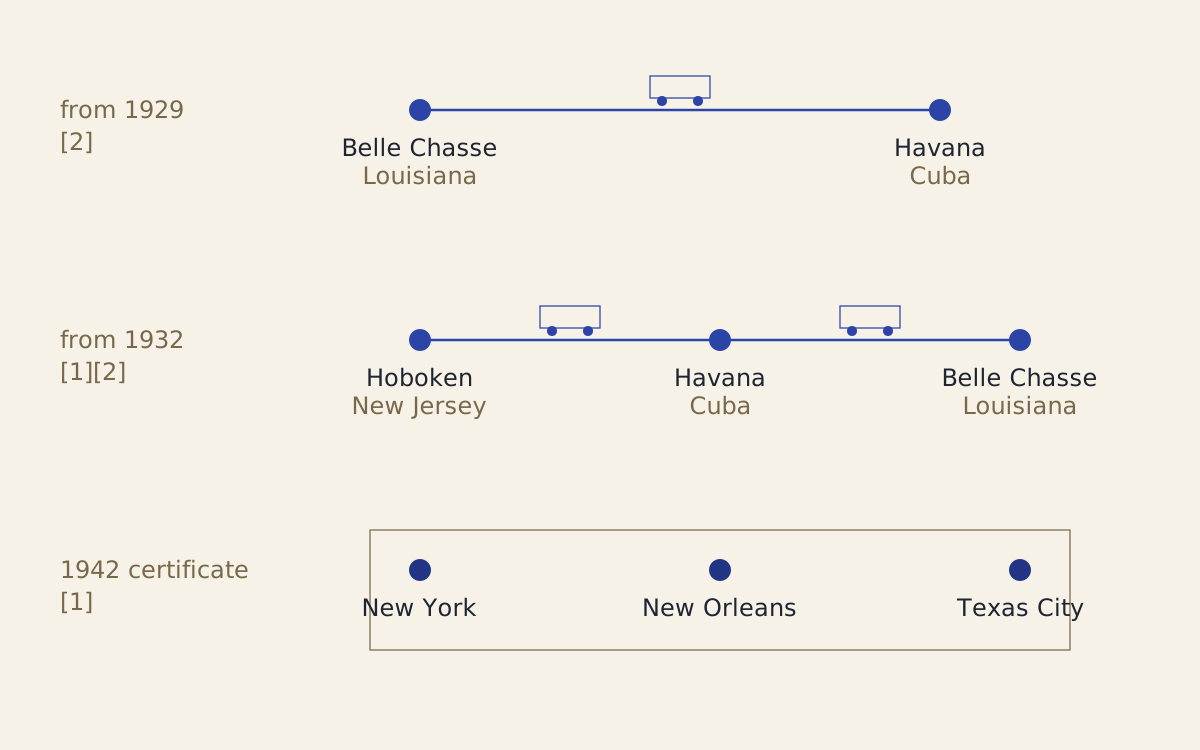
Figure: Seatrain's services in the order the two Supreme Court opinions give them, with the ports named in its 1942 certificate. Positions and distances are not drawn to scale.
Diagram: Treaties & Tradeoffs. CC BY 4.0. Open full size
Reuse credit
Diagram: Treaties & Tradeoffs, "Seatrain's rail-car services, 1929, 1932 and the 1942 certificate" — https://treatiesandtradeoffs.com/ideas/shipping-container/, CC BY 4.0 (https://creativecommons.org/licenses/by/4.0/)
Data: Ports and years: United States v. Pennsylvania R. Co., 323 U.S. 612 (1945); United States v. Seatrain Lines, 329 U.S. 424 (1947)
The services as text
- From 1929: Belle Chasse, Louisiana, to Havana, Cuba (the predecessor's foreign service) [2].
- From 1932: Hoboken, New Jersey, to Belle Chasse by way of Havana (Seatrain's interstate service) [1][2].
- 1942 certificate: New York, New Orleans and Texas City, by the Atlantic Ocean and the Gulf of Mexico; the opinion does not say which ports each route served [1].
Reported: The 1947 opinion describes the same ships in the present tense: “Loaded railroad cars can be hoisted and transported in its vessels, thereby eliminating such things as trouble, time and breakage, said to be incident to loading and unloading goods from railroad cars.” The ships also had tank space for liquid cargo in bulk [1]. The certificate that took effect on 10 August 1942 covered “commodities generally” between New York, New Orleans and Texas City, by way of the Atlantic Ocean and the Gulf of Mexico [1].
The card at the top of this page applies the known-then test: score the choice only on what its makers could know at the time, with each piece of that knowledge tied to a source. It is 1932, and you are in Seatrain's office. You have about three years of a working rail-car service to Cuba, ships built for it, and railroads that let you use their cars freely while you serve only Cuba and do not compete with them [2].
Assessed: On that list, the interstate route was a sound bet with one weak point: the cars Seatrain carried belonged to the railroads it was about to compete with. Think of each car as a box on loan, as if Seatrain's cargo space were supplied from its rivals' yards. The court record does not say whether Seatrain weighed that risk in 1932, so we neither credit it with foresight nor blame it for blindness.
Why did the railroads and the regulators fight over Seatrain?
Reported: Shortly after the interstate service began, the American Railway Association adopted a rule: “Cars of railway ownership must not be delivered to a steamship, ferry or barge line for water transportation without permission of the owner filed with the Car Service Division.” Some railroads kept lending cars to Seatrain. Others refused [2]. The Commission found that no railroad had refused cars to any of the eleven other water lines named in the Association's circular, and that the rule's sole object was to stop traffic moving from the railroads to Seatrain [2].
Reported: The Commission ordered through rail-water routes with joint rates, and it set the hire Seatrain paid for a railroad's car at $1.00 per car per day while the car was in Seatrain's possession [2]. The railroads sued. On 29 January 1945 the Supreme Court upheld the order, including routes that passed through foreign waters, with Justice Roberts dissenting [2]. We found no readable wage series for these ports in those years to give that dollar a scale, so we do not convert it and leave it as the Court gave it.
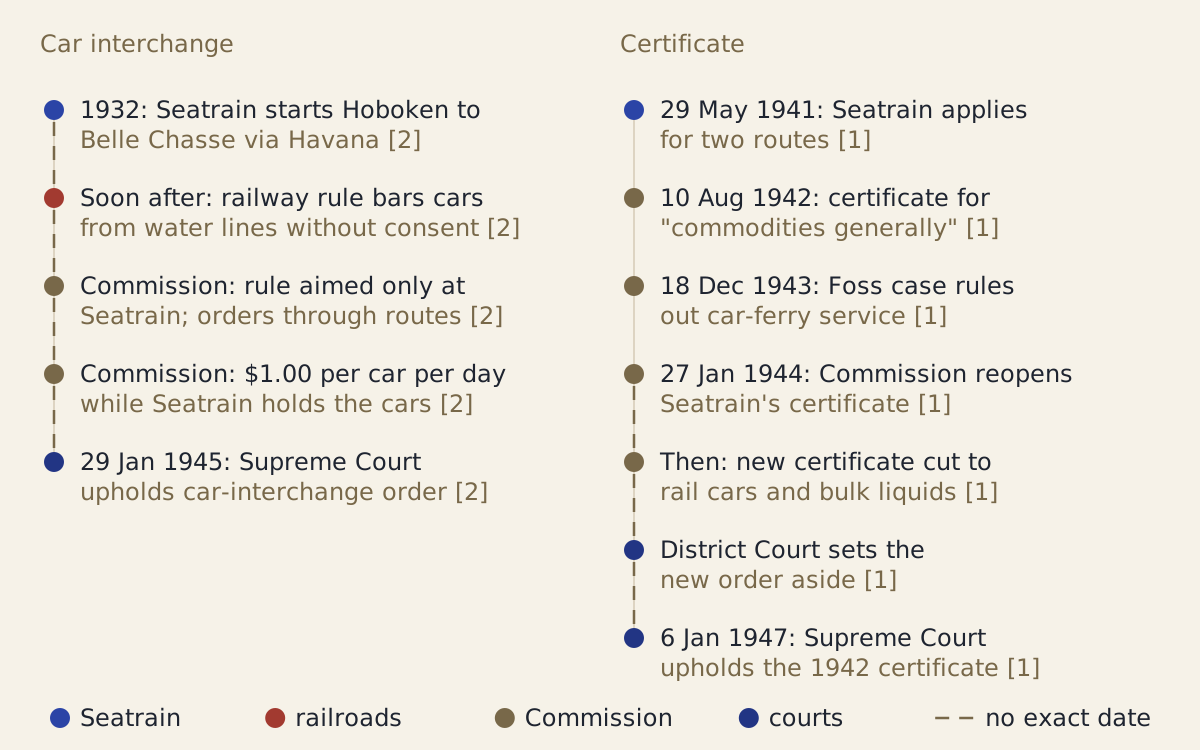
Figure: The car-interchange dispute and the certificate dispute, step by step as the two opinions give them. Dashed links join steps the opinions do not date.
Diagram: Treaties & Tradeoffs. CC BY 4.0. Open full size
Reuse credit
Diagram: Treaties & Tradeoffs, "Seatrain's two disputes, 1932–1947" — https://treatiesandtradeoffs.com/ideas/shipping-container/, CC BY 4.0 (https://creativecommons.org/licenses/by/4.0/)
Data: Steps and dates: United States v. Pennsylvania R. Co., 323 U.S. 612 (1945); United States v. Seatrain Lines, 329 U.S. 424 (1947)
The two disputes as text
- Car interchange, 1932: Seatrain starts its Hoboken to Belle Chasse service by way of Havana [2].
- Car interchange, soon after (undated): a railway association rule bars delivery of railroad cars to water lines without the owner's permission [2].
- Car interchange, undated: the Commission finds the rule aimed only at Seatrain and orders through rail-water routes [2].
- Car interchange, undated: the Commission sets car hire at $1.00 per car per day while Seatrain holds a car [2].
- Car interchange, 29 January 1945: the Supreme Court upholds the Commission's order [2].
- Certificate, 29 May 1941: Seatrain applies for certificates on two routes [1].
- Certificate, 10 August 1942: the certificate for “commodities generally” takes effect [1].
- Certificate, 18 December 1943: the Foss Launch & Tug decision rules out car-ferry service under such certificates [1].
- Certificate, 27 January 1944: the Commission reopens Seatrain's certificate [1].
- Certificate, undated: the Commission orders a narrower certificate for bulk liquids, empty rail cars and freight in rail cars [1].
- Certificate, undated: the District Court sets that order aside [1].
- Certificate, 6 January 1947: the Supreme Court upholds the 1942 certificate [1].
Was a ship full of rail cars a car ferry?
Reported: Part III of the Interstate Commerce Act, passed in 1940, put water carriers under the Commission and required certificates. A carrier in bona fide operation on 1 January 1940 was entitled to one for the routes it already served [1]. Seatrain applied on 29 May 1941 as a “common carrier by water of commodities generally,” and its certificate took effect 438 days later, on 10 August 1942 [1].
Reported: On 18 December 1943, in the Foss Launch & Tug case, the Commission ruled for the first time that a certificate for “commodities generally” did not cover carrying freight cars by water, which the opinion calls “so-called ‘car-ferry service’” [1]. Just 40 days later, on 27 January 1944, the Commission reopened Seatrain's certificate on its own motion [1].
Reported: The Commission then cancelled the certificate and ordered a narrower one, limited to liquid cargo in bulk, empty railroad cars, and goods loaded in freight cars received from and delivered to railroads [1]. In the Court's summary of the Commission's view, the original wording had stripped Seatrain of any right to carry railroad cars, “its chief business” [1]. The District Court set the order aside. On 6 January 1947, 28 days after hearing argument, the Supreme Court held that the Commission had no power to revoke the certificate, which “properly interpreted, authorized it to carry commodities generally, including freight cars” [1].
Assessed: The fight was about what kind of thing Seatrain was. In earlier proceedings the Commission had refused to class its vessels as car ferries and called them ocean-going water carriers; after Foss, it treated the rail cars aboard as a separate kind of traffic [1]. In the two cases we read, a regulator could not settle whether a loaded rail car on a ship was cargo or vehicle. That suggests the idea of shipping a sealed unit, rather than the goods inside it, still had no fixed legal place in the 1940s.
How is a rail car different from a shipping container?
Reported: Seatrain's unit of cargo was a whole railroad car with an owner. The cars belonged to railroads, which could refuse to hand them to a water line until the Commission ordered otherwise, and which were paid $1.00 for each day Seatrain held one [2].
Reported: The Army's Conex was a different object. Army photographs from Newport record Conex boxes being loaded onto a ship and stacked on a pier after unloading in 1967, and Sealand containers being unloaded from a ship onto a truck in 1971 [4].
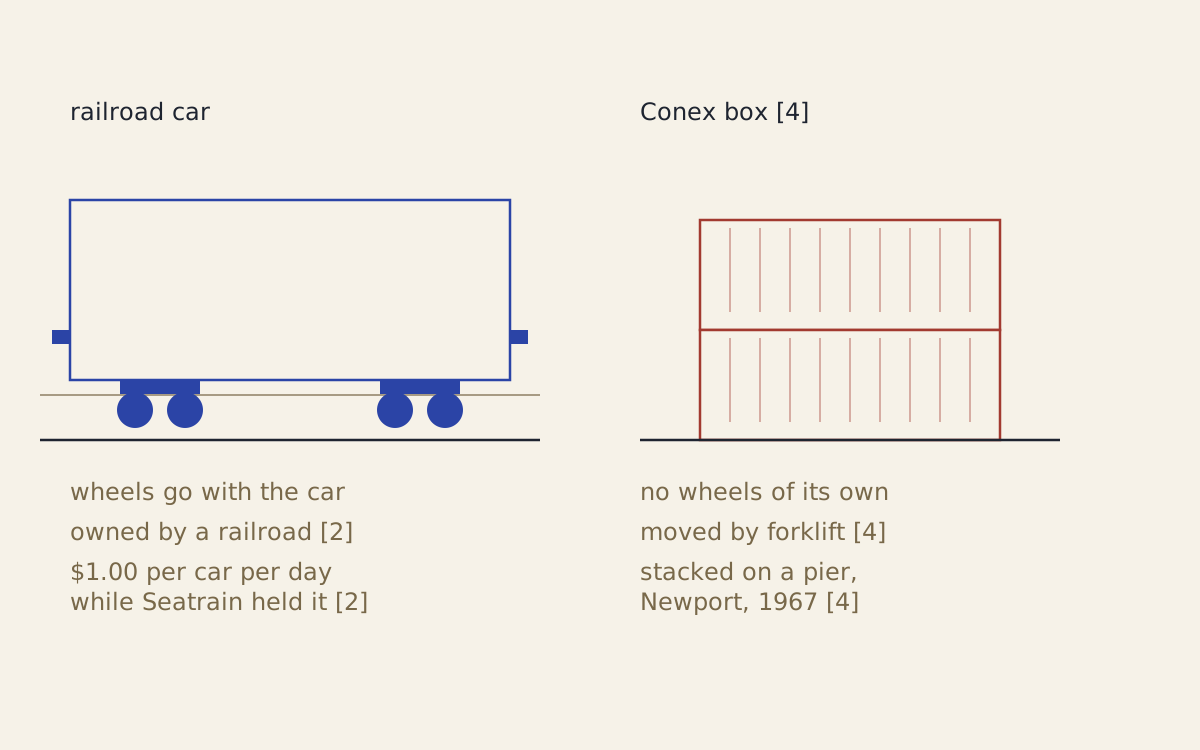
Figure: A railroad car of the kind Seatrain hoisted aboard, beside a Conex box as the 1967 Newport photographs show it. Not to scale and without dimensions: both are drawn only to show their parts.
Diagram: Treaties & Tradeoffs. CC BY 4.0. Open full size
Reuse credit
Diagram: Treaties & Tradeoffs, "A railroad car and a Conex box compared" — https://treatiesandtradeoffs.com/ideas/shipping-container/, CC BY 4.0 (https://creativecommons.org/licenses/by/4.0/)
Data: Car ownership and hire: United States v. Pennsylvania R. Co., 323 U.S. 612 (1945); Conex box handling: U.S. Army photographs, National Archives 111-CCV-154-CC46304 and CC43714 (1967)
The comparison as text
- Railroad car: travels on its own wheels; owned by a railroad; Seatrain paid $1.00 per car per day while it held one [2].
- Conex box: no wheels of its own; moved by forklift and stacked on a pier after unloading, Newport, 1967 [4].
Assessed: For readers who came for sizes, this page gives no container dimensions, because we found no document we could read that states them. The later international size standards are outside the sources used here.
Assessed: For this genealogy, the difference that matters is not size. A container can be lifted off its wheels, stacked, and handed to a truck, a ship or a train. Seatrain showed that a ship could carry freight without unpacking it, but it did not separate the box from the wheels.
How did the Army handle Conex boxes in 1967?
Reported: Army photographers recorded the boxes in use at Newport, the port one caption calls Saigon's New Port. On 18 September 1967 a Conex was photographed being loaded onto the Oceanic Victory, and on 8 October 1967 Conex containers were photographed stacked on the pier after unloading from an incoming ship [4].
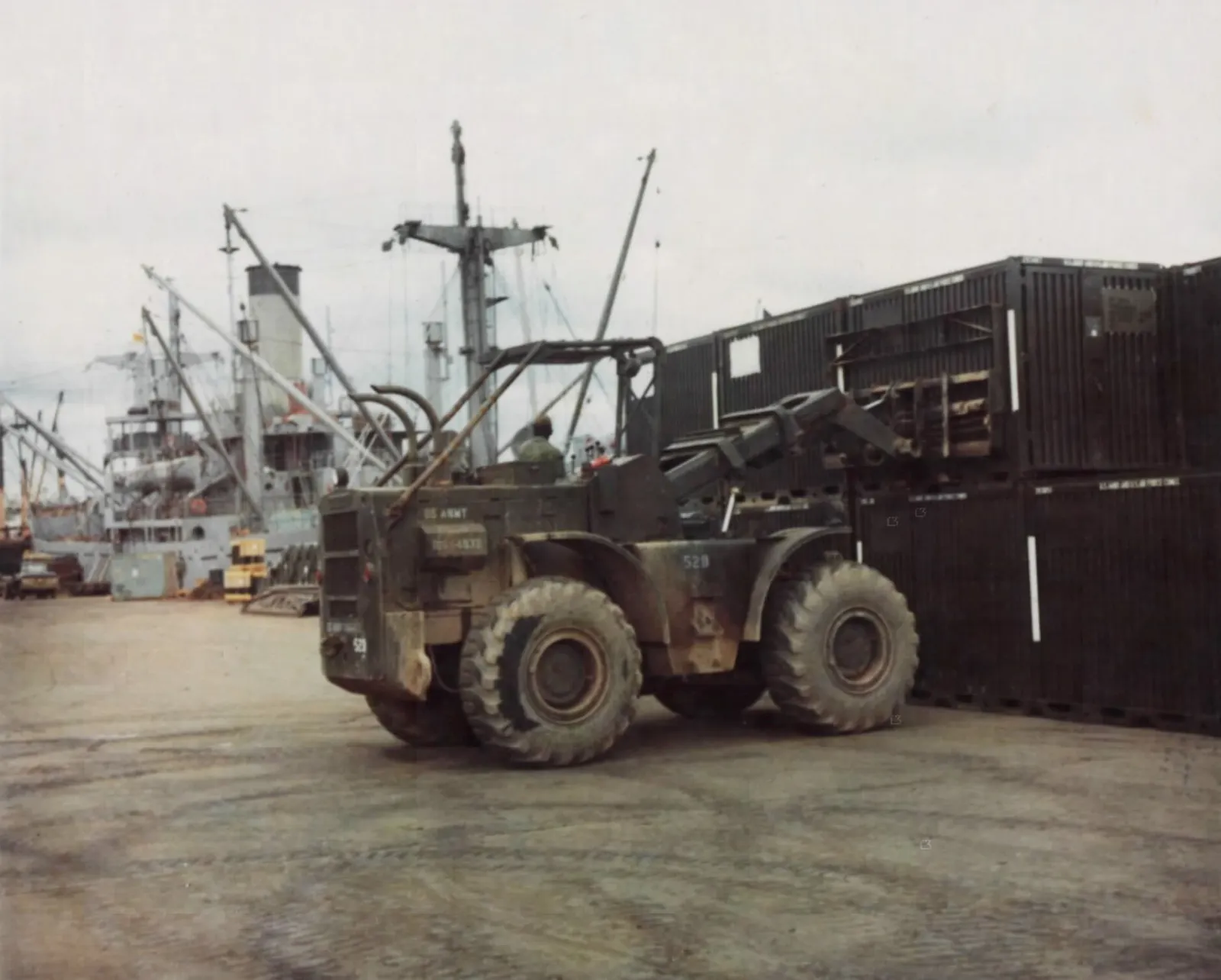
Figure: Conex containers stacked on the pier after unloading from an incoming ship at Newport, photographed on 8 October 1967 by SP5 Robert C. Lafoon, U.S. Army.
“Conex containers are stacked on the pier after being unloaded from an incoming ship at Newport” by SP5 Robert C. Lafoon, U.S. Army. Public domain.
Full credit
"Conex containers are stacked on the pier after being unloaded from an incoming ship at Newport" by SP5 Robert C. Lafoon, U.S. Army — https://commons.wikimedia.org/wiki/File:Conex_containers_are_stacked_on_the_pier_after_being_unloaded_from_an_incoming_ship_at_Newport.jpg — Public domain (U.S. federal government work, 17 U.S.C. §105; U.S. Army photograph, National Archives 111-CCV-154-CC43714)

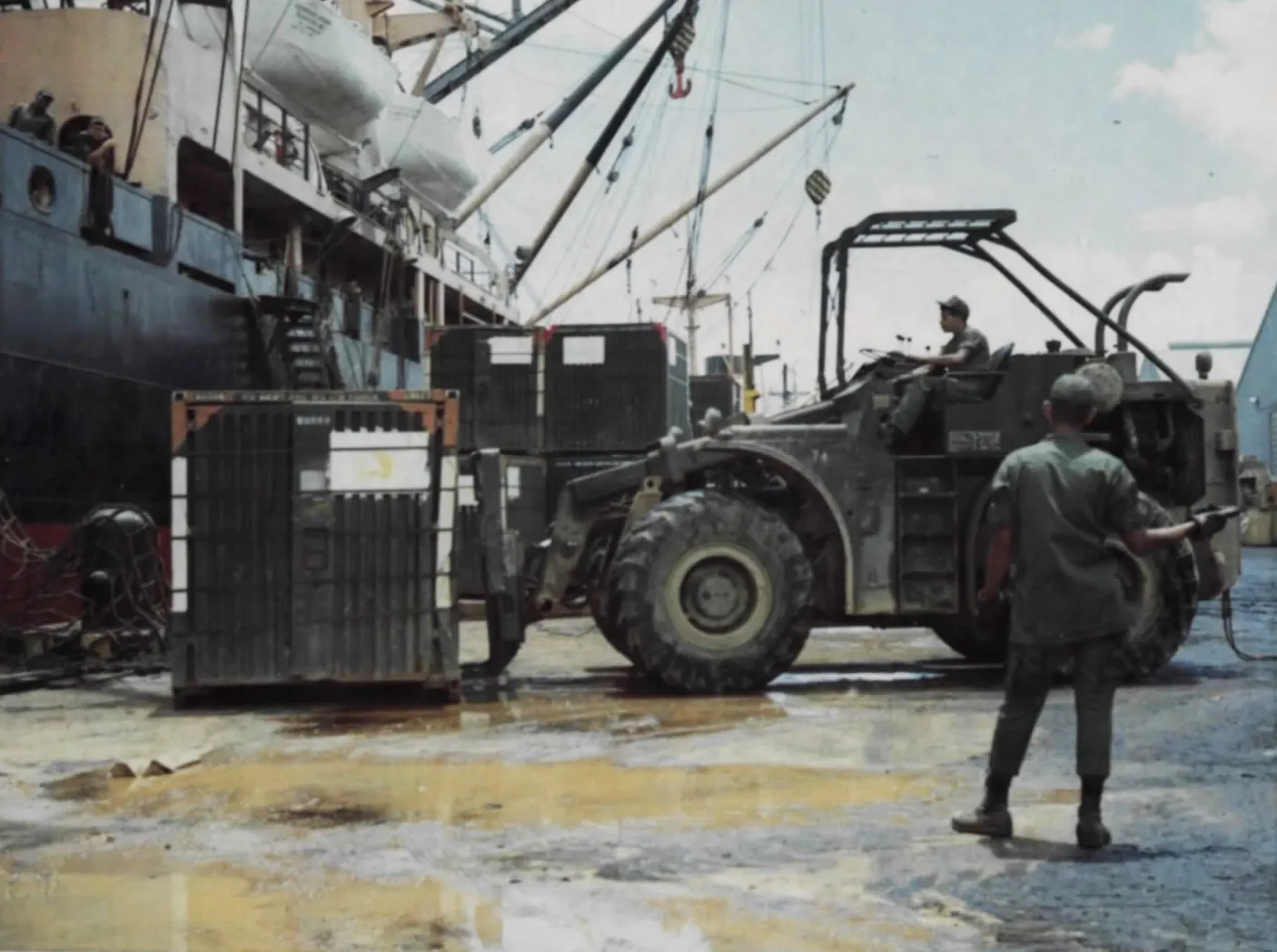
Figure: A Conex is loaded onto the “Oceanic Victory” at Saigon's New Port, photographed on 18 September 1967 by SSG James I. Hatton, U.S. Army.
"A Conex is loaded onto the Oceanic Victory at Newport" by SSG James I. Hatton, U.S. Army — https://commons.wikimedia.org/wiki/File:A_Conex_is_loaded_onto_the_Oceanic_Victory_at_Newport.jpg — Public domain (U.S. federal government work, 17 U.S.C. §105; U.S. Army photograph, National Archives 111-CCV-154-CC46304)

Assessed: The photographs show the box moved by forklift, stacked two high, and handled as one unit rather than as loose packages. Their captions do not say what the boxes held. They also do not show how many boxes moved or when the Army began using them. Two photographs from one port are evidence of use, not a count.
Who gets the credit for the shipping container?
Reported: Marc Levinson's history of container shipping, The Box (2006), puts the start of the container era at the 1956 voyage of the Ideal X [3]. We could not read a record from 1956 itself, so on this page the Ideal X rests on Levinson's account alone, and we give none of its details.
Reported: By 28 September 1971, an Army photographer at Newport recorded Sealand containers being unloaded from the SS Raphael Semmes onto a truck [4].
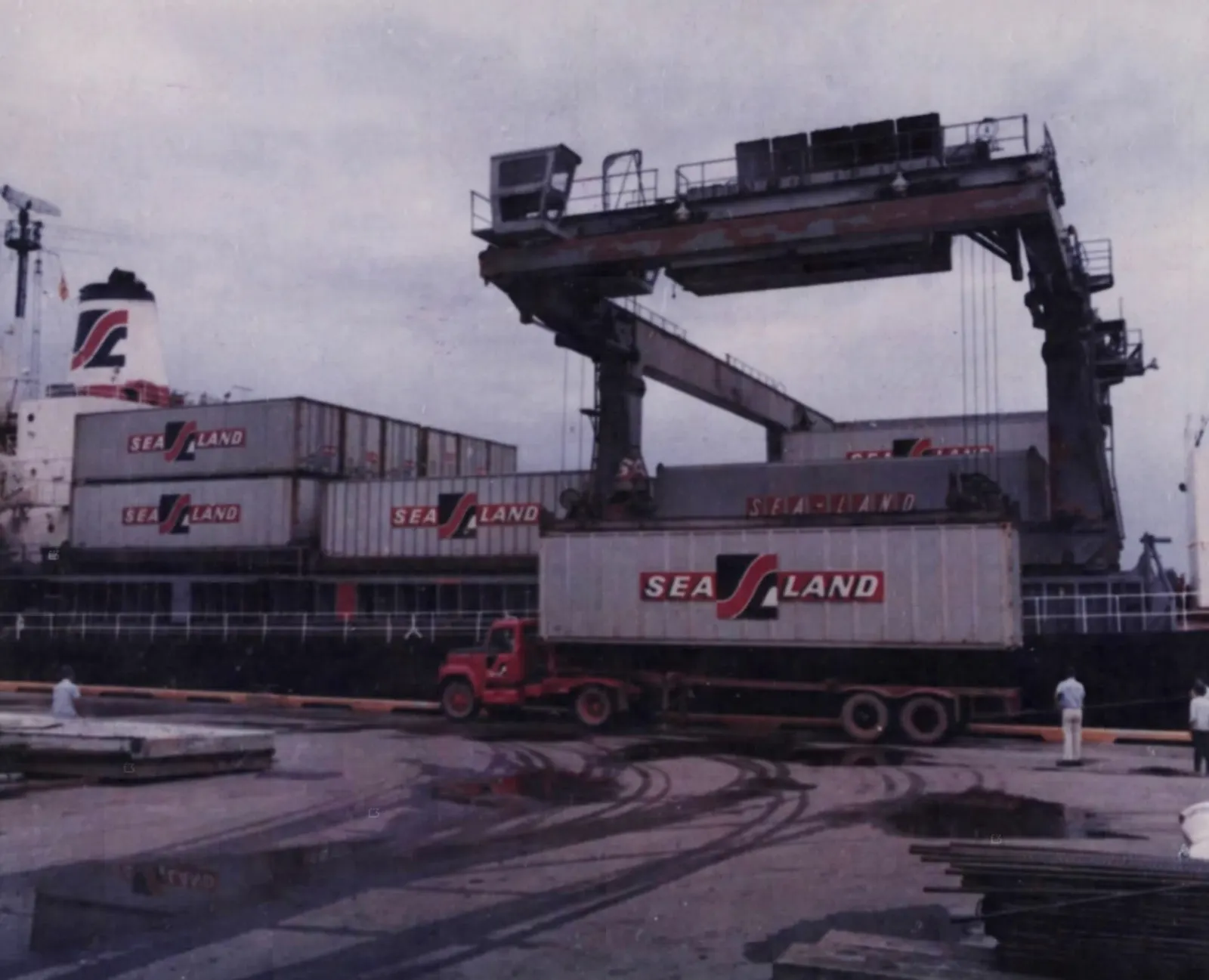
Figure: Sealand containers unloaded from the SS “Raphael Semmes” onto a truck at Newport, photographed on 28 September 1971 by SP5 Stanley D. Lasby, U.S. Army.
"Unloading Sealand containers from the SS Raphael Semmes onto a truck at Newport" by SP5 Stanley D. Lasby, U.S. Army — https://commons.wikimedia.org/wiki/File:Unloading_Sealand_containers_from_the_SS_Raphael_Semmes_onto_a_truck_at_Newport.jpg — Public domain (U.S. federal government work, 17 U.S.C. §105; U.S. Army photograph, National Archives 111-CCV-154-CC78800)

| Year | What moved, and where | Evidence | Source |
|---|---|---|---|
| 1929 | Loaded rail cars by ship, Belle Chasse to Havana | Court record (1945 opinion) | [2] |
| 1932 | Loaded rail cars, Hoboken to Belle Chasse by way of Havana | Court record (1945 and 1947 opinions) | [1][2] |
| 1942 | Certificate for “commodities generally” by sea | Court record (1947 opinion) | [1] |
| 1945 | Supreme Court upholds an order that railroads interchange cars with Seatrain | Court record (1945 opinion) | [2] |
| 1947 | Certificate upheld, freight cars included | Court record | [1] |
| 1956 | The Ideal X voyage, in Levinson's account | Book account, not read | [3] |
| 1967 | Conex boxes loaded and stacked at Newport | Photograph record | [4] |
| 1971 | Sealand containers onto a truck at Newport | Photograph record | [4] |
The lineage, one claim per row (CSV) Source and license notes (JSON) Data: United States v. Pennsylvania R. Co., 323 U.S. 612 (1945), accessed 2026-11-02, public domain (U.S. court opinion); United States v. Seatrain Lines, 329 U.S. 424 (1947), accessed 2026-11-02, public domain (U.S. court opinion); U.S. Army photographs, National Archives 111-CCV-154-CC46304, CC43714, CC78800 (captions), accessed 2026-11-02, public domain (U.S. federal government work); Marc Levinson, The Box (Princeton University Press, 2006), bibliographic record only
Assessed: The records we read do not name an inventor of the shipping container, and they do not support crowning one. They show steps: rail cars hoisted aboard ships from 1929 by the Court's account, a long dispute over whether a loaded car was cargo, Army steel boxes stacked on a pier at Newport in 1967, and trucks taking containers off a ship there in 1971. On these dates, the Ideal X came 24 years after Seatrain's interstate route began and 27 years after the Cuba service. Choosing 1956 as the start is a judgment made after containers had spread, and part of its pull is what this site calls the hindsight premium: the share of a decision's apparent wisdom or folly that is added only after the outcome is known.
Assessed: Seatrain does not take the credit either. Its ships moved freight without unpacking it, as the Commission found, but the unit was a railroad's car on loan, and the fight over those cars shows how tightly the method stayed tied to rails. This site's replay of tulip mania traces how one set of 1637 pamphlets became the standard story of that episode; the container story shows a milder form of the same habit, with one dated voyage standing in for a chain. The earliest link we found in that chain is a Louisiana dock in 1929.
Sources
- United States v. Seatrain Lines, Inc., 329 U.S. 424 (1947), argued 9 December 1946, decided 6 January 1947; opinion of the Court by Justice Black. https://tile.loc.gov/storage-services/service/ll/usrep/usrep329/usrep329424/usrep329424.pdfRead: full text of the opinion (United States Reports, pp. 424–433)
- United States v. Pennsylvania Railroad Co., 323 U.S. 612 (1945), argued 8–9 January 1945, decided 29 January 1945; opinion of the Court by Justice Black, Justice Roberts dissenting. https://tile.loc.gov/storage-services/service/ll/usrep/usrep323/usrep323612/usrep323612.pdfRead: full text of the opinion (United States Reports, pp. 612–624)
- Marc Levinson, The Box: How the Shipping Container Made the World Smaller and the World Economy Bigger (Princeton: Princeton University Press, 2006; 2nd ed. 2016). https://doi.org/10.1515/9781400880751Read: bibliographic record only
- U.S. Army photographs, Vietnam: "A Conex is loaded onto the Oceanic Victory at Saigon's New Port," 18 September 1967, SSG James I. Hatton (NARA 111-CCV-154-CC46304); "Conex containers are stacked on the pier after being unloaded from an incoming ship at Newport," 8 October 1967, SP5 Robert C. Lafoon (NARA 111-CCV-154-CC43714); "Unloading Sealand containers from the SS Raphael Semmes onto a truck at Newport," 28 September 1971, SP5 Stanley D. Lasby (NARA 111-CCV-154-CC78800). https://commons.wikimedia.org/wiki/File:Conex_containers_are_stacked_on_the_pier_after_being_unloaded_from_an_incoming_ship_at_Newport.jpgRead: photograph captions and dates as given in the photograph records
Cite this page
Treaties & Tradeoffs. “Shipping Container: Court Says Rail Cars Went to Sea by 1932.” published 2026-11-02. https://treatiesandtradeoffs.com/ideas/shipping-container/. Accessed [the date you read it].
Plain citation; add the date you consulted the page. No DOI is assigned.