Ideas & TechnologyGenealogy of an idea
Interchangeable Parts: Jefferson Described Them in 1785
Treaties & Tradeoffs Filed
In a letter of 30 August 1785, Thomas Jefferson wrote from Paris that a workman there had shown him musket locks made so alike that parts taken at random fitted together. It is the earliest account of interchangeable parts we found. Eli Whitney's musket contract, the story later writers tie to the idea, came more than 12 years later, in 1798, and his 1846 biographer says delivery planned for about two years took eight [1][3][4].
Order of business (4 sections)
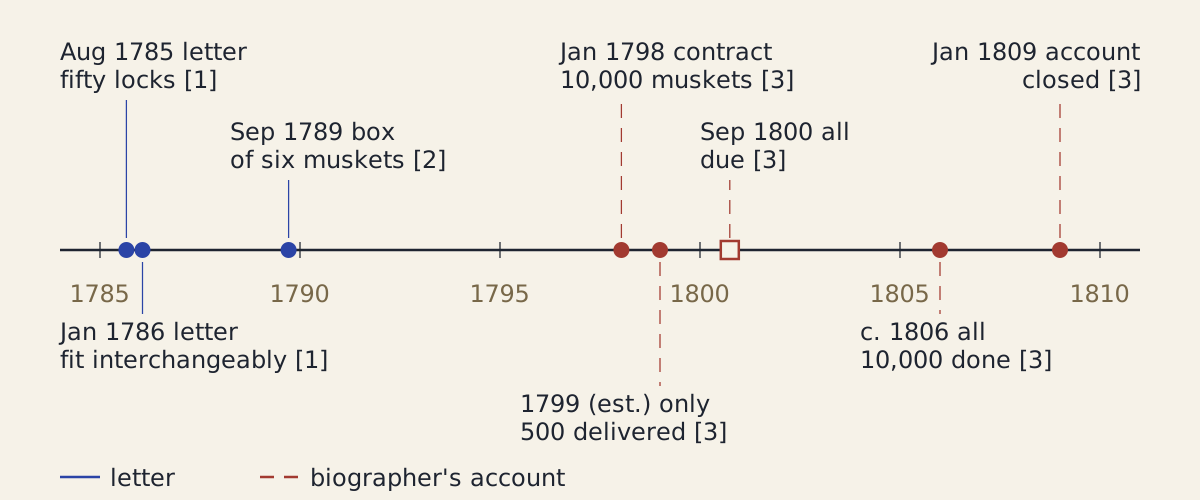
Figure: Dated steps from Jefferson's Paris letters to the close of Whitney's first musket contract, 1785 to 1809. Solid marks are letters; dashed marks rest on Olmsted's 1846 memoir, and 1799 and 1806 are approximate.
Diagram: Treaties & Tradeoffs. CC BY 4.0. Open full size
Reuse credit
Diagram: Treaties & Tradeoffs, "Interchangeable parts: from Jefferson's Paris letters to Whitney's first contract, 1785–1809" — https://treatiesandtradeoffs.com/ideas/interchangeable-parts/, CC BY 4.0 (https://creativecommons.org/licenses/by/4.0/)
Data: Letters: The Writings of Thomas Jefferson, ed. H. A. Washington, vols. 1 and 3 (1853; 1861 H. W. Derby printing), Project Gutenberg eBooks #45847 and #52878, accessed 2026-11-02, public domain; Contract and deliveries: Denison Olmsted, Memoir of Eli Whitney, Esq. (New Haven: Durrie & Peck, 1846), pp. 47–49, accessed 2026-11-02, public domain; 1799 and 1806 are this site's approximations from Olmsted's wording
The lineage as text
- 30 August 1785: Jefferson writes to John Jay of musket locks whose parts fit at random (letter) [1].
- 24 January 1786: Jefferson repeats the account to the Governor of Virginia and says the parts fit “interchangeably” (letter) [1].
- 19 September 1789: Jefferson sends Jay a box of half a dozen officer's muskets made on the same plan (letter) [2].
- 14 January 1798: Whitney's contract for 10,000 muskets, by Olmsted's account (biography) [3].
- About January 1799: 500 muskets delivered by the end of the first year (biography) [3].
- 30 September 1800: the last of the 10,000 due, as we read Olmsted's terms (biography) [3].
- About 1806: all 10,000 finished, “eight years, instead of two” (biography) [3].
- January 1809: the contract account closed (biography) [3].
In Paris in 1785, by his own account, Thomas Jefferson picked up musket-lock parts at random and found they fitted. He wrote home that the method might interest Congress if it ever bought arms [1]. The idea he described, parts made so alike that any one serves for another, is what is now called interchangeable parts.
What did Jefferson see in Paris in 1785?
Reported: Jefferson's letter to John Jay calls it “an improvement … in the construction of muskets” and says it “consists in the making every part of them so exactly alike, that what belongs to any one, may be used for every other musket in the magazine” [1]. The French government, he wrote, had examined and approved the method and was setting up a large manufactory to carry it out. So far only the lock was finished on this plan. The barrel and stock were to follow [1].
Reported: Then comes the test, in Jefferson's words: “He presented me the parts of fifty locks taken to pieces, and arranged in compartments. I put several together myself, taking pieces at hazard as they came to hand, and they fitted in the most perfect manner” [1].
Reported: The workman made the parts “by tools of his own contrivance,” expected to sell the musket two livres below “the common price,” and needed two or three years before he could supply any quantity [1]. Jefferson closed the passage with his reason for writing: “it may have an influence on the plan for furnishing our magazines with this arm” [1].
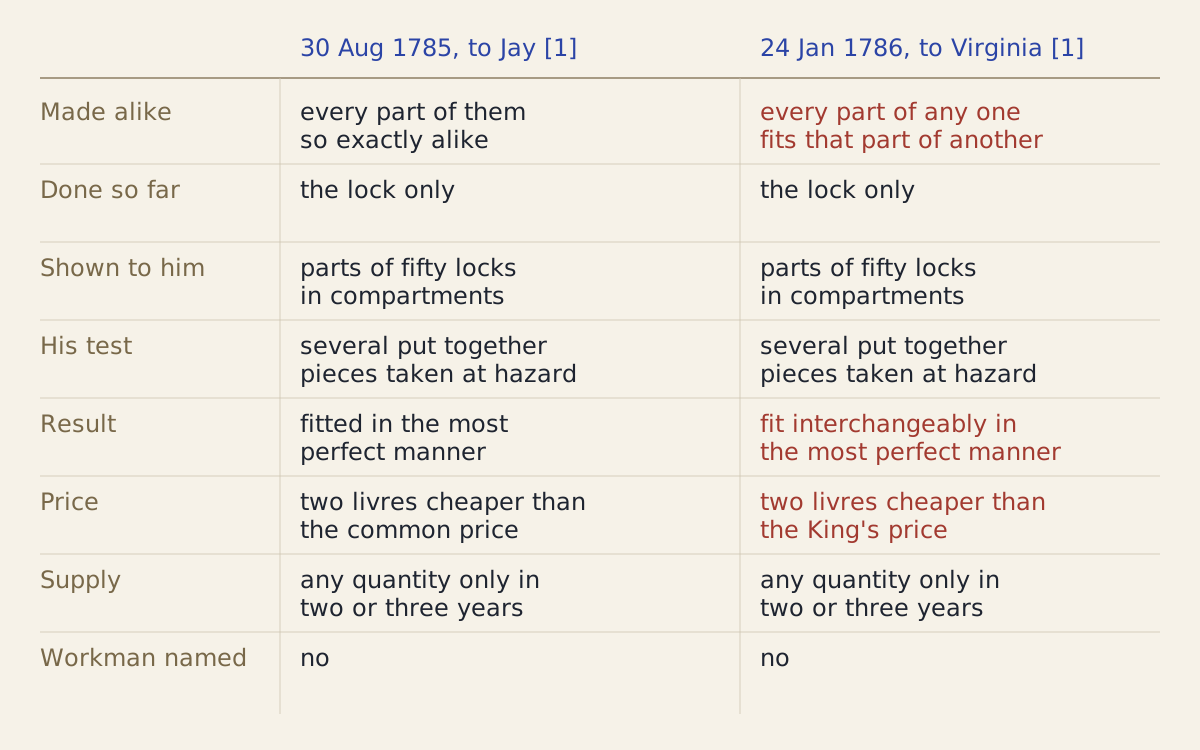
Figure: What Jefferson's letters of 30 August 1785 and 24 January 1786 say, item by item. Red marks wording that differs between the two letters.
Diagram: Treaties & Tradeoffs. CC BY 4.0. Open full size
Reuse credit
Diagram: Treaties & Tradeoffs, "Jefferson's two letters on musket locks compared, 1785 and 1786" — https://treatiesandtradeoffs.com/ideas/interchangeable-parts/, CC BY 4.0 (https://creativecommons.org/licenses/by/4.0/)
Data: Wording: Thomas Jefferson, letters of 30 August 1785 and 24 January 1786, The Writings of Thomas Jefferson, ed. H. A. Washington, vol. 1 (1853; 1861 H. W. Derby printing), pp. 412 and 514, Project Gutenberg eBook #45847, accessed 2026-11-02, public domain
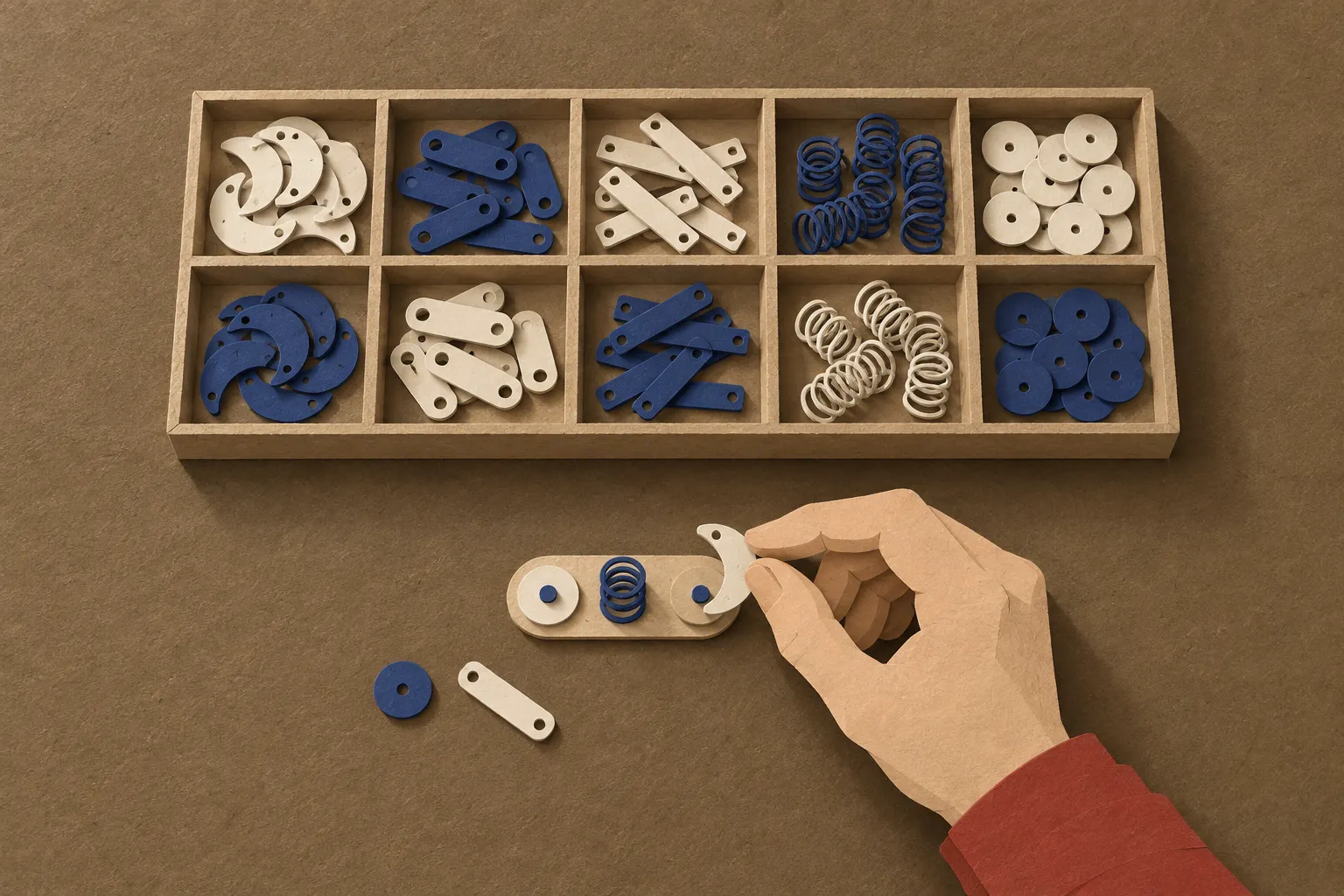
Figure: Illustration of the test Jefferson described in 1785: parts taken at random from compartments and fitted together.
Illustration: Treaties & Tradeoffs. Generated schematic image — not a photograph or historical record. © Treaties & Tradeoffs, all rights reserved.
The two letters as text
- Made alike: “every part of them so exactly alike” (1785); every part of one musket fits the same part of another “made by the same hand” (1786) [1].
- Done so far: the lock only, in both letters [1].
- Shown to him: the parts of fifty locks, taken to pieces and arranged in compartments, in both letters [1].
- His test: several put together from pieces taken at hazard, in both letters [1].
- Result: “fitted in the most perfect manner” (1785); “fit interchangeably in the most perfect manner” (1786) [1].
- Price: two livres cheaper than “the common price” (1785) or “the King's price” (1786) [1].
- Supply: any quantity only in two or three years, in both letters [1].
- Workman named: no, in both letters [1].
Reported: Jefferson told the story twice. Writing to the Governor of Virginia on 24 January 1786, 147 days after the first letter, he repeated it nearly word for word and added that the pieces fit “interchangeably” [1]. On 19 September 1789 he wrote Jay that he had shipped him “a box of officer's muskets, containing half a dozen, made by the person and on the plan” of the earlier letter, which he thought was “of the year 1785” [2].
Who was the gunsmith Jefferson visited?
Reported: Neither letter names him; Jefferson calls him only “the inventor” and “the workman” [1]. A 1922 popular history of machinery by A. Russell Bond gives the name as a mechanic called Le Blanc, without saying where it comes from [4]. None of the earlier sources we read names him, so this page calls him the Paris gunsmith, with Bond's name as Bond's.
Assessed: The letters settle what Jefferson saw and did, by his own account. They do not show how close the fit was, how many muskets the workshop made, or whether the large manufactory was ever built.
What did Whitney promise in 1798?
Reported: By Denison Olmsted's 1846 memoir, Eli Whitney wrote to Oliver Wolcott, Secretary of the Treasury, and through him obtained a contract for 10,000 muskets at $13.40 each, $134,000 in all. Olmsted dates it: “This contract was concluded on the 14th of January, 1798” [3]. Whitney was to deliver 4,000 muskets by the last day of September of the following year and the other 6,000 a year after that, and he gave bonds of $30,000 [3].
Reported: Olmsted is a friendly witness. His memoir praises Whitney throughout, and it prints Wolcott's own letter of 7 May 1814, which calls Whitney “my friend” and says that all contracts for military supplies had been made under Wolcott's superintendence [3]. We use Olmsted for the contract because it is the only account of the terms we could read. Every figure in this section is his.
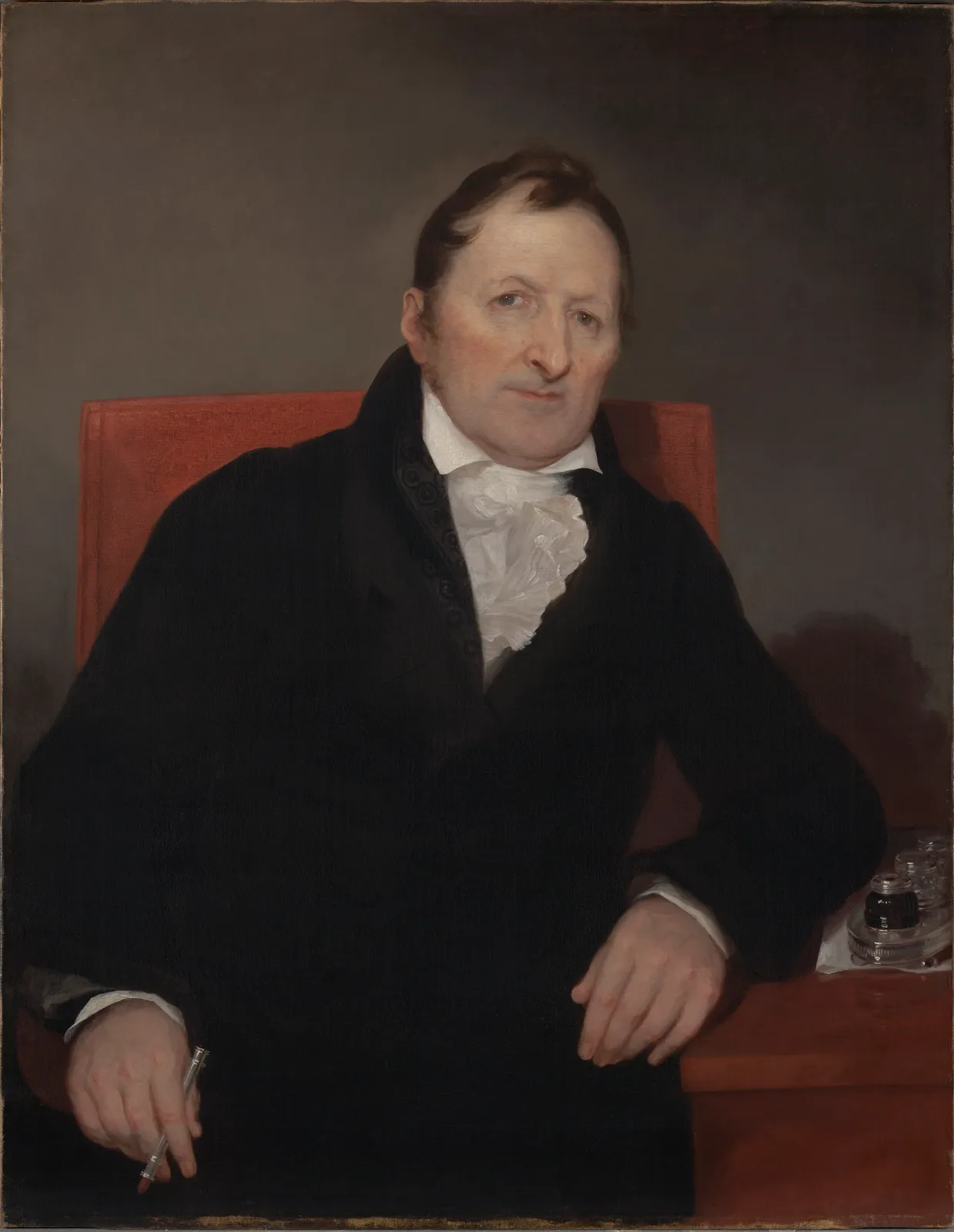
Figure: Eli Whitney, oil on canvas by Samuel F. B. Morse, 1822 (Yale University Art Gallery).
"Eli Whitney (1765–1825) B.A. 1792, M.A. 1795" by Samuel F. B. Morse — https://commons.wikimedia.org/wiki/File:Eli_Whitney_by_Samuel_Finley_Breese_Morse_1822.jpeg — Public domain (author d. 1872; US/EU; Yale University Art Gallery 1827.1)

Reported: Whitney had almost nothing in place. In Olmsted's words, “the works were all to be erected, the machinery to be made, and much of it to be invented,” and the workmen “were yet to learn the trade” [3]. Ten New Haven backers secured a $10,000 bank loan for him. Wolcott advanced $5,000 at signing, with $5,000 more promised once the works were ready [3].
The card at the top of this page applies the known-then test: score the choice only on what its makers could know at the time, with each piece of that knowledge tied to a source. Put yourself at Wolcott's desk in January 1798. Jefferson's letters about the Paris workshop existed, and a box of muskets made on that plan had been shipped to Jay in 1789. But nothing we read shows that Wolcott knew of either [1][2].
Assessed: On the record we have, Wolcott was buying a person, not a proven method. Whitney had a reputation from the cotton gin and backers in New Haven, but he had no armory, machinery or trained hands. Olmsted, drawing on an informant he does not name, adds that several other contractors of the time tried the English method instead [3]. Signing Whitney was a bet on what he might build, and the terms show it: money up front, a bond, and a short schedule.
How long did Whitney take to deliver?
Reported: Not two years. “At the end of the first year after the contract was made, instead of four thousand muskets, only five hundred were delivered,” Olmsted writes, “and it was eight years, instead of two, before the whole ten thousand were completed” [3]. The business was not closed until January 1809, when the balance still owed to Whitney came to $2,450, because the government had advanced so much along the way [3].
Reported, with our check: Olmsted calls the schedule “a little more than the period of two years” [3]. Counting from 14 January 1798 to 30 September 1800, the date we take for the second delivery, it is 989 days, or about 2 years and 8½ months. Olmsted's own multiplication holds: 10,000 muskets at $13.40 make $134,000 [3].
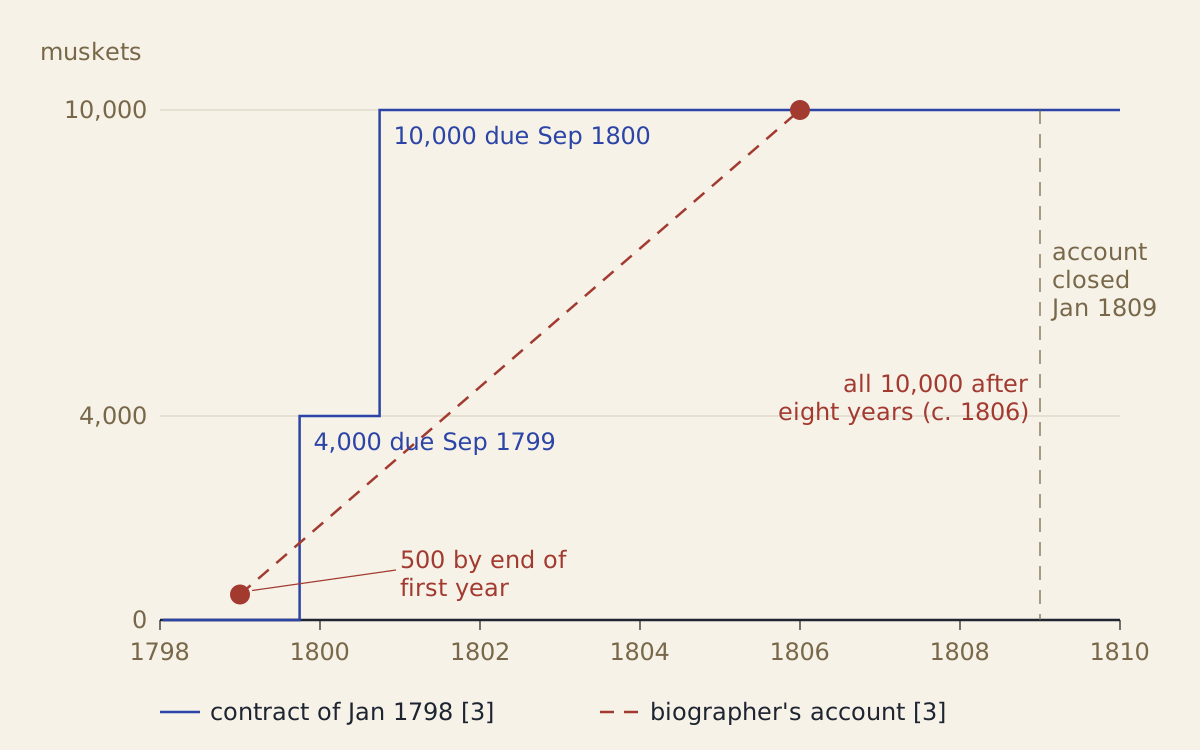
Figure: The contract schedule against the deliveries Olmsted reports. The dashed line only joins his two figures; the dates in between were not recorded in the memoir.
Diagram: Treaties & Tradeoffs. CC BY 4.0. Open full size
Reuse credit
Diagram: Treaties & Tradeoffs, "Whitney's 1798 musket contract: schedule and deliveries" — https://treatiesandtradeoffs.com/ideas/interchangeable-parts/, CC BY 4.0 (https://creativecommons.org/licenses/by/4.0/)
Data: Contract terms and deliveries: Denison Olmsted, Memoir of Eli Whitney, Esq. (New Haven: Durrie & Peck, 1846), pp. 47–49, accessed 2026-11-02, public domain; deadlines read by this site from Olmsted's wording; 1799 and 1806 are approximate
The contract terms and deliveries, one figure per row (CSV) Source and license notes (JSON) Data: Denison Olmsted, Memoir of Eli Whitney, Esq. (New Haven: Durrie & Peck, 1846), pp. 47–49, accessed 2026-11-02, public domain; total and day count checked by this site
We found no readable wage series for Connecticut armorers in the 1790s. So we leave the $13.40 as Olmsted gives it and do not convert it into days of pay.
Reported: Olmsted blames the start on a severe early winter, on workmen who could not direct themselves, and on Whitney having to make even his tools [3]. He quotes a letter in which Whitney told Wolcott that “there is no branch of the work that can proceed well, scarcely for a single hour, unless I am present” [3]. Wolcott, by Olmsted's account, inspected the works and said the advances had been spent with great prudence [3].
Assessed: On Olmsted's own figures, Whitney delivered a twentieth of the order in its first year. It comes to an eighth of the 4,000 due at the first deadline, which was still months away. That is a slow start for the works that the same memoir credits with a new method.
What did his biographer say Whitney's method was?
Reported: Olmsted writes that Whitney's machinery aimed to make “the same part of different guns, as the locks, for example, as much like each other as the successive impressions of a copper-plate engraving” [3].
Reported: His later pages on the method, a footnote says, come from an unnamed gentleman “personally and intimately acquainted with the subject” [3]. Parts moved through the works in lots of hundreds or thousands, each workman did one simple operation, and at the end the parts went together “as if each had been made for its respective fellow” [3]. He contrasts this with the English method, in which each workman made a different limb of the musket [3].
Reported: Olmsted goes further. He writes that Whitney's system and most of his machinery were taken up by every other considerable arms works in the United States, public and private, and that a former Secretary of War admitted in conversation that his improvements saved the government $25,000 a year at the two public armories alone [3]. Olmsted names neither the secretary nor the year.
Assessed: These are claims about aims, method and influence, written 21 years after Whitney's death in 1825 by an admirer, partly from an informant he does not name [3]. They do not report a test like the one Jefferson made in Paris, and the $25,000 rests on an unnamed official's remark as Olmsted retells it. We give it as Olmsted's claim and nothing more.
Did Eli Whitney invent interchangeable parts?
Reported: The idea, and a working demonstration of it on musket locks, appears in Jefferson's letter of 1785, more than 12 years before Whitney's contract [1][3]. Later accounts change who tells the story and what they add.
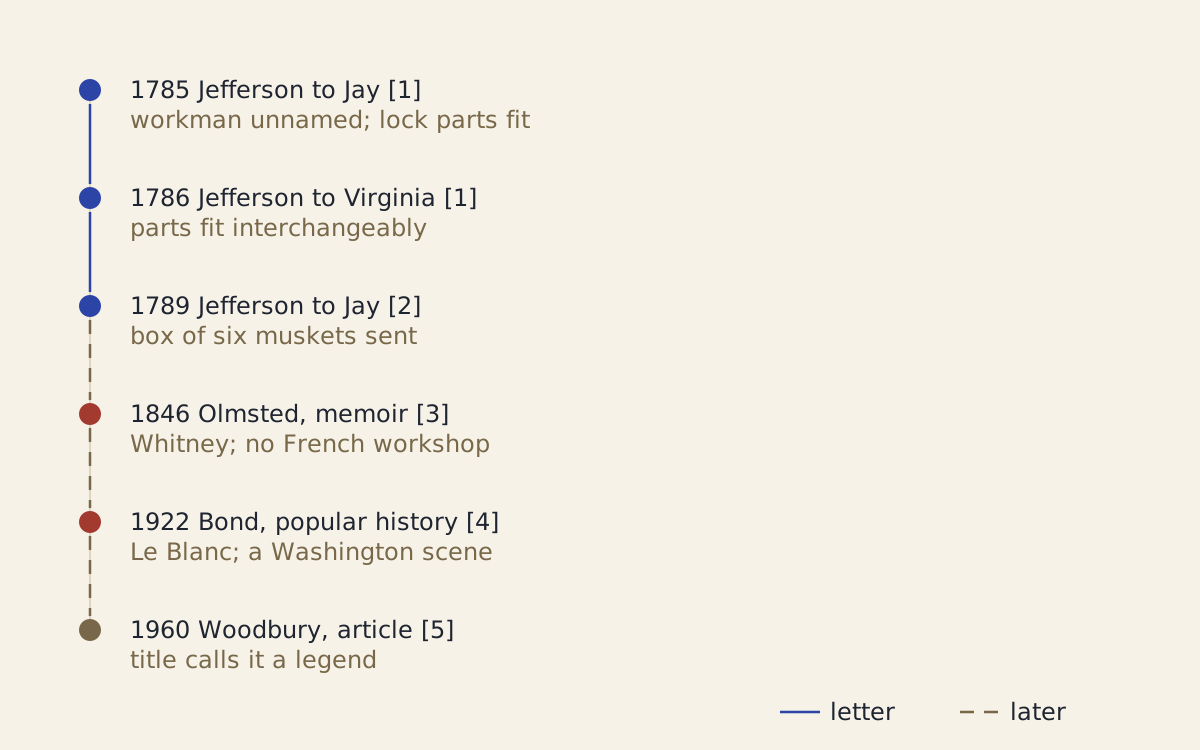
Figure: The order in which the sources on this page describe interchangeable parts, from Jefferson's letters to a 1960 article title. Not to scale.
Diagram: Treaties & Tradeoffs. CC BY 4.0. Open full size
Reuse credit
Diagram: Treaties & Tradeoffs, "Interchangeable parts: the order of retelling, 1785–1960" — https://treatiesandtradeoffs.com/ideas/interchangeable-parts/, CC BY 4.0 (https://creativecommons.org/licenses/by/4.0/)
Data: The Writings of Thomas Jefferson, ed. H. A. Washington, vols. 1 and 3 (1853; 1861 printing), accessed 2026-11-02, public domain; Denison Olmsted, Memoir of Eli Whitney (1846), accessed 2026-11-02, public domain; A. Russell Bond, Mechanics: The Science of Machinery (1922), Project Gutenberg eBook #49445, accessed 2026-11-02, public domain (US: published 1922; EU: author d. 1937); Robert S. Woodbury, Technology and Culture 1, no. 3 (1960), bibliographic record only
The order of retelling as text
- 1785: Jefferson to Jay; the workman is not named; the lock parts fit (letter) [1].
- 1786: Jefferson to the Governor of Virginia; the parts fit “interchangeably” (letter) [1].
- 1789: Jefferson to Jay; a box of six muskets made on the plan is sent (letter) [2].
- 1846: Olmsted's memoir credits Whitney's machinery and says nothing of the French workshop (biography) [3].
- 1922: Bond names the Paris workman Le Blanc and describes a scene in Washington (book account) [4].
- 1960: Robert S. Woodbury's article title calls the Whitney story a legend (bibliographic record only) [5].
Reported: Bond's 1922 book has the most vivid scene: Whitney, met with doubt, took ten pieces of each musket part to Washington, picked parts from each pile at random and put together ten muskets [4]. Bond gives no date, no place more exact than Washington, and no source. Olmsted's 1846 memoir, which we read in full, does not describe it [3]. Bond also names Simeon North beside Whitney as the Americans who took up the French idea, so even his popular account gives the American side two names, not one [4].
| Popular version | Where it appears | What the record shows |
|---|---|---|
| Whitney assembled ten muskets in Washington from parts chosen at random | Bond, 1922, no date or source [4] | Not in Olmsted's 1846 memoir; we read no record of it [3] |
| A mechanic named Le Blanc developed the French method | Bond, 1922 [4] | Jefferson's letters name no one [1] |
| The US government failed to take up the French system | Bond, 1922 [4] | Jefferson sent muskets made on the plan to Jay in 1789; we read nothing on what became of them [2] |
| Whitney's parts were as alike as prints from one copper plate | Olmsted, 1846 [3] | A claim about aim and method; Olmsted reports no test of his muskets [3] |
The lineage, one claim per row (CSV) Source and license notes (JSON) Data: The Writings of Thomas Jefferson, ed. H. A. Washington, vols. 1 and 3 (1853; 1861 H. W. Derby printing), Project Gutenberg eBooks #45847 and #52878, accessed 2026-11-02, public domain; Denison Olmsted, Memoir of Eli Whitney, Esq. (New Haven: Durrie & Peck, 1846), accessed 2026-11-02, public domain; A. Russell Bond, Mechanics: The Science of Machinery (New York: P. F. Collier & Son, 1922), Project Gutenberg eBook #49445, accessed 2026-11-02, public domain (US: published 1922; EU: author d. 1937); Robert S. Woodbury, "The Legend of Eli Whitney and Interchangeable Parts," Technology and Culture 1, no. 3 (1960), bibliographic record only
Reported: Robert S. Woodbury's 1960 article in Technology and Culture is titled “The Legend of Eli Whitney and Interchangeable Parts” [5]. We could read only its bibliographic record, so we report its title and not its argument.
Who gets the credit, and why?
Assessed: On these sources, the earliest credit belongs to the Paris workshop that Jefferson visited, whatever its master's name. Whitney's place in the record we read is a contract signed in 1798 and filled eight years later, plus his biographer's account of how his machines worked. Neither shows that he got there first. Olmsted calls Whitney's course “entirely new,” but he sets it only against the English method and never mentions the French workshop [3].
Assessed: The pull of Whitney's name is partly what this site calls the hindsight premium: the share of a decision's apparent wisdom or folly that is added only after the outcome is known. By 1922 Bond could write that Britain had taken up the method and called it the “American System” [4].
Assessed: Once the method carried an American name, an American inventor with a well-known arms contract may have made a tidy starting point. Bond's 1922 version mentions the long preparation but not the eight years, and has Whitney soon silencing his critics [4]. Our replay of tulip mania traces a similar drift, where later writers copied an early account and added to it.
Assessed: What the records we read cannot settle is when interchangeable muskets became routine in American armories, or when the name “American System” was first used. We found no document we could read that dates either, so this page stops at the earliest links: a workshop in Paris in 1785 and a contract in New Haven in 1798.
Sources
- Thomas Jefferson to John Jay, Paris, 30 August 1785, and to the Governor of Virginia, Paris, 24 January 1786, in The Writings of Thomas Jefferson, ed. H. A. Washington, vol. 1 (1853; read in the New York: H. W. Derby, 1861 printing), pp. 412 and 514 of the 1861 printing. https://www.gutenberg.org/ebooks/45847Read: full text of the volume; both letters read in full
- Thomas Jefferson to John Jay, Paris, 19 September 1789, in The Writings of Thomas Jefferson, ed. H. A. Washington, vol. 3 (1853; read in the New York: H. W. Derby, 1861 printing). https://www.gutenberg.org/ebooks/52878Read: full text of the volume; the letter of 19 September 1789 read in full
- Denison Olmsted, Memoir of Eli Whitney, Esq. (New Haven: Durrie & Peck, 1846), pp. 47–54. https://archive.org/details/memoirofeliwhitn00olmsRead: full text of the 1846 edition
- A. Russell Bond, Mechanics: The Science of Machinery, Popular Science Library vol. 5 (New York: P. F. Collier & Son, 1922), ch. III, “Machines for Making Machines,” section “The Interchangeable System.” https://www.gutenberg.org/ebooks/49445Read: full text; chapter III read in full
- Robert S. Woodbury, “The Legend of Eli Whitney and Interchangeable Parts,” Technology and Culture 1, no. 3 (1960): 235. https://doi.org/10.2307/3101392Read: bibliographic record only
Cite this page
Treaties & Tradeoffs. “Interchangeable Parts: Jefferson Described Them in 1785.” published 2026-11-02. https://treatiesandtradeoffs.com/ideas/interchangeable-parts/. Accessed [the date you read it].
Plain citation; add the date you consulted the page. No DOI is assigned.