Ideas & TechnologyGenealogy of an idea
Madness of Crowds, 1852 Edition: 3 of 16 Chapters on Money
Treaties & Tradeoffs Filed
Only 3 of the 16 chapters in the 1852 edition of Charles Mackay's Memoirs of Extraordinary Popular Delusions and the Madness of Crowds are about money: the Mississippi Scheme, the South-Sea Bubble and the Tulipomania, which by our count hold 13.6 percent of its words. The other 13 cover alchemists, prophecies, witch trials, the Crusades and smaller follies [1]. The 1841 first edition, whose title page as transcribed lacks “the Madness of Crowds,” opened with the same three chapters among 19 [2][3][4].
Order of business (5 sections)
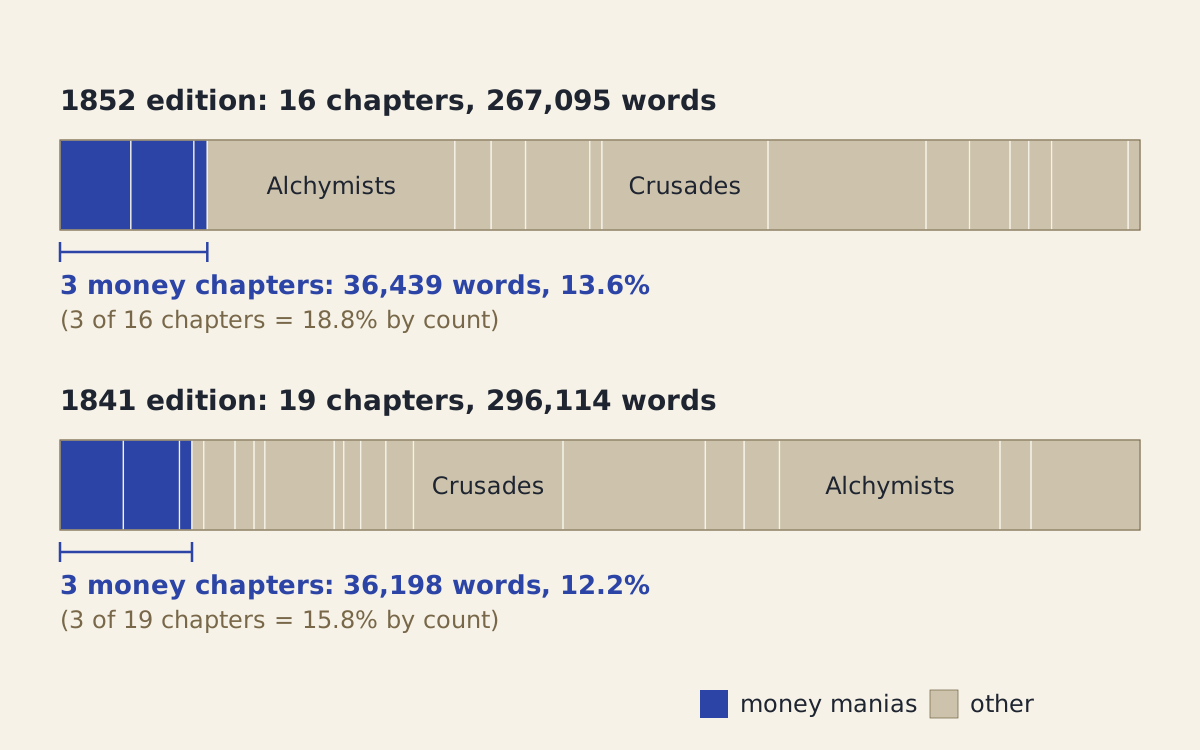
Figure: Words per chapter in the 1852 and 1841 editions, laid end to end in book order, with the three money chapters in blue.
Diagram: Treaties & Tradeoffs. CC BY 4.0. Open full size
Reuse credit
Diagram: Treaties & Tradeoffs, "Extraordinary Popular Delusions: words per chapter in the 1852 and 1841 editions" — https://treatiesandtradeoffs.com/ideas/extraordinary-popular-delusions/, CC BY 4.0 (https://creativecommons.org/licenses/by/4.0/)
Data: Charles Mackay, Memoirs of Extraordinary Popular Delusions and the Madness of Crowds, 2 vols. (London: Office of the National Illustrated Library, 1852), Project Gutenberg eBook #24518, accessed 2026-11-02, public domain; Charles Mackay, Memoirs of Extraordinary Popular Delusions, 3 vols. (London: Richard Bentley, 1841), Project Gutenberg eBooks #636, #713 and #884, accessed 2026-11-02, public domain
In 1852, Charles Mackay reissued a book on crowd follies whose first three chapters were about money. The reissue came out in London in two volumes from the Office of the National Illustrated Library, “illustrated with numerous engravings,” under a longer title than the three volumes of 1841 [1][2]. Its preface promises accounts of the South-Sea madness and the Mississippi delusion “more complete and copious than are to be found elsewhere.” The same preface calls the work “more of a miscellany of delusions than a history” [1].
What is Extraordinary Popular Delusions about?
Reported: Mackay's preface describes times when “whole communities suddenly fix their minds upon one object, and go mad in its pursuit” [1]. It runs through the Crusades, witchcraft, the philosopher's stone, slow poisoning, duelling and omens before it says that “Money, again, has often been a cause of the delusion of multitudes.” The paragraph closes on the herd: “Men, it has been well said, think in herds; it will be seen that they go mad in herds, while they only recover their senses slowly, and one by one” [1].
Reported: The same paragraph opens the 1841 first volume under the heading “National Delusions,” so the herd sentence goes back to the first edition [2]. The 1852 title page calls Mackay “LL.D.” and the author of Egeria and The Salamandrine; the 1841 title page calls him the author of The Thames and Its Tributaries and The Hope of the World [1][2].
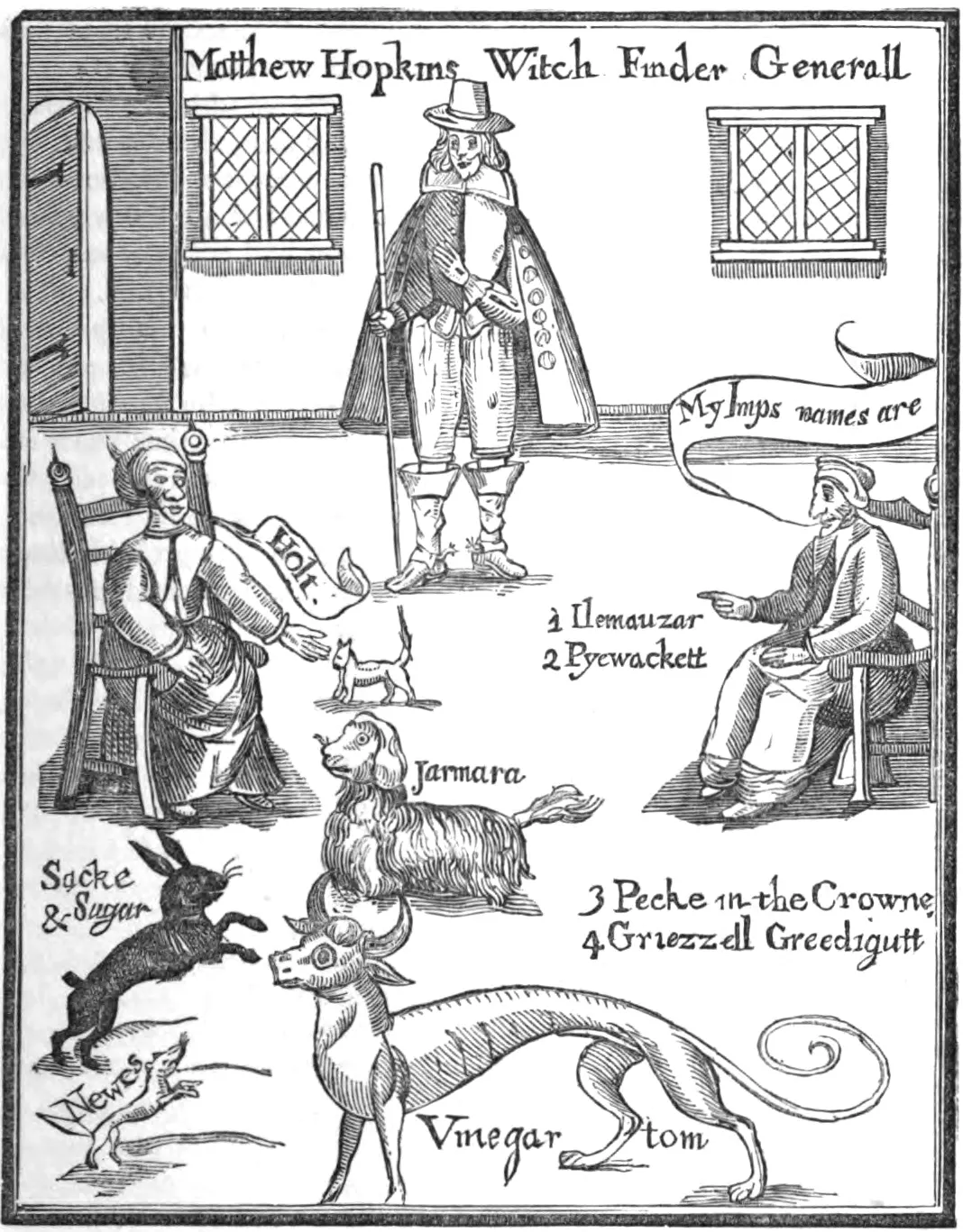
Figure: Matthew Hopkins, “Witch Finder Generall,” with the animals the woodcut names as imps, from a scan of a modern reprint of Mackay, whose 1852 list of engravings includes a print of Hopkins.
“Woodcut: Matthew Hopkins, Witch Finder Generall” by Unknown artist. Public Domain Mark.
Full credit
"Woodcut: Matthew Hopkins, Witch Finder Generall" by Unknown artist — https://commons.wikimedia.org/wiki/File:Matthew_Hopkins.png — Public domain (anonymous woodcut dated before 1650 on its file page (from a broadside), reproduced in Mackay's 1852 edition (list of engravings, vol. 2: Mathew Hopkins); public domain in the US (published before 1931) and the EU (anonymous work published more than 70 years ago); faithful scan of a two-dimensional public-domain work)

Assessed: Read as a whole, the book is a catalogue of shared beliefs and fashions, from alchemy to beards, with three financial episodes at its head. A reader who opens it for the history of markets will find roughly one word in seven on markets.
Which chapters are about money?
Reported: The 1841 first volume names its three money episodes outright. After the line about money, it says that “France, with her Mississippi madness, set the first great example, and was very soon imitated by England with her South Sea Bubble,” and that Holland had gone mad for tulips at an earlier period [2]. “Taking them in the order of their importance,” it goes on, the history starts with John Law and the Mississippi scheme, so the tulips come third although they came first in time [2].
Reported: The 1852 edition drops that paragraph and heads its first chapter “Money Mania” [1]. It moves the alchemists, the fortune-tellers and the magnetisers, which had filled the 1841 third volume under the heading “Philosophical Delusions,” into its first volume, right behind the money chapters [1][4]. Three 1841 chapters are missing from the 1852 contents: “The Love of the Marvellous and the Disbelief of the True,” “The O. P. Mania” and “The Thugs, or Phansigars” [1][2]. No chapter is new.
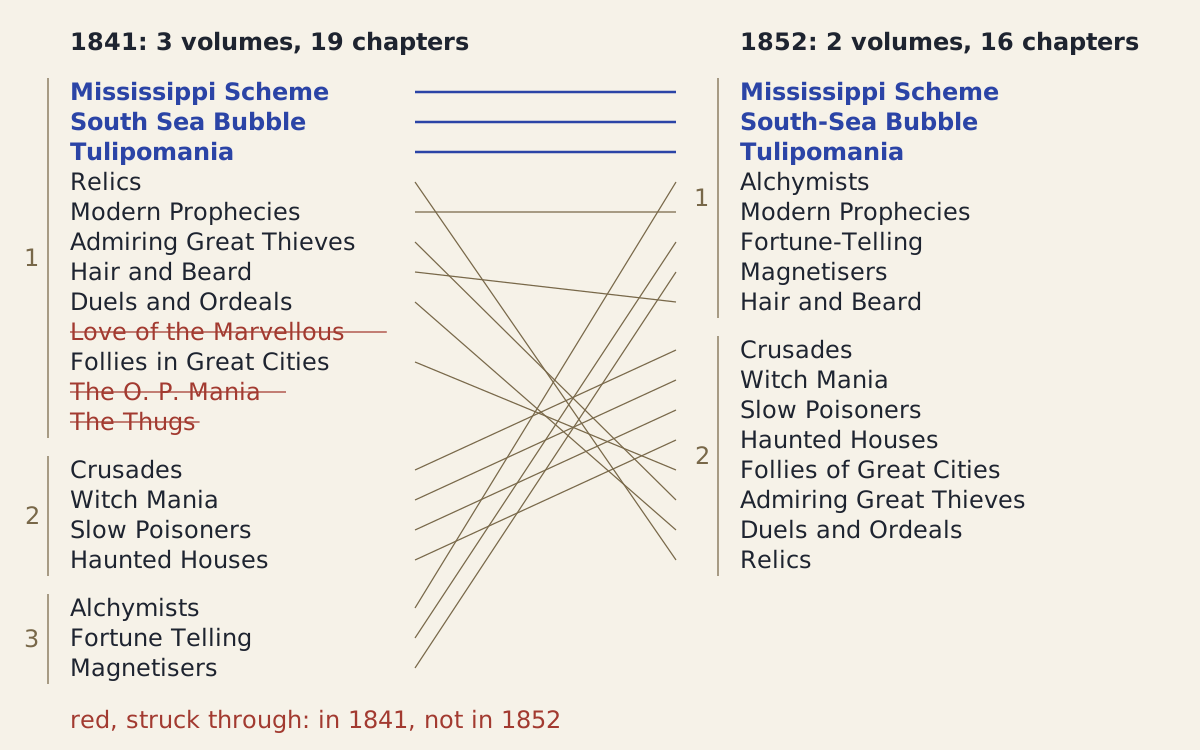
Figure: The chapter lists of the 1841 and 1852 editions, volume by volume, with lines joining the same chapter in each; the three 1841 chapters absent in 1852 are struck through.
Diagram: Treaties & Tradeoffs. CC BY 4.0. Open full size
Reuse credit
Diagram: Treaties & Tradeoffs, "Extraordinary Popular Delusions: chapter lists of 1841 and 1852" — https://treatiesandtradeoffs.com/ideas/extraordinary-popular-delusions/, CC BY 4.0 (https://creativecommons.org/licenses/by/4.0/)
Data: Charles Mackay, Memoirs of Extraordinary Popular Delusions and the Madness of Crowds, 2 vols. (London: Office of the National Illustrated Library, 1852), Project Gutenberg eBook #24518, accessed 2026-11-02, public domain; Charles Mackay, Memoirs of Extraordinary Popular Delusions, 3 vols. (London: Richard Bentley, 1841), Project Gutenberg eBooks #636, #713 and #884, accessed 2026-11-02, public domain
The chapter lists as text
- 1841, volume 1: The Mississippi Scheme; The South Sea Bubble; The Tulipomania; Relics; Modern Prophecies; Popular Admiration for Great Thieves; Influence of Politics and Religion on the Hair and Beard; Duels and Ordeals; The Love of the Marvellous and the Disbelief of the True; Popular Follies in Great Cities; The O. P. Mania; The Thugs, or Phansigars [2].
- 1841, volume 2: The Crusades; The Witch Mania; The Slow Poisoners; Haunted Houses [3].
- 1841, volume 3: The Alchymists; Fortune Telling; The Magnetisers [4].
- 1852, volume 1: The Mississippi Scheme; The South-Sea Bubble; The Tulipomania; The Alchymists; Modern Prophecies; Fortune-Telling; The Magnetisers; Influence of Politics and Religion on the Hair and Beard [1].
- 1852, volume 2: The Crusades; The Witch Mania; The Slow Poisoners; Haunted Houses; Popular Follies of Great Cities; Popular Admiration of Great Thieves; Duels and Ordeals; Relics [1].
Assessed: By chapter count, money takes 3 of 19 chapters in 1841, or 15.8 percent, and 3 of 16 in 1852, or 18.8 percent [1][2][3][4]. The chapter-count share rose because three other chapters left. By our count the three money chapters hold 36,198 words in the 1841 text and 36,439 in the 1852 text [1][2]. The gap is 241 words.
How long is each chapter?
Method: This page quotes no prices, so it makes no wage-day conversion. We counted the words of each chapter in the Project Gutenberg texts, from one chapter heading to the next, with verse epigraphs and footnotes in and engraving captions out; for 1841 the short introduction before the alchemists is left out [1][2][3][4]. By that count the 1852 edition runs to 267,095 words, of which the three money chapters hold 36,439, or 13.6 percent. The 1841 text runs to 296,114 words, with 12.2 percent on money [1][2][3][4].
| Chapter, 1852 edition | Volume | Words | Share of the edition |
|---|---|---|---|
| The Mississippi Scheme | 1 | 17,523 | 6.6% |
| The South-Sea Bubble | 1 | 15,595 | 5.8% |
| The Tulipomania | 1 | 3,321 | 1.2% |
| The Alchymists | 1 | 61,228 | 22.9% |
| Modern Prophecies | 1 | 8,976 | 3.4% |
| Fortune-Telling | 1 | 8,495 | 3.2% |
| The Magnetisers | 1 | 15,881 | 5.9% |
| Influence of Politics and Religion on the Hair and Beard | 1 | 3,011 | 1.1% |
| The Crusades | 2 | 41,083 | 15.4% |
| The Witch Mania | 2 | 39,071 | 14.6% |
| The Slow Poisoners | 2 | 10,749 | 4.0% |
| Haunted Houses | 2 | 10,029 | 3.8% |
| Popular Follies of Great Cities | 2 | 4,642 | 1.7% |
| Popular Admiration of Great Thieves | 2 | 5,638 | 2.1% |
| Duels and Ordeals | 2 | 18,940 | 7.1% |
| Relics | 2 | 2,913 | 1.1% |
Chapter word counts for both editions (CSV) Source and license notes (JSON) Data: Charles Mackay, Memoirs of Extraordinary Popular Delusions and the Madness of Crowds, 2 vols. (London: Office of the National Illustrated Library, 1852), Project Gutenberg eBook #24518, accessed 2026-11-02, public domain; Charles Mackay, Memoirs of Extraordinary Popular Delusions, 3 vols. (London: Richard Bentley, 1841), Project Gutenberg eBooks #636, #713 and #884, accessed 2026-11-02, public domain
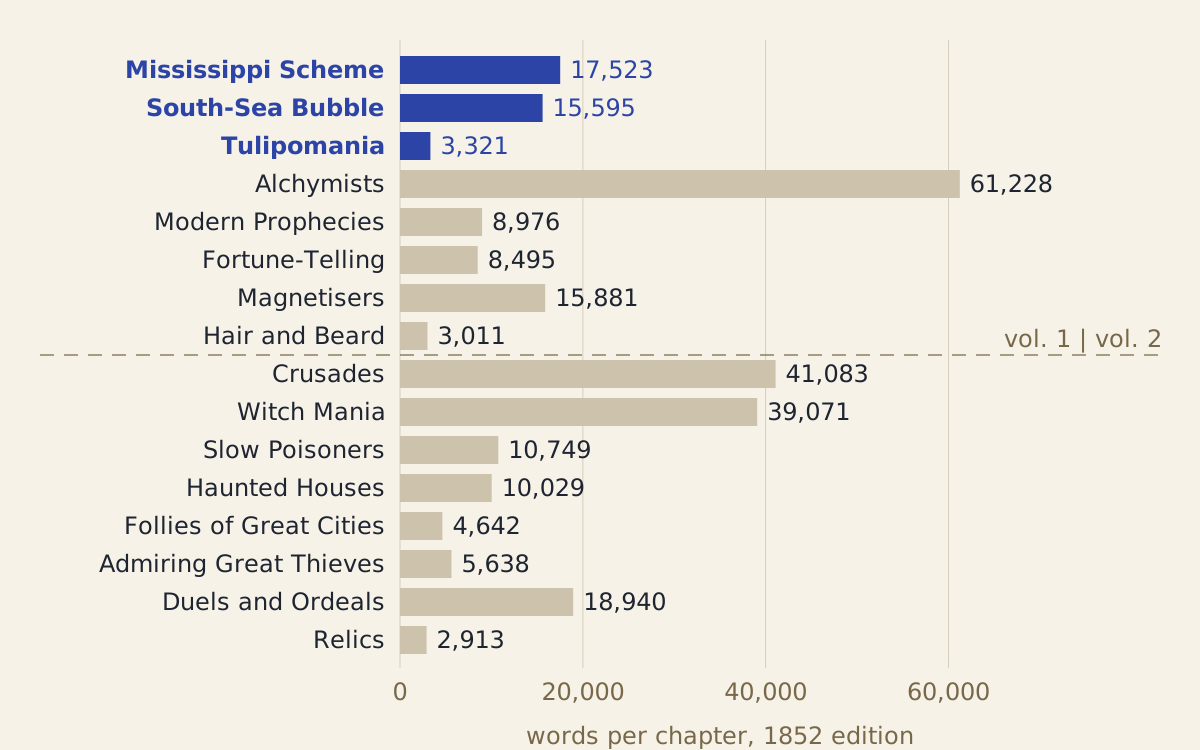
Figure: Words per chapter in the 1852 edition, in book order, with the money chapters in blue.
Diagram: Treaties & Tradeoffs. CC BY 4.0. Open full size
Reuse credit
Diagram: Treaties & Tradeoffs, "Extraordinary Popular Delusions: words per chapter, 1852 edition" — https://treatiesandtradeoffs.com/ideas/extraordinary-popular-delusions/, CC BY 4.0 (https://creativecommons.org/licenses/by/4.0/)
Data: Charles Mackay, Memoirs of Extraordinary Popular Delusions and the Madness of Crowds, 2 vols. (London: Office of the National Illustrated Library, 1852), Project Gutenberg eBook #24518, accessed 2026-11-02, public domain
Assessed: The longest chapter is “The Alchymists,” at 61,228 words, more than the Mississippi Scheme (17,523), the South-Sea Bubble (15,595) and the Tulipomania (3,321) put together. “The Crusades,” at 41,083 words, and “The Witch Mania,” at 39,071, are each longer than all three as well. The tulip chapter, which Anne Goldgar names as the basis of most modern images of the tulip craze, is one of the shortest in the book [5].
Reported: The chapter outlines show what fills the other 13. “The Witch Mania” runs from popular notions of the devil to Matthew Hopkins and the burnings at Würzburg, and “Popular Follies of Great Cities” collects London catch-phrases such as “What a shocking bad hat” [1]. The chapter on hair and beards takes in Peter the Great's tax upon beards, and “The Magnetisers” takes in Mesmer and Perkins's “Metallic Tractors” [1].
Where did Mackay get the bubble stories?
Reported: Mackay names his sources in passing, not in notes with pages. In the Mississippi chapter he cites Duclos's Secret Memoirs of the Regency, the Mémoires de la Régence, the letters of the Duchess of Orleans and the Biographie Universelle [1]. In the South-Sea chapter he quotes Coxe's Walpole, the Political State, Maitland's History of London, the Parliamentary History, Smollett and Gibbon's Memoirs [1]. Across the three money chapters we found one page reference, to page 274 of the second volume of the Duchess of Orleans's letters [1].
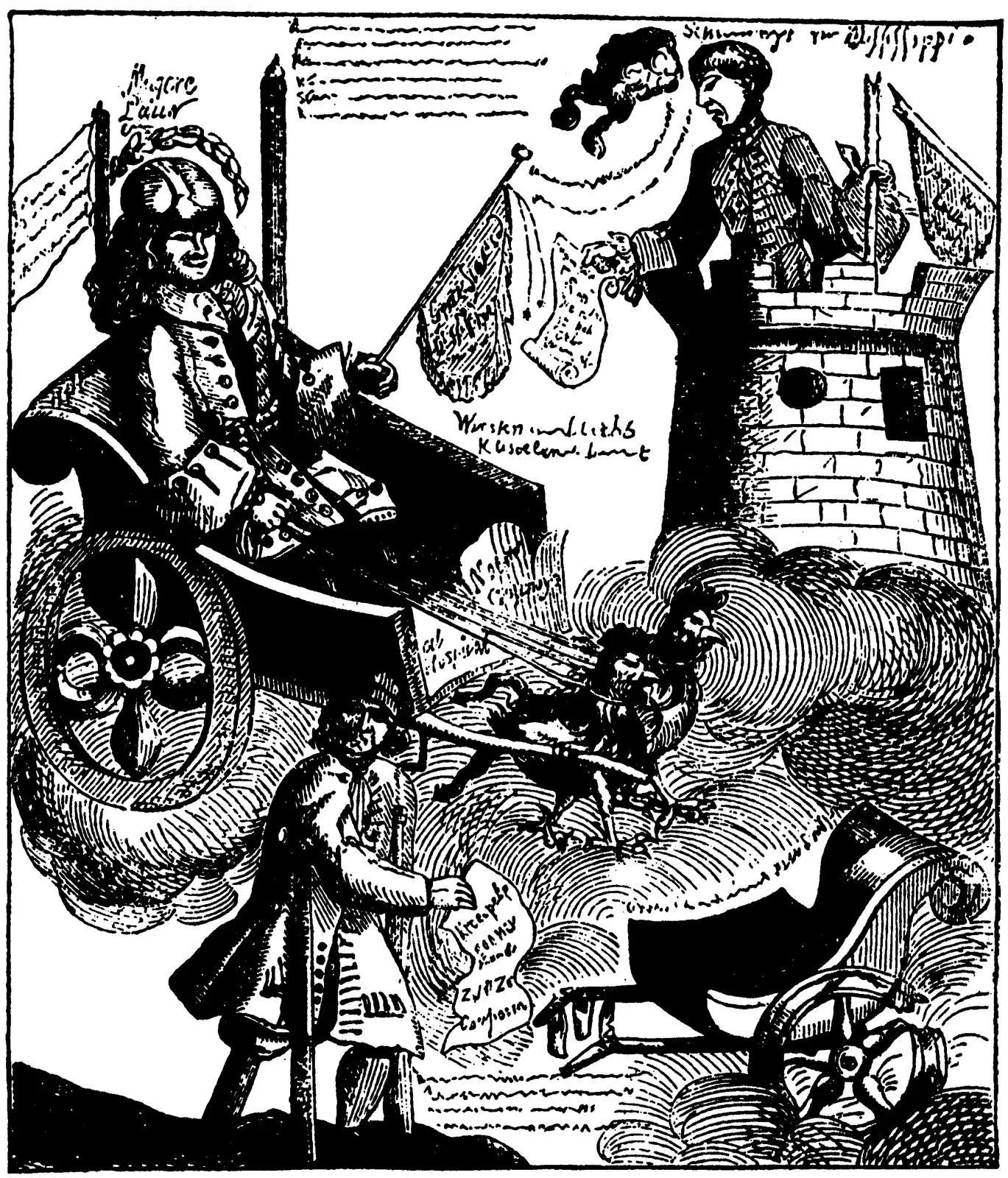
Figure: “Law in a Car drawn by Cocks,” one of the caricatures that the 1852 edition copies from the Dutch collection “Het groote Tafereel der Dwaasheid,” here from a scan of a modern reprint of Mackay.
“Caricature: John Law in a car drawn by cocks” by Unknown artist. Public Domain Mark.
Full credit
"Caricature: John Law in a car drawn by cocks" by Unknown artist — https://commons.wikimedia.org/wiki/File:John_Law_in_Car_Drawn_by_Cocks.png — Public domain (anonymous caricature dated about 1720 on its file page and reproduced in Mackay's 1852 edition (list of engravings: Caricature, Law in a Car drawn by Cocks); public domain in the US (published before 1931) and the EU (anonymous work published more than 70 years ago); faithful scan of a two-dimensional public-domain work)

Reported: The 1852 text adds sources that the 1841 transcription lacks. Its notes credit caricatures to the Dutch collection Het groote Tafereel der Dwaasheid, to the Bubblers' Medley and to prints in Mr. Hawkins' collection, and one note cites Wright's England under the House of Hanover [1][2].
Reported: The tulip chapter rests on Beckmann's History of Inventions and on an author whose name the 1841 text gives as “Munting” and the 1852 text as “Hunting,” although the 1852 index lists “Munting's history of the tulip mania” [1][2]. Goldgar traces that chain from Mackay back through Beckmann and Munting to pamphlets of 1637, and the tulip mania replay follows it step by step [5].
Reported: For the top of South Sea stock, Mackay says it was quoted at one thousand per cent at “the commencement of August” [1]. Adam Anderson's history of commerce, published in 1764, puts it at 1,000 and upward a few days after the Midsummer closing of the books [7]. The South Sea Bubble replay sets the two accounts side by side.
Sources Mackay names in the money chapters, by edition (CSV) Source and license notes (JSON) Data: Charles Mackay, Memoirs of Extraordinary Popular Delusions and the Madness of Crowds, 2 vols. (London: Office of the National Illustrated Library, 1852), Project Gutenberg eBook #24518, accessed 2026-11-02, public domain; Charles Mackay, Memoirs of Extraordinary Popular Delusions, 3 vols. (London: Richard Bentley, 1841), Project Gutenberg eBooks #636, #713 and #884, accessed 2026-11-02, public domain
Assessed: The bubble chapters are compilations from memoirs, the parliamentary record, earlier histories and satirical prints, almost all named without a page. That makes them hard to check line by line. Where we could set one of Mackay's dates beside an earlier account, as with the South Sea top, the two disagree.
What changed in the 1852 edition?
Reported: The 1852 title page adds “and the Madness of Crowds” to the title of 1841, as transcribed, and promises “numerous engravings” [1][2]. A new note to the South-Sea chapter says that the first edition appeared “some time before the outbreak of the Great Railway Mania” of 1845 and the following year, and that until 1845 the South-Sea project was the greatest British example of the public's appetite for commercial gambling [1]. The chapter's text still closes, as in 1841, with the bubble companies of the panic year 1825 and the schemes of 1836 [1][2].
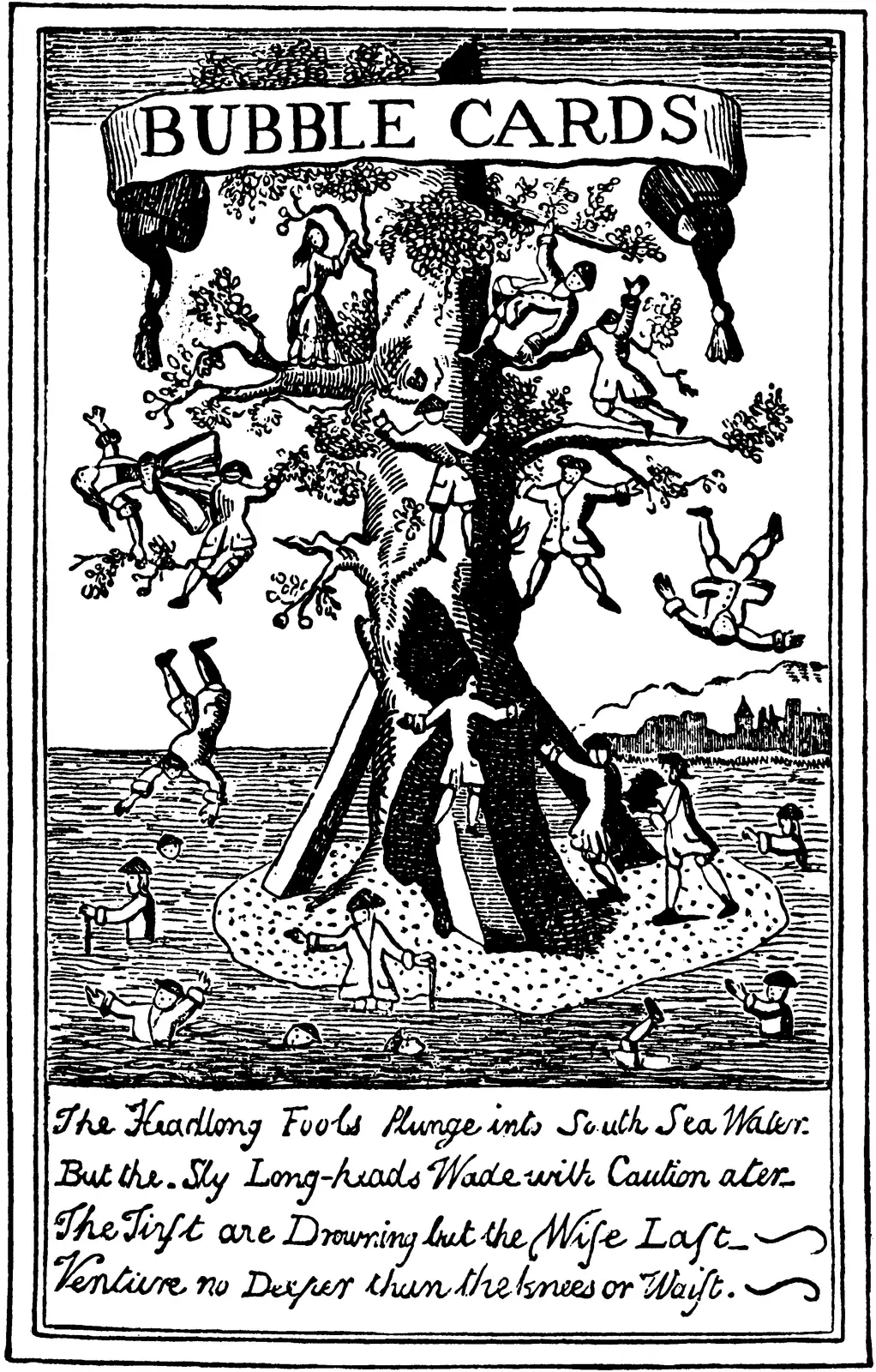
Figure: A bubble card from the South-Sea chapter, copied from the Bubblers' Medley by the 1852 note, with people climbing a tree and falling into the water; from a scan of a modern reprint.
“Caricature: Bubble Cards, people climbing the Tree of Fortune” by Unknown artist. Public Domain Mark.
Full credit
"Caricature: Bubble Cards, people climbing the Tree of Fortune" by Unknown artist — https://commons.wikimedia.org/wiki/File:South_Sea_Bubble_Cards-Tree.png — Public domain (anonymous bubble card dated 1720 on its file page, reproduced in Mackay's 1852 edition (list of engravings: Caricature, People climbing the Tree of Fortune, from the Bubblers' Medley; note 19 to the South-Sea chapter); public domain in the US (published before 1931) and the EU (anonymous work published more than 70 years ago); faithful scan of a two-dimensional public-domain work)

Reported: The 1852 preface also carries lines we did not find in the 1841 transcription: the claim about the South-Sea and Mississippi memoirs, the description of the book as a miscellany, and the statement that “Religious matters have been purposely excluded” [1][2].
The card at the top of this page applies the known-then test: score the choice only on what its makers could know at the time, with each piece of that knowledge tied to a source.
Assessed: On the card's record, Mackay in 1852 knew of a new mania that, by his own note, had outgrown the South Sea scheme, and he gave it a footnote rather than a chapter. By chapter count, the money share rose only because three other chapters left. By words it rose from 12.2 to 13.6 percent, and some kept chapters, such as “The Magnetisers” (29,855 words in 1841, 15,881 in 1852), also got shorter [1][4]. Judged on what he could see then, he was revising a miscellany, and his 1852 preface calls it one [1].
Assessed: The preface's exclusion of religious matters sits awkwardly beside the chapters on the Crusades, the witch mania and relics, all of which stay in 1852 [1].
Why is it remembered as a book about money?
Reported: Goldgar, introducing her 2007 study of the tulip trade, writes that most modern images of the craze are based on Mackay, whose book she cites as Extraordinary Popular Delusions and the Madness of Crowds “of 1841” and calls “still in print and doing well” [5]. She adds that financial newsletters have invoked tulipmania as a warning to investors [5]. Peter Garber's 1990 paper “Famous First Bubbles” sets out to explain “the three most famous bubbles”: the tulipmania, the Mississippi Bubble and the South Sea Bubble, the same three episodes that open Mackay's book [6].
Assessed: We did not find, in the sources we read, who first presented the book as a guide to markets, or when. What the record shows is narrower. The money chapters are the part that the two scholars we read take up, and a citation like Goldgar's joins the 1852 title to the 1841 date.
Assessed: Mackay's own headings grade the tulip buyers and the investors of 1720 before the story starts, since a “delusion” or a “mania” is a verdict that needs the ending. Much of that verdict is what this site calls the hindsight premium: the share of a decision's apparent wisdom or folly that is added only after the outcome is known. Whether the prices of 1720 were rational is argued on other pages of this site, not here. A similar gap between a later story and an earlier document turns up in the replay of interchangeable parts.
Sources
- Charles Mackay, Memoirs of Extraordinary Popular Delusions and the Madness of Crowds, 2 vols. (London: Office of the National Illustrated Library, 1852). Project Gutenberg eBook #24518. https://www.gutenberg.org/ebooks/24518Read: full text of the 1852 edition, both volumes
- Charles Mackay, Memoirs of Extraordinary Popular Delusions, vol. 1 (London: Richard Bentley, 1841). Project Gutenberg eBook #636. https://www.gutenberg.org/ebooks/636Read: full text of vol. 1 as transcribed
- Charles Mackay, Memoirs of Extraordinary Popular Delusions, vol. 2 (London: Richard Bentley, 1841). Project Gutenberg eBook #713. https://www.gutenberg.org/ebooks/713Read: full text of vol. 2 as transcribed (the eBook has no imprint page)
- Charles Mackay, Memoirs of Extraordinary Popular Delusions, vol. 3 (London: Richard Bentley, 1841). Project Gutenberg eBook #884. https://www.gutenberg.org/ebooks/884Read: full text of vol. 3 as transcribed (the eBook has no imprint page)
- Anne Goldgar, Tulipmania: Money, Honor, and Knowledge in the Dutch Golden Age (Chicago: University of Chicago Press, 2007), excerpt from pp. 1–7. https://press.uchicago.edu/Misc/Chicago/301259.htmlRead: publisher's excerpt, pp. 1–7
- Peter M. Garber, "Famous First Bubbles," Journal of Economic Perspectives 4, no. 2 (Spring 1990): 35–54. https://www.aeaweb.org/articles?id=10.1257/jep.4.2.35Read: article page with abstract
- Adam Anderson, An Historical and Chronological Deduction of the Origin of Commerce, vol. 2 (London: A. Millar and others, 1764), p. 288. https://archive.org/details/historicalchrono02andeRead: p. 288 of vol. 2
Cite this page
Treaties & Tradeoffs. “Madness of Crowds, 1852 Edition: 3 of 16 Chapters on Money.” published 2026-11-02. https://treatiesandtradeoffs.com/ideas/extraordinary-popular-delusions/. Accessed [the date you read it].
Plain citation; add the date you consulted the page. No DOI is assigned.