Patterns in StrategyCase review
Fabian Strategy: Rome Made a Second Dictator, Polybius Says
Treaties & Tradeoffs Filed
The Fabian strategy is named for Quintus Fabius Maximus, whom Rome made dictator in 217 BC after the defeat at Lake Trasimene, and who followed Hannibal through Italy without risking a battle. Within months, Polybius writes, Rome gave his deputy Marcus Minucius equal power, so that there were “two Dictators” for the same war, and the two divided the army [1][2]. A year later the Senate ordered the battle that was fought at Cannae [1].
Order of business (6 sections)
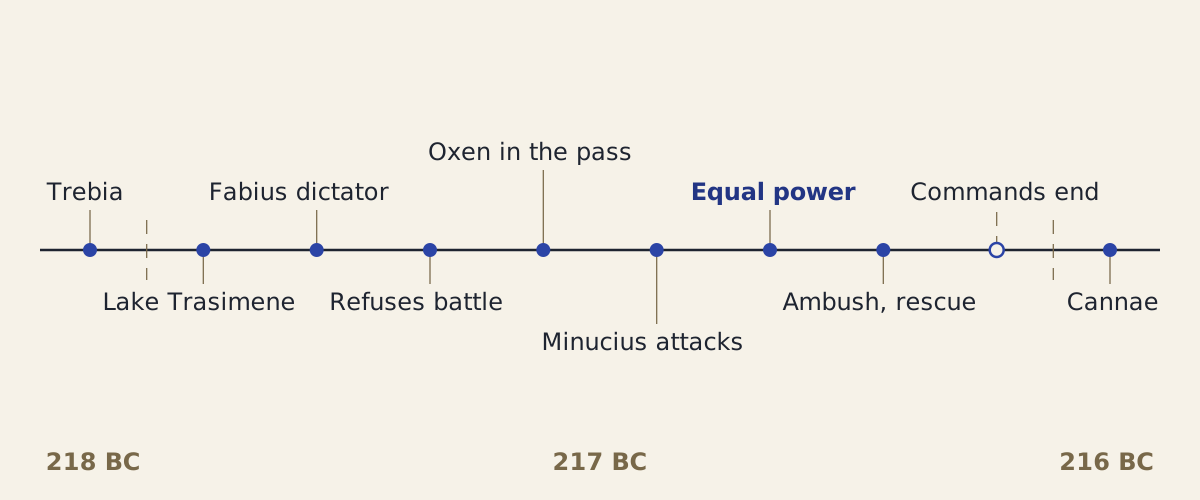
Figure: The campaign from the Trebia to Cannae, events in the order Polybius and Livy give them, spaced evenly rather than by date; the hollow mark is the end of a command Livy puts at about six months.
Diagram: Treaties & Tradeoffs. CC BY 4.0. Open full size
Reuse credit
Diagram: Treaties & Tradeoffs, "The Fabian campaign, 218–216 BC" — https://treatiesandtradeoffs.com/patterns/fabian-strategy/, CC BY 4.0 (https://creativecommons.org/licenses/by/4.0/)
Data: Polybius, The Histories, book 3, trans. Evelyn S. Shuckburgh (1889), Project Gutenberg eBook #44125, accessed 2026-11-02, public domain; Livy, The History of Rome, books 21–23, trans. D. Spillan and Cyrus Edmonds, Project Gutenberg eBook #10907, accessed 2026-11-02, public domain
The timeline as text
- December 218 BC: battle of the Trebia [1].
- Spring 217 BC: Hannibal marches into Etruria [1][2].
- 217 BC: battle at Lake Trasimene, where 15,000 Romans fell [1][2].
- 217 BC, days later: 4,000 Roman horse are cut off, and Rome decides it needs a commander with absolute powers [1][2].
- 217 BC: Quintus Fabius Maximus is named dictator, with Marcus Minucius as master of the horse [1][2].
- Summer 217 BC: Fabius camps near Hannibal in Apulia and refuses the battle Hannibal offers [1][2].
- Summer 217 BC: Hannibal crosses Samnium into the Falernian plain; Fabius keeps to the hills [1][2].
- Autumn 217 BC: Hannibal escapes the pass by driving oxen with burning faggots up a ridge at night [1][2].
- Autumn 217 BC: Fabius goes to Rome; Minucius attacks Hannibal's foragers near Geronium [1][2].
- 217 BC: Rome gives Minucius power equal to Fabius's; the army is divided; Fabius rescues Minucius from an ambush [1][2].
- Late 217 BC: Fabius and Minucius give up their commands, Fabius after about six months, and the consuls take over their armies [1][2].
- Winter and spring 216 BC: the commanders in the field are told to avoid a general engagement [1].
- 216 BC, at harvest time: the Senate orders battle, and the consuls fight Hannibal at Cannae [1].
The timeline, with the passage in each of the three accounts (CSV) Source and license notes (JSON) Data: Polybius, The Histories, book 3, trans. Evelyn S. Shuckburgh (1889), Project Gutenberg eBook #44125, accessed 2026-11-02, public domain; Livy, The History of Rome, books 21–23, trans. D. Spillan and Cyrus Edmonds, Project Gutenberg eBook #10907, accessed 2026-11-02, public domain; Plutarch, Lives of Fabius and Pericles and their Comparison, trans. John Dryden, rev. Arthur Hugh Clough, Project Gutenberg eBook #674, accessed 2026-11-02, public domain
In 217 BC, after Hannibal had beaten two Roman armies, Rome named a dictator who would not give battle. Quintus Fabius took over newly enrolled legions, four by Polybius's count and two by Livy's, marched to within sight of Hannibal's camp in Apulia, and kept to the high ground [1][2]. When Hannibal led out his army and waited in battle order, nobody came out to meet him [1][2]. Fabius, Polybius writes, had made up his mind “not to risk a battle,” and at first he was despised for it [1].
What did Fabius do in 217 BC?
Reported: Polybius describes the method in detail. Fabius kept his army hovering near the enemy, took the strong positions first and kept his supplies to the rear [1]. He never let his soldiers go out foraging or stray from the camp, and he picked off the Carthaginians who straggled from their camp in search of plunder [1]. Livy's account matches: Fabius marched along the heights at a moderate distance, “so as neither to let him go altogether nor yet to encounter him” [2].
Reported: Polybius also gives Fabius's reasoning. Hannibal's men had been trained in war from youth, had won many battles and believed their only hope lay in victory. So Fabius fell back on the two things in which Rome had the advantage, “an inexhaustible supply of provisions and of men” [1].
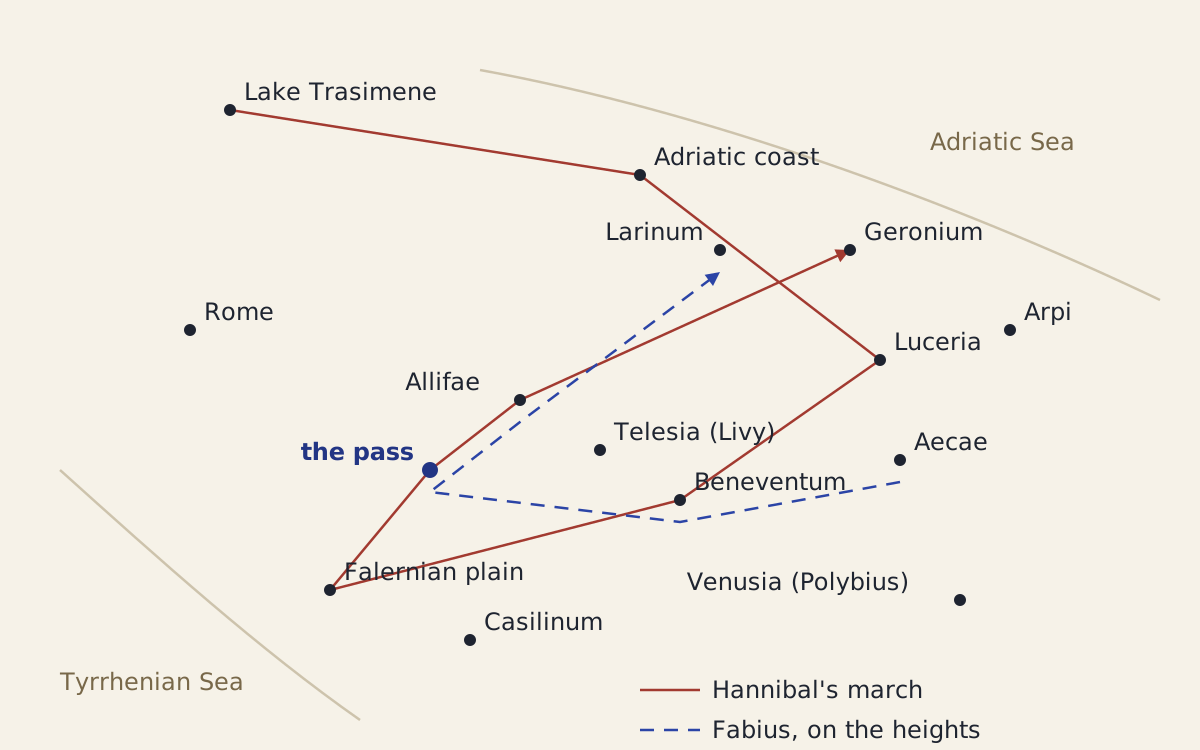
Figure: The places named for the campaign of 217 BC, set in relative position from the narratives of Polybius and Livy; not to scale, and showing relative positions only.
Diagram: Treaties & Tradeoffs. CC BY 4.0. Open full size
Reuse credit
Diagram: Treaties & Tradeoffs, "Places named for the campaign of 217 BC, in relative position" — https://treatiesandtradeoffs.com/patterns/fabian-strategy/, CC BY 4.0 (https://creativecommons.org/licenses/by/4.0/)
Data: Polybius, The Histories, book 3, trans. Evelyn S. Shuckburgh (1889), Project Gutenberg eBook #44125, accessed 2026-11-02, public domain; Livy, The History of Rome, books 21–23, trans. D. Spillan and Cyrus Edmonds, Project Gutenberg eBook #10907, accessed 2026-11-02, public domain
The route as text
- Hannibal, after Lake Trasimene, marches to the Adriatic coast and rests his army there [1].
- He moves into Daunia, around Luceria and Arpi; Fabius camps near Aecae in Polybius, near Arpi in Livy [1][2].
- Hannibal crosses into Samnium, overruns the land of Beneventum and takes an unwalled town, Venusia in Polybius and Telesia in Livy [1][2].
- He descends into the Falernian plain by the river Vulturnus; Fabius keeps to the heights above it [1][2].
- Hannibal leaves through a pass, Eribianus in Polybius and Callicula in Livy, and camps near Allifae [1][2].
- He winters at Geronium; Fabius camps in the territory of Larinum [1][2].
Reported: Hannibal tried to force the issue. He crossed into Samnium, overran the land of Beneventum, took a town (Venusia in Polybius, Telesia in Livy) and then descended into the Falernian plain near Capua, so as either to drag Fabius into battle or to show the allies that Rome had abandoned them [1][2]. Polybius notes that up to then not a single Italian city had gone over to Hannibal [1]. Fabius followed along the mountain skirts and would not go down, partly because the enemy was stronger in cavalry [1].
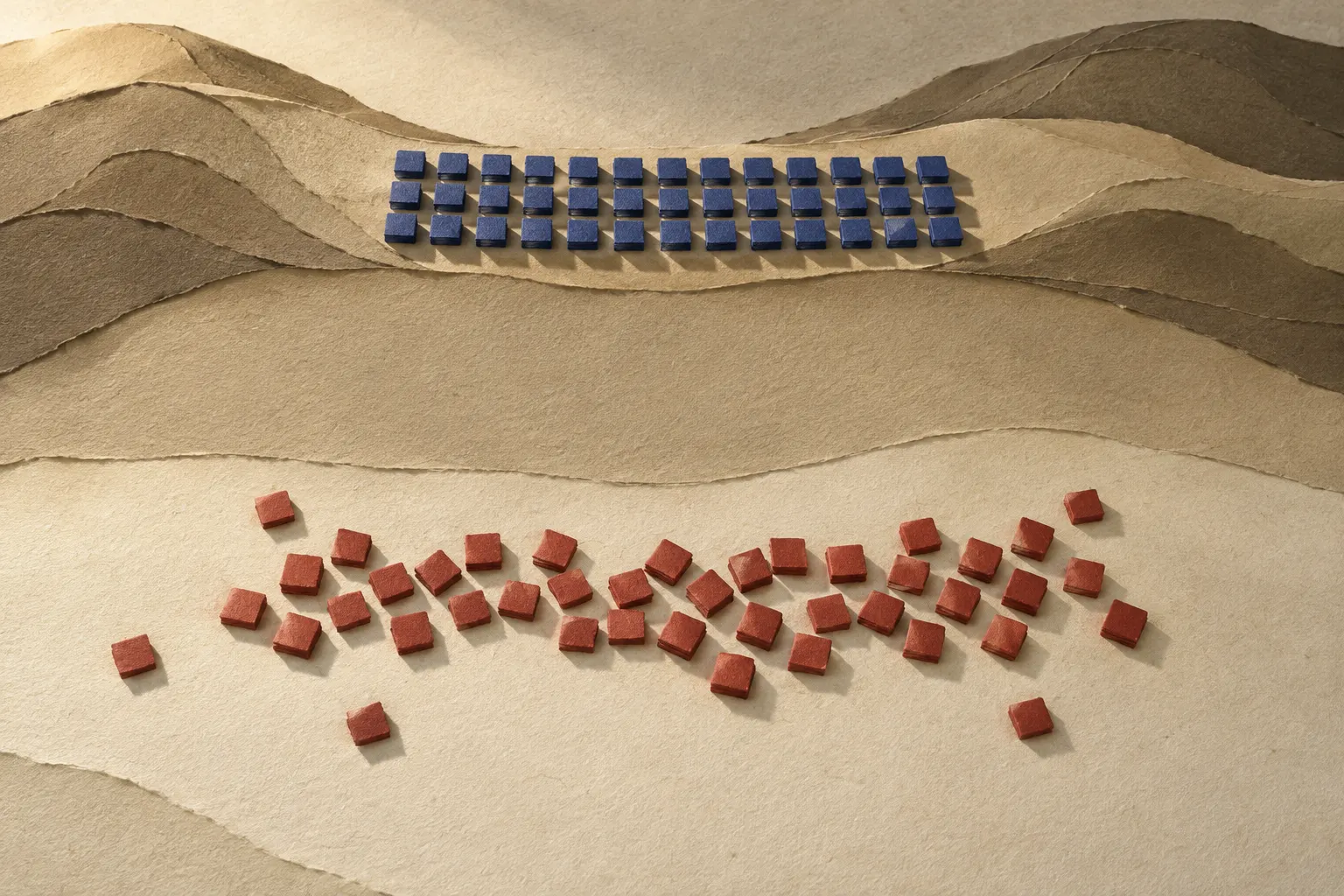
Figure: A sand-table sketch of an army keeping to the heights beside another army on the plain, the method Polybius describes for 217 BC.
Illustration: Treaties & Tradeoffs. Generated schematic image — not a photograph or historical record. © Treaties & Tradeoffs, all rights reserved.
Reported: When Hannibal turned to leave the plain, Fabius placed about 4,000 men in the pass and camped on a hill above it [1]. In the night Hannibal had about 2,000 oxen driven up a ridge with burning faggots tied to their horns; the guards left the pass to meet the lights, and the army slipped through [1][2][4]. Fabius kept his men in camp. At daybreak, Polybius writes, Hannibal's Iberian companies killed 1,000 Romans on the heights; Livy says the Romans lost a few, and Plutarch says a good many [1][2][4].
What could Fabius know in summer 217 BC?
The card at the top of this page applies the known-then test: score the choice only on what its makers could know at the time, with each piece of that knowledge tied to a source. Stand where Fabius stood in the summer of 217 BC. Two Roman armies have been beaten, at the Trebia and at Lake Trasimene, where 15,000 Romans fell, and days later 4,000 horse sent ahead by the consul Servilius were cut off [1][2]. The enemy has the better cavalry and is feeding itself on Italian farms, but no allied city has yet gone over [1].
Reported: Fabius had four newly enrolled legions, joined with the troops that had come from Ariminum, in Polybius's account; Livy has two new legions added to the consul's army [1][2]. He had supplies in abundance to his rear, and a command that Livy puts at six months [1][2].
Reported: Three courses were open, as the record shows them. Fabius could accept the battle Hannibal offered outside the Roman camp [1][2]. He could follow on the high ground and fight only small actions [1][2]. Or he could hold Rome and the walled towns: the Senate first gave him and Minucius the task of strengthening the city's walls, and Fabius ordered people in unfortified places to move to safety, burning their buildings and spoiling their crops [2].
Assessed: On that list, declining battle was a reasonable choice. Hannibal's army had just won twice, and Fabius commanded newly raised legions against it. The choice could not promise an end to the war. In 217 BC nobody knew whether Hannibal would run short of food.
Who was Fabius Maximus, and why Cunctator?
Reported: Plutarch says Fabius was fourth in descent from Fabius Rullus, the first of the family to be called Maximus, and that he was nicknamed Verrucosus, for a wart on his upper lip, and as a child Ovicula, “The Lamb,” for his mild temper [4]. He was five times consul, and won a triumph over the Ligurians in his first consulship [4]. Livy calls the office of 217 BC his second dictatorship [2].
Reported: Even the title is disputed. Polybius calls him Dictator [1]. Livy says that, strictly, the people created him prodictator, because only a consul could name a dictator and the surviving consul was far off in Gaul; his later fame, Livy adds, and descendants who embellished the inscription on his statue, made him remembered as dictator [2][3].
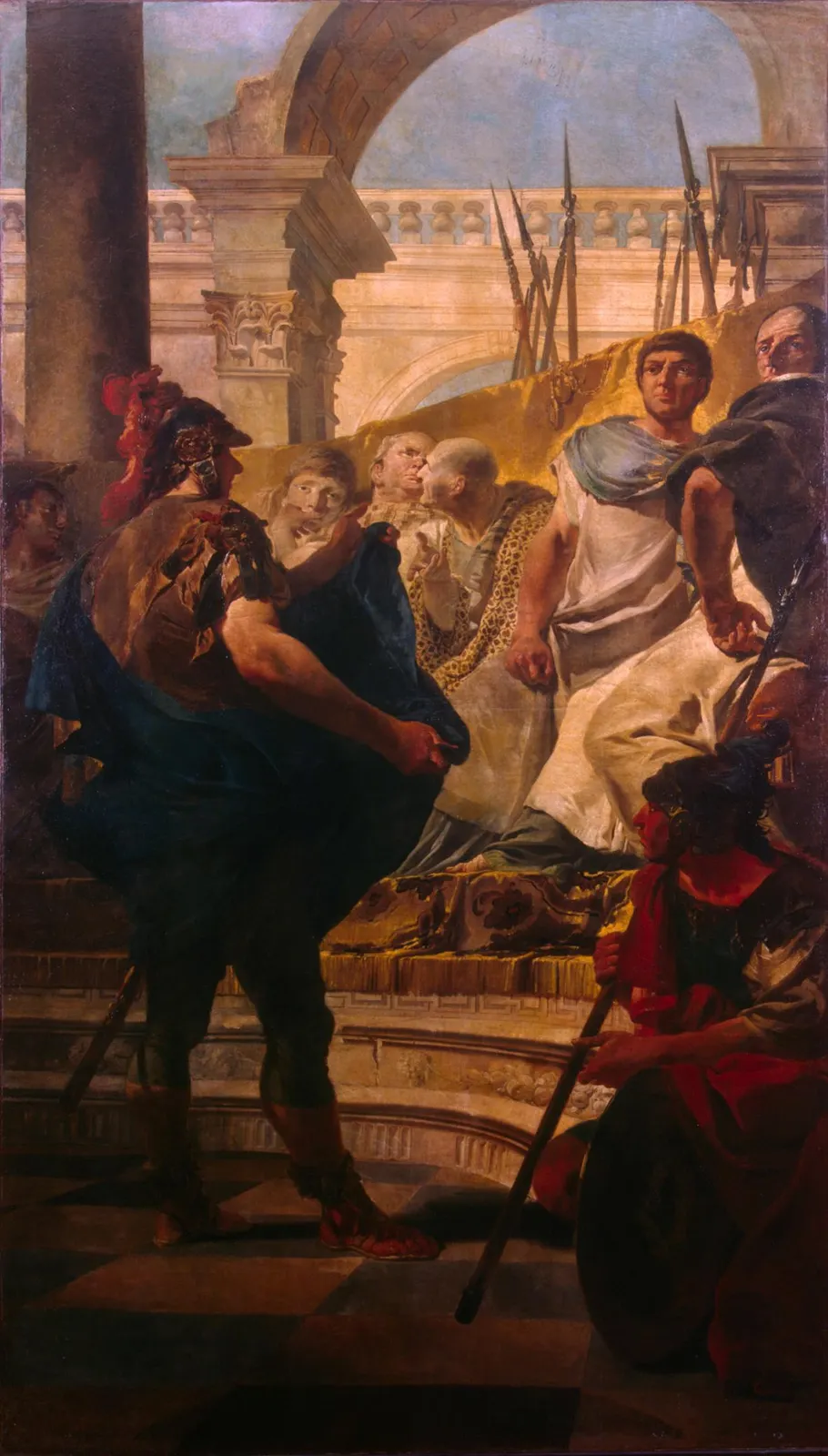
Figure: Quintus Fabius Maximus Before the Senate of Carthage, oil on canvas by Giovanni Battista Tiepolo, 1725–29 (Hermitage), showing the scene Livy sets before the war, when an envoy he names Quintus Fabius offered peace or war from a fold of his robe.
"Quintus Fabius Maximus Before the Senate of Carthage" by Giovanni Battista Tiepolo — https://commons.wikimedia.org/wiki/File:Quintus_Fabius_Maximus_Before_the_Senate_of_Carthage_Hermitage.jpg — Public domain (painter d. 1770; public domain in the US and the EU; faithful reproduction of a two-dimensional work, Hermitage Museum ГЭ-7471)

Reported: The name Cunctator, “the Delayer,” comes out of this campaign's vocabulary. In Livy's Latin, Minucius taunts Fabius as sluggish instead of a cunctator, a man who delays, and timid instead of cautious [3]; the English translation renders it “sluggish instead of patient” [2]. Recording Fabius's death, Livy calls him “that one man who by his delay retrieved our affairs, as Ennius says” [5]. The sources read here do not show when Cunctator became a fixed name; Shuckburgh's 1889 translation of Polybius uses it as a margin heading for this episode [1].
Why did Rome make a second dictator?
Reported: Strictly, Rome doubled the supreme command; the army was divided later. In the autumn, Fabius went to Rome to perform sacrifices and left Minucius in command, with orders to avoid a blow rather than strike one [1]. Minucius attacked Hannibal's foragers near Geronium and drove the Carthaginians back to their camp [1]. An exaggerated account reached Rome, and, in Polybius's words, the people “gave him absolute power as well as Fabius … and so there were two Dictators made for carrying on the same war, which had never happened at Rome before” [1].
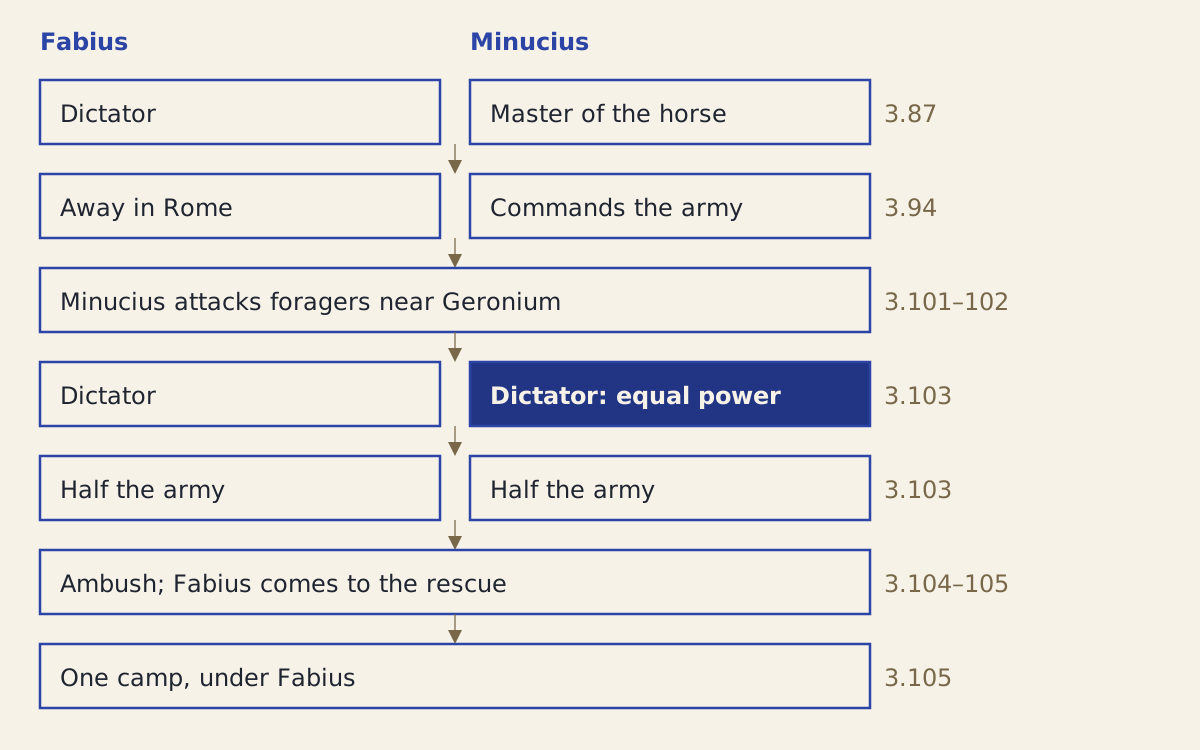
Figure: How the Roman command changed in 217 BC, step by step in the order Polybius gives, with his chapter numbers.
Diagram: Treaties & Tradeoffs. CC BY 4.0. Open full size
Reuse credit
Diagram: Treaties & Tradeoffs, "The Roman command in 217 BC, step by step" — https://treatiesandtradeoffs.com/patterns/fabian-strategy/, CC BY 4.0 (https://creativecommons.org/licenses/by/4.0/)
Data: Polybius, The Histories, book 3, trans. Evelyn S. Shuckburgh (1889), Project Gutenberg eBook #44125, accessed 2026-11-02, public domain
The change of command as text
- Fabius is dictator; Minucius is his master of the horse [1].
- Fabius goes to Rome; Minucius commands the army [1].
- Minucius attacks Hannibal's foragers near Geronium [1].
- Rome gives Minucius absolute power as well: two dictators, in Polybius's words [1].
- The army is divided, and the two camps lie about 12 stades apart [1].
- Hannibal ambushes Minucius, and Fabius comes to his rescue [1].
- The armies join camps again, and Minucius obeys Fabius [1][2].
Reported: Livy gives the politics. The tribune Marcus Metilius accused Fabius of dragging out the war to stay in office and proposed to make the right of the master of the horse equal to the dictator's. Only Gaius Terentius Varro spoke for the bill, and it passed [2][3]. Fabius's standing had already suffered: Hannibal had spared his farm while burning the land around it, and Fabius had agreed a prisoner exchange without the Senate, then sold the farm to pay for it [2].
Reported: Back with the army, the two men had to share the command, and the sources disagree on how. Polybius says Fabius offered Minucius a choice between alternate days and two separate armies, and Minucius chose to separate; the camps lay about 12 stades apart [1]. Livy and Plutarch give the proposal to Minucius and the refusal to Fabius, who divided the army instead [2][4]. Hannibal then hid men in hollows near a hill between the camps (500 horse and 5,000 infantry in Polybius, 5,000 infantry and cavalry together in Livy), drew Minucius out and had his whole army in danger when Fabius led out his own troops to the rescue [1][2].
Assessed: On this record, the phrase “split his command” needs care. The people gave Minucius equal power, and the two men then divided the army between them; the sources disagree on whose idea that was. Livy and Plutarch both close the episode with Minucius leading his men to Fabius's camp and hailing him as father [2][4].
Where do Polybius, Livy and Plutarch disagree?
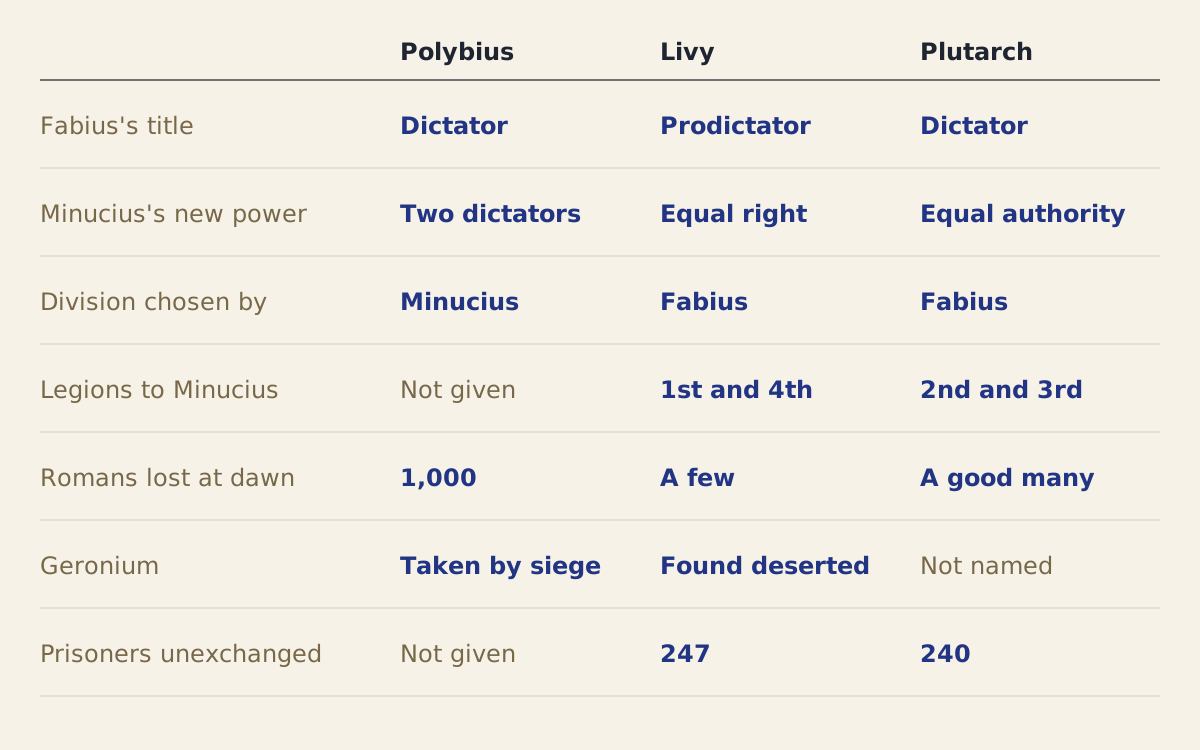
Figure: Seven points on which the three ancient accounts of 217 BC differ; bold marks a point where they give different answers.
Diagram: Treaties & Tradeoffs. CC BY 4.0. Open full size
Reuse credit
Diagram: Treaties & Tradeoffs, "Where Polybius, Livy and Plutarch differ on 217 BC" — https://treatiesandtradeoffs.com/patterns/fabian-strategy/, CC BY 4.0 (https://creativecommons.org/licenses/by/4.0/)
Data: Polybius, The Histories, book 3, trans. Evelyn S. Shuckburgh (1889), Project Gutenberg eBook #44125, accessed 2026-11-02, public domain; Livy, The History of Rome, books 21–23, trans. D. Spillan and Cyrus Edmonds, Project Gutenberg eBook #10907, accessed 2026-11-02, public domain; Livy, Latin text ed. C. F. Walters and R. S. Conway (Oxford), books 22–23, wording and units only, accessed 2026-11-02; Plutarch, Lives of Fabius and Pericles and their Comparison, trans. John Dryden, rev. Arthur Hugh Clough, Project Gutenberg eBook #674, accessed 2026-11-02, public domain
| Point | Polybius | Livy | Plutarch |
|---|---|---|---|
| Fabius's title | Dictator [1] | Prodictator, strictly [2][3] | Dictator [4] |
| Minucius's new power | Two dictators [1] | Equal right with the dictator [2][3] | Equal authority [4] |
| Who chose to divide the army | Minucius, from Fabius's two options [1] | Fabius, refusing alternate days [2] | Fabius, refusing alternate days [4] |
| Legions given to Minucius | Not given [1] | First and fourth [2] | Second and third [4] |
| Romans lost at daybreak after the pass | 1,000 [1] | A few [2] | A good many [4] |
| Geronium | Taken by siege, inhabitants killed [1] | Found deserted [2] | Not named [4] |
| Prisoners left over in the exchange | Not given [1] | 247, at 2½ pounds of silver each [2][3] | 240, at 250 drachmas each [4] |
Every point, one claim per row, with the passage (CSV) Source and license notes (JSON) Data: Polybius, The Histories, book 3, trans. Evelyn S. Shuckburgh (1889), Project Gutenberg eBook #44125, accessed 2026-11-02, public domain; Livy, The History of Rome, books 21–23, trans. D. Spillan and Cyrus Edmonds, Project Gutenberg eBook #10907, accessed 2026-11-02, public domain; Livy, Latin text ed. C. F. Walters and R. S. Conway (Oxford), books 22–23, wording and units only, accessed 2026-11-02; Plutarch, Lives of Fabius and Pericles and their Comparison, trans. John Dryden, rev. Arthur Hugh Clough, Project Gutenberg eBook #674, accessed 2026-11-02, public domain; William Smith, A Smaller Dictionary of Greek and Roman Antiquities, 12th ed. (1884), Table XI, Project Gutenberg eBook #65909, accessed 2026-11-02, public domain
Reported: Livy's account of 216 BC bears on Minucius's rank. After Cannae, with Marcus Junius already dictator in the field, Marcus Fabius Buteo was named dictator to fill the Senate, and in Livy he objected to “two dictators at one time, which had never been done before” [2][3][4]. Plutarch, by contrast, calls the grant of equal authority to Minucius a thing without precedent, and counts Buteo's appointment as its repeat [4].
Assessed: Read together, Livy's passages treat Minucius as a master of the horse given equal rights, while Polybius counts two dictators. Calling Minucius a co-dictator therefore takes Polybius's side of a question the sources leave open.
Reported, with our check: The ransom figures can be worked through. Livy's Latin gives two and a half pounds (pondo) of silver for each of 247 men, which comes to 617½ pounds [2][3]. Plutarch's 240 men at 250 drachmas each come to 60,000 drachmas, or 10 talents if the talent is the Attic one of 6,000 drachmas; yet Plutarch's own comparison of Fabius with Pericles says the sum “did not exceed six talents” [4][6].
Method: The 10 talents rest on our assumption that Plutarch meant the Attic talent, which Smith's dictionary of 1884 puts at 6,000 drachmas [6]. We do not convert either sum into days' wages, because we found no readable wage series for Rome or Greece in 217 BC; the sums stay in pondo and drachmas.
Assessed: None of these differences changes the outline. All three share it: a dictator who would not give battle, a deputy raised to equal power, a near disaster and a reunion. They do show that the details people repeat, such as who proposed dividing the army, depend on which writer they follow.
Did the Fabian strategy work?
Reported: Polybius thought so, and said so with the ending in view: “it was not long before facts testified to the wisdom of his policy” [1]. After the dictators laid down office, the commanders in the field were told not to hazard a general engagement and to fight skirmishes instead, through the winter and spring of 216 BC [1]. Then, at harvest time, Hannibal seized the citadel of Cannae with its grain, and the Senate ordered the consuls to give battle [1].
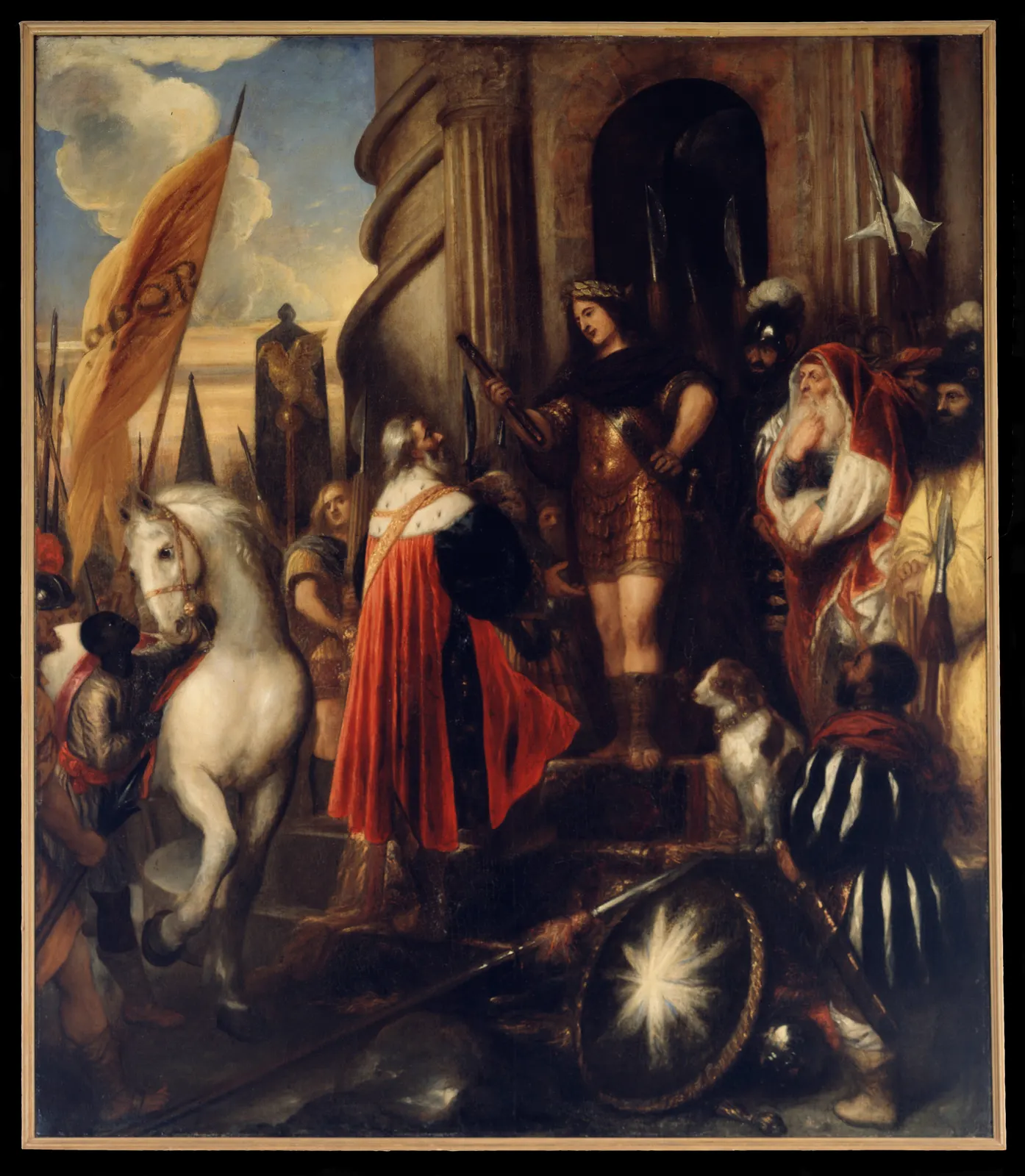
Figure: Quintus Fabius Maximus, his horse, and his son, oil on canvas by Jan Lievens, 1656 (Royal Palace, Amsterdam); it shows the story Plutarch tells of the old Fabius dismounting at the order of his son, the consul.
"Quintus Fabius Maximus, his horse, and his son" by Jan Lievens — https://commons.wikimedia.org/wiki/File:Jan_Lievens_-_Quintus_Fabius_Maximus_-_Google_Art_Project.jpg — Public domain (painter d. 1674; public domain in the US and the EU; faithful reproduction of a two-dimensional work, Royal Palace of Amsterdam 9.03)

Reported: Plutarch describes what Cannae did to Fabius's reputation. Counsels the Romans had “branded as cowardice and fear” before the battle, they now “accounted to have been more than human wisdom” [4]. After Cannae, Plutarch writes, Fabius kept to his old method of following Hannibal without fighting, and the Romans, as Posidonius tells it, called Marcellus their sword and Fabius their buckler [4]. Plutarch also records that Fabius opposed Scipio's invasion of Africa, the campaign that drew Hannibal out of Italy, and died about the time Hannibal left [4][5].
Assessed: Plutarch's sentence is a clean case of the hindsight premium, the share of a decision's apparent wisdom or folly that is added only after the outcome is known. Fabius took command a year before Cannae. Cannae showed what fighting on Hannibal's terms could cost; it did not show that delay would have won the war. The record supports a narrower claim: for the months Fabius held command, the run of large defeats stopped, which Livy calls “some intermission from disasters” [2].
Assessed: The record also shows a part of the method that did not work in 217 BC. Delay was supposed to wear down an army living off the land. Yet Polybius writes that Hannibal found “such an abundance of provisions” in Samnium and then wintered at Geronium, sending two-thirds of his army out to gather grain every day [1]. Whether a delay pays depends on what the other side can find to eat, a sum of the kind worked through for the Roman legion's grain.
Where does the pattern break?
Assessed: The pattern under test is that refusing battle at home against a stronger field army buys time for the side with deeper reserves. Polybius ties Fabius's choice to Rome's provisions and men, and notes that the allies were still loyal [1]. Plutarch, who paired Fabius's life with that of the Athenian Pericles, supplies a counterexample from the same kind of choice [4].
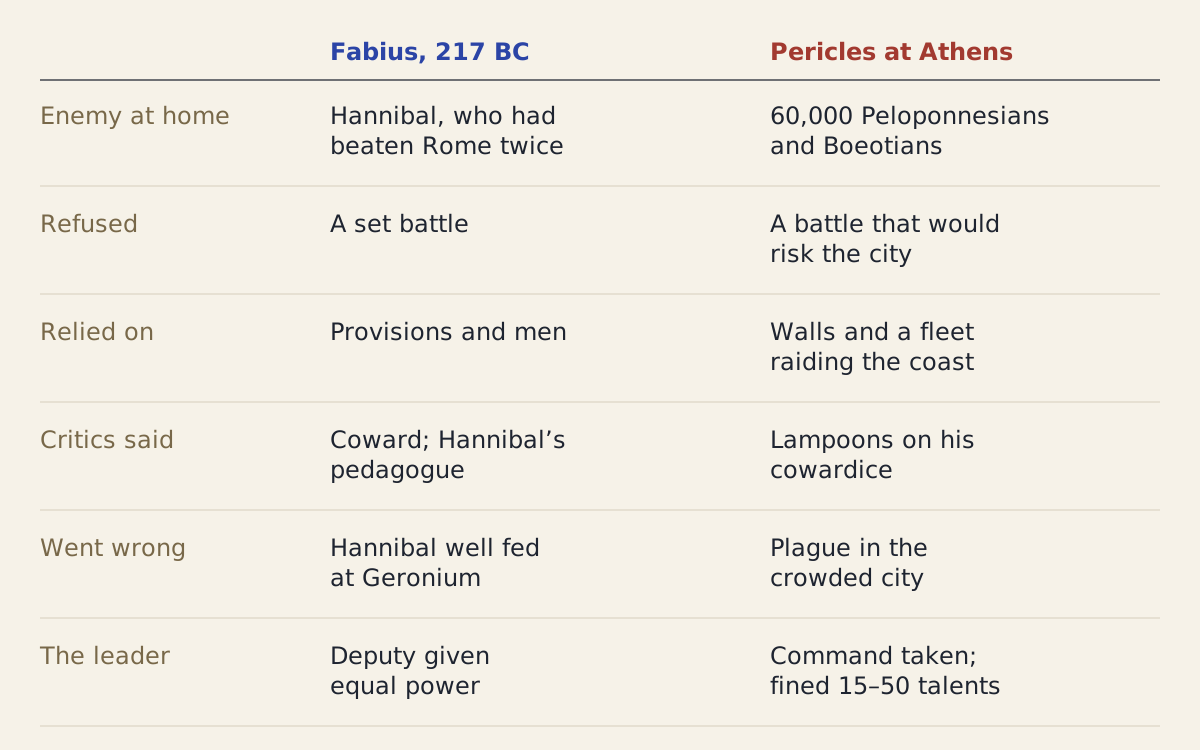
Figure: Fabius and Pericles compared on six points, from Polybius and from Plutarch's lives of the two men; Plutarch's sources disagree on the size of Pericles's fine.
Diagram: Treaties & Tradeoffs. CC BY 4.0. Open full size
Reuse credit
Diagram: Treaties & Tradeoffs, "Fabius in 217 BC and Pericles at Athens compared" — https://treatiesandtradeoffs.com/patterns/fabian-strategy/, CC BY 4.0 (https://creativecommons.org/licenses/by/4.0/)
Data: Polybius, The Histories, book 3, trans. Evelyn S. Shuckburgh (1889), Project Gutenberg eBook #44125, accessed 2026-11-02, public domain; Plutarch, Lives of Fabius and Pericles and their Comparison, trans. John Dryden, rev. Arthur Hugh Clough, Project Gutenberg eBook #674, accessed 2026-11-02, public domain
The comparison as text
- Enemy at home: Hannibal, who had beaten the Romans twice [1]; Peloponnesians and Boeotians, 60,000 men-at-arms at first, laying waste Attica [4].
- What each refused: a set battle [1]; a battle that would risk the city itself [4].
- What each relied on: Rome's provisions and men [1]; the city walls and a fleet of 100 galleys raiding the Peloponnese [4].
- What critics said: coward, and Hannibal's pedagogue [1][4]; songs and lampoons on his cowardice [4].
- What went against the plan: Hannibal well supplied at Geronium [1]; a plague in a city crowded with country people [4].
- What happened to the leader: his deputy given equal power [1]; his command taken away and a fine of 15 talents by the lowest account, 50 by the highest [4].
The two cases, one claim per row (CSV) Source and license notes (JSON) Data: Polybius, The Histories, book 3, trans. Evelyn S. Shuckburgh (1889), Project Gutenberg eBook #44125, accessed 2026-11-02, public domain; Plutarch, Lives of Fabius and Pericles and their Comparison, trans. John Dryden, rev. Arthur Hugh Clough, Project Gutenberg eBook #674, accessed 2026-11-02, public domain
Reported: In Plutarch's account, when the Spartans and their allies invaded Attica, Pericles would not risk the city in battle against 60,000 men-at-arms of the Peloponnesians and Boeotians; he shut the gates, sent a fleet of 100 galleys to raid the Peloponnese and bore the lampoons [4]. Then plague struck the crowded city. His enemies persuaded the Athenians that crowding the country people inside the walls had caused it [4]. They took away his command and fined him, 15 talents by the lowest account and 50 by the highest [4].
Assessed: The comparison sets limits on the pattern. Refusing battle protected neither leader's authority: Rome raised Fabius's deputy to his level, and Athens removed Pericles. Nor did it settle the material side: Hannibal found food in Italy, and the crowding that Pericles's plan required was blamed for the plague [1][4]. It did not end either war; in Rome's case Plutarch has Fabius opposing the offensive in Africa that did.
Reported: Plutarch's own verdict on the pair cuts both ways: Pericles was “a good prophet of bad success,” and Fabius “a bad prophet of success that was good” [4].
Assessed: So the pattern holds only inside narrow limits: a defender with more men and food than the invader, allies who stay loyal, and a government willing to bear the cost for months. Where those conditions fail, delay becomes a wager. A 20th-century defensive plan is replayed in the Maginot Line replay, and the war Fabius fought is followed past Cannae in the Hannibal replay.
Sources
- Polybius, The Histories of Polybius, vol. 1, translated by Evelyn S. Shuckburgh (London: Macmillan, 1889), book 3. Project Gutenberg eBook #44125. https://www.gutenberg.org/ebooks/44125Read: full text of book 3 in this translation
- Livy, The History of Rome, Books 9–26, translated by D. Spillan and Cyrus Edmonds (19th century). Project Gutenberg eBook #10907. https://www.gutenberg.org/ebooks/10907Read: book 21, chapter 18, book 22, chapters 1–32, and book 23, chapters 22–23, in this translation
- Livy, Ab Urbe Condita, vol. 3, books 21–25, edited by C. F. Walters and R. S. Conway, Oxford Classical Texts (Oxford: Clarendon Press, 1929; reprinted with corrections). https://archive.org/details/titiliviaburbeco03livyRead: Latin text of book 22, chapters 8–31, and book 23, chapter 23, for wording and units
- Plutarch, Plutarch's Lives, translated by John Dryden and others, revised by Arthur Hugh Clough: Life of Fabius, Life of Pericles, and Comparison of Pericles with Fabius. Project Gutenberg eBook #674. https://www.gutenberg.org/ebooks/674Read: full text of the Life of Fabius and the Comparison, and the war chapters of the Life of Pericles, in this translation
- Livy, The History of Rome, Books 27–36, translated by Cyrus Edmonds (1850). Project Gutenberg eBook #12582. https://www.gutenberg.org/ebooks/12582Read: book 30, chapter 26, in this translation
- William Smith, A Smaller Dictionary of Greek and Roman Antiquities, 12th ed. (London: John Murray, 1884), Table XI "Grecian Weights". Project Gutenberg eBook #65909. https://www.gutenberg.org/ebooks/65909Read: Table XI in the 1884 edition
Cite this page
Treaties & Tradeoffs. “Fabian Strategy: Rome Made a Second Dictator, Polybius Says.” published 2026-11-02. https://treatiesandtradeoffs.com/patterns/fabian-strategy/. Accessed [the date you read it].
Plain citation; add the date you consulted the page. No DOI is assigned.